





A mismatched billing address can cause a legitimate payment to be declined during address verification, leading to abandoned checkouts and lost revenue. Keeping billing details consistent across checkout, invoices, and customer records helps prevent unnecessary payment failures.
In Malaysia, billing addresses also play a role in LHDN e-Invoicing, as the buyer’s address is required for e-Invoices submitted through MyInvois. Businesses must also handle this information responsibly under the Personal Data Protection Act 2010 (PDPA). Accurate billing data therefore supports payment approval, tax validation, and data compliance.
This guide explains what a billing address is, why it matters, how it differs from a shipping address, and how an invoicing system can help manage billing information accurately.
Key Takeaways
Understand the full definition and purpose of a billing address in invoicing and financial transactions.
Learn the key differences between billing and shipping addresses and when they overlap.
Discover what information must appear on an invoice and how billing address fits in.
Inaccurate billing information can lead to payment failures, invoicing errors, and compliance issues. Billing management software helps businesses maintain accurate customer details and keep billing processes consistent.
What Is a Billing Address? A Complete Definition
At its core, it serves two primary purposes:
- Communication: It tells the seller where to send the invoice, statement of account, or any billing-related correspondence so that it reaches the right person or department responsible for authorizing and making payment.
- Verification: It acts as a security layer. Payment processors and banks use the billing address to verify that the person making a purchase is the legitimate cardholder or account holder. This is known as Address Verification Service (AVS).
The billing address is not necessarily where goods are delivered or where the business physically operates. A company might have its head office in Kuala Lumpur, a warehouse in Shah Alam, and a billing address that routes to its finance department in a completely different location. Understanding this distinction is vital for anyone involved in procurement, accounts payable, invoicing, or e-commerce.
Billing Address in the Context of Invoicing
For example, in Malaysia’s e-invoicing framework, the recipient’s details, including their address must be accurately reflected on the electronic invoice to ensure compliance. Errors in this field are not just administrative inconveniences; they can trigger penalties and cause serious compliance headaches for both the buyer and the seller.
The billing address on an invoice typically includes:
- Full legal name of the customer (individual or business entity)
- Street address or P.O. Box number
- City or town
- State or province
- Postal code / postcode / ZIP code
- Country (particularly important for international invoices)
In a B2B setting, it may also include a specific department name (e.g., “Accounts Payable Department”) or a contact person to ensure the invoice is routed correctly within the customer’s organisation. Some businesses also include a purchase order (PO) number alongside the billing address to help their finance teams match the invoice to an existing PO in their system.
Billing Address Requirements Under Malaysia MyInvois (LHDN SDK)
For businesses issuing LHDN e-Invoices, the buyer’s billing address is a mandatory field in the MyInvois SDK. Rather than a single address line, it must be submitted as structured XML or JSON data to ensure successful validation.
Example:
- Address Line 1: No. 25, Jalan SS 21/35
- City: Petaling Jaya
- State Code: 10 (Selangor)
- Country Code: MYS
Failing to provide these fields in the correct format may result in MyInvois validation errors, causing the e-Invoice to be rejected before submission.
Billing Address vs. Shipping Address: Understanding the Difference
Both addresses appear on the same order, so they are easy to mix up. The difference is simple once you look at what each one is for: one identifies who is paying, the other tells you where the goods go. The table below breaks down that difference across the points that matter most at checkout and in invoicing.
| Aspect | Billing Address | Shipping Address |
|---|---|---|
| Main purpose | Identifies the payer and verifies their identity | Directs where the physical goods should be delivered |
| The question it answers | Who is paying for this order | Where should the product be sent |
| Tied to | The payment method and the record held by the bank or card issuer | The order fulfilment and delivery process |
| Used by | Payment gateways, banks, and finance or invoicing teams | Warehouse, logistics, and courier partners |
| When it is required | On every paid transaction, including services with no physical delivery | Only when physical goods need to be delivered |
| Typical business case | A retail chain bills everything to its head office | The same chain ships stock to individual store locations |
| If it is wrong | The payment is declined and the invoice record becomes inaccurate | The parcel is delayed, misrouted, or returned to sender |
Billing Address on Invoices: What You Need to Know
Now let us look more closely at how billing addresses function within formal invoices one of the most critical financial documents in any business relationship. A properly formatted invoice is not just a payment request; it is a legal document, a record for tax purposes, and a statement of the commercial relationship between buyer and seller.
The Legal Requirement for Billing Address on an Invoice
In most countries, tax authorities require that invoices contain specific information to be considered valid for tax deduction or credit purposes. The billing address that is, the address of the recipient of the invoice is almost universally one of these required fields. Without it, an invoice may not be accepted as a legitimate business document.
In Malaysia, for instance, the Inland Revenue Board (LHDN) has been progressively rolling out e-invoicing requirements.
Standard Invoice Fields and Where Billing Address Fits
A standard invoice typically contains the following elements:
| Invoice Field | Description |
|---|---|
| Invoice Number | A unique identifier for the invoice |
| Invoice Date | The date the invoice was issued |
| Due Date | When payment is expected |
| Seller or Supplier Details | Name, address, and tax registration number of the seller |
| Buyer or Customer Billing Address | Full name and address of the invoice recipient or payer |
| Shipping Address (if different) | Where the goods are physically delivered |
| Line Items | Description, quantity, and unit price of the goods or services |
| Subtotal, Tax, and Total | Financial summary of the transaction |
| Payment Terms and Methods | How and when payment should be made |
| Notes or References | PO numbers, special instructions, and other supporting details |
Common Billing Address Errors on Invoices and Their Consequences
Even small errors in a billing address can have outsized consequences. Here are the most common mistakes businesses make and what can happen as a result:
-
Wrong company name: The customer’s accounts payable system may reject invoices sent to an incorrect legal entity name, causing payment delays.
- Outdated address: If a customer moves and you don’t update your records, someone will send paper invoices to the wrong location. Incorrect address information can invalidate even digital invoices for tax purposes.
-
Missing department or contact details: In large organizations, an invoice without a specific department or PO number may go unprocessed for weeks or months.
- Incorrect postcode or country: These errors can make it difficult for postal services to deliver physical invoices and can cause issues with automated invoice matching systems.
-
Using the shipping address instead of the billing address: New customers often make this surprisingly common mistake when onboarding occurs quickly without proper data verification.
The financial impact of these errors compounds quickly. Delayed payments affect cash flow. Disputed invoices require administrative time to resolve. In regulated industries, incorrect invoices can trigger audits or compliance reviews.
Types of Billing Addresses and How They Vary by Context
Personal Billing Address
Business Billing Address
For businesses, the billing address is typically one of the following:
- Registered office address: The legal address of the company as registered with the relevant authorities (e.g., the Companies Commission of Malaysia).
- Head office address: The main operational headquarters, which may differ from the registered address.
- Accounts payable department address: A specific address or postal designation for the finance or accounts payable team, which may be a different floor, building, or even city from the main office.
- P.O. Box address: Some businesses use a dedicated PO Box to centralise all incoming invoices and financial mail.
International Billing Address
Cross-border transactions add another layer of complexity to billing addresses. Different countries have different address formats, and what works for a Malaysian address will not translate directly to a German, American, or Indian address. Businesses that invoice internationally must ensure their systems can handle varied address formats and that they are capturing the correct billing address for each jurisdiction.
For international invoices, it is also important to include the country name clearly to avoid any ambiguity. Currency, tax treatment, and even the legal requirements for what constitutes a valid invoice may differ based on the billing address’s country.
Digital and Virtual Billing Address
With the rise of digital-first businesses and cloud-based accounting, some entities use virtual addresses or registered agent services as their billing address. This is common among remote-first companies, freelancers operating through professional employer organizations, and businesses that want to maintain a professional presence in a specific city without a physical office there. These are perfectly legitimate as billing addresses as long as the mail and communication actually reach the responsible party.
Managing Billing Addresses Efficiently in Modern Business
For small businesses with a handful of clients, managing billing addresses might be as simple as maintaining a well-organised spreadsheet. But as businesses scale and transaction volumes grow, manual management becomes error-prone and unsustainable. This section explores the best practices and technological approaches to managing billing addresses effectively.
Centralizing Customer Data
The first step towards efficient billing address management is centralising all customer information in a single, authoritative system. Whether that is a Customer Relationship Management (CRM) system, an Enterprise Resource Planning (ERP) platform, or a dedicated accounting or invoicing application, the goal is to ensure there is one master record for each customer that contains their current, verified billing address.
When billing address information is scattered across spreadsheets, email threads, and various departmental systems, errors and inconsistencies are inevitable. Centralisation reduces duplication, ensures consistency, and makes it far easier to update records when a customer’s address changes.
Address Verification at the Point of Entry
One of the most effective ways to prevent billing address errors is to validate addresses at the point of entry rather than trying to correct them downstream. Modern address verification APIs can check whether an entered address exists in postal authority databases in real time, flagging potential errors before saving them to the system.
For e-commerce businesses in particular, integrating address autocomplete functionality which suggests valid addresses as the user types dramatically reduces input errors. This is not just a convenience for customers; it directly improves data quality and reduces the administrative burden of chasing incorrect payment details.
Processes for Keeping Addresses Current
- Annual or periodic reviews: For long-term customers, send a brief confirmation request asking them to verify or update their billing address.
- Trigger-based updates: When a customer updates their payment method, prompt them to also confirm their billing address.
- Return mail management:If you receive undeliverable paper invoices, contact the customer immediately and update their record.
- Automated email bounce management: For digital invoices, email bounces or undeliverable notifications should trigger the same address verification workflow.
Role of Invoicing Software in Billing Address Management
Modern invoicing software has made it significantly easier to manage billing addresses accurately. Good invoicing platforms allow businesses to maintain detailed customer profiles, auto-populate billing addresses on new invoices, send invoices directly to the billing contact’s email, and receive alerts when important billing details seem inconsistent.
There is a wide range of invoicing tools on the market, from simple standalone applications to fully integrated financial management suites. Understanding the capabilities of different tools helps businesses choose the right solution for their scale and complexity. For example, examining platforms like Wave Invoice can provide insights into what features matter most for efficient billing management, including how billing address fields are handled, stored, and verified within the invoicing workflow.
Billing Address in Automated and Recurring Billing
Subscription businesses and companies with recurring billing arrangements face a particular challenge: billing addresses must remain accurate over an extended period, often years. When a subscriber changes their card, they also change the associated billing address, and if they do not capture these updates promptly, subsequent payments may fail or fraud detection systems may flag transactions.
Best practices for recurring billing address management include:
- Sending pre-payment notifications that include the current billing address on file, giving customers the opportunity to flag any needed updates.
-
Implement major card networks’ card account updater services, which can automatically update billing addresses when a card is replaced.
- Providing customers with a self-service portal where they can update their billing address and payment details at any time without needing to contact customer support.
Best Practices for Billing Address Management: A Summary
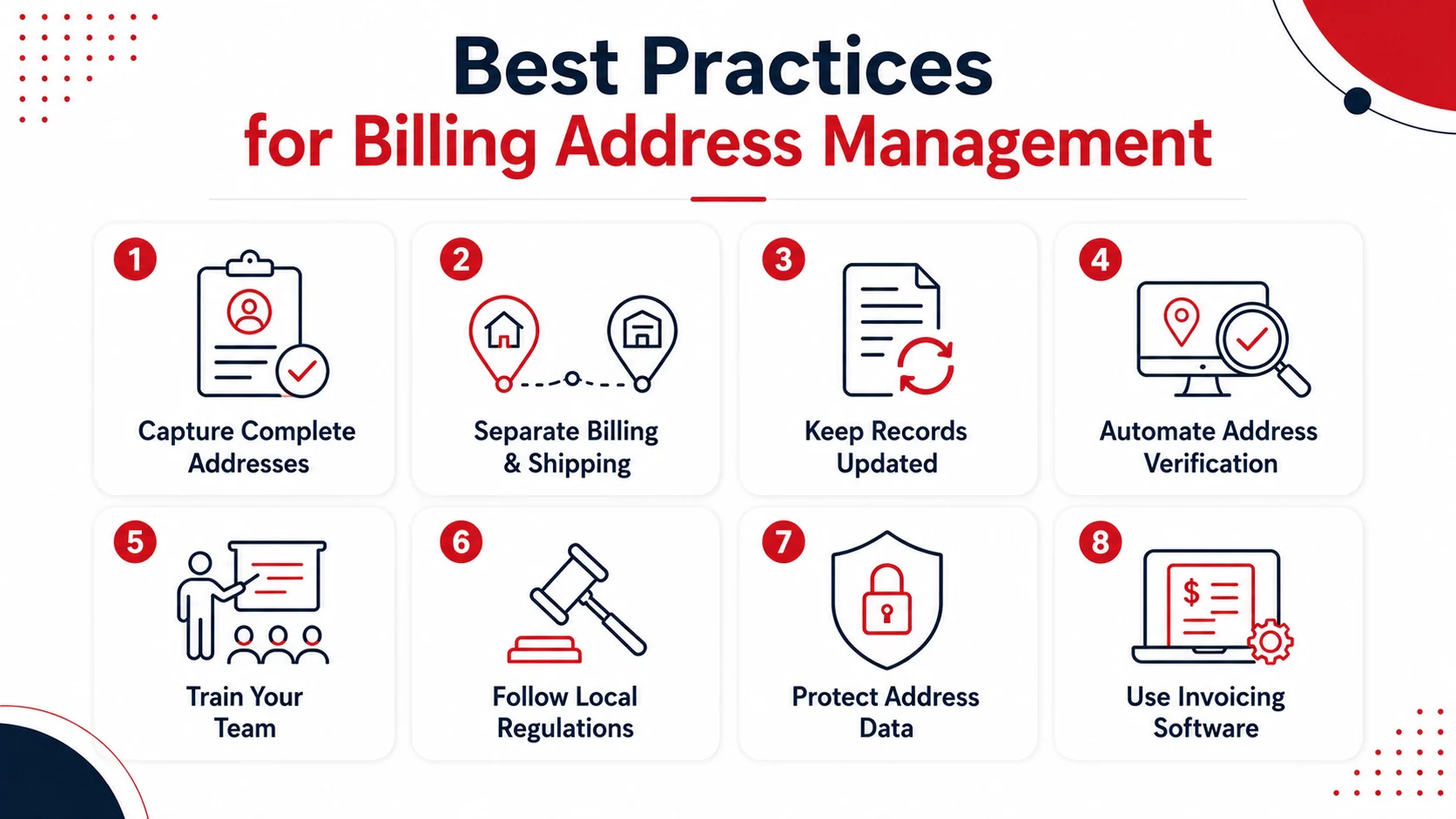
As we bring together everything we have discussed, we present a consolidated set of best practices for effectively managing billing addresses across different business contexts:
1. Capture Complete and Accurate Billing Addresses at Onboarding
The best time to get billing address information right is when you first engage with a customer. Build your onboarding process to systematically capture all required billing address fields, validate them in real time where possible, and store them in a centralized customer record. Do not rely on informally gathered contact details that may be a personal email or a convenience address rather than the proper billing address.
2. Always Distinguish Between Billing and Shipping Addresses
Never assume that a shipping address and a billing address are the same, even if a customer has not specified otherwise. Build your systems and forms to capture both explicitly, and make it easy for customers to indicate when they differ. Label each clearly on invoices.
3. Keep Billing Address Records Up to Date
Implement regular review processes and trigger-based update workflows to ensure billing addresses remain current. The cost of maintaining accurate data is far lower than the cost of chasing late payments or re-issuing invoices due to address errors.
4. Use Technology to Automate Address Verification
Leverage address verification APIs, autocomplete functionality, and postal database lookups to validate billing addresses at the point of entry. Automated verification reduces human error and improves data quality across the board.
5. Train Your Team
Ensure that everyone involved in invoicing, customer onboarding, and accounts receivable understands the importance of billing addresses and knows how to capture, verify, and update them correctly. Many billing address errors stem from staff not knowing which address to use rather than any systematic failure.
6. Comply With Local and International Regulations
Stay current with the invoicing regulations in every jurisdiction where you do business. Whether it is Malaysia’s e-invoicing requirements, EU VAT rules, or other local tax authority guidelines, make sure your billing address practices and the completeness of address information on your invoices meet all applicable legal standards.
7. Protect Billing Address Data
Treat billing address data as sensitive personal or business information. Store it securely, limit access to authorized personnel only, and ensure your data handling practices comply with applicable data protection laws including Malaysia’s PDPA.
8. Use Appropriate Invoicing Software
"An online billing address is a vital security check to confirm a buyer's identity. If details don't match bank records, the system may block the sale as fraud. This can hurt customer trust and stop your revenue flow instantly. Accurate data ensures every purchase is safe and smooth for your business."
Conclusion
Throughout this guide, we have seen that a billing address is far more than a simple line on a form. It is the foundation of accurate financial communication, a cornerstone of tax compliance, a critical tool for fraud prevention, and a significant factor in maintaining healthy cash flow through timely and undisputed payment.
As invoicing continues to evolve driven by mandatory e-invoicing requirements, digital transformation initiatives, and increasingly sophisticated fraud threats the importance of billing address accuracy will only grow.
Prioritizing billing addresses as essential data helps businesses secure payments, stay compliant, and protect against fraud. While it may seem like a small detail, getting this right is a powerful way to strengthen your financial operations. To see how these tools can organize your billing process, you can explore the features through a free demo.

FAQ about Billing Address
A billing address acts as a vital shield against identity theft by using the Address Verification Service (AVS). Banks and payment processors use this system to confirm that the person making a purchase is the actual cardholder. If the details provided do not match the bank’s records, the transaction is usually blocked to prevent fraud.
In B2B transactions, billing and shipping addresses often differ to separate the payment from the delivery. The billing address identifies who pays the bill, which is usually the finance or accounts department. The shipping address shows where the goods should be delivered, such as a warehouse or office. For individual shoppers, these addresses are typically the same unless they are sending a gift.
Absolutely. Under Malaysia’s e-invoicing framework, the Inland Revenue Board (LHDN) requires accurate buyer details, including their address, to validate a transaction. An incorrect billing address can make an invoice legally invalid for tax deductions and may result in penalties for non-compliance for both the buyer and the seller.