







An employee joins your company on the 15th. Payroll closes on the 30th. Do you pay them a full month’s salary or only for the days they actually worked?
That partial payment is called prorated salary. It applies whenever someone does not work a complete pay period, whether they started mid-month, resigned before month-end, or took unpaid leave. Getting it wrong is more common than most HR teams realize.
Payroll errors create severe compliance exposure.PwC Malaysia highlights PwC Malaysia highlights that incorrect employee payments and statutory contributions bring legal and reputational risks that standardized payroll procedures prevent. For prorated salary, mistakes typically stem from inconsistent formulas for new hires or miscalculated deductions across EPF, SOCSO, and EIS.

What is Prorated Salary?
A prorated salary, or pro-rata, refers to the adjusted pay given to an employee who hasn’t worked the full pay period. Instead of receiving the full salary, the employee gets a portion based on the actual time worked.
The prorated salary meaning involves dividing the full salary by the total number of workdays in the pay period and multiplying that by the number of days the employee actually works. This method ensures the employee is paid fairly for the time worked and that their compensation, including any applicable benefits tied to their employement, is properly aligned.
For example, if someone starts on the 21st and the payday is the 31st, they will only be paid for the 10 days worked. This ensures fair pay and compliance, especially when the employee’s start or end date doesn’t match the regular pay period.
When Should a Company Apply Prorated Salary?
| Employment Scenario | Trigger Event | Proration Method Applied | Key HR Compliance Focus |
|---|---|---|---|
| New Hire Mid-Month | An employee commences employment after the pay cycle start date | Pay calculated only from official start date to end of cycle | Ensure statutory deductions apply strictly to the prorated amount |
| Resignation or Termination | An employee departs before the final working day of the month | Pay calculated from cycle start date until the final employment day | Reconcile final tax clearance and statutory contributions accurately |
| Mid-Cycle Wage Increment | A promotion or salary increment takes effect in the middle of a pay period | Split calculation using the previous rate before the effective date and the updated rate after | Document both salary structures clearly on the monthly payslip |
| Unpaid Leave or Time Off | An employee takes approved or unapproved leave without pay | Deduction of unpaid workdays from the standard monthly base salary | Verify whether the daily wage deduction uses calendar or working days |
| Reduced Work Schedule | An employee converts to part-time or reduced operational hours | Pay calculated strictly against actual contracted hours or days worked | Maintain full alignment with Employment Act minimum wage thresholds |
- New Hire Starting Mid-Pay Period: When a new employee begins after the payroll period starts, their pay is prorated based on the days or hours worked.
- Employee Leaves Mid-Pay Period: If an employee resigns or is terminated during a pay period, their salary is prorated to cover only the days worked.
- Mid-Cycle Salary Increase: If an employee gets a raise during a pay period, their pay is prorated to reflect both their old and new salary.
- Part-Time or Reduced Hours: Employees working part-time or reduced hours are paid based on their full-time equivalent hours, with their salary prorated accordingly.
- Unpaid Leave of Absence or Unpaid Time Off: When an employee takes unpaid leave, their salary is prorated for the days worked before taking leave.
rorated salaries ensure fair payment and help companies comply with Malaysia’s payroll policies and labor laws. Clear communication about these adjustments is crucial to avoid misunderstandings. For companies managing multiple pay structures, integrating payroll with modern HR system helps keep salary data consistent across departments.
Legal Considerations of Prorated Salary

When dealing with prorated salary, there are certain legal aspects to consider in Malaysia:
- Minimum Wage Compliance: The salary paid, including prorated pay, must comply with the minimum wage laws set by the Malaysian government. Employers cannot pay below the minimum wage for the prorated hours worked.
- Overtime Pay: Employees are entitled to overtime compensation for hours worked beyond the standard workday. If an employee works overtime during a prorated period, they must be paid accordingly, including their prorated salary, based on the applicable overtime pay rates.
- Pay Equality and Non-Discrimination: Employers must ensure that prorated salaries are applied consistently and equitably, adhering to the principles of equal pay for equal work, regardless of gender, age, or other protected characteristics.
- Employment Contracts and Agreements: Contract documents for employee or collective agreements may contain provisions on prorated salary calculations. Employers are obligated to follow these terms, ensuring the calculations align with what’s agreed upon.
Employers must comply with these provisions to avoid labor disputes or penalties. Many companies now let software handle the payroll math to reduce errors and stay compliant.
How to Calculate Prorated Salary
To calculate prorated pay, you need to determine the portion of the full salary that corresponds to the time worked by the employee. Here’s a step-by-step guide:
- Identify the Employee’s Monthly Salary: Start by determining the full monthly salary the employee would earn if they worked the entire month.
- Set the Reference Period: Define the specific time frame for the prorated pay calculation, which is usually a month, a bi-weekly period, or any other defined time period.
- Calculate the Proportion of Time Worked: Calculate the employee’s actual work time in the reference period by dividing the number of days worked by the total number of workdays in the month.
- Calculate the Prorated Pay: Multiply the proportion of time worked by the full monthly salary. This gives the employee prorated pay for that period.
Formula: Prorated Pay = (Proportion of Time Worked) x (Full Monthly Salary)
For example, if an employee starts a job on the 15th of the month and their full monthly salary is RM4,000, and the month has 20 workdays, the employee works 10 days. Their prorated salary would be RM2,000 (10/20 * RM4,000).
It’s important to note that prorated pay calculations can differ based on company policies or specific agreements. Be sure to check with HR or follow the company’s guidelines to ensure accurate calculations.
More Examples of Prorated Salary Calculation
| Metode Prorata | Dasar Perhitungan | Status Akhir Pekan & Libur Nasional | Contoh Aplikasi (Gaji RM 3.100) | Tujuan Utama |
|---|---|---|---|---|
| Calendar Days | Total hari kalender dalam bulan berjalan (misal: 30 atau 31 hari) | Termasuk akhir pekan dan hari libur nasional | (RM 3.100 × 15 hari) ÷ 30 = RM 1.550 | Memberikan kompensasi yang adil berdasarkan total hari dalam bulan tersebut. |
| Working Days | Jumlah hari kerja aktual dalam bulan berjalan (misal: 22 hari) | Tidak termasuk akhir pekan; termasuk hari libur nasional | (RM 3.100 × 10 hari) ÷ 22 = RM 1.409 | Berfokus secara spesifik pada hari di mana karyawan diwajibkan untuk bekerja. |
| Regular Days | Angka tetap 26 hari per bulan | Mengabaikan fluktuasi akhir pekan dan hari libur nasional | (RM 3.100 × 13 hari) ÷ 26 = RM 1.550 | Menyediakan pendekatan terstandarisasi untuk menyederhanakan proses perhitungan payroll. |
- Calendar Days Proration:
In Malaysia, the calendar days proration method calculates salary based on the total number of days in the month, including weekends and public holidays. For example, if an employee’s monthly salary is RM3,100 and they work 15 out of 30 days in a month, the calculation would be:
(RM 3,100×15)÷30 = RM 1,550(RM3,100×15)÷30=RM1,550. This ensures fair compensation for the days worked. - Working Days Proration:
The working days proration method adjusts salary according to the number of actual working days in the month, excluding weekends but including public holidays. For instance, if an employee’s monthly salary is RM3,100 and they work 10 out of 22 working days, the calculation would be:
(RM 3,100×10)÷22 = RM 1,409(RM3,100×10)÷22=RM1,409. This method focuses on the days employees are expected to work. - Regular Days Proration:
Regular days proration uses a fixed 26-day calculation to determine salary, regardless of weekends and public holidays. For example, if an employee’s monthly salary is RM3,100 and they work 13 days, the calculation would be:
(RM 3,100×13)÷26 = RM 1,550 (RM3,100×13)÷26=RM1,550. This standardized approach simplifies payroll calculations.
The choice of proration method depends on a company's operational model. Calendar Days are ideal for shift-based industries (retail/logistics) to ensure fair compensation based on actual calendar days. Corporate environments with fixed schedules prefer Working Days to accurately measure active work productivity. Meanwhile, the manufacturing sector uses Regular Days (a fixed divider) for the efficiency and stability of mass payroll calculations.
How to Communicate Prorated Salary Policy
Clear communication of prorated salary policies is crucial to avoid confusion among employees. Here are some best practices for HR managers:
- Explain Policies During Onboarding: During onboarding, explain key terms such as “prorated pay,” how it’s calculated, and when it applies. Setting these expectations from the start helps employees understand how their pay will be affected.
- Provide Simple, Easy-to-Understand Examples: Use clear, easy-to-follow examples to show how prorated salary works, especially when employees start or leave during a pay period. Giving these examples helps employees better understand how their pay will be calculated.
- Include the Policy in the Employee Handbook: Ensure the policy is documented in the employee handbook so employees can easily refer to it when needed. This makes it easier for employees to access and understand the policy anytime.
By following these practices, companies can ensure transparency and understanding regarding prorated compensation, fostering trust and clarity in the workplace.
Automate Prorated Salary Calculations with Payroll Software
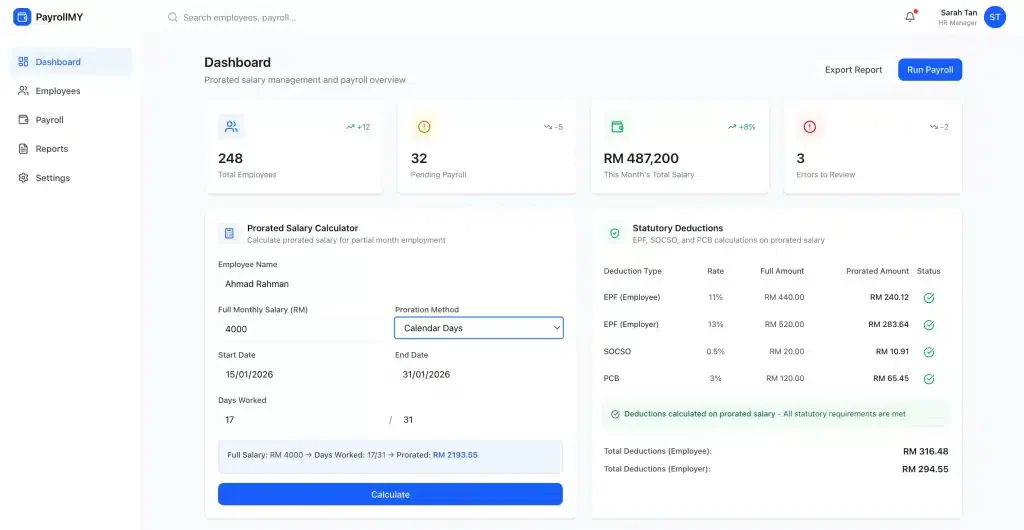
Calculating prorated salary manually works when you have a handful of employees. But as headcount grows, so do the errors. Different start dates, mid-month resignations, unpaid leave, part-time arrangements, each scenario requires a slightly different calculation, and spreadsheets do not flag mistakes.
Payroll software automates this by pulling employee start dates, applying the correct proration method, and adjusting statutory deductions like EPF, SOCSO, and PCB accordingly.
When an employee joins on the 15th, the system calculates their partial salary without HR needing to do the math manually. The same applies when someone resigns mid-cycle or switches from full-time to part-time.
Features that matter for prorated salary:
- Automatic proration: Calculates partial salary based on your chosen method, calendar days, working days, or fixed 26-day basis, and applies it consistently across all employees.
- Statutory deduction adjustments: Ensures EPF, SOCSO, and PCB are calculated on the prorated amount, not the full monthly salary.
- Overtime integration: Includes overtime pay in prorated periods without requiring separate manual calculation.
- Payslip clarity: Generates payslips that show employees exactly how their prorated amount was calculated, reducing questions and disputes.
- Daily and hourly worker support: Handles employees paid by the day or hour, where proration is essentially built into every pay cycle.
- Approval workflows: Routes payroll for review before processing, so errors get caught before money moves.
- Audit trail: Keeps records of which calculation method was used for each employee, useful during internal audits or labor disputes.
For companies experiencing rapid inventory turnover that drives frequent mid-month hires, high employee turnover, or mixed full-time and part-time staff, payroll software reduces the time spent on manual calculations and lowers the risk of underpaying or overpaying employees.
Conclusion
A prorated salary ensures that employees are compensated fairly for the actual time they’ve worked during a pay period. It applies when someone starts or leaves mid-cycle, works part-time, or experiences a salary change. Understanding how to calculate pro rated salary is crucial for maintaining compliance and transparency in payroll processes.
HashMicro Payroll Software removes the complexity from prorated salary calculations, ensuring accuracy and compliance with Malaysian labor laws. By automating these calculations, HR software Malaysia helps businesses avoid errors and streamline payroll management. With features like customizable payslips, tax compliance, and real-time updates, HashMicro provides a comprehensive solution for managing payroll efficiently.
Ready to simplify your payroll processes and enhance employee satisfaction? Try a free demo of HashMicro Payroll Software today and see how it can transform your payroll management.
FAQ about prorated salary
Prorated salary refers to the adjusted pay given to an employee who hasn’t worked the full pay period. It ensures they are compensated fairly for the actual days worked, rather than receiving a full month’s salary.
In Malaysia, salary can be prorated using three methods: by calendar days, working days, or a fixed 26-day calculation. Employers choose the method that best fits their needs, ensuring fair compensation for the days worked.
Paying prorated means adjusting an employee’s salary to reflect the actual time worked during a pay period. This approach is used when an employee starts or leaves mid-cycle, ensuring they receive fair compensation.
Yes, statutory deductions are calculated as a percentage of the final prorated salary, not the full monthly base pay. This is crucial because changes in the salary amount often affect tax brackets or mandatory contribution thresholds. Using payroll software ensures these deductions automatically adjust to the actual amount the employee receives, helping companies avoid penalty risks caused by manual calculation errors.
Absolutely, as the operational dynamics of each department may vary. A company might apply Working Days for corporate staff with fixed schedules and Calendar Days for shift workers to maintain fair compensation. The main requirement is that these differences must be transparently stated in each employee's employment contract. Additionally, managing these split formulas should ideally be automated within a payroll system to avoid burdening HR's monthly accounting process.
Switch to Code mode or refresh to load the visual preview.
Switch to Code mode or refresh to load the visual preview.