







Choose a PIM system by testing how it organises product attributes, approvals and publishing across your sales channels. Catalogue complexity matters more than product count alone when updates keep failing. This guide gives Malaysian catalogue managers and business owners practical evaluation criteria, cost examples and questions for a focused shortlist.
The sections below explain the workflow, evaluation criteria and practical next steps.
What is a PIM System?
A PIM system organises the information used to describe and sell products. Typical requirements include attributes, descriptions, images, variants and publishing rules. Buyers should test the required workflow against their own catalogue.
For example, a MYR 240 fitting may need size, material and installation details. The stock code identifies the item, while approved content explains its use. Keeping both consistent reduces avoidable questions during ordering.
Turn Your Catalogue Problems into Evaluation Criteria
Translate each recurring problem into a task the vendor must demonstrate using your records. Describe what must happen, who approves it and what evidence will count as a pass.
Begin with a recent catalogue update. Trace the supplier file, internal edits, image selection, approvals and destination uploads. Include time spent chasing missing information and correcting rejected submissions. These activities count even when they happen outside the main spreadsheet.
Use the following requirements table as a starting point. These are evaluation criteria, not promises that every PIM system provides the same functionality.
| Business problem | Required capability to test | Demonstration task | Acceptance evidence |
|---|---|---|---|
| Variants have inconsistent specifications | Attribute and variant modelling | Model a product family with shared attributes and variant-specific values. | The agreed structure preserves shared values and legitimate variant differences. |
| Supplier files require repetitive copying | Bulk imports and mapping | Import your sample file, then submit an updated version. | Mappings, rejected rows and changed values are visible; duplicates are addressed. |
| Incomplete records reach customers | Validation rules | Submit products with missing dimensions and unsuitable values. | The agreed rules identify failures before the relevant publication step. |
| Descriptions remain unfinished | Enrichment workflow | Move a supplier description through editing and review. | Editors can identify outstanding work and distinguish drafts from approved content. |
| Images and documents become mismatched | Asset associations | Associate product images and a technical document with the correct variants. | Reviewers can verify the product, asset version and intended destination. |
| Unauthorised edits bypass review | Permissions and approval workflows | Attempt a restricted edit, then submit an authorised change for approval. | Access follows the agreed roles, and approval evidence identifies the responsible people. |
| Language versions drift apart | Localisation controls | Edit an English description and review the related Bahasa Malaysia version. | The team can identify which version needs review without losing approved text. |
| Channel requirements differ | Channel-specific publishing | Prepare the same product for destinations with different field requirements. | Outputs meet the agreed destination rules, with publication results available for inspection. |
Write acceptance conditions before the demonstration. Define usability through a concrete task. Can the merchandiser correct rejected records without reimporting unrelated records? Ask the vendor to explain any manual steps, configuration or additional services needed.
Run a sample catalogue test
Choose sample records covering ordinary work and difficult exceptions. Include similar variants with different measurements. Agree the demonstration scope with the vendor before the session.
Ask the vendor to import the sample and highlight missing information. Then approve the corrected content and publish the agreed output. Inspect validation, approval and publication results separately. A successful import alone does not demonstrate that the complete workflow meets your requirements.
Then change the specification after approval and repeat the relevant steps. Check whether the team can identify affected records and destinations, and establish whether the change requires another approval. Record what happened rather than accepting a verbal assurance that it can be configured later.
Choose the right type of intervention
| Your situation | Buying direction | Evidence to gather first |
|---|---|---|
| A simple, controlled catalogue with limited changes | Improve spreadsheet governance before adding software. | Named ownership, a shared template, clear permissions and an approval routine. |
| Repeated enrichment, review and publication across destinations | Evaluate PIM against the recurring workload. | Rework records, channel requirements and results from the sample catalogue test. |
| Missed enquiries, unclear opportunities or neglected quotations | Assess CRM separately. | Lead ownership, opportunity stages and the process for creating follow-up activities. |
Avoid using catalogue size as the deciding factor. Product count alone cannot explain the workload. Attribute variety, changes, approvals and publishing requirements also matter.
For a MYR 240 fitting, remove its required size attribute during the test. Check whether the reviewer can identify and correct that specific omission.
Map PIM, ERP, DAM and CRM Responsibilities Before Integration
Agree which system owns each field before discussing connectors. An integration should move approved information to its intended destination while protecting fields owned elsewhere.
The responsibility map below is a planning model, not a fixed architecture. Exact ownership varies by implementation, existing systems and the way your business works.
| System or discipline | Typical responsibility to agree | Boundary to test |
|---|---|---|
| PIM | Product enrichment and channel content, including approved descriptions and descriptive attributes. | Which approved fields leave the content workflow, and which destination receives them? |
| Enterprise resource planning (ERP) | Operational product records used in purchasing, stock and order processes. | Which operational identifiers and fields must remain authoritative? |
| Digital asset management (DAM) | Digital assets, their versions and associated usage information. | Where are files maintained, and how are their product associations checked? |
| Customer relationship management (CRM) | Customer opportunities and related sales activities. | How does approved product content reach the quotation process, if required? |
Document the product identifiers used across systems, including how variants are recognised. Agree field ownership, synchronisation direction and update frequency. Also define what happens when validation fails, when a destination is unavailable and when competing edits create a conflict.
For example, the content workflow may own the approved marketing description. ERP can remain responsible for the operational product identifier. This is an illustrative design choice, not an established integration. The vendor must show how your chosen arrangement would work.
Use a changed product specification as the acceptance test. Follow it from approval to the intended destination and inspect the resulting record. Check that authoritative fields in other systems remain unchanged. Ask how the team detects and recovers failed transfers.
Check the quotation handoff explicitly
Ask where the quotation description originates. The operational product record, a separate description field or a manual edit. Then ask how a newly approved specification would reach that description.
Ask the proposed supplier to demonstrate any required PIM connector, content synchronisation and quotation-description mapping. Record the demonstrated behaviour and obtain written confirmation of the implementation scope.
Keep forecast requirements separate
Ask the supplier to identify which figures are open opportunity totals, demonstrate any required forecast calculations and explain their assumptions. Record the results separately from the PIM acceptance tests.
Use the same MYR 240 fitting across ERP, content and sales records. Change its marketing description and inspect which operational fields remain unchanged. For the related workflow, see Sales Journal Types, Format, and Examples Unpacked.
Measure Data Quality and Build a Realistic MYR Business Case
Measure content quality and publishing effort before estimating financial value. Compare suppliers using the same sample records, definitions and measurement period, then request a full cost breakdown in MYR.
Start with a baseline covering a representative publishing cycle. Record who performs each task, when approved inputs become available and when the destination accepts the content. Keep waiting time visible, because a quick editing step can still sit inside a slow approval process.
| Evaluation measure | Evidence to collect | Measurement rule to agree |
|---|---|---|
| Attribute completeness | Ask for counts of populated and missing required fields. | Fix the required fields for each product category and destination before assessment. Check validity separately from whether a field is populated. |
| First-pass publication | Ask for counts of submissions accepted immediately and submissions returned for correction. | Define a submission consistently and count all relevant attempts during the agreed period. |
| Rework | Ask for the reviewed records and a list of those requiring correction. | Define what constitutes a correction and count each affected record consistently within the review batch. |
| Publishing time | Ask for timestamps showing approved input and successful publication. | Use the same start and finish events, and specify whether elapsed time includes non-working hours. |
Keep the denominators visible in supplier reports. Completeness results mean little when difficult attributes are excluded. Publication results must also include failed submissions. Record exclusions and exceptions alongside the outcome.
Compare like with like when reviewing progress. A batch of straightforward descriptions is different from a catalogue update involving technical documents, language review and several destination formats. Where the workload changes, explain that difference before attributing an improvement to the system.
Value released time carefully
Suppose a team saves 30 staff hours monthly at MYR 35 hourly. That releases capacity worth MYR 1,050 each month.
Ask your finance team to assess how the proposed time reduction would affect expenditure. Decide how the team will use the released capacity. Options include overdue enrichment, additional catalogue updates or reduced overtime. Support any cash-saving estimate with spending evidence.
Compare that value with subscription charges, implementation, data cleansing, connectors, training, support and ongoing administration. Ask vendors to identify which costs are recurring, which are tied to delivery milestones and which depend on additional work. Request MYR quotations rather than relying on unsourced market prices.
Include your own team's effort as well. Assign owners for attributes, conflicting records, mappings and destination rules. Technical implementation by an external partner does not remove those responsibilities.
Keep sales outcomes in context
Win rate = won / (won + lost) × 100. Define the reporting period and deal population consistently, and review pricing, lead quality and salesperson activity separately.
Use product-content measures to evaluate the content project. Keep the sales review separate, and request evidence for any proposed connection between catalogue changes and commercial results. For the related workflow, see What is a Sales Funnel? Stages, Strategy & Real Examples.
Evaluate HashMicro Alongside Your PIM Requirements
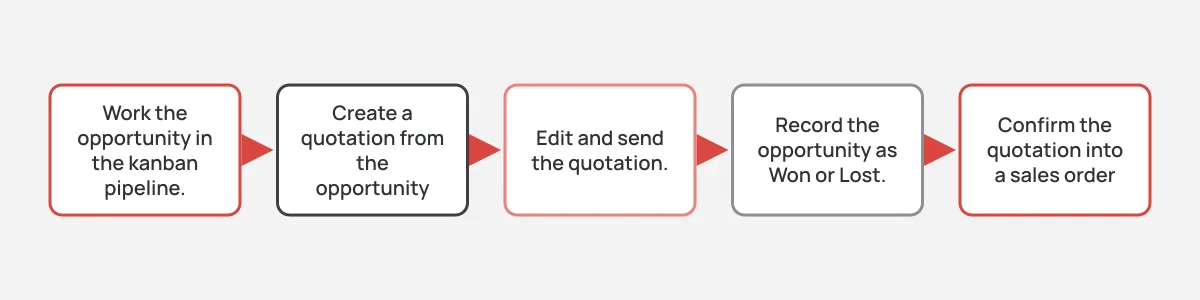
HashMicro CRM manages leads, opportunities and sales activities. A salesperson can create a quotation from an opportunity using customer and product records. Confirmed quotations continue into sales orders for fulfilment and invoicing. For the related workflow, see Sales Report: Definition, Types, Templates, and How to Create.
This workflow helps assess where approved descriptions reach customer-facing documents. For a MYR 8,000 quotation, inspect the product identifier and description used. Assign responsibility for correcting the description before the quotation reaches the customer.
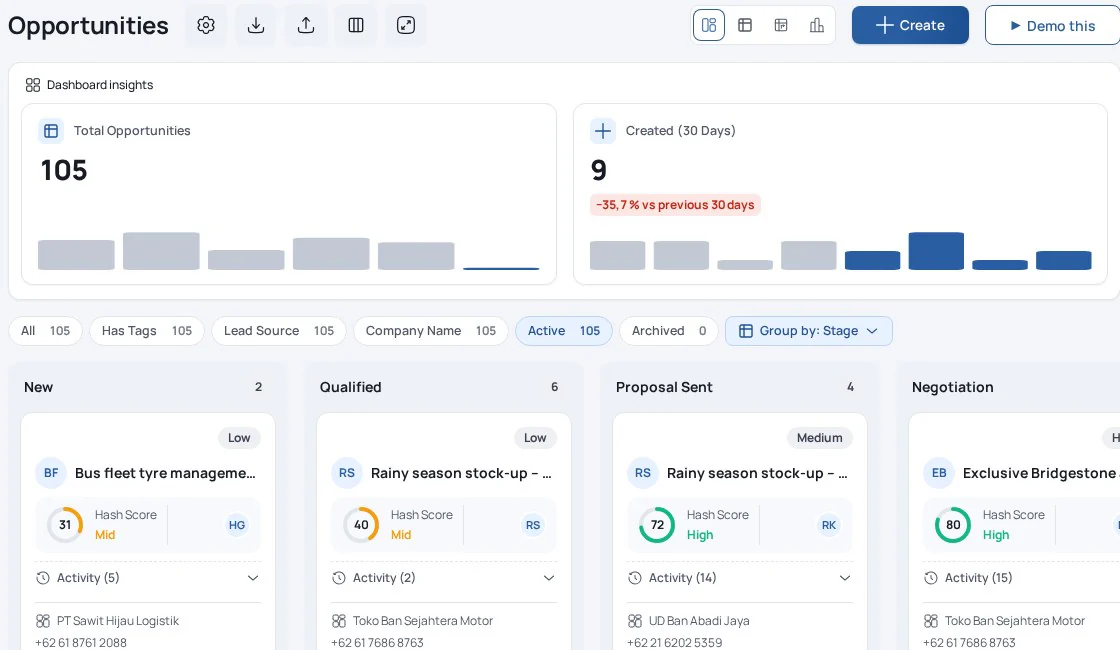
Evaluate any proposed PIM connection as a separate integration requirement. Specify the fields, direction, frequency and failure handling in the scope. A working CRM quotation does not establish a catalogue publishing service.
Prepare Your Shortlist and Test the Workflow Before Committing
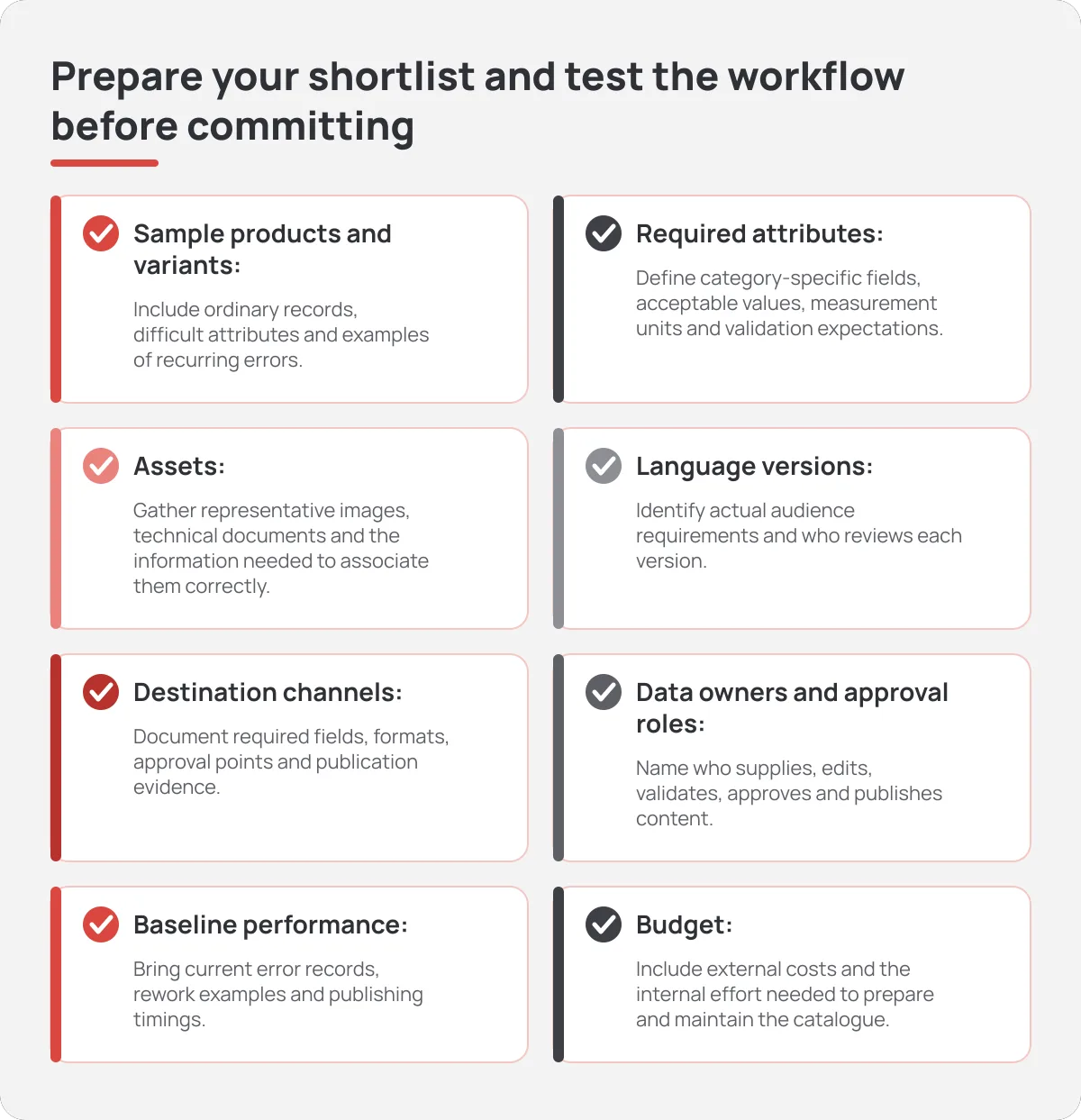
Prepare representative records, named owners and written acceptance conditions before arranging demonstrations. Shortlist suppliers against the workflow they can demonstrate and the implementation responsibilities they are prepared to document.
Your preparation pack should include:
- Sample products and variants: Include ordinary records, difficult attributes and examples of recurring errors.
- Required attributes: Define category-specific fields, acceptable values, measurement units and validation expectations.
- Assets: Gather representative images, technical documents and the information needed to associate them correctly.
- Language versions: Identify actual audience requirements and who reviews each version.
- Destination channels: Document required fields, formats, approval points and publication evidence.
- Data owners and approval roles: Name who supplies, edits, validates, approves and publishes content.
- Baseline performance: Bring current error records, rework examples and publishing timings.
- Budget: Include external costs and the internal effort needed to prepare and maintain the catalogue.
Attach a field-ownership map and a list of required connectors. For each proposed connector, request evidence of supported versions, implementation responsibilities, failure handling and data export. Clarify who maintains it when either connected system changes.
Ask for an export demonstration using your sample records. Check whether the output preserves identifiers, variant relationships, language versions and the information your team would need to move elsewhere. Agree the export scope and any associated services in writing.
Use the same demonstration script for shortlisted suppliers and record exceptions against each requirement. Distinguish functionality shown during the session from configuration still to be completed, manual workarounds and proposed development. An unresolved requirement should remain visible in the decision record.
Avoid predictable buying mistakes
Importing unclean data can carry existing disagreements into a new system. Resolve duplicate identifiers, conflicting specifications and unclear attribute meanings before treating an import as complete. Assign an owner to exceptions rather than leaving them in a shared queue indefinitely.
Unclear ownership can also undermine a technically successful integration. State who approves corrections, who handles failed transfers and who decides when systems disagree. Treat an integration claim as a question to test until the connector works with the agreed records and destinations.
Finally, test visibility and action separately. Repeat the quotation follow-up test with the responsible salesperson so the next action has a clear owner. Evaluate any claimed commercial improvement separately from the content acceptance results.
If you also need lead, opportunity and quotation management, discuss your CRM workflow with HashMicro. For the related workflow, see 15 Best Sales Management Software in Malaysia (2026).
Build the shortlist around a MYR 10,000 catalogue migration exercise. Require each supplier to price the same records, mappings and acceptance checks.
Keep Malaysian Tax and Personal Data Responsibilities Clear
LHDN manages e-Invois, while Royal Malaysian Customs administers SST. Product descriptions must remain consistent with the records used by finance. PIM ownership does not replace tax classification or invoice validation.
Consider a catalogue item priced at MYR 500 before applicable taxes. Finance owns the tax treatment, while merchandising owns the approved product description. Test whether integrations preserve those separate responsibilities.
Protect named supplier contacts and customer details under PDPA Malaysia. Use masked records during selection and restrict access to personal information. A product catalogue should not become an uncontrolled contact database.
Conclusion
Bring one catalogue change and one MYR 8,000 quotation to your discussion. Trace the approved description through HashMicro CRM Software. Book a Demo.
FAQ
A PIM system centralises product information so teams can maintain descriptions, attributes and channel-ready content consistently. A Malaysian distributor with 500 SKUs might need one approved specification for each pack size. Product information management is different from tracking sales opportunities; a CRM product catalogue alone does not establish full PIM functionality.Before selecting a solution, write down the specific record your team needs and who will maintain it. Use a small representative sample to confirm the scope with operational staff. Separate essential requirements from optional features, then ask the supplier to demonstrate the essential workflow using that sample.
Take 1 product sold as a single unit and a carton of 12. Define its identifiers, units, descriptions, images and approval owner before publishing changes. Review which fields differ by channel and which must stay consistent. Record the source of each approved attribute so staff can trace a correction back to its owner.As a next step, draw the handover between the people involved and identify where an exception needs approval. Walk through the example with the person doing the work and the person reviewing it. Keep the supporting documents together so another team member can reproduce the result.For the connected process, read: Related workflow: Sales Report: Definition, Types, Templates, and How to Create.
Cost depends on SKU volume, languages, data quality, channels, migration and approval workflows. A Malaysian team maintaining 500 products in 2 languages has more preparation work than one sharing a single catalogue. An illustrative RM 2,000 photography budget belongs in project planning; it is not a PIM licence quotation. Request separate implementation and recurring charges.Build a total-cost worksheet for the first year and later years, showing assumptions beside each line. Include internal staff time and ask who owns any extra work. Next, compare written proposals against the same scope and acceptance criteria rather than comparing headline fees with different inclusions.
A Malaysian wholesaler may list one item with different descriptions across 3 sales channels. The warehouse still needs a consistent item identifier and pack size. Use one real category to map missing attributes and inconsistent units. Keep sensitive supplier terms separate from public product descriptions, and assign a person to approve each published change.Treat these figures as an illustrative scenario, not a statutory threshold or promised result. Next, repeat the exercise with a recent transaction and ask its owner to explain every difference. Check the relevant official guidance for the local context, and retain the documents that support your own decision.Official local guidance: PDPA Malaysia.
Compare systems using a sample of 20 products, including variants and incomplete records. Ask the supplier to show how an editor finds missing data and how an approver rejects a change. Product catalogue features vary by solution. Confirm the precise data model and publishing scope before treating a general ERP or CRM as a PIM replacement.Next, record the outcome of each test and the evidence used to accept it. Name a responsible reviewer for any gap before agreeing the final scope. Ask for a repeat demonstration when a critical case fails, then use the written results to support the purchasing decision.
- Agree mandatory requirements before scoring.
- Test exceptions with supporting evidence.
- Record gaps and obtain a named owner.
Begin with one product category and agree the mandatory fields before importing everything. A pilot of 50 SKUs can reveal inconsistent units, duplicate codes and unclear image ownership. Assign an owner for each attribute group and a reviewer for published descriptions. Define an acceptance checklist before adding the next product category or channel.Next, agree the pilot’s acceptance criteria with the people who will use the process daily. Keep an issue log with an owner and a due date for each problem. Expand only after the team can explain and reproduce the results, including the handling of a correction.
- Prepare a clean sample and assign owners.
- Rehearse the complete workflow and corrections.
- Review the results before expanding the rollout.
For 2 sales channels, map the product identifier, field ownership and update direction separately. An ERP may own stock and costs while a product content process owns descriptions and images. Confirm whether channel connectors require separate work. A successful file export does not demonstrate a supported, monitored integration with every marketplace.Next, create a field map and test both a normal record and a deliberate error before approving the interface. Ask who monitors failures and how corrections are replayed without duplicates. Include support responsibilities in the written scope so a future incident has a clear owner.