









 Limited to 100 registrants

When construction activity increases, finance teams do not only handle more invoices. They also need to track job costs, progress claims, retention, variations, and subcontractor payments across multiple sites. Without clear project-level accounting, a small mismatch in one claim or cost allocation can affect budget visibility for the whole project.
Official figures reflect the scale of activity. The Department of Statistics Malaysia reported the value of construction work done at RM34.1 billion in Q4 2023 and it was up 6.8 percent year on year. When project volume rises, small gaps in cost allocation, claims tracking, or reporting can quickly reduce financial visibility.
That is why many contractors and developers use construction accounting software to automate repetitive work, tie costs to the right job and phase, and standardize reporting for clearer control.
Key Takeaways
Construction project accounting automates financial tasks, ensuring accuracy and better project management.
Construction accounting commonly faces significant challenges that complicate accurate cost tracking and revenue recognition.
A construction-focused accounting system helps centralize job costs, automate billing, and improve financial visibility across projects.
Digital tools maintain real time visibility to ensure every Source of Funds is tracked with precision.

Shortlisted Construction Accounting Software
Before we move on to the list of recommendations, here are some of the most prominent accounting software for construction companies I curated for businesses, based on features, relevance, and user experience.



Best Because
It's made accounting less boring with more precise organization of all the numbers

Best Because
Cloud-based system provide the ability to access from anywhere in the world
Best Because
Comprehensive suite of tools designed specifically for construction management

Best Because
Effortlessly simplifies complex accounting tasks
Best Because
Empowered contractors to take control of projects and bring efficiency,

Best Because
Helps user with a clarified menu providing directions to various reports and financials
Of course, the recommendations don’t stop there because plenty more construction accounting software exists. To help you choose, there are evaluated the best 21 construction accounting software in Malaysia for 2026.
What is Construction Accounting Software?
Construction accounting software is designed to handle the financial needs of construction businesses more accurately. Unlike general-purpose platforms, accounting software for a construction company provides project-based accounting and cost-control tools.
One of its main advantages in Malaysia is the ability to simplify financial processes for project-based work. It also supports detailed job costing, helping construction accountants track each project’s expenses and revenue more accurately.
Another key feature of construction accounting software is integrating various accounting modules. From vendor payments and customer billing to payroll and general ledger management, it brings financial activities into one connected platform.
What Challenges Often Arise in Construction Accounting?
Construction accounting commonly faces challenges, including complex multi-phase projects, unstable cash flow, and strict compliance requirements that make accurate cost tracking and revenue recognition difficult. These issues are especially significant in Malaysia, where delayed payments and IRBM regulations require tighter financial controls and more precise reporting.
Below are the detailed challenges that construction companies must understand to maintain accuracy, compliance, and financial stability:
- Project Complexity: Construction projects often involve multi-phase timelines, diverse teams, and numerous cost elements. This intricate structure complicates construction accounting and heightens the likelihood of errors in cost allocation and revenue recognition, potentially impacting profitability.
- Cash Flow Management: Managing cash flow is a persistent challenge in construction, where expenses are incurred upfront, but payments are often delayed. The right accounting software for construction company can help overcome challenges such as cash flow instability and delayed payments.
- Regulatory Compliance: Malaysia’s regulatory landscape, including tax obligations and financial reporting standards, demands meticulous attention. Construction companies must remain compliant with laws set by the Inland Revenue Board of Malaysia (IRBM) to avoid penalties and ensure smooth operations.
What Features Matter Most in Accounting Software for Contractors?
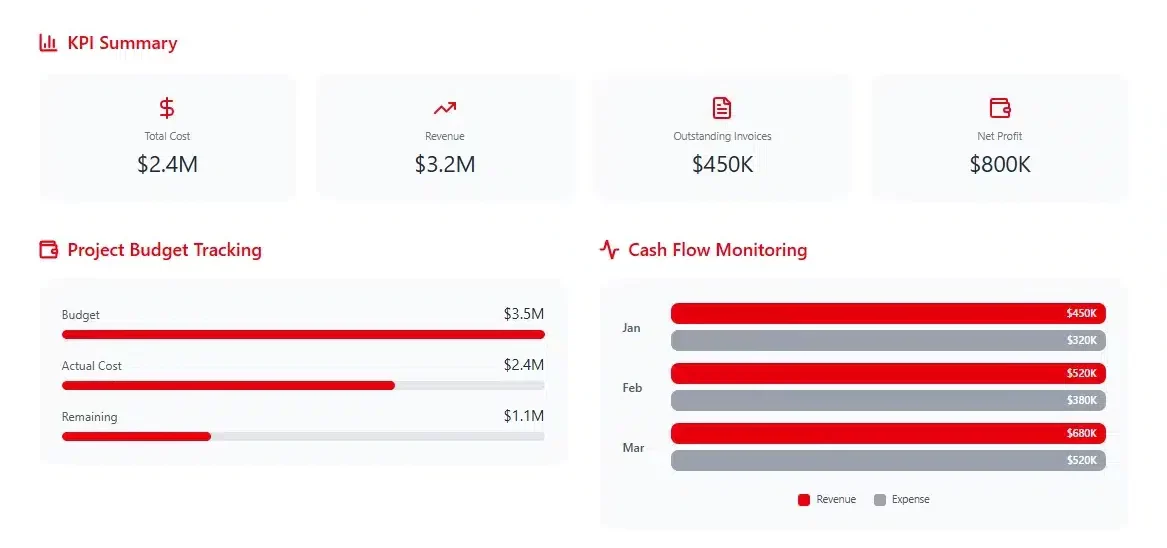
Selecting the right construction accounting software requires understanding which features directly influence efficiency and profit. A strong construction accounting system from a company simplifies cost tracking, billing, and reporting while improving real-time visibility for project and financial control.
1. Job Costing: Job costing helps contractors monitor expenses for each project, including materials, labor, and overhead. This ensures all costs are allocated correctly and that every construction job stays within its planned budget and profitability target.
2. Progress Billing: Efficient billing keeps cash flow system stable during long-term projects. With progress billing in construction accounting software, contractors can invoice based on work milestones or completion percentages, reducing delays and improving payment consistency.
3. Financial Reporting: Real-time financial reporting allows construction companies to review project costs, revenue, and cash flow instantly. With accurate analytics, teams can make data-driven decisions, manage resources better, and maintain long-term financial health.
4. Payroll and Expense Tracking: Automate salary calculations, project-related reimbursements, and the monitoring of source of funds for project expenditures. They reduce errors, improve transparency and compliance, and clarify fund allocation across projects.
Payroll and expense tracking features automate salary calculations, project-related reimbursements, and the monitoring of source of funds for project expenditures. They reduce errors, improve transparency and compliance, and clarify fund allocation across projects.
5. System Integration: The best construction accounting software integrates with project management, CRM, and procurement tools. This connectivity reduces duplication, aligns departments, and provides a unified financial view for smooth and efficient operations.
For teams evaluating construction accounting software, it’s important to look beyond brand names and focus on workflows like job costing, progress billing, and retention. If you’re managing construction accounting in Malaysia, our dedicated guide to construction accounting fundamentals can give you a clearer foundation before you choose a system.
Quick Comparison of Construction Accounting Software in Malaysia
| Software | Best For | Strength | Key Features | Malaysian Compliance | Pricing |
|---|---|---|---|---|---|
| HashMicro | Project-based financial control | End-to-end job costing & financial visibility | Project accounting, cash flow forecasting, subcontractor management | Supports LHDN e-Invoicing, SST, and local implementation. | Custom pricing. |
| FreshBooks | Small construction teams | Easy invoicing & expense tracking | Cloud accounting, reporting, collaboration | Limited Malaysia-specific construction compliance. | RM98.70–RM305.50/month |
| NetSuite | Large enterprises | Highly customizable ERP | Real-time insights, audit trails, automation | Supports Malaysian tax via localization. | Custom pricing. |
| Procore | Large contractors | Strong project management | Billing workflows, forecasting, collaboration | Compliance depends on ERP integration. | Custom pricing. |
| Zoho Books | Small businesses | Simple and affordable | Invoices, expense tracking, workflows | Supports SST and Malaysian tax settings. | RM70.50–RM1,128/month |
| Buildertrend | Residential builders | Client communication tools | Payments, financial tracking, integrations | Requires local accounting integration. | RM935–RM4,695/month |
| Sage 300 CRE | Mid–large firms | Advanced job costing | Reporting, billing, project management | Requires localization. | Custom pricing. |
| Premier | General contractors | All-in-one solution | Job costing, payroll, reporting | Compliance via localization. | Custom pricing. |
| CoConstruct | SMEs | Integrated project + finance | Scheduling, budgeting, reporting | Requires accounting integration. | RM465.30–RM1,875.30/month |
| FOUNDATION | Mid-sized firms | Strong accounting modules | AIA billing, payroll, job costing | Requires localization. | Custom pricing. |
| CMiC | Large companies | Full ERP suite | Cost, revenue, financial management | Supports localization for Malaysia. | Custom pricing. |
| Century Software | Malaysia-based firms | Localized solution | Budgeting, payroll, reporting | Built for Malaysian tax and payroll. | Custom pricing. |
| RedTeam | Commercial builders | Bid & project management | Vendor collaboration, change orders | Requires accounting integration. | Custom pricing. |
| QuickBooks | Small–mid firms | Strong accounting basics | Job costing, payroll, reporting | Supports SST with limited localization. | RM6,298–RM33,840/year |
| Deltek ComputerEase | Mid-sized firms | Flexible billing | Payroll, dashboards, reporting | Requires customization. | Custom pricing. |
| Xero | SMEs | Cloud simplicity | Bank feeds, invoicing, tracking | Supports SST and local integrations. | RM94–RM376/month |
| Gusto | Payroll-focused teams | HR & payroll strength | Tax automation, payroll runs | Not designed for Malaysian compliance. | RM230.30–RM846/month (+ user fee) |
| Viewpoint Vista | Large firms | Deep financial tracking | Contracts, job costing, multi-company | Supports localization. | Custom pricing. |
| Acumatica | Enterprises | Flexible ERP | CRM, financials, BI tools | Supports Malaysian tax via partners. | Custom pricing. |
| Construction Partner | Mid-sized firms | Strong job costing | Payroll, inventory, forecasting | Limited Malaysia-specific compliance. | Custom pricing. |
| COINS | Enterprise construction | End-to-end management | Supply chain, payroll, forecasting | Supports localized implementation. | Custom pricing. |
21 Best Construction Accounting Software for Malaysian Businesses
1. Hashmicro Construction Accounting Software
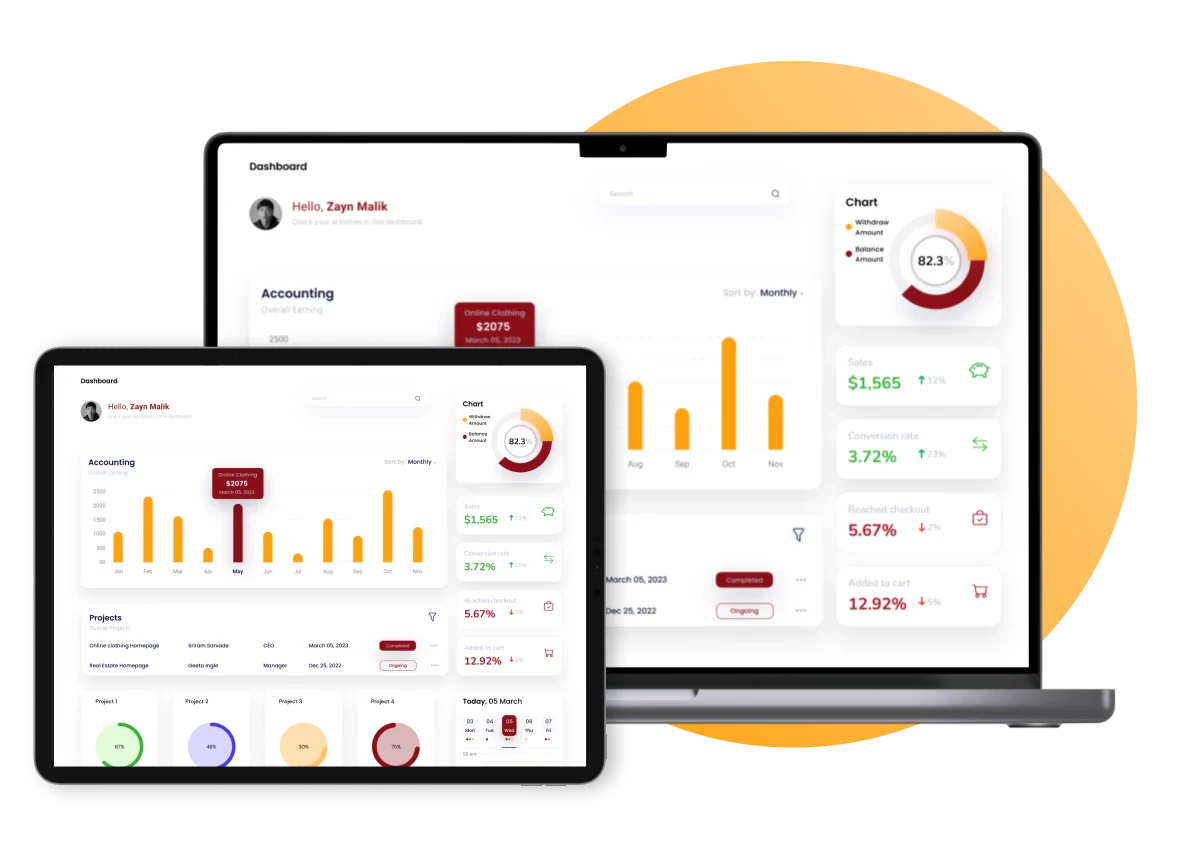
HashMicro is a cloud based system provider that facilitates the operational needs of construction firms in Malaysia through a centralized platform. An integrated construction accounting system like this helps organize complex workflows such as job costing, progress billing, and variation tracking across multiple project sites.
By utilizing real time data updates, management can monitor actual costs against budgets and improve estimating accuracy to reduce the risk of financial projection errors. This approach helps companies standardize records across common pain points like budget overruns and audit readiness, ensuring better financial transparency for stakeholders.
Features:
- Financial Dashboard
- Project Accounting
- Cash Flow Forecasting
- Bank Reconciliation
- Accrual and Amortization
- Expense Management
- Subcontractor Management
- Reporting and analytics
Custom, based on modules and users; contact the HashMicro team for a tailored quote.
Custom, based on modules and users; contact the HashMicro team for a tailored quote.
Pricing: Custom, based on modules and users; contact the HashMicro team for a tailored quote.
Why this suits Malaysian construction: HashMicro is a South East Asian system meeting local SST and CIDB needs. It supports MIDA SAG with unlimited user pricing and local Bahasa Melayu support.
| Pros | Cons |
|
|
"A construction accounting system helps contractors and developers manage project costs, invoices, and financials in one centralized platform, improving visibility and control in a fast-moving environment where budgets and timelines shift quickly."
2. FreshBooks
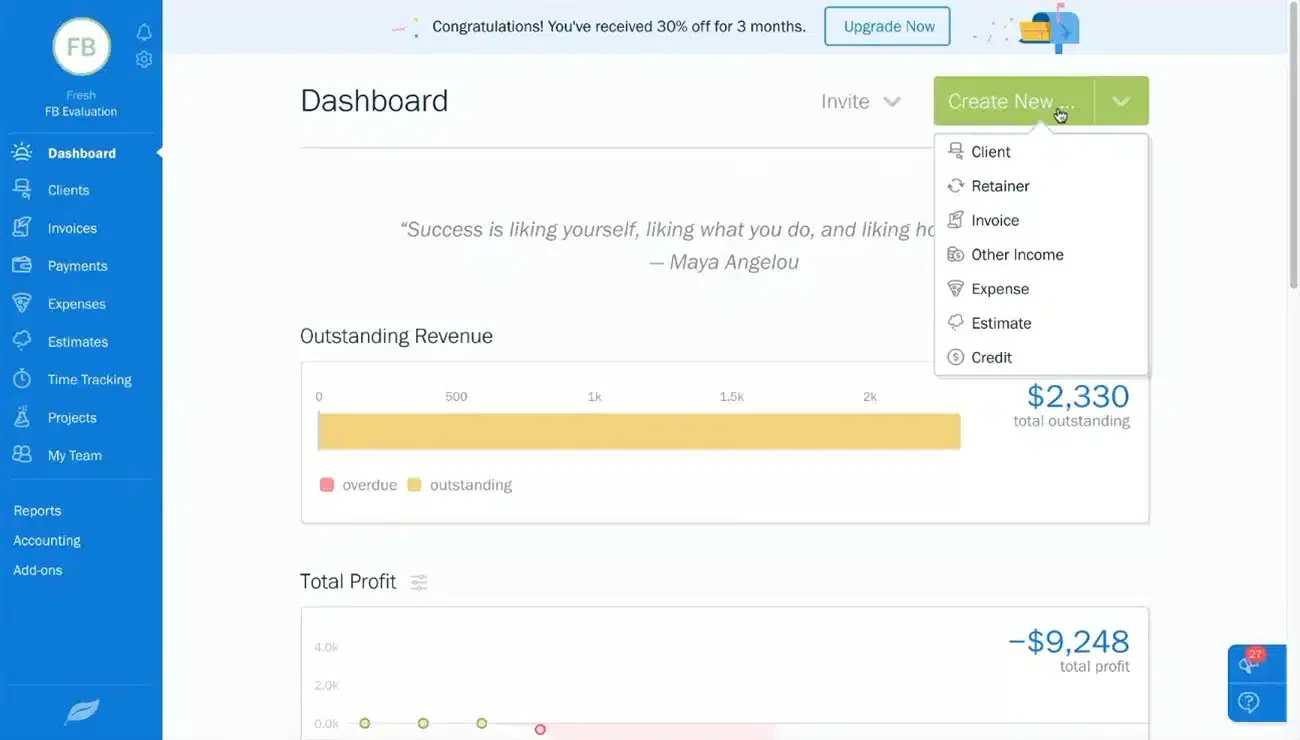
FreshBooks focuses on invoicing, expense tracking, and basic financial reporting for smaller construction teams. Its construction use is limited because it does not cover deeper job costing, progress billing, or project cost control in the same way as construction-specific accounting systems.
Features:
- Customizable Chart of Accounts
- Detailed financial insights
- Secure, cloud-based collaboration
| Pros | Cons |
|
|
Why this suits Malaysian construction: FreshBooks is a cloud based tool for local contractors to manage SST and project billing. It provides financial clarity across sites with an accessible interface.
Website: https://www.freshbooks.com/
3. NetSuite
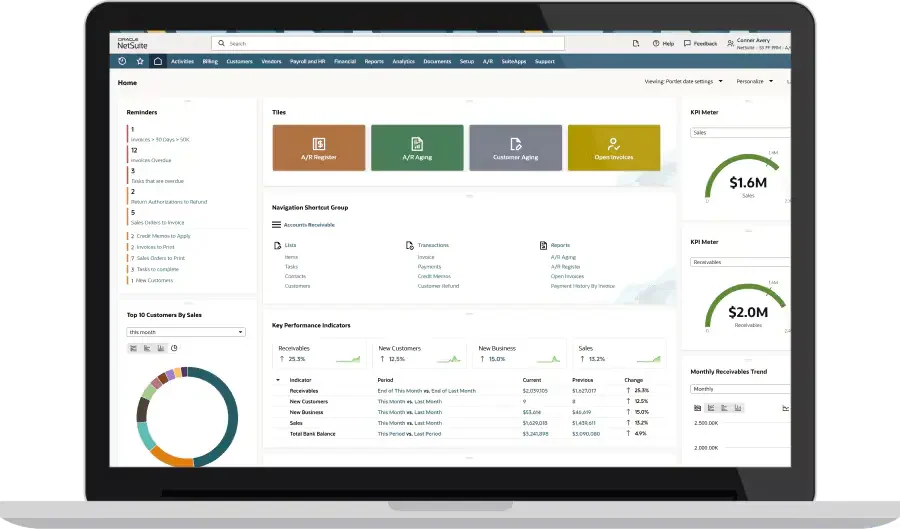
NetSuite Cloud Accounting Software simplifies transaction recording, payables and receivables management, tax collection, and financial reporting. This cloud-based construction accounting software provides real-time financial data access and integrates seamlessly with other NetSuite platforms.
Features:
- Real-time financial insights
- Automated journal entries
- Enhanced audit trails
- Streamlined invoicing and accounts payable
| Pros | Cons |
|
|
Why this suits Malaysian construction: NetSuite is a cloud based ERP for large Malaysian contractors. It unifies SST and project financials for multi site operations.
Website: https://www.netsuite.com/
4. Procore
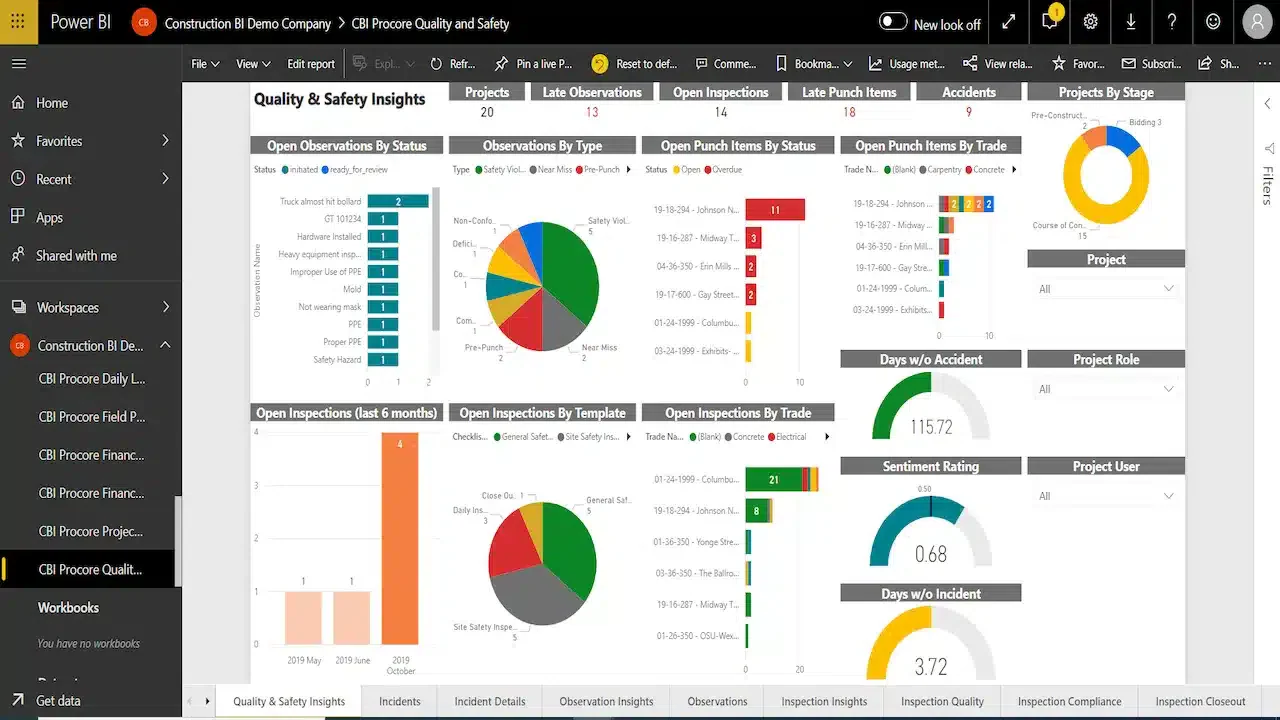
Procore is mainly used for site coordination, including RFIs, drawings, submittals, and field communication. For accounting, it usually needs to connect with a separate finance or ERP system.
Features:
- Invoice creation, collection, and approval
- Automated billing workflows
- Comprehensive estimating and cost forecasting
- Custom workflows and collaboration
| Pros | Cons |
|
|
Why this suits Malaysian construction: Procore is a cloud based platform connecting field and office teams. It simplifies CIDB compliance and provides real time project visibility.
Website: https://www.procore.com/
5. Zoho Books
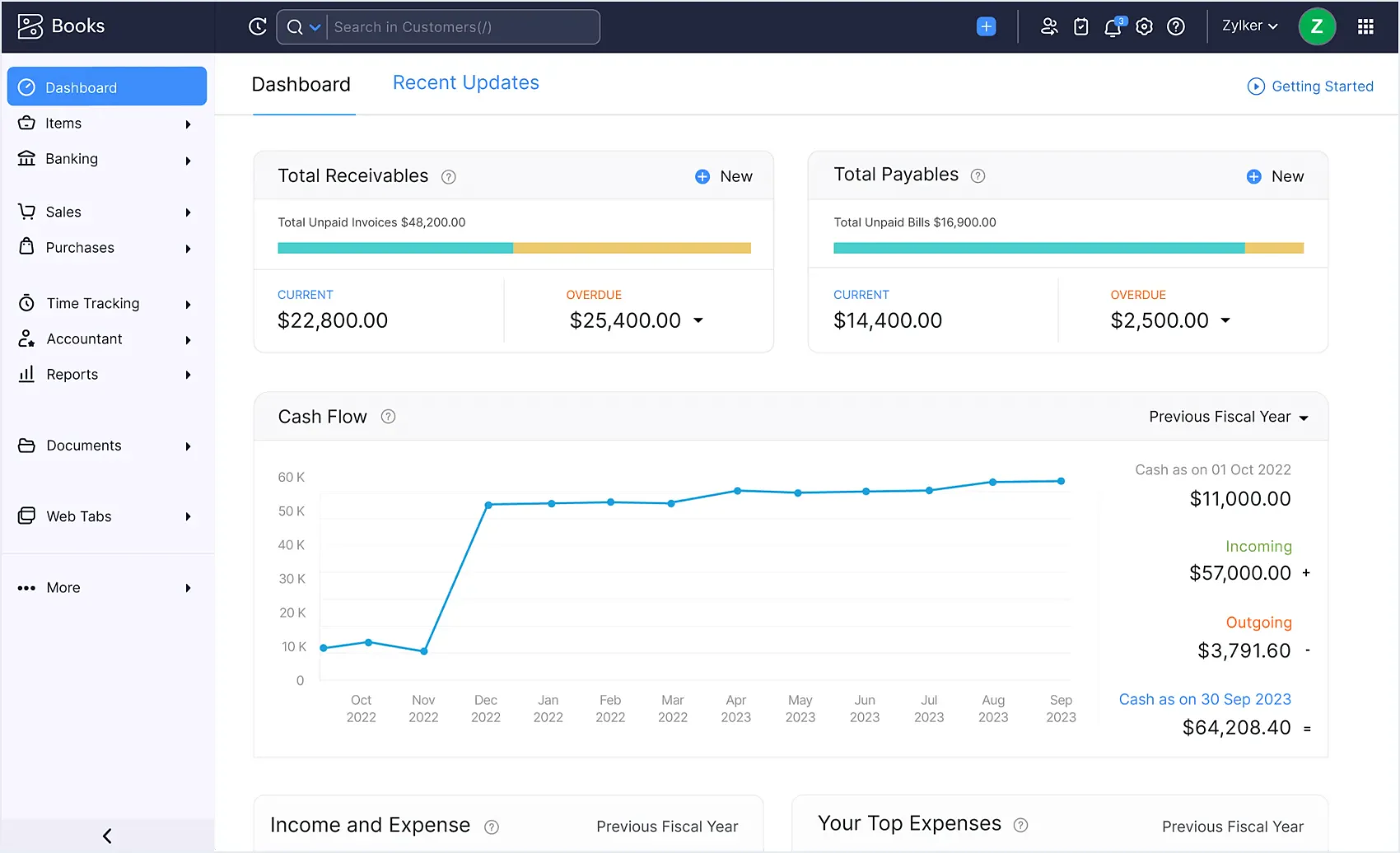
Zoho Books focuses on basic accounting needs such as invoices, expenses, bank feeds, and financial statements. For construction firms, it can cover routine finance tasks, but deeper project costing, progress claims, and site-level cost tracking may still require additional tools.
Features:
- Customized and automated business workflows
- Comprehensive end-to-end accounting features
- Simple creation of bills and invoices
- Bills and invoices can be set on a loop
- Tracks landed costs and inventory level
| Pros | Cons |
|
|
Why this suits Malaysian construction: Zoho Books is a cloud based tool for local contractors to manage SST and job costing. It provides affordable project tracking and automated billing for multi site operations.
Website: https://www.zoho.com/books/
6. Buildertrend
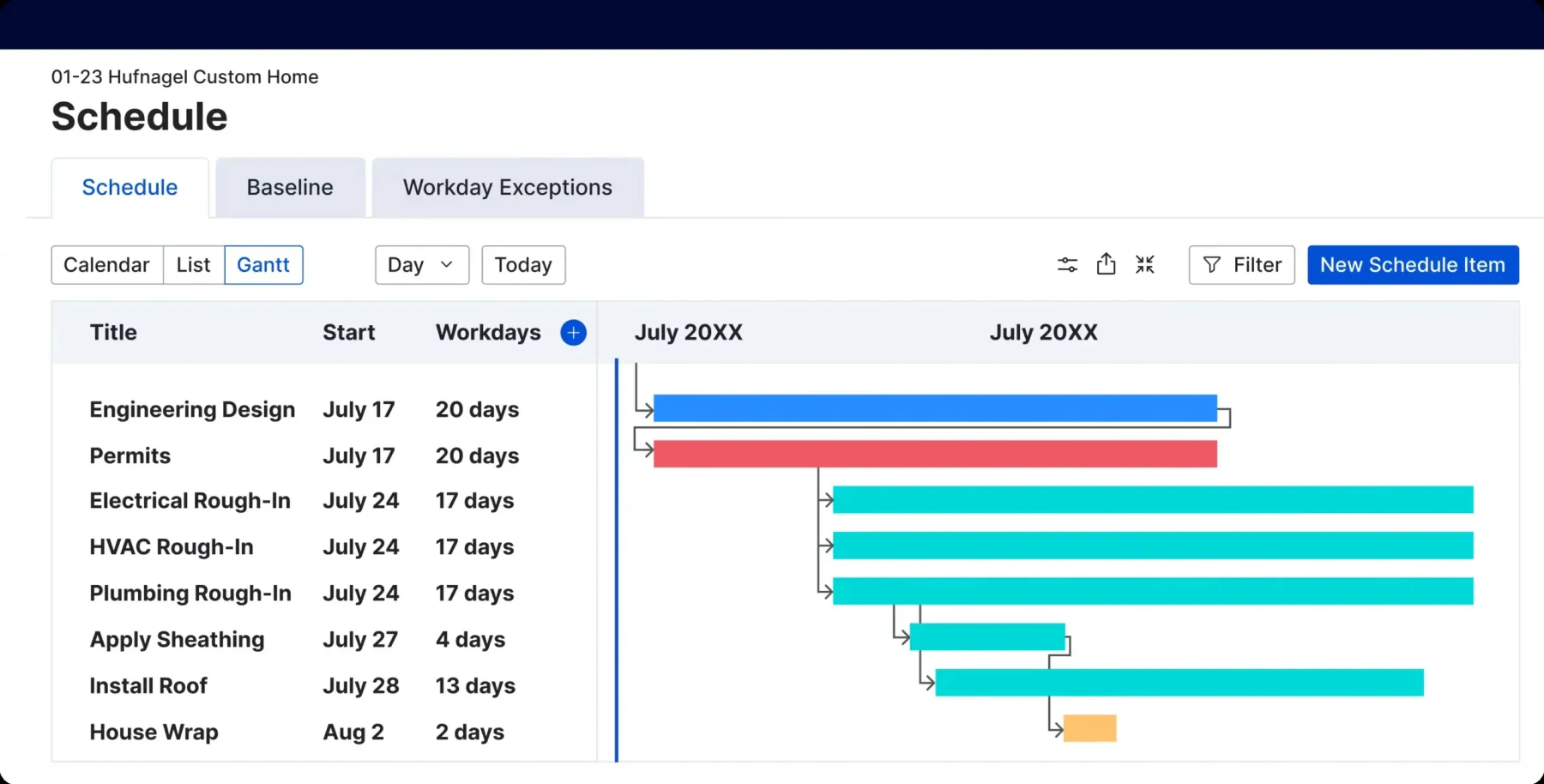
Buildertrend is common among home builders and remodelers that use construction management tools for client portals, selections, scheduling, and payment flows. For deeper accounting needs, it usually still depends on integrations such as QuickBooks or Xero.
Features:
- Tracks finances
- Facilitates and receives online payments
- Provides affordable insurance options
- Offers lending solutions
| Pros | Cons |
|
|
Why this suits Malaysian construction: Buildertrend is a cloud based platform for local residential contractors. It unifies project scheduling and SST tracking to ensure financial visibility across every site.
Website: https://buildertrend.com/
7. Sage 300 Construction and Real Estate
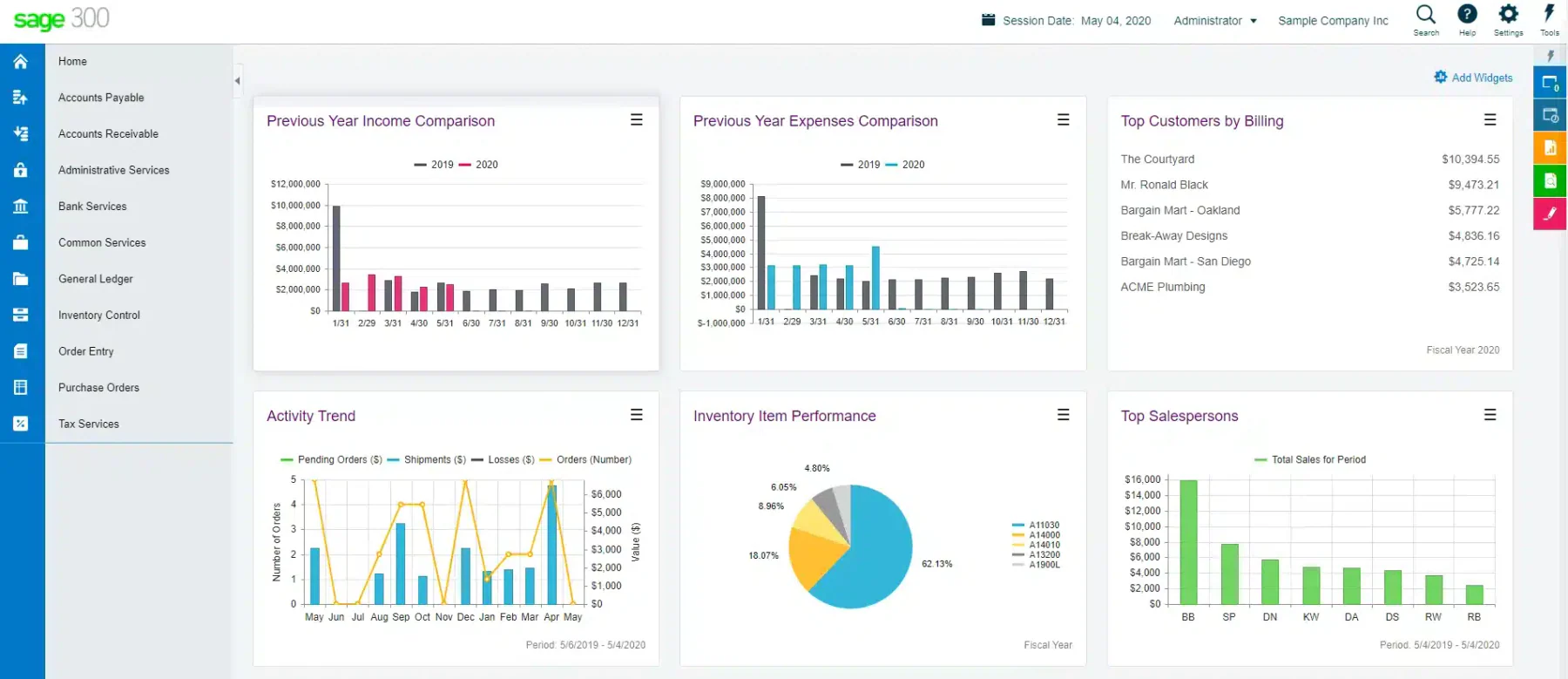
Sage 300 Construction and Real Estate (CRE) is a comprehensive construction and property and real estate management software ideal for mid-market to enterprise construction companies. Despite reduced new developments, it remains a strong choice for detailed financial management and construction project accounting.
Features:
- Document and project management
- Service management
- Complex inter-company billing
- Customized reporting
| Pros | Cons |
|
|
Why this suits Malaysian construction: Sage 300 Construction and Real Estate is a cloud based ERP for established Malaysian firms. It manages complex job costing and SST compliance to ensure financial control across multi site projects.
Website: https://www.sage.com/
8. Premier
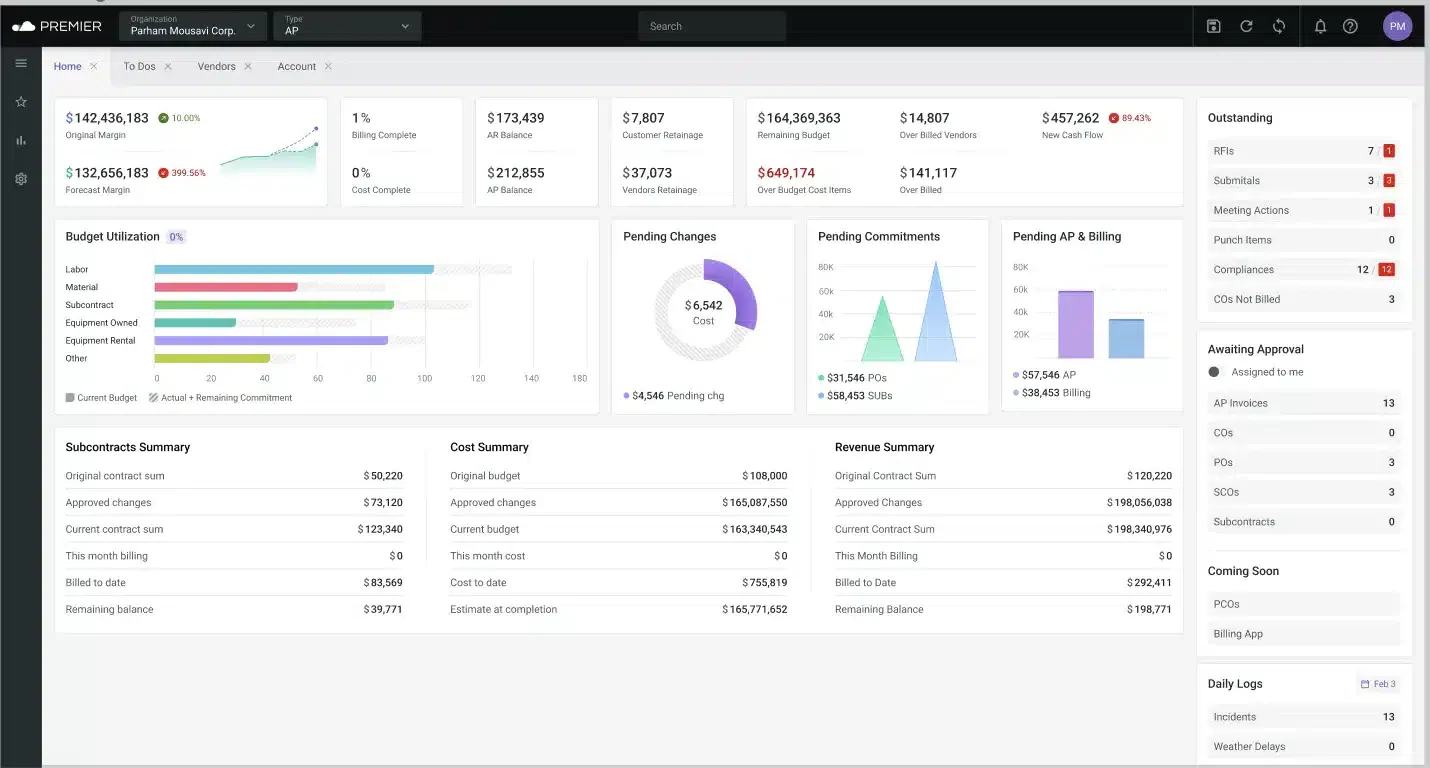
Premier offers a cloud-based construction accounting software that enables the management of multiple companies and projects. It features real-time job costing, budget management, and customizable dashboards for project oversight.
Key functionalities include cost-plus and progress billing, numerous accounting modules, document management, and payroll features. However, it lacks a mobile version and does not offer a free trial.
Features:
- Cost-plus billing, progress-billing, and other accounts receivable modules
- 50 pre-built customizable reports with drill-down capabilities
- Automated invoicing creation and alerts
- Cost-to-completion tracking and job costing
- Document management and electronic signatures
- Change order management
- Payroll, audit trails, and year-end financial reporting
| Pros | Cons |
|
|
Why this suits Malaysian construction: Premier is a cloud based ERP for contractors to unify accounting and project management. It simplifies SST tracking and job costing to maintain financial accuracy across every site.
Website: https://premiercs.com/
9. CoConstruct
 CoConstruct integrates project, operation, and financial management into a single platform, facilitating construction project management from preconstruction to financial oversight.
It features cost catalogs, lead management, standard estimating tools, and QuickBooks integration for financial tasks. Its project management capabilities are robust, though it lacks built-in payroll processing and advanced reporting features.
Features:
- Centralized project management platform
- Construction scheduling and timeline management
- Financial reporting and analytics
- Budgeting and forecasting tools
- Accounts payable and accounts receivable management
| Pros | Cons |
|
|
Why this suits Malaysian construction: CoConstruct is a cloud based platform for local custom home builders. It simplifies SST tracking and project scheduling to ensure financial visibility across residential sites.
Website: https://www.coconstruct.com/
10. Foundation
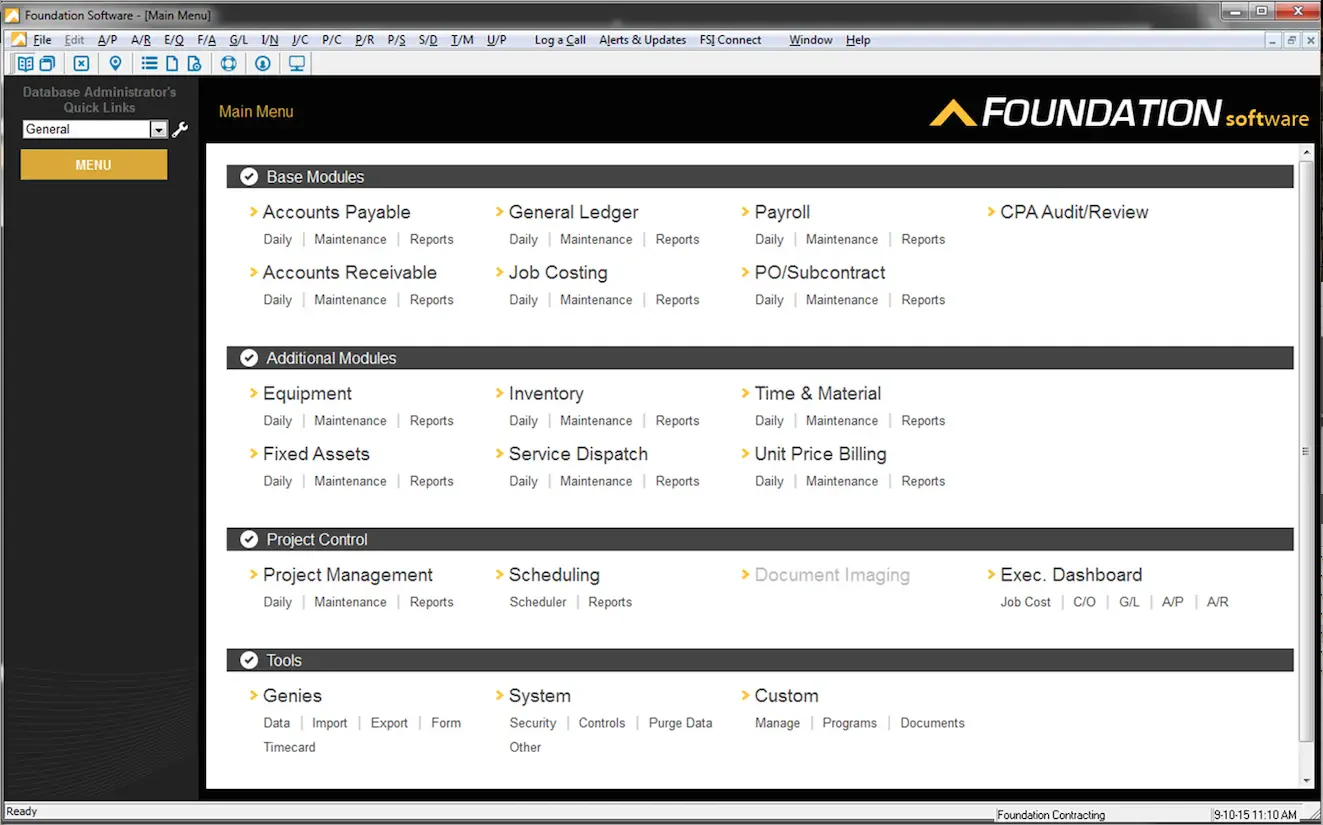
Designed specifically for the construction industry, FOUNDATION is cloud-based software that offers a variety of customizable accounting modules and is recognized for its strong mobile usage.
Its features include AIA billing, job costing, general ledger, payroll management, and a CPA Audit and Review dashboard. Notably, it has limited project management tools and no mobile app.
Features:
- Standard AIA billing software
- Progress-billing, cost-plus, time and materials, unit price, and other accounts receivable modules
- Accounts payable module with conditional defaults and automatic error-checking to ensure accuracy
- General ledger with comparative trial balances, bank reconciliation, automated recurring journal entries, and audit trail management
- Budgeting software, job cost tracking, cost management and reporting, and change order management
- Timecard entry, processing, and calculations, prevailing wage management, and payroll reporting
- CPA Audit and Review dashboard to organize and share key reports and journal entries with CPAs
| Pros | Cons |
|
|
Why this suits Malaysian construction: Foundation is a cloud based ERP for contractors to manage job costing and SST. It provides clear financial visibility for multi site operations to ensure project accuracy.
Website: https://www.foundationsoft.com/
11. CMiC
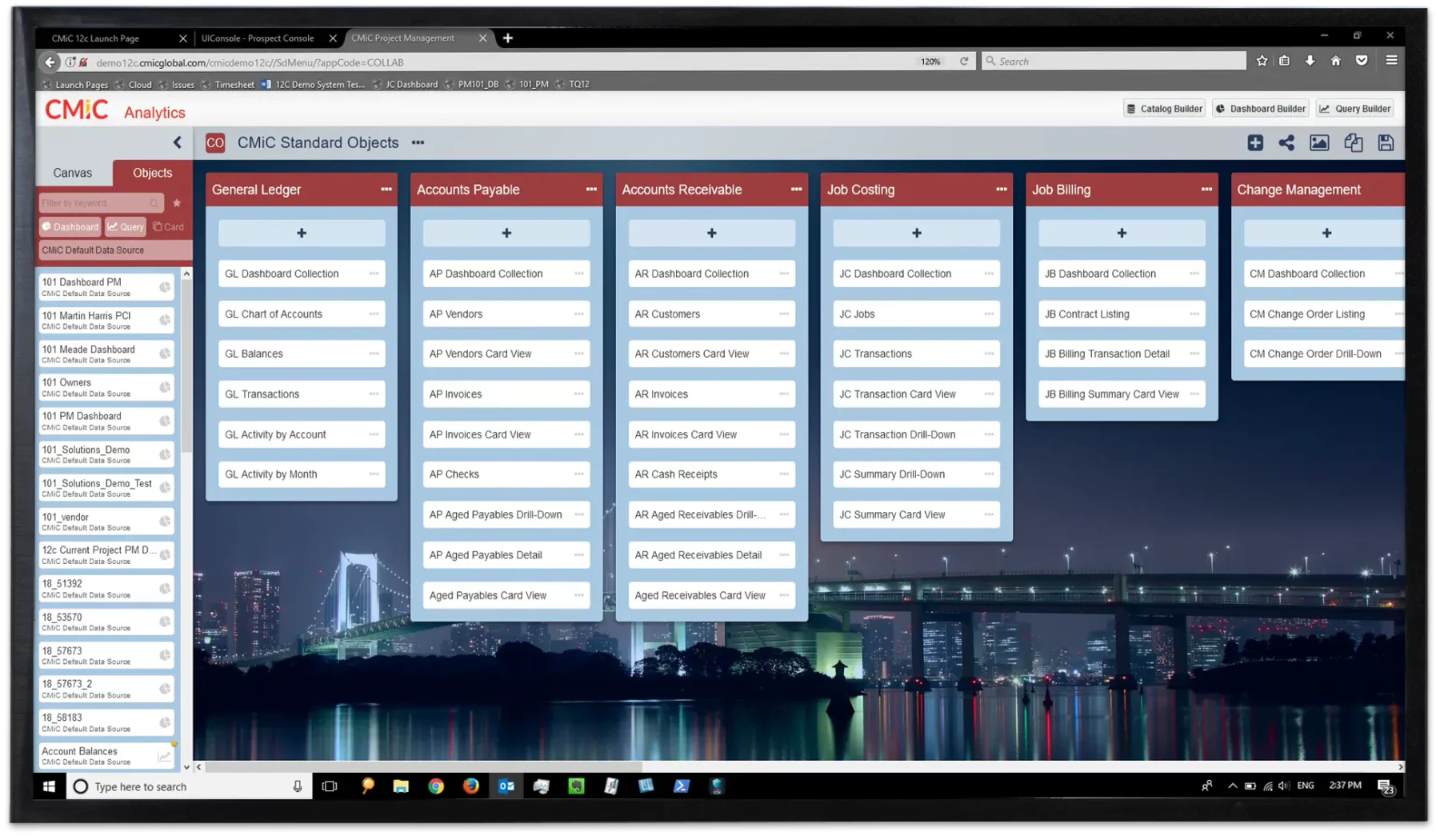 CMiC works best when project accounting cannot sit apart from operations. Large contractors use it to connect contract billing, job cost updates, revenue tracking, and financial reporting inside one construction ERP environment.
Features:
- Accounts payable, receivable, billing, and general ledger
- Revenue management with contract management and invoicing
- Cost management for labor, equipment, and expenses
- Comprehensive financial reporting
| Pros | Cons |
|
|
Why this suits Malaysian construction: CMiC is a cloud based ERP built for large scale contractors. It unifies project management and SST compliance on a single database to maintain financial accuracy across every site.
Website: https://cmicglobal.com/
12. Century Software
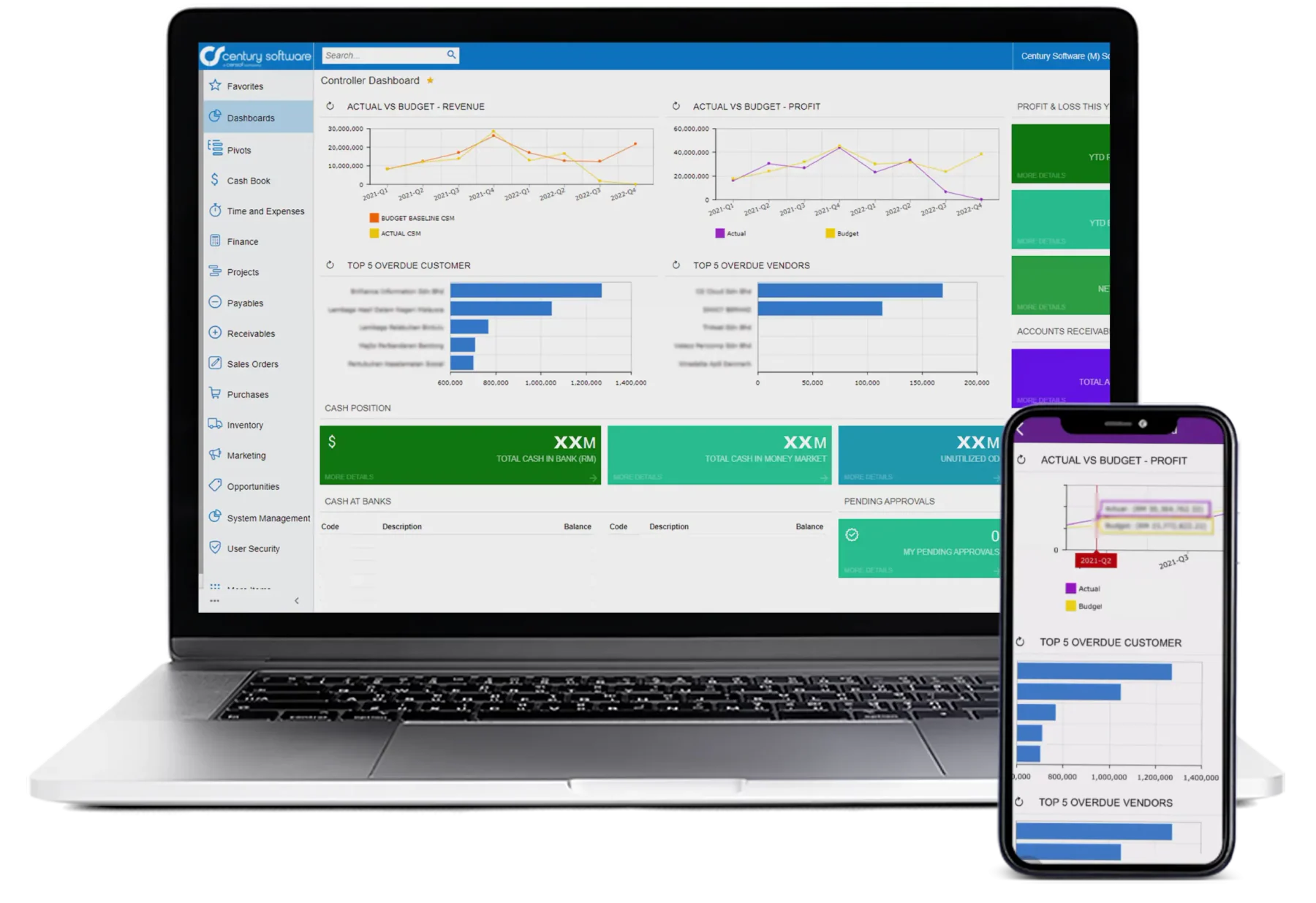
Century Software Malaysia offers comprehensive construction accounting software tailored to the construction industry’s financial management needs. This software enhances financial accuracy and provides real-time insights into project costs and financial health.
Features:
- Project costing and management
- Financial reporting and analysis
- Budgeting and forecasting
- Accounts payable and receivable
- Cash flow management
- Payroll management
- Compliance and audit trail
| Pros | Cons |
|
|
Why this suits Malaysian construction: Century Software is a cloud based financial system built for Malaysian firms. It simplifies SST compliance and project costing to maintain financial accuracy across every site.
Website: https://centurysoftware.com.my/
13. RedTeam
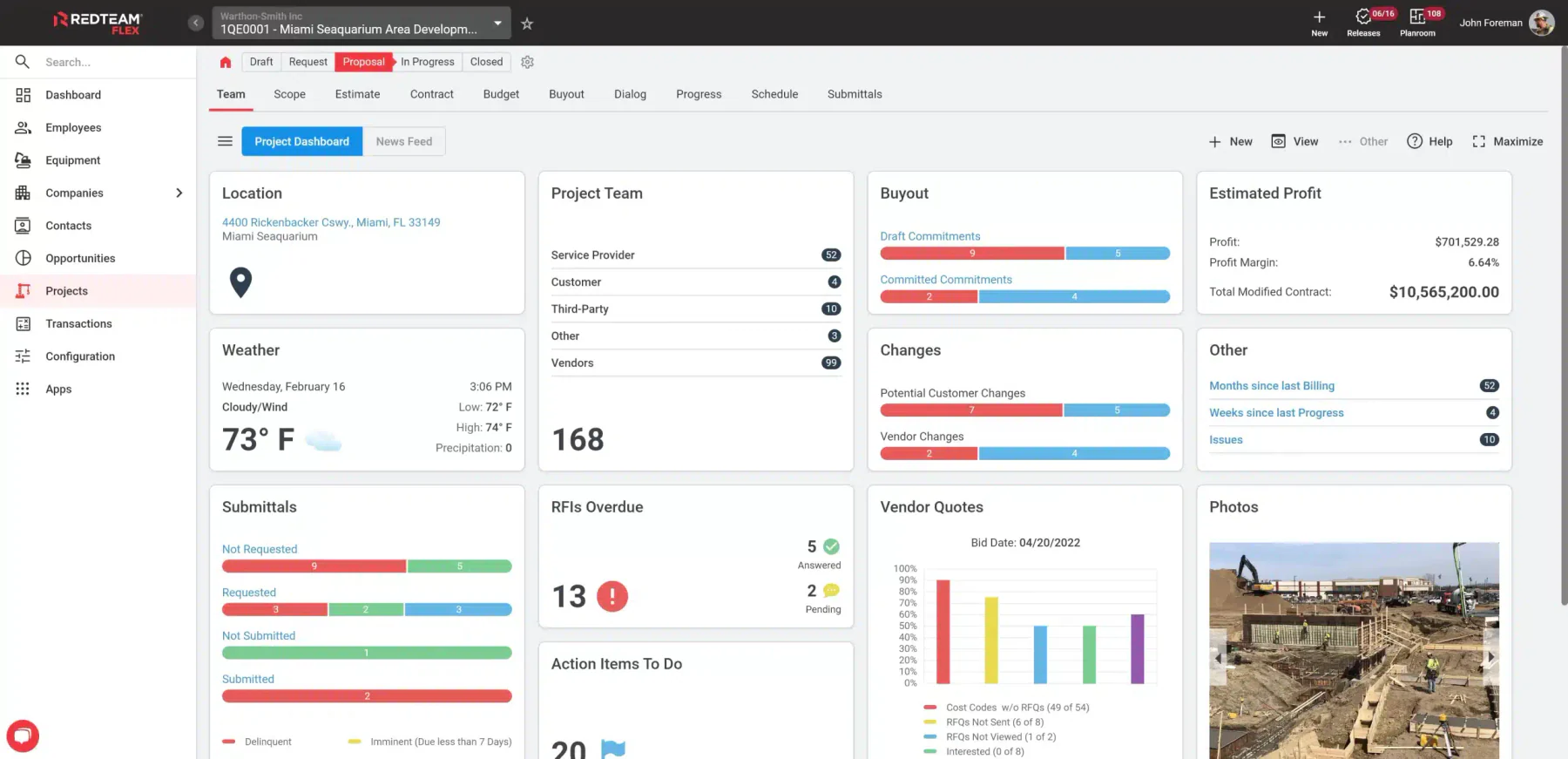
RedTeam, developed by a commercial construction firm, provides construction companies with a deep understanding of industry needs. It excels in bid management, project management, and communication, offering a well-rounded solution for construction project accounting.
Features:
- Comprehensive project management
- Bid management and comparison
- Change order management
- Vendor collaboration
| Pros | Cons |
|
|
Why this suits Malaysian construction: RedTeam is a cloud based platform for local commercial contractors. It unifies project management and SST tracking to maintain financial visibility across every site.
Website: https://redteam.com/
14. QuickBooks
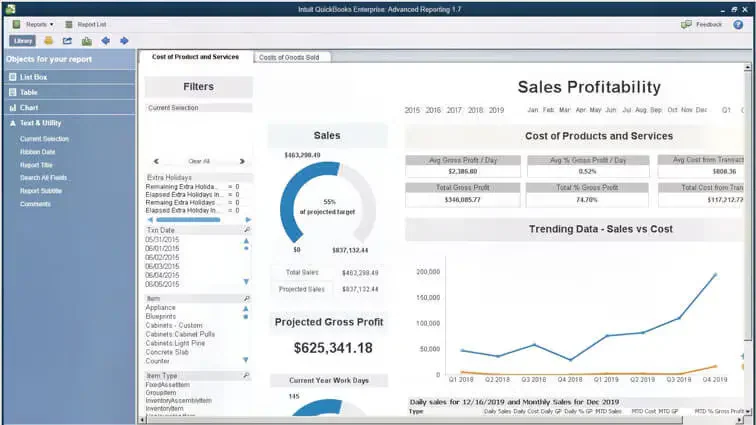
QuickBooks Enterprise Contractor Edition still fits teams that want desktop-based accounting with optional cloud access. Its stronger areas are job costing, payroll, estimates, and contractor reports, while full construction project control usually needs another system beside it.
Features:
- Accounts payable and receivable
- Invoicing, job costing, and estimates
- Payment processing
- Construction-specific reporting
| Pros | Cons |
|
|
Why this suits Malaysian construction: QuickBooks is a cloud based tool for local contractors to manage SST and project billing. It provides financial clarity across sites with an accessible interface.
Website: https://quickbooks.intuit.com/my/
15. Deltek ComputerEase
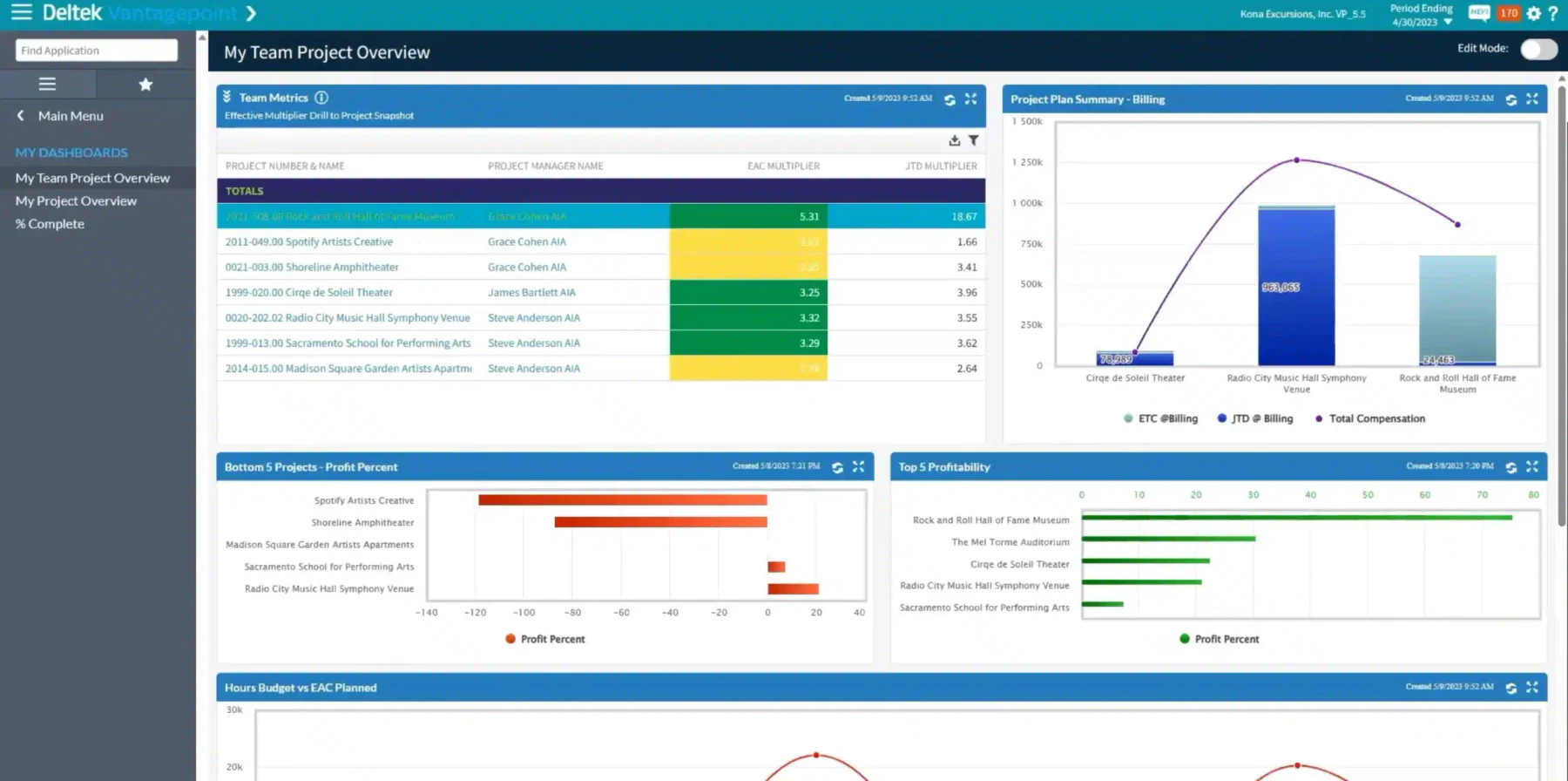
Deltek ComputerEase designed for construction businesses that need accounting software with industry-specific financial controls. Its strengths include job costing, payroll, billing, and project reporting, while broader ERP capabilities such as CRM, procurement, or advanced resource planning may require integration with other systems.
Features:
- Insurance, prevailing wage, and payroll management
- Flexible billing options
- Custom reports
- Pre-configured executive dashboards
- Cost tracking
| Pros | Cons |
|
|
Why this suits Malaysian construction: Deltek ComputerEase is a cloud based platform for local contractors to manage job costing and SST. It provides financial visibility to ensure accuracy across every site.
Website: https://www.deltek.com/
16. Xero
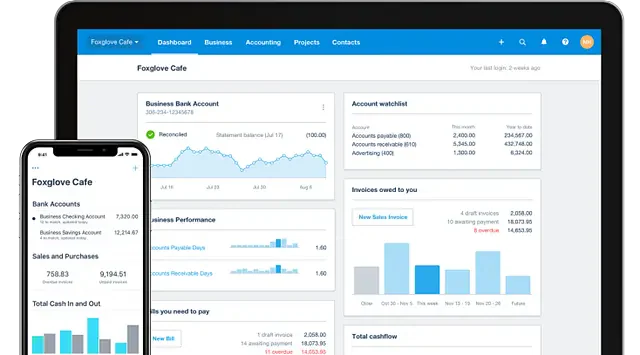
Xero suits construction teams that need simple cloud accounting rather than a full construction accounting suite. It handles invoicing, bank feeds, expenses, and transaction records, but detailed job costing or progress billing usually needs connected add-ons.
Features:
- Bill and expense tracking
- Online payments integration
- Bank feed connection
- Time tracking
Pricing: From around RM53/month.
| Pros | Cons |
|
|
Why this suits Malaysian construction: Xero is a cloud based tool for local contractors to manage SST and project billing. It provides financial visibility across sites with an accessible interface.
Website: https://www.xero.com/my/
17. Gusto
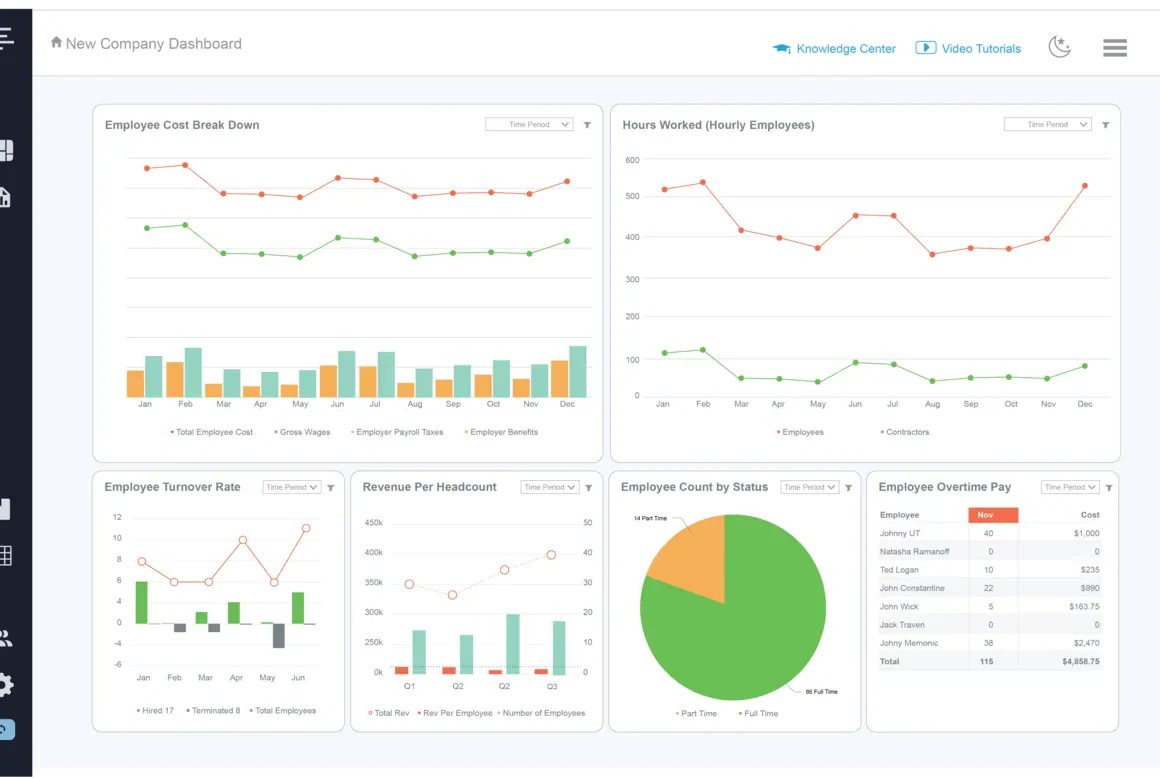
Gusto offers well-developed payroll and HR management for construction companies, supporting both local and international contractors. It excels in payroll processing and benefits management, although it lacks built-in accounting capabilities.
Features:
- Automatic tax calculation
- Unlimited payroll runs
- Time tracking integrated with payroll
- Supports international contractor payments
| Pros | Cons |
|
|
Why this suits Malaysian construction: Gusto is a cloud based platform for local contractors to manage payroll and team HR. It simplifies labor cost tracking for SST and provides financial clarity across every site.
Website: https://gusto.com/
18. Viewpoint Vista
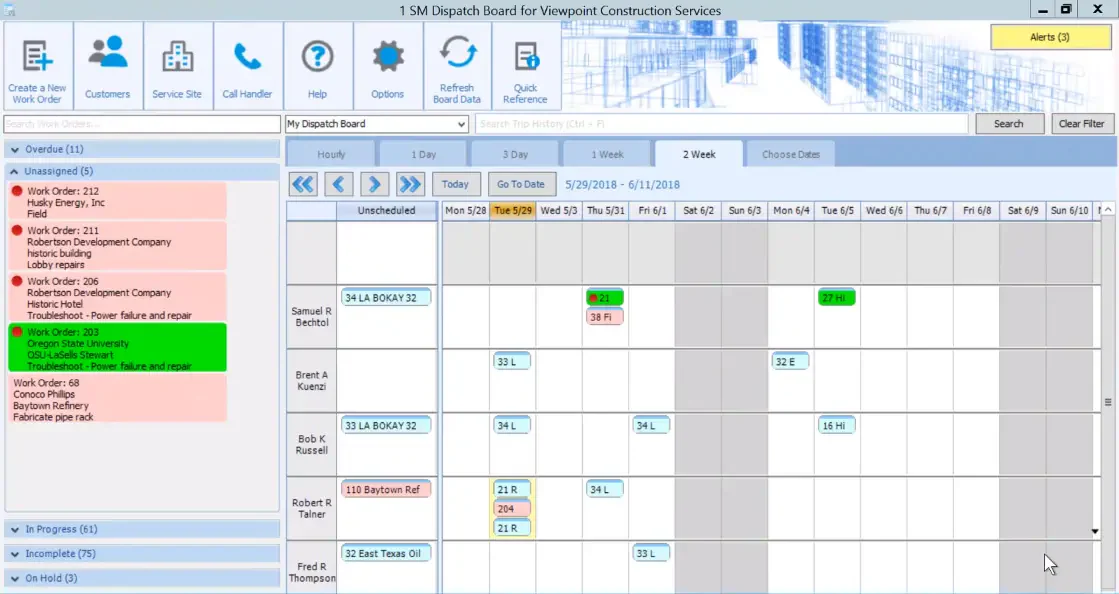
Viewpoint Vista often appears in contractor finance teams that manage multiple companies, inter-company billing, and detailed contract costs. It goes deeper than basic accounting software, but the setup and learning curve are usually heavier for smaller firms.
Features:
- Accounts payable, receivable, and general ledger
- Detailed tracking of contracts, change orders, and materials
- Multi-company and inter-company capabilities
- Job costing and budgeting
Pricing: Custom; contact the Trimble team for a quote.
| Pros | Cons |
|
|
Why this suits Malaysian construction: Viewpoint Vista is a cloud based ERP for large scale contractors. It unifies project financials and SST tracking to maintain high standards of transparency across every site.
Website: https://www.trimble.com/
19. Acumatica
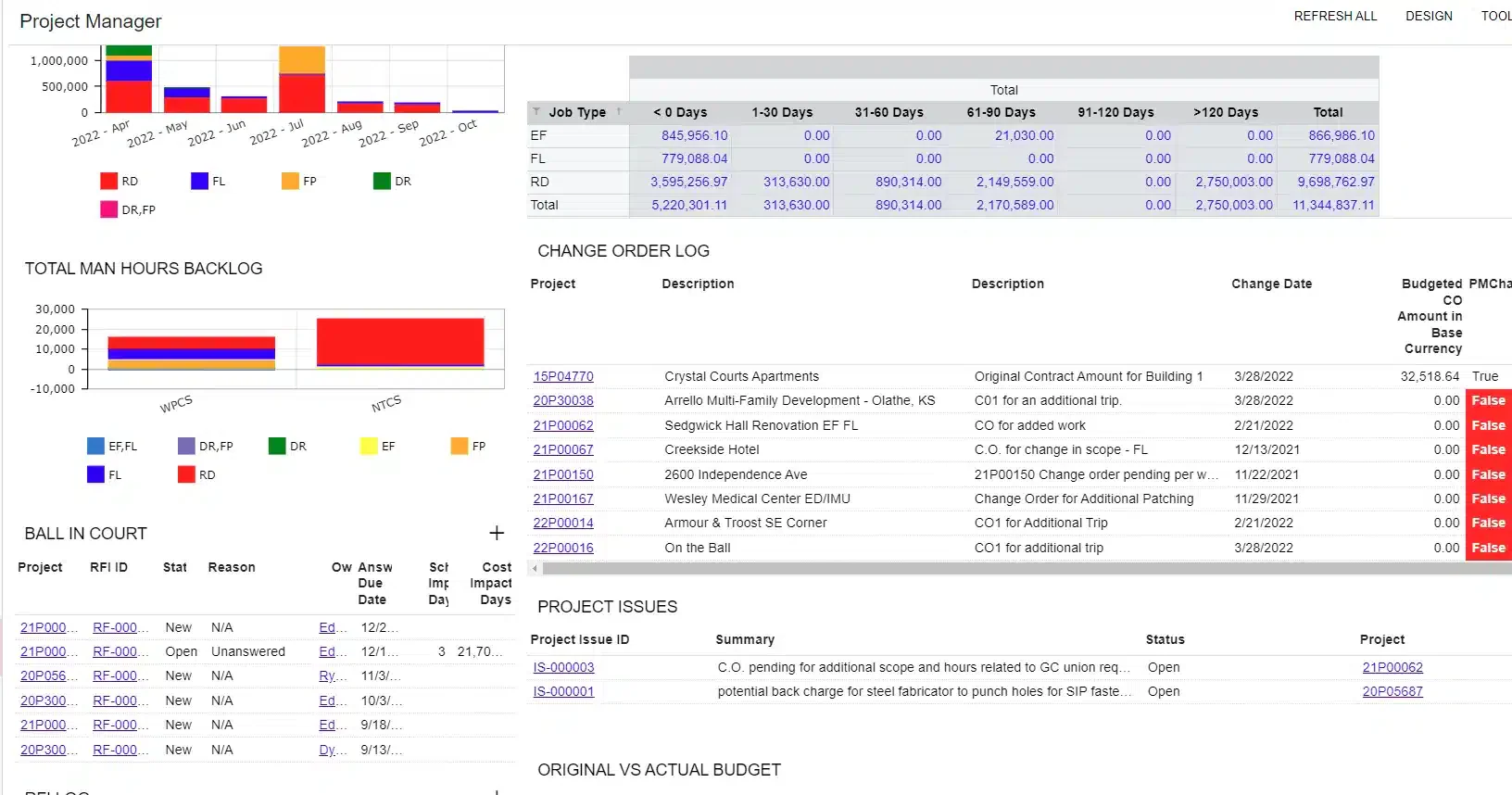
Acumatica usually fits contractors that want ERP, project accounting, service management, and CRM in the same environment. Its flexibility is useful for companies with mixed construction and service operations, but setup can be heavier than standard cloud accounting tools.
Features:
- General ledger, receivables, and payables
- Multi-company and inter-company accounting
- AIA reporting and payroll
- Cost tracking and business intelligence
| Pros | Cons |
|
|
Why this suits Malaysian construction: Acumatica is a cloud based ERP for local firms to manage project financials and SST. It connects field teams with the office to provide real time visibility across every site.
Website: https://www.acumatica.com/
20. Construction Partner
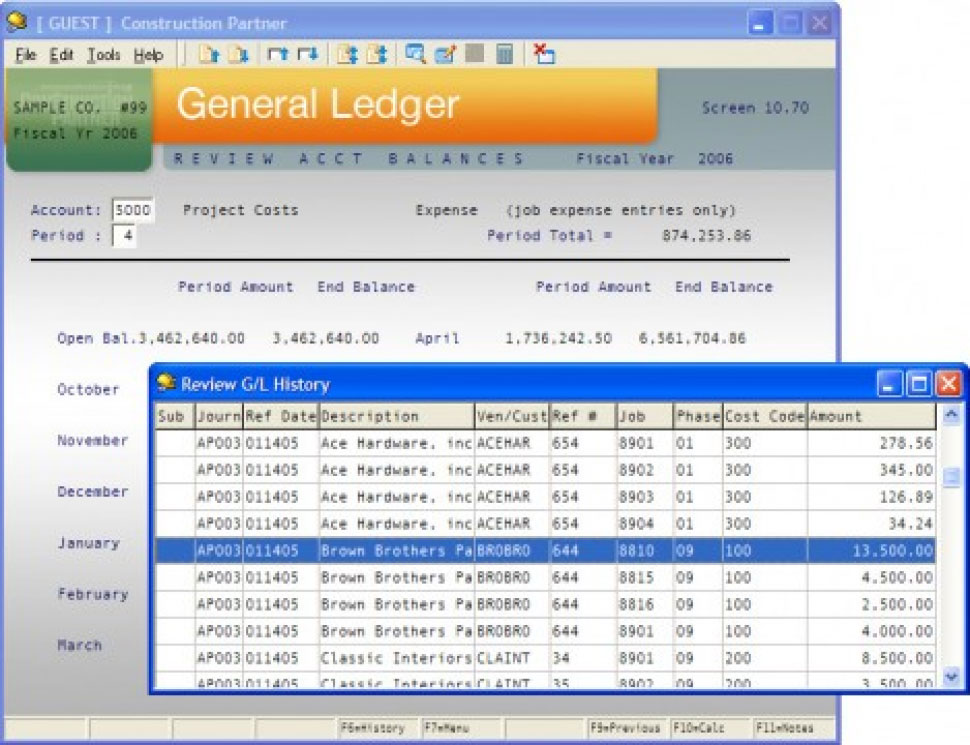
Construction Partner still follows the desktop software route. Contractors use it for job costing, payroll, general ledger, and estimating when they prefer keeping accounting work on-premise instead of moving everything to the cloud.
Features:
- Accounts payable and receivable
- Job costing, purchase orders, and estimating
- Payroll and labor compliance
- Equipment and inventory management
- Budgeting and forecasting
- Reporting and analytics
Pricing: Package-based pricing; contact the vendor for a quote.
| Pros | Cons |
|
|
Why this suits Malaysian construction: Construction Partner is a cloud based system for local contractors to manage SST and job costing. It ensures financial accuracy across sites with a simple interface.
Website: https://www.constructionpartner.com/
21. COINS
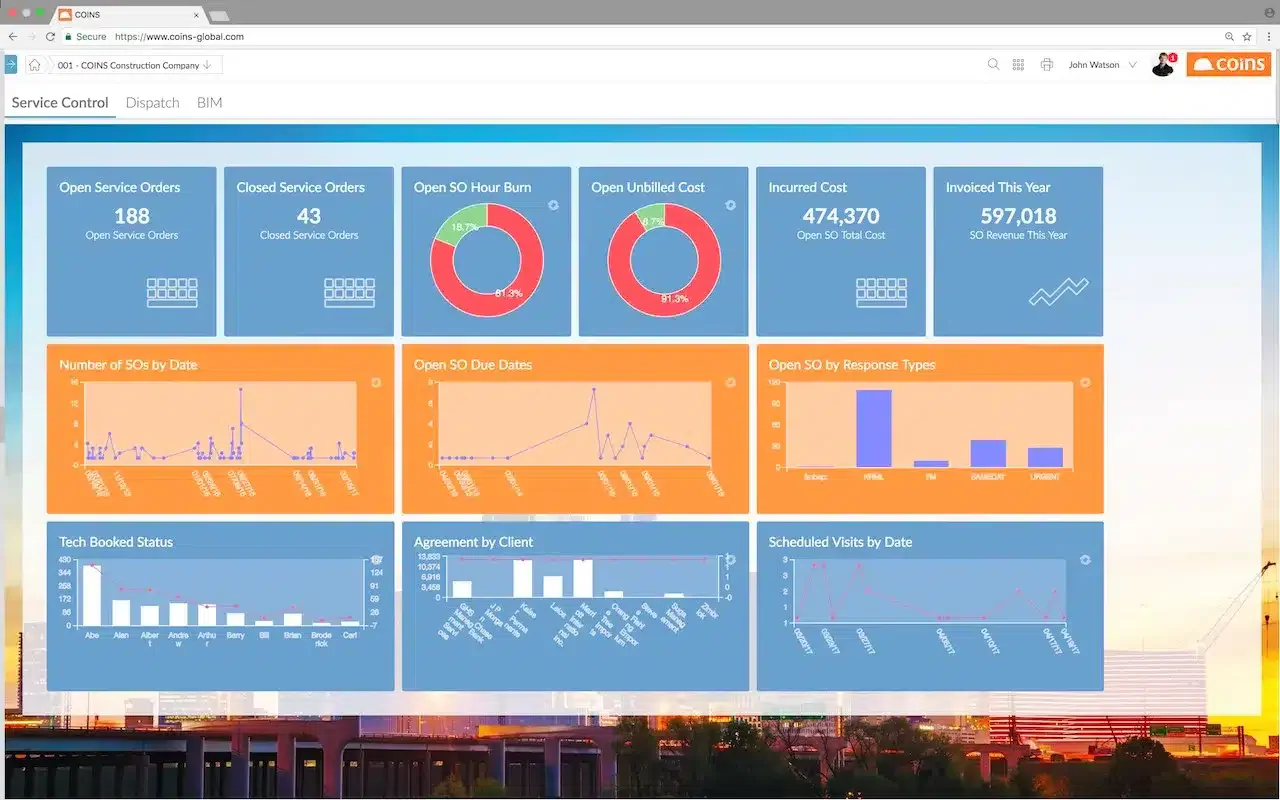
COINS stands for Construction Industry Solutions and focuses on construction, engineering, home building, and service contractors. Its coverage goes beyond accounting, with modules for project delivery, supply chain, payroll, and service management.
Construction company accounting COINS covers a wide array of functions, including project delivery, supply chain oversight, and service management. Ideal for mid-sized to enterprise-level companies, COINS can be deployed either on-premise or as a cloud-based solution.
Features:
- Time and materials billing
- Pre-construction, project management, and post-construction tools and services
- Payroll management and time tracking
- Robust reporting with the ability to drill down into each transaction
- Financial forecasting tools
- Multi-currency handling
- Extensive information security controls
| Pros | Cons |
|
|
Why this suits Malaysian construction: COINS is a cloud based ERP for large scale contractors. It unifies project financials and SST tracking to ensure end to end visibility across multi site operations.
Website: https://www.theaccessgroup.com/
Overall Comparison of Construction Accounting Software for Malaysian Businesses
I present an overall comparison of the leading construction accounting software for Malaysian businesses to help you identify the best solution that aligns with your project complexities, operational needs, and long-term financial goals.
| Provider | Job Costing | Billing Automation | Integration | Ease of Implementation |
|---|---|---|---|---|
| HashMicro | ||||
| FreshBooks | ||||
| NetSuite | ||||
| Procore | ||||
| Zoho Books | ||||
| Buildertrend | ||||
| Sage 300 |
Why Should Malaysian Companies Use Construction Accounting Software?

Adopting construction accounting software can provide significant advantages for modern construction businesses in Malaysia. This software enhances operational efficiency and ensures businesses remain competitive in the industry by streamlining the management of costs structure management.
- Flexibility and Accessibility: Cloud solutions allow construction companies to access financial data from anywhere, promoting better collaboration and decision-making. This is particularly useful for Malaysian construction projects that often involve remote sites and multiple teams working across different locations.
- Enhanced Data Security: Cloud-based systems provide secure, easily retrievable data storage, which is crucial in Malaysia with rising cybersecurity concerns. On-premise systems offer direct control over security measures, tailored to specific regulatory needs.
- Cost-Effectiveness: Cloud solutions reduce the need for expensive hardware and IT maintenance, with 73% of firms reporting better financial control and fewer payment delays.
- Improved Cash Flow Management: Cloud solutions provide real-time financial visibility, enabling businesses to monitor cash flow more efficiently. On-premises systems also offer robust cash flow tools, ensuring accurate, up-to-date financial data for better decision-making.
- Robust Reporting and Analytics: These tools enable construction accountants to generate detailed financial reports, track project progress, and identify potential issues before they escalate.
Study Case: Construction Accounting Software for Comprehensive Project
A mid-sized Malaysian construction company faced persistent project delays and erratic cash flows from outdated manual accounting practices. Inaccurate job costing across complex multi-phase infrastructure projects frequently triggered financial discrepancies and regulatory compliance risks. Traditional spreadsheet systems lacked real-time visibility, hindering timely decision-making and profitability tracking for management.
Deployment of specialized construction accounting software automated job costing, compliance reporting, and financial reconciliation processes. The integrated ERP platform slashed financial errors by 40% while delivering real-time dashboards for comprehensive project oversight and forecasting. This digital transformation accelerated project timelines, ensured CIDB compliance, and significantly enhanced profitability on government infrastructure contracts.
Tips on Choosing the Right Construction Accounting Software
Selecting the right construction accounting software is crucial for the success of any construction business, including in Malaysia. Here are some key tips to help you make an informed decision:
- Understand your business needs: Identify the specific accounting challenges your business faces and the features you require, such as project cost tracking and progress billing.
- Integration capabilities: Ensure the software can integrate seamlessly with your existing systems, such as project management tools and ERP systems, to streamline operations.
- Compliance and reporting: Choose software that can handle local tax calculations and generate necessary reports to ensure compliance with Malaysian financial regulations.
- User-friendly interface: Opt for software with an intuitive design that simplifies complex accounting tasks and reduces the learning curve for your team.
- Localization: Ensure the software is tailored to the Malaysian market and complies with local regulations, standards, and languages. This includes considerations such as currency, tax calculations, and industry-specific requirements unique to Malaysia.
By considering these tips, you can select construction accounting software that not only meets your current needs but also supports your business growth and success in the competitive Malaysian market.
Explore top revenue recognition tools to ensure accurate and compliant revenue tracking for your business.
Which Construction Accounting Software Suits Your Business?
| Software | Best For | Why It Fits Malaysian Construction |
|---|---|---|
| HashMicro | End-to-end ERP with unlimited users | Supports SST, CIDB, MIDA SAG, and Bahasa Melayu with strong project costing and real-time financial tracking. |
| FreshBooks | Simple invoicing & expense tracking | Ideal for SMEs needing easy SST billing and financial clarity across projects. |
| NetSuite | Enterprise ERP | Unifies financials across multi-site operations with strong automation and reporting. |
| Procore | Project collaboration | Connects field and office teams with real-time project and compliance visibility. |
| Zoho Books | Affordable cloud accounting | Automates invoicing, SST tracking, and job costing for growing contractors. |
| Buildertrend | Residential contractors | Combines scheduling, payments, and project tracking for homebuilders. |
| Sage 300 CRE | Mid-large enterprises | Handles complex job costing, inter-company billing, and financial control. |
| Premier | Full construction ERP | Supports billing, payroll, job costing, and document management in one system. |
| CoConstruct | Custom home builders | Integrates scheduling, budgeting, and financial tracking for residential projects. |
| Foundation | Accounting-focused firms | Strong job costing, payroll, and audit-ready financial reporting. |
| CMiC | Large contractors | End-to-end ERP covering financials, cost, and project lifecycle management. |
| Century Software | Local Malaysian firms | Built for Malaysian compliance with strong financial reporting and cost control. |
| RedTeam | Commercial contractors | Strong in bid management, collaboration, and project workflows. |
| QuickBooks | SMEs | Popular for job costing, invoicing, and simple financial tracking. |
| Deltek ComputerEase | Cost-focused contractors | Flexible billing and deep cost tracking with executive dashboards. |
| Xero | Cloud-first SMEs | Automates invoicing, bank feeds, and financial visibility. |
| Gusto | Payroll-focused teams | Simplifies payroll, tax, and workforce cost tracking. |
| Viewpoint Vista | Large enterprises | Advanced financial and project tracking across multiple entities. |
| Acumatica | Flexible ERP users | Combines accounting, CRM, and project management in one platform. |
| Construction Partner | Mid-sized firms | Strong estimating, payroll, and job costing features. |
| COINS | Enterprise construction firms | End-to-end solution covering supply chain, finance, and project lifecycle. |
Conclusion
The right construction accounting software depends on how complex your projects are. FreshBooks, Xero, and QuickBooks may be enough for smaller contractors that mainly need invoicing, expense tracking, and basic job costing. If your team focuses more on site coordination than accounting depth, Procore or Buildertrend can be more relevant, but they usually still need accounting integrations.
For mid-sized to large contractors, Sage 300 CRE, CMiC, Viewpoint Vista, Acumatica, and COINS are stronger options when projects involve multi-company reporting, complex billing, retention, and detailed cost control. Malaysian contractors that need local support, SST readiness, CIDB-related workflows, Bahasa Melayu assistance, and integrated ERP modules can place HashMicro in the shortlist.
Before booking a free demo, list the workflows that create the most finance friction, such as progress claims, subcontractor costs, job costing, or reporting delays. A free demo will be more useful when your team can test whether the system fits real project scenarios, not just general accounting needs.

FAQ about Construction Accounting Software in Malaysia
In construction, project-based accounting is typically used. This method focuses on tracking each project’s costs, revenue, and profitability separately. It includes job costing, where expenses like labor, materials, and overhead are assigned to specific projects, allowing for accurate financial management.
Construction accounting involves tracking and managing costs, revenues, and profits related to specific construction projects. The percentage-of-completion method or completed-contract method is often used, depending on the project’s duration. It ensures that construction costs are allocated correctly, and the revenue is recognized as work progresses.
To record construction accounting, you’ll use specialized software or manual methods to document costs like labor, materials, and overhead for each project. These costs are then matched against revenue for accurate project financial reporting. Additionally, job costing ensures that each phase or segment of construction is properly tracked.
In construction accounting, a basic formula for determining the project’s profit is: Profit = Revenue – Direct Costs (Labor + Materials + Overhead). A key metric often used is the Gross Profit Margin, which is calculated as: Gross Profit Margin = (Revenue – Cost of Goods Sold) / Revenue x 100. This helps you understand the profitability of each project and the efficiency of your cost management.
Yes. Modern systems automatically format your financial data to meet LHDN e-invoicing standards and calculate SST accurately, ensuring contractors avoid reporting errors and government penalties.
The “best” construction accounting software is subjective because every contractor has different project sizes, budgets, and workflows. FreshBooks or QuickBooks may suit smaller businesses with straightforward bookkeeping needs, while Procore or Buildertrend may fit contractors prioritising project coordination. Malaysian contractors managing multiple projects, job costs, procurement, materials, progress claims, and retention can also evaluate integrated ERP solutions such as HashMicro. Compare functionality, local support, integrations, implementation requirements, and total cost before deciding.
General accounting software primarily handles functions such as invoicing, accounts payable, bank reconciliation, and financial reporting. Construction accounting software adds project-specific controls, including job costing, committed costs, work-in-progress reporting, progress billing, retention, variation orders, and subcontractor payments. This allows contractors to monitor each project’s budget, actual cost, cash flow, and profitability instead of viewing financial performance only at the company level.
Malaysian contractors should prioritise project and WBS-level job costing, budget-versus-actual reporting, progress billing, retention tracking, variation management, subcontractor payments, approval controls, and multi-site material visibility. The software should also support SST and LHDN e-Invoice or MyInvois workflows, either natively or through reliable integration. Contractors working under relevant contract arrangements should additionally check support for PAM- or JKR-style progress claims, local implementation assistance, audit trails, and consolidated project reporting.