









 Limited to 100 registrants


ERP ROI shows whether the financial benefits of an enterprise resource planning system outweigh its full cost. For Singapore businesses, a useful calculation includes software, implementation, training, ongoing support, and any eligible grant support, rather than comparing the subscription price with expected savings alone.
This guide explains the ERP ROI formula, the costs and benefits to measure, and a worked example in Singapore dollars. It also covers the EDGE Grant and local requirements that can affect an ERP business case.
Key Takeaways
ERP ROI compares measurable benefits with the full cost of owning and operating the system over a defined period.
A sound calculation includes implementation, migration, training, subscriptions, support, and benefits that can be measured against a baseline.
A Singapore grant may reduce eligible project costs, but support is conditional and is generally reimbursed after payment and completion.
Tracking adoption and operational KPIs after go-live shows whether projected returns are being achieved.
What Is ERP ROI?
"A useful ERP ROI estimate starts before implementation. Record the time, errors, and costs you expect to reduce, then compare those figures with actual results after go-live. Grant support can lower the investment, but measurable operational gains determine its return."
ERP ROI measures the return from an ERP investment by comparing its benefits with its full cost.
ERP ROI meaning and why it matters
ERP projects affect several teams, so their value rarely appears in one budget line. A shared ERP may reduce manual reconciliation in finance, improve stock planning in operations, and speed up customer responses in sales. Calculating ROI helps a business decide which outcomes justify the investment and gives project owners targets to check after launch.
Hard returns vs soft returns
Hard returns can be measured in money, such as lower overtime costs, fewer write-offs, or reduced spending on software that the ERP replaces. Soft returns include better visibility, easier collaboration, and improved employee experience. Soft returns matter, but they should be reported separately unless the business has a defensible way to assign them a monetary value.
ERP ROI Formula
Use the same time period when measuring ERP benefits and costs.
The basic ROI formula
ERP ROI (%) = [(Total measurable benefits − Net total cost) ÷ Net total cost] × 100
Net total cost means the full project cost less any grant amount the business is eligible for and actually receives. Keep the calculation before and after grant support so decision-makers can see whether the project makes sense without funding. Avoid counting the same benefit twice, such as recording staff time saved as both a labour saving and a separate productivity saving.
Total cost of ownership (TCO)
TCO combines upfront and ongoing expenses: software, implementation, integration, data migration, training, hardware where needed, support, and internal staff time. It may also include the cost of running old and new systems in parallel during the transition. A low licence fee does not necessarily mean a low TCO.
Choosing the right time frame
Choose a period long enough to capture benefits after implementation, while keeping forecasts credible. Three years is a practical planning window for the example below. Show benefits by year because savings may start slowly as employees learn the system. For larger investments, finance teams can also calculate net present value to account for the timing of cash flows.
ERP Costs to Include in Your ROI Calculation

Build the cost estimate from a vendor proposal and your internal implementation plan.
Software licence or subscription
Count licence fees or cloud subscriptions for the users, modules, entities, and locations in scope. Check whether the quote includes storage, additional users, transaction volumes, and future price changes.
Implementation, integration and data migration
Include configuration, process design, integrations with existing systems, data cleansing, migration, and testing. Data migration can take substantial internal effort when customer, product, or financial records need correction before import.
Training and change management
Budget for role-specific training, user guides, process updates, and time spent by employees learning the system. Managers also need time to explain new responsibilities and resolve issues during adoption.
Hardware and infrastructure
An on-premise deployment may require servers, backups, security tools, and related maintenance. A cloud deployment may avoid some of those purchases but can still require devices, network upgrades, or integration infrastructure.
Ongoing support and maintenance
Include vendor support, upgrades, internal administration, and maintenance of connected applications. Confirm which services the contract includes and which are charged separately.
Hidden costs businesses often miss
Common omissions include internal project staff, temporary parallel operations, custom reports, extra testing, and post-launch fixes. Set aside a documented contingency and record how it is used. Do not treat a possible grant as guaranteed funding when approving the budget.
ERP Benefits That Drive ROI
Measure each potential benefit against a baseline recorded before implementation.
Lower labour and administrative costs
Connected workflows can reduce duplicate entry, manual approvals, and reconciliation. Calculate savings from hours removed multiplied by an appropriate labour cost, but count them as cash savings only if they reduce overtime, temporary staffing, hiring needs, or another actual expense. Otherwise, report the time released as capacity.
Lower inventory costs and better cash flow
Better visibility into stock and purchasing can help reduce excess inventory, urgent purchases, and write-offs. Lower inventory may release cash, but the released working capital is different from an annual profit saving. For ROI, count measurable carrying-cost reductions and avoided losses; show the cash release separately.
Faster financial close and reporting
When transactions flow into a shared finance system, teams may spend less time gathering data and reconciling spreadsheets. Measure close-cycle days, reporting hours, and any related overtime or external accounting costs before and after implementation.
Fewer errors and better decisions
Validation and shared records can reduce pricing mistakes, duplicate purchases, and incorrect invoices. Value the errors that have a recorded cost. Better decisions are a useful outcome, but avoid assigning a dollar figure without evidence that links the decision to a financial result.
Faster customer response times
Shared order, stock, and customer information can shorten the time needed to answer enquiries or resolve problems. Track response times first. Add a revenue benefit to ROI only when sales or retention data supports a credible link.
How to Calculate ERP ROI Step by Step
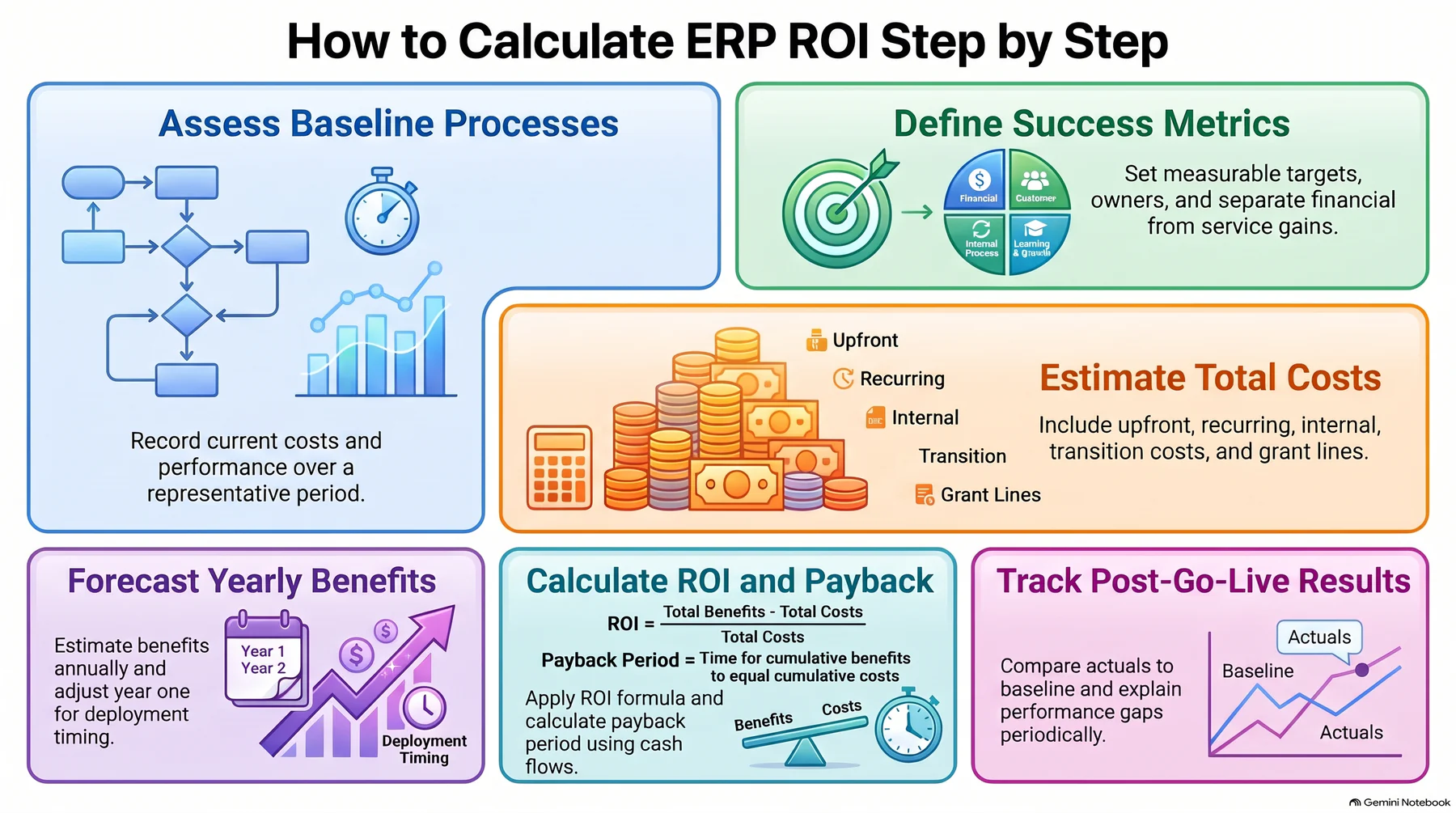
Follow these six stages to make your estimate measurable and easy to review.
1. Assess current processes and set a baseline
Record present costs and performance, such as monthly reporting hours, inventory write-offs, invoice corrections, and order response times. Use a representative period so seasonal peaks do not distort the baseline.
2. Define goals and success metrics
Choose a small set of measurable outcomes. For each one, document the baseline, target, measurement method, and owner. Separate financial savings from service or visibility improvements.
3. Estimate total costs
Add upfront spending and recurring charges for the chosen time frame. Include internal effort and a realistic allowance for transition costs. Record grant support as a separate line because approval, eligible expenses, and payment timing can differ from the initial estimate.
4. Estimate benefits over time
Forecast benefits year by year. Reduce the first-year estimate if implementation and user adoption mean the system will operate for only part of that year.
5. Calculate ROI and payback period
Apply the ROI formula, then use annual cash flows to find when cumulative net benefits recover the investment. Payback answers when the project recovers its cost; ROI describes the return over the full period. They answer different questions.
6. Track results after go-live
Compare actual results with the baseline at agreed intervals. Update the forecast when user adoption, costs, or operating conditions change, and explain any gap between projected and realised benefits.
ERP ROI Example in S$
This illustrative three-year example shows how the costs, benefits, and grant assumption fit together.
Assumptions
A company evaluates an ERP project over three years. Upfront implementation costs S$18,000, integration and migration cost S$8,000, and training costs S$4,000. The software subscription is S$12,000 a year and support is S$3,000 a year. Hardware costs are assumed to be zero.
Measurable benefits are estimated at S$25,000 in year one and S$45,000 in each of years two and three. For illustration only, assume the company qualifies for S$6,000 of EDGE support on S$12,000 of eligible first-year software costs, receives approval, completes the project, and is reimbursed in year one. This uses the 50% SME support rate listed for the EDGE Integrated ERP activity ; it is not an actual award or company result.
| Item | Calculation | Three-year amount |
| Upfront implementation, integration, migration and training | S$18,000 + S$8,000 + S$4,000 | S$30,000 |
| Software and support | (S$12,000 + S$3,000) × 3 | S$45,000 |
| Total cost before grant | S$30,000 + S$45,000 | S$75,000 |
| Illustrative grant received | 50% × S$12,000 eligible software cost | S$6,000 |
| Net total cost | S$75,000 − S$6,000 | S$69,000 |
| Total measurable benefits | S$25,000 + S$45,000 + S$45,000 | S$115,000 |
Calculation
Three-year ROI with the assumed grant = [(S$115,000 − S$69,000) ÷ S$69,000] × 100 = 66.7%. Without grant support, the same project has an illustrative ROI of 53.3% : [(S$115,000 − S$75,000) ÷ S$75,000] × 100.
For cash payback, assume S$30,000 is paid upfront. Year one brings S$25,000 of benefits and S$6,000 of grant reimbursement, less S$15,000 in subscription and support costs, leaving S$14,000 unrecovered. Year two produces S$30,000 in net benefits after recurring costs. At an even monthly rate, the remaining S$14,000 is recovered about 5.6 months into year two, or roughly 1.47 years after the upfront payment.
How to read the result
The 66.7% figure is a three-year return under the stated assumptions, not an annual return or a guaranteed outcome. The payback estimate also depends on when benefits, costs, and reimbursement actually occur. Recalculate with a lower-benefit scenario and without grant support before making a decision.
ERP ROI for Singapore Businesses: EDGE Grant and Local Considerations
Funding rules and local requirements can change the cost and scope of a Singapore ERP project.
How the EDGE Grant changes the net investment
Enterprise Singapore's Integrated Enterprise Resource Planning activity under the EDGE Grant lists support of up to 50% for SMEs, capped at S$30,000, and up to 30% for non-SMEs, capped at S$18,000. The activity cost is capped at S$60,000, and supported software costs are capped at 12 months. Maintenance and GST are listed as unsupported costs. These are activity-specific limits; the broader EDGE programme's maximum support rate should not be applied to an ERP calculation.
Grant support lowers net project cost only if the business qualifies and its claim succeeds. Enterprise Singapore states that EDGE support is reimbursed after the activity is completed and paid for, so businesses still need to plan for the initial cash outlay. Confirm eligible costs and available annual grant capacity before entering a grant amount in the ROI model.
Eligibility and application points
The Enterprise Singapore ERP activity page requires a solution with at least three core business functions. It says the applicant must be a for-profit business registered and operating in Singapore, have at least 30% ownership by Singapore citizens or permanent residents, and use or implement the solution in Singapore for at least one month.
Applicants must not start work or pay a supplier before submitting the application. A vendor proposal with a cost breakdown and a projection of expected savings for one year after completion are among the required materials. Check the full conditions before committing to a project.
Local compliance needs that affect ROI
Include the effort needed to configure Singapore GST treatment, tax invoices, and reporting where these apply to the business. IRAS says the GST InvoiceNow Requirement is being introduced in phases and provides an implementation-date check for GST-registered businesses.
IRAS directs users of off-the-shelf software to check accredited InvoiceNow-Ready Solutions; businesses with in-house enterprise systems should work with an IMDA-accredited access point provider. Budget for the applicable setup rather than assuming every ERP subscription includes it. Treat recoverable input GST according to the company's tax position when preparing costs.
Why Some ERP Projects Miss Their ROI

These project issues can prevent forecast benefits from becoming actual savings.
No clear business case or baseline
Without starting measures, a team cannot show whether reporting became faster or errors became less costly. Agree on the baseline before changing processes or migrating data.
Weak governance and ownership
Benefits can fall between departments when nobody owns them. Assign a decision-maker for project scope and an operational owner for each expected result.
Over-customisation and scope creep
Extra changes add cost, testing, and maintenance. Assess each requested customisation against its measurable benefit and the cost of using a standard process instead.
Low training and user adoption
A deployed system produces little value if employees continue using spreadsheets outside it. Train people for the tasks they perform, monitor usage, and address workflow problems after launch.
How to Improve ERP ROI
Focus on changes your teams can implement, measure, and sustain.
Start with core modules
Begin with the processes that have clear costs or bottlenecks, such as purchasing, inventory, or finance. Add modules when their dependencies and expected benefits are understood. If grant support is part of the business case, ensure the proposed scope still meets the grant's function requirements.
Standardise processes before configuring
Resolve inconsistent approval rules, product records, and reporting definitions before reproducing them in the ERP. Cleaner processes reduce configuration and migration work.
Invest in training
Use realistic transactions in training and give employees time to practise before go-live. Follow up with targeted support when usage data or error rates show where people are struggling.
Assign owners and KPIs to each benefit
For every forecast saving, name the person responsible, the data source, and the review date. For example, a finance owner can compare monthly close hours against the pre-ERP baseline while an inventory owner tracks write-offs and carrying costs.
How ERP Software Helps Track and Improve ROI
ERP software can bring transaction and operational data into one reporting environment. Teams can compare purchasing lead times, inventory levels, invoice corrections, and financial close dates against the baselines in their business case. The exact reports depend on the system and its configuration.
Reviewing these measures after go-live helps managers find where expected savings have not appeared. They can then adjust a workflow, improve data quality, or provide more training. The ERP supplies evidence for the review; the business still needs owners to act on it.
Conclusion
ERP ROI compares measurable benefits with the full cost of implementing and running the system over a defined period. A credible business case includes all major costs, uses a measured baseline, avoids counting benefits twice, and shows how returns build over time.
For Singapore businesses, grant eligibility and local compliance needs can materially change the calculation. Model the project before and after potential EDGE support, then track actual costs and KPIs after go-live to see whether the investment is delivering its planned return. Request a free consultation with HashMicro to help you build a cost and benefit estimate based on your business rather than an industry-wide assumption.
Frequently Asked Questions
ERP ROI is the percentage return from an ERP investment over a defined period. It compares measurable financial benefits with the full cost of implementing and operating the system.
Subtract net total ERP cost from total measurable benefits, divide the result by net total cost, and multiply by 100. Use the same time period for benefits and costs, and show potential grant support separately.
There is no universal payback period. It depends on implementation cost, recurring charges, adoption speed, and the benefits achieved. Estimate annual cash flows and track them after go-live to find the actual payback date.
Hard benefits have a measurable financial value, such as reduced overtime or fewer inventory write-offs. Soft benefits include better visibility and collaboration. Include soft benefits in a financial ROI calculation only when their value can be supported with evidence.
Eligible Singapore businesses may receive support for an integrated ERP project through the EDGE Grant. Support depends on the activity rules, application approval, eligible costs, and a successful claim. Calculate ROI both with and without the possible grant.
Common reasons include an unclear baseline, weak ownership, growing project scope, and low user adoption. Setting measurable goals and reviewing actual results after go-live helps teams address these problems.