








A pallet leaving a Singapore warehouse carries more than a shipment. It also creates responsibility for custody, condition, return, and the next action required by the supply-chain network.
Pallet pooling is a shared-use model in which reusable pallets circulate among manufacturers, warehouses, distributors, transport operators, and retailers. Each party may hold the pallet at a different point, while ownership remains defined by agreement.
This guide explains how pallet pooling works, how it differs from pallet exchange and pallet hire, and how businesses can prepare warehouse and ERP data before joining a programme.
Key Takeaways
Pallet pooling depends on clear ownership, custody, return, inspection, and exception rules.
Every handover should create a movement record, responsible party, and next action.
Pooling and exchange should be compared by network coverage, pallet standards, partner participation, and control maturity.
ERP preparation requires consistent pallet data, location balances, provider statements, and reconciliation rules.

What Is Pallet Pooling?
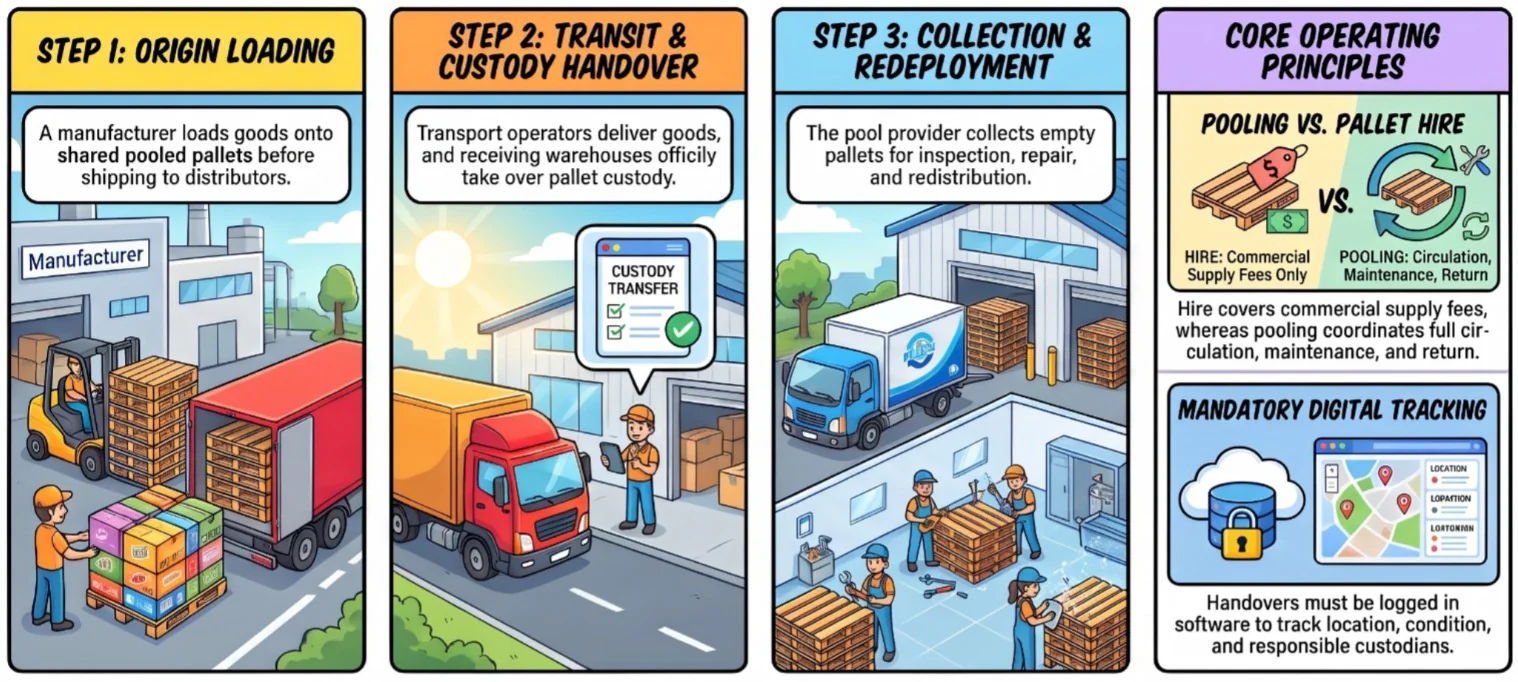
Pallet pooling is a shared-use system in which reusable pallets circulate through an agreed supply-chain network. The arrangement defines who owns the pallet, who holds it, when it should be returned, and how its condition is assessed.
Instead of purchasing and maintaining a separate pallet fleet, participating businesses use pallets made available through a coordinated programme. The owner, current custodian, and party responsible for the next action may all be different.
1. Shared-use ownership and custody
A Singapore manufacturer may load products onto a pooled pallet before sending them to a distributor. The transport operator then carries it, the receiving warehouse accepts custody, and a pool provider may later collect it for inspection or redeployment.
These handovers should be recorded in inventory management software rather than assumed. A clear record identifies the pallet, location, condition, responsible party, movement date, and action due next.
2. How pallet hire differs from pallet pooling
Pallet hire is a commercial arrangement in which a provider supplies pallets for an agreed fee or service term. Pallet pooling is the wider operating model that coordinates shared pallet circulation, collection, inspection, repair, and return.
A provider may charge for pallet hire, movements, collections, or damage handling. The exact treatment depends on the contract, network design, and responsibilities assigned to each participant.
3. Why responsibility must be documented
Pooling distributes responsibility across several companies and sites. Without clear custody rules, a business may receive the goods correctly but still show the pallet under the wrong holder in its records.
Every agreement should explain who accepts the pallet, who reports damage, who arranges collection, and who investigates loss or disputed handovers.
How Does Pallet Pooling Work Across a Singapore Supply Chain?
The pallet cycle normally connects issue, dispatch, receipt, collection, inspection, repair, and redeployment. Each movement should create evidence that operations, procurement, finance, and the provider can reconcile.
The exact sequence depends on the network, but the following control points are common across Singapore distribution lanes.
| Stage | Responsible party | Required record | Main exception |
|---|---|---|---|
| Issue | Pool operator, warehouse, or manufacturer | Allocation or issue record | Wrong quantity or pallet type |
| Dispatch | Warehouse and carrier | Dispatch and transport record | Missing scan or unclear custody |
| Receipt | Distributor, warehouse, or retailer | Receipt and condition record | Damage or incomplete handover |
| Collection and inspection | Pool operator, carrier, or approved site | Collection and inspection record | Delayed collection or disputed damage |
| Redeployment or investigation | Pool operator and accountable partner | Redeployment, loss, or dispute record | Missing evidence or unresolved liability |
1. The pallet cycle from issue to redeployment
At issue, the business confirms the pallet type, quantity, destination, and expected movement. At dispatch, the record should connect the pallets with the shipment, carrier, loading site, and receiving location.
After receipt, the receiving party confirms the pallet quantity and condition. Usable pallets return to circulation, while damaged or non-compliant ones go through inspection, quarantine, repair, or investigation. Refer to MOM’s workplace safety and health resources when setting inspection and quarantine rules.
2. Handover points, exceptions, and reconciliation
A pallet handover is complete only when the receiving party accepts custody and the warehouse management software reflects the change. Recording the product receipt without updating the pallet record creates an inaccurate balance.
When a pallet is missing or damaged, the exception should include the last confirmed location, handover date, condition evidence, investigation owner, and target resolution date.
- At dispatch: confirm the identifier, quantity, condition, carrier, and destination.
- At receipt: record custody acceptance, condition, site, and receiving party.
- At exception: assign an investigation owner and due date.
- At reconciliation: match movement records with provider statements and approved adjustments.
3. A Singapore pooling scenario with labelled assumptions
Assume a Singapore manufacturer sends finished goods to a distributor in Tuas before delivering them to retail sites. The provider collects empty pallets from agreed locations, with return timing depending on route availability and partner participation.
The manufacturer maintains accurate dispatch records, the distributor confirms receipt and condition, and the provider handles collection and redeployment. Any changes to these responsibilities should be stated in the service agreement.
What Benefits Can Pallet Pooling Deliver?
Pallet pooling can improve coordination, availability, quality consistency, and movement visibility, provided the network has reliable records, standardised processes, and partners who follow agreed return and inspection procedures.
1. Lower ownership burden and better pallet availability
A shared pool may reduce the need for each business to purchase, repair, store, and retire its own pallet fleet. The practical benefit depends on the provider’s coverage and the return routes available to participating sites.
Availability should be measured against actual shipment lanes and peak requirements. A pool can become less useful when pallets cannot return promptly to the locations that need them.
2. Standardisation and standard pallet sizes in Singapore
Common pallet specifications can simplify handling, storage, loading, and inspection. The selected dimensions must match warehouse equipment, warehouse racking, vehicles, customer requirements, and the provider’s network.
Businesses should check each programme’s specifications rather than assume a standard Singapore pallet size. ISO 6780 sets pallet dimensions and tolerances, but requirements vary by provider, facility, vehicle, and receiving site.
3. Transport efficiency and financial control
Coordinated collection and redeployment can reduce unnecessary pallet purchases and improve planning for return movements. The result depends on accurate location records and clear collection responsibilities.
Finance also needs a reliable link between movement events, service fees, damage charges, loss decisions, repairs, and replacement costs. Without that link, the business may dispute charges or delay valid adjustments.
4. Sustainability benefits and the conditions they depend on
Reusable pallets may support reuse, repair, and redeployment when the programme maintains the assets properly. Sustainability claims should be based on measured reuse, repair, disposal, and transport records.
- Operational benefit: better availability and fewer unresolved pallet movements.
- Financial benefit: clearer service charges and adjustment records.
- Quality benefit: consistent inspection, repair, and quarantine rules.
- Sustainability benefit: reuse and redeployment supported by measured records.
Pallet Pooling vs Pallet Exchange: Which Model Fits?
Pallet pooling uses a managed or shared network to coordinate reusable pallet circulation, while pallet exchange relies on agreed handovers between trading partners, with each party returning an equivalent pallet or resolving any difference.
The right model depends on shipment routes, partner participation, pallet specifications, return coordination, and the ability to maintain accurate records.
1. Ownership, collection, and quality control
Pooling often places collection, inspection, and redeployment under programme rules. Exchange usually depends on direct arrangements between partners, so each party must understand when custody begins and ends.
Quality standards can be consistent in a pooling network when the provider applies one inspection method. Exchange requires partners to agree on acceptable condition grades, repair decisions, and evidence for disputed damage.
2. Documentation, coverage, and accountability
Pooling requires visibility across many custody events and participating locations. Exchange may involve fewer parties, but missing return records can still create disputes and unbalanced pallet accounts.
Both models require agreed documents for issue, dispatch, receipt, return, inspection, loss, damage, and financial adjustment. The difference is mainly where coordination and accountability sit.
3. Which model fits which operation
- Pooling fits: multi-party networks requiring coordinated circulation across several sites.
- Exchange fits: predictable lanes with dependable bilateral partners.
- Pooling limitation: provider coverage, programme fees, and network dependency.
- Exchange limitation: inconsistent returns, standards, and dispute handling.
A business with irregular regional lanes may need a managed pool, while a closed-loop operation with stable partners may manage exchange more directly. The decision should follow the network design rather than the name of the commercial model.
"Whether a business chooses pooling or exchange, the model only works if every handover leaves a record. A pallet should never move without someone being responsible for it."
How Do Pallet Control, Tracking, and Inventory Visibility Work?
Pallet control records where a reusable asset is, who is responsible for it, whether it is usable, and what action is due next. Product inventory records goods available for sale or production, so the two control areas should not be treated as identical.
1. Tracking pallets across locations
Each pallet record should contain an identifier, pallet type, current location, custody holder, condition, movement date, expected return, discrepancy status, and handover evidence.
The identifier may use a barcode, RFID tag, or another approved method. Technology should follow the required process, data exchange, and scanning conditions at each site. Existing inventory tracking practices, such as barcode scanning, can often be extended to pallets.
2. How missing pallets and late returns distort stock balances
A late return can make pallets appear unavailable even when they remain somewhere in the network. A missing handover can also leave the asset assigned to a previous site, creating inaccurate pallet stock balances and delayed investigation.
These differences affect collection planning, provider statements, damage responsibility, and replacement decisions. Regular reconciliation is needed to separate timing issues from confirmed loss.
3. Pallet control inside warehouse, purchasing, and reporting processes
Warehouse teams use pallet records to confirm receipt, dispatch, collection, and condition. Procurement and finance use the same records to review service charges, repairs, replacements, and contract compliance.
Management reporting should show unresolved movements by site, custody holder, age, condition, and next action. This gives decision-makers a clearer view of operational exposure than a total pallet count alone.
- Missing or late: identify the last confirmed location and movement date.
- Damaged: record inspection evidence and quarantine status.
- Disputed: assign the responsible investigator and supporting documents.
- Financially unresolved: hold or approve the adjustment according to the agreement.
How Should You Evaluate a Pallet Pooling Programme?
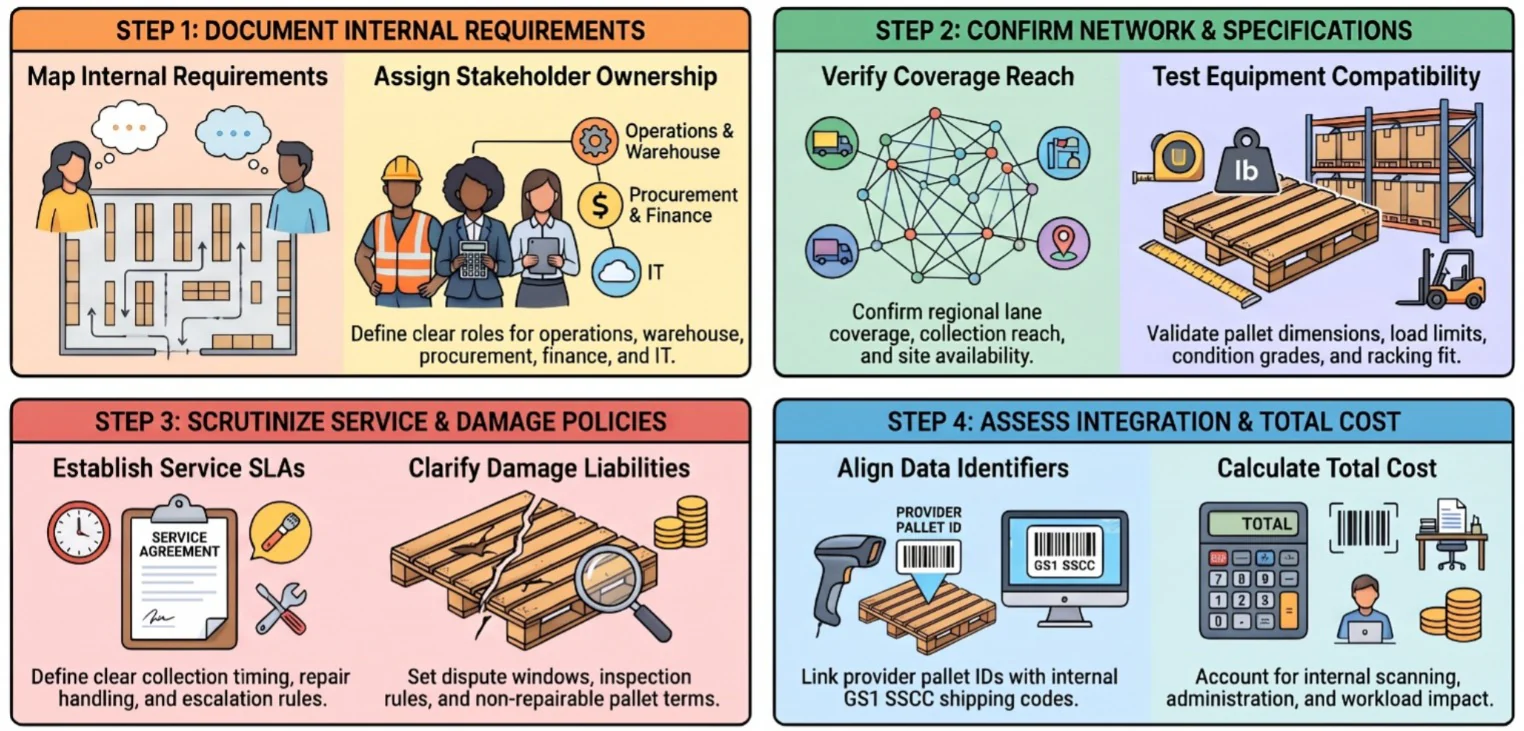
Evaluate a pallet pooling programme against actual shipment lanes, participating sites, pallet specifications, service commitments, data requirements, and exception rules.
A provider presentation is not enough. Each important claim should be tested through a process walk-through, sample report, data file, contract clause, or stakeholder review.
1. Network coverage and pallet specifications
Confirm whether the provider covers the Singapore locations and regional lanes that the business actually uses. Check collection reach, partner participation, turnaround expectations, and the pallet types available at each site.
Review dimensions, load limits, condition grades, inspection criteria, and compatibility with racking, forklifts, vehicles, and customer facilities.
2. Service levels, collection, and damage policies
Service terms should state collection timing, escalation contacts, repair handling, quarantine procedures, missing-pallet liability, and replacement rules.
Damage policies should explain the evidence required, the inspection authority, the dispute window, and the treatment of pallets that cannot be repaired.
3. Reporting, integration, and total operating impact
Ask how the programme exchanges issue, dispatch, receipt, collection, inspection, repair, loss, and redeployment data. The provider should explain file formats, reporting frequency, identifiers, and reconciliation responsibilities.
Standards such as the GS1 Serial Shipping Container Code (SSCC) can identify the loaded logistic unit, while the pooled pallet itself may carry the provider’s own identifier, so confirm how the two records are linked.
Assess the full operating impact, including internal administration, storage, scanning, exception handling, finance review, and staff training. A lower service fee may not represent a lower total cost if the internal workload increases.
4. Preparing internal requirements before requesting a quotation
Prepare a short requirements document before requesting proposals. It should describe shipment lanes, warehouse locations, pallet types, expected movements, known exceptions, system records, and the teams responsible for each control.
- Network: Singapore and regional lanes, participating sites, and collection reach.
- Standards: dimensions, condition grades, inspection, and quarantine rules.
- Service: collection timing, repair handling, loss treatment, and escalation.
- Data: identifiers, movement events, provider files, and reconciliation reports.
- Commercial terms: service fees, damage charges, replacement rules, and adjustments.
- Internal ownership: operations, warehouse, procurement, finance, and IT responsibilities.
How Can You Prepare ERP and Warehouse Data for Pallet Pooling?
Your ERP modules and warehouse data should represent both the physical pallet and the commercial responsibility attached to it. The setup must show where the pallet is, who holds it, what condition it is in, and how related charges are reconciled.
1. Pallet item master and unit-of-measure setup
Define each pallet type with its identifier structure, dimensions, capacity, condition grade, and unit of measure. The business should also decide whether pooled pallets are recorded as returnable packaging, an asset, a service-related item, or another controlled category.
The treatment should reflect the agreement and accounting policy. It should not classify pooled pallets as ordinary product inventory unless that accurately represents the commercial model.
2. Recording pallet movements and balances by location
Record issue, dispatch, receipt, transfer, collection, inspection, repair, loss, quarantine, and redeployment as separate events where the process requires them.
Balances should be visible by site, custody holder, condition, and status. This helps warehouse teams plan returns while giving finance and procurement a reliable basis for reviewing provider charges.
3. Reconciling pallet records with provider statements
Provider statements should be matched with internal movement records, approved exceptions, and contract terms. Differences should be classified as timing variances, missing evidence, confirmed loss, damage, repair, or disputed charge.
Assign one owner for reconciliation and define the approval threshold for adjustments. This prevents unresolved differences from remaining in the records without a decision or follow-up date.
- Master data: identifier, pallet type, dimensions, and condition grade.
- Movement data: issue, dispatch, receipt, transfer, collection, repair, and redeployment.
- Balance data: quantity by site, custody holder, condition, and status.
- Reconciliation data: provider statement, internal movement record, charge, and adjustment.
Conclusion
Pallet pooling works when ownership, custody, handover, condition, return, and exception rules are defined across the network. The physical movement of each pallet should remain connected to a clear operational and financial record.
Singapore businesses should assess provider coverage, pallet standards, partner participation, measurable controls, and ERP readiness before adopting a pooling programme. Businesses reviewing how ERP and warehouse records can support pallet control can book a free consultation with our team.
Frequently Asked Questions
Pallet pooling is a shared-use operating model that coordinates pallet circulation, collection, inspection, repair, and redeployment. Pallet hire is a commercial arrangement in which a provider supplies pallets for an agreed fee or service term.
No. Pooling usually relies on a managed network and programme rules, while pallet exchange depends on agreed handovers and reciprocal returns between participating partners.
There is no single size that suits every operation. Confirm the required dimensions with the provider, warehouse equipment, customer facilities, transport lanes, and the applicable network specification.
Record the pallet identifier, location, custody holder, condition, movement date, expected return, discrepancy status, and handover evidence. Use barcode, RFID, or another method that fits the approved process.
Review network coverage, pallet specifications, collection timing, inspection rules, damage and loss treatment, reporting, data exchange, service fees, adjustment procedures, and internal ownership of reconciliation.
Yes. ERP and warehouse records can connect pallet movements, site balances, custody status, provider statements, charges, damage decisions, and approved adjustments when the required fields and responsibilities are defined.