











 Limited to 100 registrants


Min max inventory is a replenishment method that sets a minimum stock level to trigger a reorder and a maximum level to cap how much stock you hold. For Singapore businesses that depend on imports, limited storage and multi-channel sales, it is a simple way to avoid stockouts without tying up cash in excess stock.
This guide explains the min max formula, shows a step-by-step calculation with a worked example in S$, compares min max with other methods, and covers the mistakes to avoid when setting levels.
Key Takeaways
Min max inventory uses a minimum level (reorder point) to trigger orders and a maximum level to cap stock on hand.
The minimum level equals average daily demand multiplied by lead time, plus safety stock. The maximum level equals the reorder point plus the reorder quantity.
Singapore businesses should review min max levels regularly because import lead times, demand and storage costs change over time.
Inventory management software can automate min max levels by item and location, send reorder alerts and keep stock records accurate.

What Is Min Max Inventory?
"Min max levels give purchasing teams a clear rule for when to reorder and how much to hold, so Singapore businesses can avoid stockouts without tying up cash in excess stock. "
Min max inventory is a stock control method that defines two limits for each item: a minimum quantity that signals when to reorder and a maximum quantity that stock should not exceed. The sections below explain the key terms and how the system works day to day.
Min, max and reorder point explained
The minimum level is the stock quantity at which a new order must be placed. It is usually the same as the reorder point and covers expected demand during the supplier lead time plus a safety buffer.
The maximum level is the highest quantity the business wants to hold, based on storage space, cash availability, shelf life and demand. Stock above this level is generally excess stock.
How the min max system works
The team checks the inventory position, which is stock on hand plus stock already on order, against the minimum level. When it falls to or below the minimum, the business orders enough to bring the position back up to the maximum.
Because the order quantity depends on how far stock has fallen, orders can vary in size. This makes min max flexible for items with uneven demand.
Why Min Max Inventory Matters for Singapore Businesses

Singapore businesses often face high rental costs, reliance on imports and demand across several sales channels. Min max levels give purchasing teams clear, repeatable rules for these conditions.
Balancing stockouts and excess stock
A minimum level that is too low risks stockouts, lost sales and unhappy customers. A maximum level that is too high leads to dead stock, markdowns and possible write-offs. Min max sets boundaries on both sides.
Managing limited storage space and cash flow
Warehouse and retail space in Singapore is expensive, so every extra pallet or shelf has a cost. A maximum level linked to available space and budget prevents over-ordering and keeps working capital available for faster-moving items.
Coping with import lead times and multi-channel demand
Items sourced from overseas suppliers can have long and variable lead times, which require a larger safety buffer. When the same stock serves retail, online and wholesale channels, min max levels help the business plan for combined demand rather than for each channel separately.
Min Max Inventory Formula
The min max formula has four parts: safety stock, the reorder point (minimum level), the reorder quantity and the maximum level. Several variations exist, and the versions below are the most commonly used.
Safety stock
Safety stock is the buffer that protects against higher-than-expected demand or late deliveries.
Safety stock = (Maximum daily usage × Maximum lead time) − (Average daily usage × Average lead time)
Businesses with reliable demand statistics may instead use a service-level approach: Safety stock = Z × standard deviation of demand during lead time.
Reorder point (minimum level)
Reorder point (min) = (Average daily usage × Average lead time) + Safety stock
Reorder quantity
The reorder quantity can be a fixed order size based on supplier minimums, packaging, shipping container loads, review cycle or economic order quantity (EOQ). In a pure min max system, the quantity ordered is the maximum level minus the current inventory position.
Maximum level
Maximum level = Reorder point + Reorder quantity
Some businesses also deduct minimum usage during the minimum lead time. Choose one definition and apply it consistently across all items.
How to Calculate Min Max Inventory Levels Step by Step
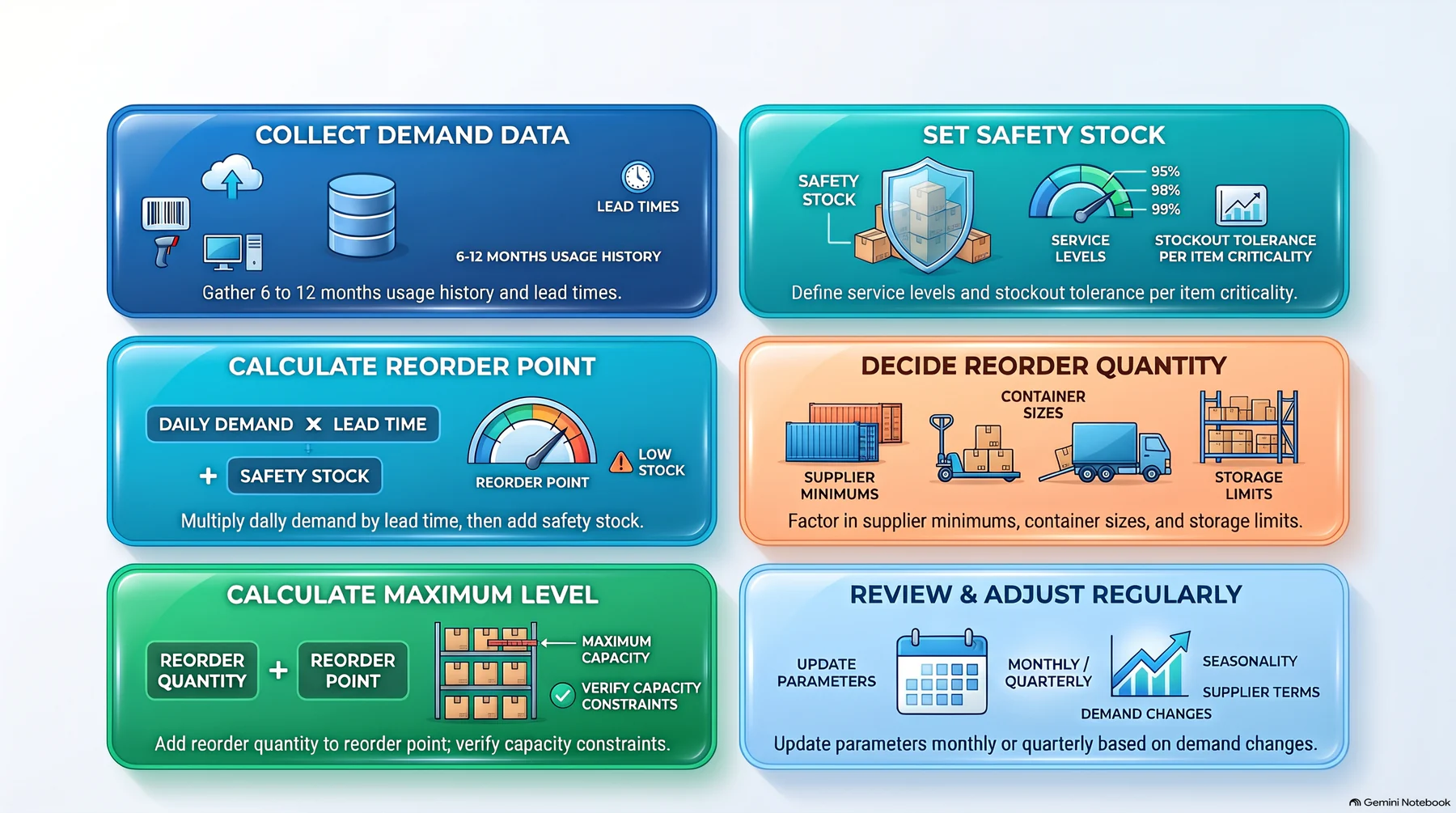
Follow these six steps for each item or item group. Start with high-value and fast-moving products, where mistakes are most costly.
1. Collect demand and lead time data
Gather at least 6 to 12 months of sales or usage history by item and location. Record supplier lead times from order date to goods receipt, including the shortest, average and longest values.
2. Set the service level and safety stock
Decide how important it is to avoid stockouts for each item. Critical or high-margin products may justify higher safety stock than low-value, easily replaced items.
3. Calculate the reorder point
Multiply average daily demand by average lead time, then add safety stock. This is your minimum level.
4. Decide the reorder quantity
Consider supplier minimum order quantities, container or pallet sizes, shipping costs, shelf life and storage space. Compare the result with EOQ where ordering and holding costs are known.
5. Calculate the maximum level
Add the reorder quantity to the reorder point. Then check the result against storage capacity, budget and expiry limits, and lower it if necessary.
6. Review and adjust regularly
Update the levels when demand, lead times, supplier terms, promotions or seasonality change. Fast-moving items may need monthly review, while stable items can be reviewed quarterly.
Min Max Inventory Example in S$
The following example shows how a Singapore retailer could set levels for an imported product. The figures are illustrative only.
Assumptions
| Input | Value |
|---|---|
| Average daily demand | 40 units |
| Maximum daily demand | 55 units |
| Average lead time | 14 days |
| Maximum lead time | 18 days |
| Planned reorder quantity | 1,200 units |
| Unit cost | S$12 |
Calculation
| Item | Calculation | Result |
|---|---|---|
| Safety stock | (55 × 18) − (40 × 14) = 990 − 560 | 430 units |
| Reorder point (min) | (40 × 14) + 430 | 990 units |
| Maximum level | 990 + 1,200 | 2,190 units |
| Stock value at minimum | 990 × S$12 | S$11,880 |
| Stock value at maximum | 2,190 × S$12 | S$26,280 |
What the result means for ordering
When the inventory position falls to 990 units, the purchasing team orders enough to reach 2,190 units, which is 1,200 units if nothing else is on order. During the 14-day average lead time, the business expects to sell about 560 units, so stock should arrive with roughly 430 units left as a buffer.
The maximum level also shows the most cash the business expects to tie up in this item, about S$26,280, which helps with budgeting and storage planning.
Min Max vs Other Inventory Methods
Min max is one of several replenishment approaches. The comparisons below show how it relates to the methods most often used alongside it.
Min max vs reorder point
A reorder point system triggers an order at a set level, usually for a fixed quantity. Min max also uses a reorder point but adds a maximum level, so the order quantity adjusts to bring stock back up to that cap.
Min max vs EOQ
EOQ calculates the order size that minimises combined ordering and holding costs. It answers how much to order, while min max answers when to order and how high stock should go. Many businesses use EOQ to help choose the reorder quantity inside a min max system.
Min max vs safety stock method
Safety stock is a component of min max rather than a separate system. It builds a buffer into the minimum level, while min max also defines the upper limit.
| Method | Main question answered | Order quantity | Upper limit |
|---|---|---|---|
| Min max | When to order and how high stock should go | Maximum minus inventory position | Yes |
| Reorder point | When to order | Usually fixed | Not defined |
| EOQ | How much to order | Cost-optimised fixed quantity | Not defined |
| Safety stock | How large the buffer should be | Not defined | Not defined |
Advantages and Limitations of Min Max Inventory
| Advantages | Limitations |
|---|---|
| Simple to understand and apply across many items | Static levels may not reflect seasonality, trends or promotions |
| Reduces both stockouts and overstocking | Needs accurate demand, lead time and stock data |
| Supports clear reorder rules and approvals | Needs regular review as conditions change |
| Helps plan storage space and cash requirements | Less suitable for products with highly unpredictable or one-off demand |
| Easy to automate in inventory software | Does not by itself forecast future demand |
When to Use Min Max Inventory

Min max works best when demand is reasonably steady and lead times are known. It is less effective when demand changes sharply or products are made to order.
Businesses and products that suit min max
Min max suits retailers, wholesalers, distributors, F&B operators and maintenance teams that manage many standard items. It works well for consumables, spare parts, packaging, office supplies and everyday products with repeat demand.
When another method works better
Consider other methods for fashion, seasonal or short-life products, new products without sales history, or items made to order. Demand-driven planning, MRP or periodic forecasting may give better results in these cases.
Common Min Max Inventory Mistakes and How to Avoid Them
| Mistake | Why it causes problems | How to avoid it |
|---|---|---|
| Using one lead time for all suppliers | Delays at some suppliers cause stockouts | Track lead time by supplier and item |
| Setting levels once and never reviewing | Demand and supplier terms change | Review on a fixed schedule and after major changes |
| Ignoring stock on order | Duplicate orders create excess stock | Compare the inventory position, not only stock on hand, with the minimum |
| Setting the maximum without checking storage or expiry | Stock may not fit or may expire | Check space, budget and shelf life before approving levels |
| Applying the same buffer to every item | Critical items are under-protected and low-value items are over-stocked | Set service levels by item importance |
| Relying on inaccurate stock records | Reorder triggers fire too early or too late | Run regular cycle counts and fix recording errors |
Using Inventory Management Software to Automate Min Max Levels
Spreadsheets can handle min max for a few items, but they become hard to maintain as products, locations and suppliers increase. Inventory management software can apply the rules automatically and keep the data current.
Set min and max levels by item and location
Software lets you assign different levels to each product, warehouse, branch or outlet. This reflects local demand and storage limits instead of applying one rule everywhere.
Get automatic reorder alerts and purchase suggestions
When the inventory position reaches the minimum, the system can alert the team or suggest a purchase order up to the maximum. This reduces manual checking and missed reorders.
Keep stock records accurate in real time
Real-time updates from receiving, sales, transfers and adjustments help the reorder rules work from reliable data. Barcode scanning and integrated purchasing further reduce recording errors.
Review turnover and ageing reports to adjust levels
Turnover and ageing reports show which items are overstocked, slow-moving or frequently out of stock. Use them to raise, lower or retire min max levels instead of adjusting by guesswork.
Conclusion
Min max inventory gives Singapore businesses a practical way to decide when to reorder and how much stock to hold. By combining demand, lead time, safety stock and storage limits, teams can reduce stockouts, control cash tied up in inventory and simplify purchasing decisions.
The method works best with accurate data and regular reviews, and it should be adjusted for seasonal or unpredictable items. Automating the levels in inventory software makes it easier to apply the rules consistently across items, locations and suppliers.
HashMicro can help your business set up stock levels, reorder alerts and connected purchasing and accounting processes. Request a free consultation to discuss your inventory management requirements.

Frequently Asked Questions About Min Max Inventory
Min max inventory is a replenishment method that sets a minimum stock level to trigger a reorder and a maximum level to limit how much stock is held. When stock reaches the minimum, the business orders enough to return to the maximum.
Calculate safety stock first, then set the minimum level as average daily demand multiplied by average lead time plus safety stock. The maximum level is the minimum level plus the reorder quantity, adjusted for storage space, budget and shelf life.
A reorder point only defines when to order, usually for a fixed quantity. Min max also defines a maximum level, so the order quantity varies to bring the inventory position back up to that cap.
Yes. It is simple to set up and helps small businesses control cash and limited storage space. It works best for products with fairly steady demand and known supplier lead times.
Review levels on a regular schedule, such as monthly for fast-moving items and quarterly for stable items. Also review them after changes in demand, supplier lead times, pricing, promotions or storage capacity.
Yes. Inventory management software can store min and max levels by item and location, track stock in real time, send reorder alerts and suggest purchase quantities based on the inventory position.