




Goods in transit are products that have left the seller but have not yet reached the buyer. They sit between two warehouses, and someone must still record them in the books.
This article explains what goods in transit mean, who owns them, and how to account for them. It also shows how to track in-transit inventory so your stock and financial reports stay accurate.
Singapore businesses feel this more than most because the country depends on imports. Sea freight, GST on imports, and Incoterms all affect when stock becomes yours.
Key Takeaways
Goods in transit are shipped products not yet received; ownership and shipping terms determine who records them at reporting date.
Goods in transit accounting records inventory when risks and rewards transfer, with FOB terms guiding journal entries and valuation.
Inventory in transit matters for Singapore businesses because imports, lead times, GST and Incoterms affect cash flow and reporting.
In-transit inventory tracking uses ownership dates, shipment documents, monthly reconciliation and clear team responsibilities to keep records accurate.
What Is Goods in Transit?
Goods in transit are items that have been shipped but not yet received by the buyer. They may be on a ship, a truck, a plane, or waiting at a port or customs checkpoint.
The goods in transit meaning also covers a timing question. The stock exists, but it is not in your warehouse, so you cannot sell it or count it in a physical stock take.
Finance teams often call this inventory in transit or stock in transit. Inventory management software can keep that status visible while the goods remain outside the warehouse. Whichever term you use, the stock belongs on the books of whoever legally owns it at the reporting date.
The key point is ownership, not location. Ownership depends on the sales terms agreed between buyer and seller, which the next section explains.
"Goods in transit are still your stock on paper, even when you cannot see or sell them."
Goods in Transit Accounting: Who Owns the Stock?
Goods in transit accounting follows one rule: the party that holds the risks and rewards of ownership records the inventory. The shipping terms on the purchase order decide who that is.
1. FOB shipping point vs FOB destination
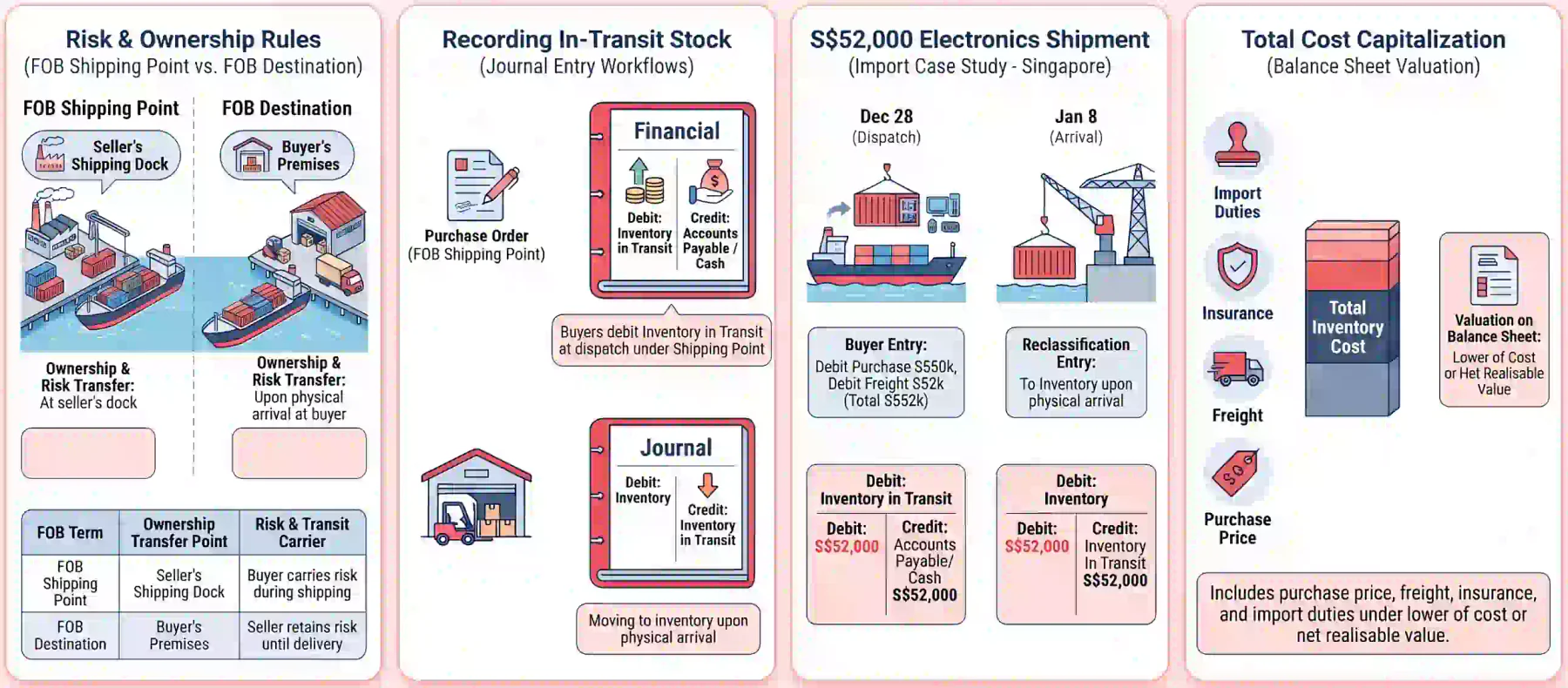
Under FOB shipping point, ownership passes to the buyer when the goods leave the seller's dock. The buyer records the inventory in transit and carries the risk during shipping.
Under FOB destination, ownership passes when the goods arrive at the buyer's premises. The seller keeps the inventory on its books until delivery and bears the transit risk.
2. Journal entries for the buyer and the seller
Under FOB shipping point, the buyer debits Inventory in Transit and credits Accounts Payable once the goods ship. The seller records the sale and removes the stock at the same time.
Under FOB destination, the seller keeps the goods in inventory until delivery. The buyer records nothing until the goods arrive. At that point, the buyer debits Inventory and credits Accounts Payable.
When goods under FOB shipping point arrive, the buyer moves the balance from Inventory in Transit to Inventory. Total stock value does not change, only its status.
3. Worked example with a Singapore import shipment
A Singapore distributor buys S$50,000 of electronics from a Shenzhen supplier on FOB shipping point terms. The goods ship on 28 December, and the financial year ends on 31 December.
On 28 December, the distributor debits Inventory in Transit S$50,000 and credits Accounts Payable S$50,000. If it pays S$2,000 in freight, that cost is added to the inventory value.
The goods arrive on 8 January. The distributor then transfers S$52,000 from Inventory in Transit to Inventory. Without the December entry, both stock and payables would be understated.
4. Valuing inventory in transit on the balance sheet
Inventory in transit is valued at cost, which includes the purchase price, freight, insurance, and other costs needed to bring the goods to their location. Import duties are included where they apply.
On the balance sheet, most companies show it within total inventory or as a separate line. Under SFRS(I) 1-2, inventory is measured at the lower of cost and net realisable value.
Why Inventory in Transit Matters for Singapore Businesses
Singapore imports most of what it sells, so in-transit stock is a large part of working capital for many importers, retailers, and distributors. Delays directly affect sales and cash flow.
1. Port congestion and sea freight lead times
Singapore is one of the world's busiest transhipment hubs, yet global disruptions still stretch lead times. A shipment planned for two weeks can take much longer.
Longer transit means more cash tied up in stock you cannot sell. It also means more risk that sales teams promise stock that has not arrived.
2. GST on imports and Singapore Customs documentation
Goods imported into Singapore are subject to GST, currently 9%, calculated on the customs value plus duties. GST-registered businesses can claim it as input tax, subject to IRAS rules.
Import permits are lodged through Singapore Customs. Your permit records, invoices, and bills of lading support both your GST claims and your in-transit stock records. See IRAS and Singapore Customs for current rules.
3. Incoterms used in Singapore trade
Incoterms such as FOB, CIF, and DAP set when risk and cost transfer between buyer and seller. Importers commonly see FOB and CIF, while exporters often quote CIF or DAP.
Always map each Incoterm to an accounting treatment. FOB and CIF generally transfer risk at loading, so the buyer records inventory in transit. DAP keeps it with the seller until delivery.
Risks of Goods in Transit
Stock in transit is out of your control, yet it still affects your books. The main risks are physical loss, insurance gaps, tied-up cash, and reporting errors.
1. Loss, damage, and theft
Cargo can be lost, damaged, or stolen at any handover, including port, truck, and warehouse transfers. Each handover is a point where records and physical stock can drift apart.
Under FOB shipping point, the buyer carries this risk from the moment goods leave the seller. Check the sales terms before you ship, not after something goes wrong.
2. Insurance coverage and claims
Marine cargo insurance covers goods in transit against loss and damage. Cover should match the Incoterm, because the party that carries the risk should hold the policy.
Keep the invoice, bill of lading, and survey report together. Claims are far quicker when your in-transit records show exactly what shipped and when ownership passed.
3. Cash flow tied up in stock you cannot sell
You often pay suppliers before the goods arrive. Until receipt, that money sits in stock you cannot sell, which strains working capital for smaller importers.
Tracking in-transit value helps you see how much cash is committed. It also helps you time purchase orders so a late shipment does not leave you short.
4. Inaccurate stock counts and financial reporting errors
Goods in transit are missed in physical counts because they are not in your warehouse. If they are also missed in the books, inventory and payables are both understated.
The reverse also happens. Recording stock as received too early overstates inventory and lets sales teams promise goods that are still at sea.
How to Track In-Transit Inventory Accurately
Good in-transit inventory tracking comes down to four habits: record ownership on time, use trusted documents, reconcile regularly, and give each step a clear owner.
1. Record ownership transfer at the right time
Use the Incoterm on each purchase order to set the transfer date. Record the inventory in transit on that date, not when the invoice is paid or the goods are unpacked.
Write the rule into your procurement policy. When every team uses the same trigger, month end cut-off disputes drop sharply.
2. Use shipment documents and carrier tracking data
The bill of lading, commercial invoice, packing list, and import permit prove what shipped and when. Use them as the source for every in-transit entry.
Carrier tracking data adds the expected arrival date. Together, they let you flag delayed shipments early and update stock availability in your warehouse management software for sales.
3. Reconcile in-transit stock at every month end
List every open shipment and compare it with the Inventory in Transit balance. Each item should match a purchase order, a shipping document, and an owner.
Clear anything that has arrived but is still marked in transit. Investigate anything that has been in transit far longer than normal lead times.
4. Assign clear ownership across procurement, warehouse, and finance
Procurement tracks the shipment, the warehouse confirms receipt, and finance books the entries. Without named owners, each team assumes another has done it.
A short handover checklist for each stage keeps the process consistent. It also gives auditors a clear trail from order to receipt.
Managing Goods in Transit with Inventory Software
Spreadsheets work for a handful of shipments. Once you import regularly, inventory software keeps purchasing, warehouse, and finance records in one place.
1. Real-time visibility from purchase order to receipt
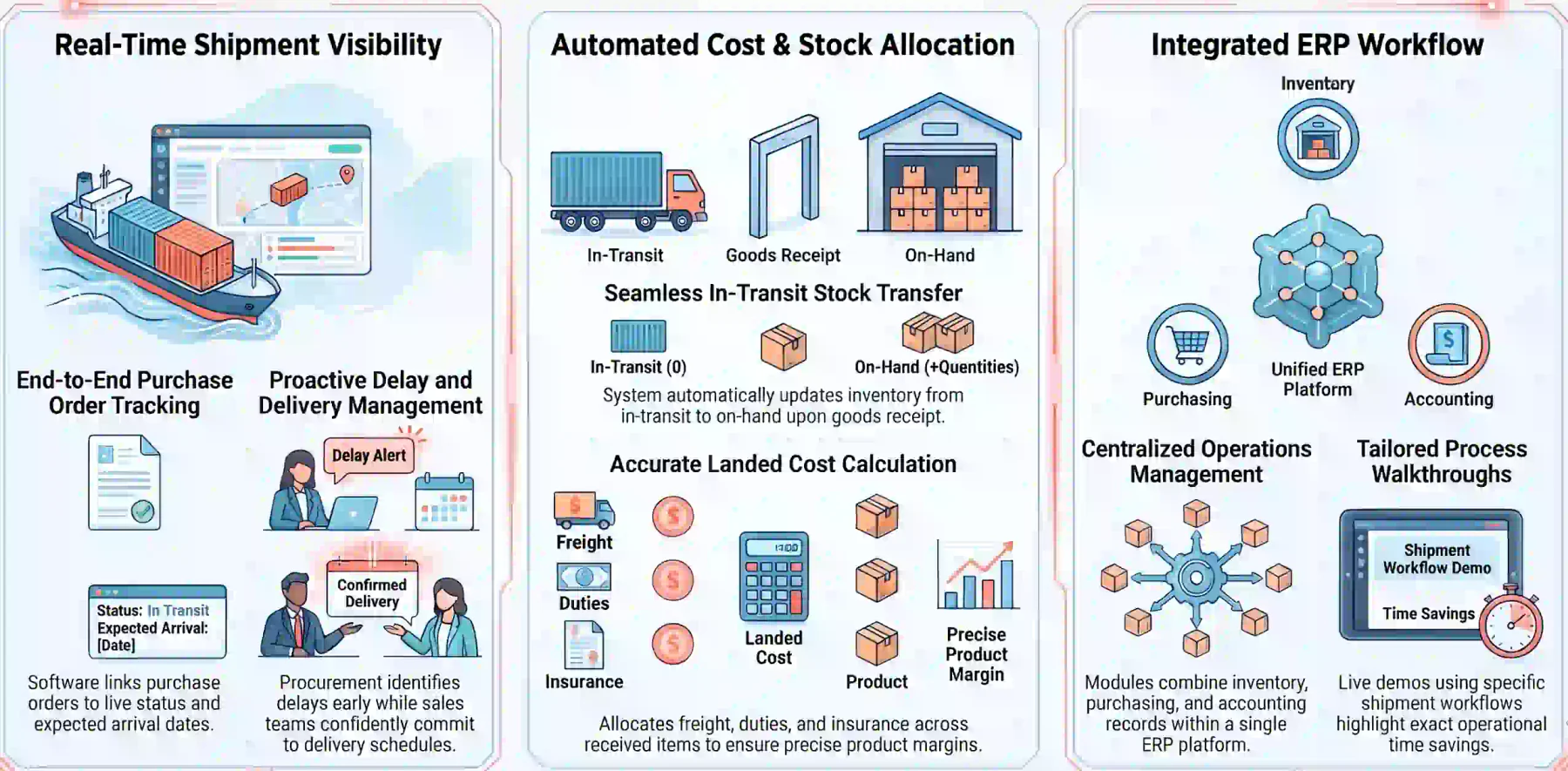
Software links each purchase order to its shipment status and expected arrival date. Teams can see which stock is on the way without chasing emails or spreadsheets.
That visibility helps sales commit to realistic delivery dates. It also helps procurement spot delays before they cause stockouts.
2. Automated in-transit stock and landed cost allocation
Systems can move stock from in transit to on hand when goods are received, so the balance updates without manual journals. This cuts month end clean-up.
Landed cost covers freight, insurance, and duties. Allocating these across the received items gives a more accurate unit cost and margin for every product.
3. How HashMicro supports Singapore inventory teams
HashMicro provides ERP software that connects inventory, purchasing, and accounting software for Singapore businesses. Teams can manage stock movements and supplier orders in one system.
To see how this fits your import workflow, book a demo with HashMicro. A short walkthrough using your own shipment process shows where the time savings are.
When shipment, warehouse and accounting records stay connected, teams can review in-transit stock more accurately. Hashy AI helps identify delayed receipts, missing documents and inventory mismatches.






Conclusion
Goods in transit are stock you own, or owe for, but cannot yet use. The sales terms decide who records them, and accurate records protect your balance sheet.
For Singapore importers, long lead times, GST, and Incoterms make this a daily concern. Clear rules, regular reconciliation, and the right software keep in-transit stock under control.
If you are interested in learning more about goods in transit, then you can book a free consultation with our experts and gain deep business insights with us.

Frequently Asked Questions
Goods in transit are products that have been shipped but not yet received. They are between seller and buyer, so they are neither in your warehouse nor available to sell.
It depends on the shipping terms. Under FOB shipping point, the buyer owns them once they leave the seller. Under FOB destination, the seller owns them until they arrive.
The owner records them as inventory in transit at cost, including freight and insurance. When the goods arrive, the balance moves from Inventory in Transit to Inventory.
Yes, if you own them at the reporting date. They appear within total inventory or as a separate line, even though they are not in your warehouse and were not physically counted.
Link each purchase order to its shipping documents and carrier updates, record ownership at the Incoterm trigger, and reconcile open shipments every month end. Inventory software automates most of this.