







A workplace accident rarely traces back to one careless act. It usually traces back to a risk assessment nobody updated, a permit issued without a check, or a duty that sat between two parties and was owned by neither.
The Workplace Safety and Health Act is the law that decides who carries those duties in Singapore and what happens when they are not met. It applies far more broadly than many employers expect, reaching occupiers, employers, contractors, employees, and suppliers of machinery.
This guide covers who the Act binds, the duties each party carries, the risk management and reporting requirements behind it, the penalties for breaches, and how to keep compliance running day to day rather than only before an audit.
Key Takeaways
The WSH Act places workplace safety duties on employers, occupiers, contractors, employees, and other parties
Effective risk management helps businesses identify hazards, apply controls, and maintain safer work practices
A structured WSH compliance system helps businesses manage safety records, training, incidents, and corrective actions

What Is the Workplace Safety and Health Act?

The Workplace Safety and Health Act is Singapore’s main law for workplace safety and health, administered by the Ministry of Manpower. It replaced the older Factories Act and expanded safety requirements across different types of workplaces.
The Act focuses on reducing risks at their source and making the parties who create or manage those risks accountable. This means a company can face penalties for poor safety management even when no accident has occurred.
The Act covers most workplaces, including construction sites, factories, warehouses, offices, and service premises. Assuming the Act only applies to industrial workplaces can therefore lead to serious compliance gaps.
Who Does the WSH Act Apply To?
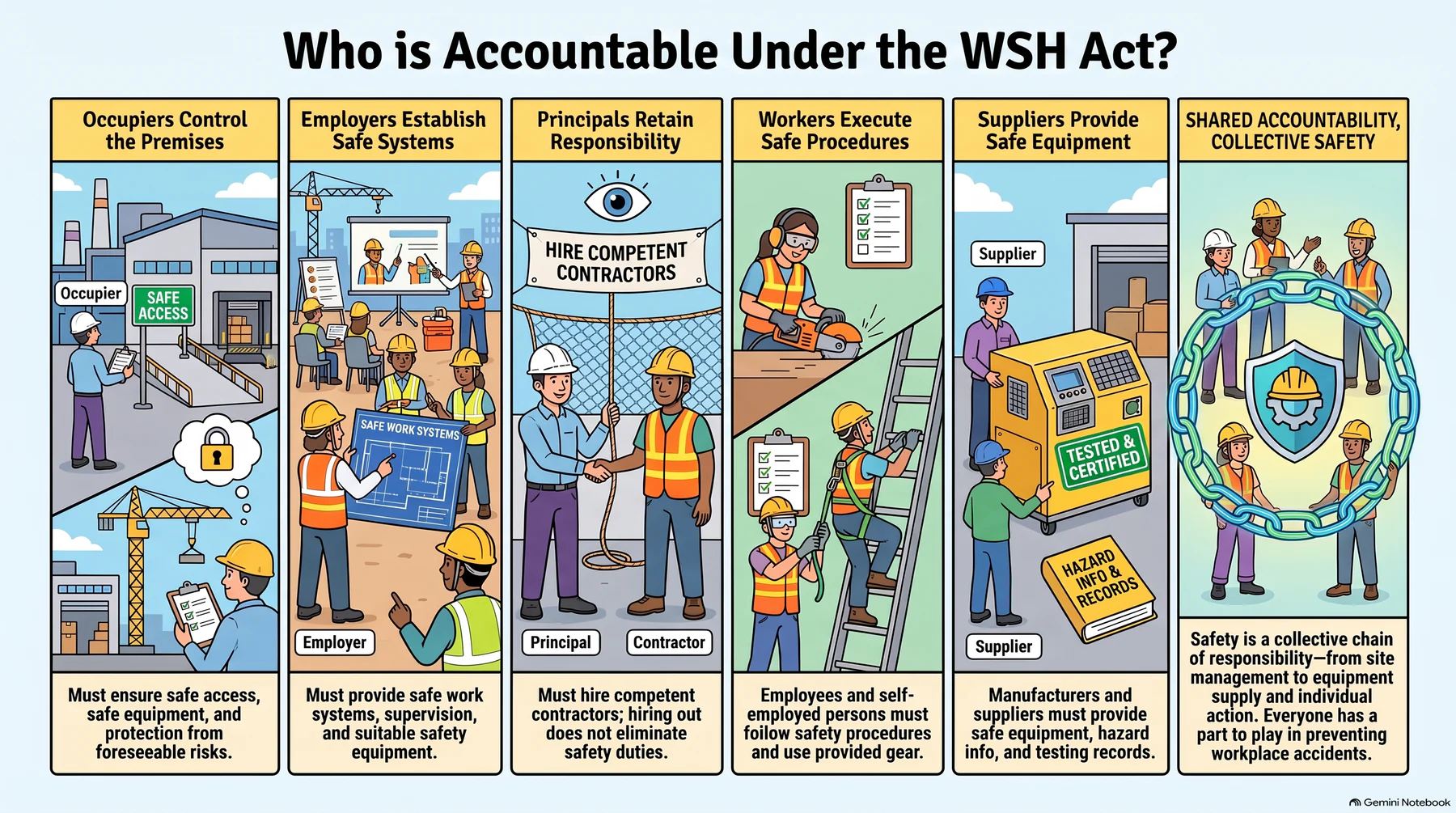
The WSH Act places duties on several parties involved in workplace activities. This means more than one party may be held accountable when a safety failure occurs.
1. Occupiers
An occupier is the party that controls the workplace or premises. Their duties include providing safe access, safe equipment, and a working environment that does not expose people to foreseeable risks.
2. Employers
Employers must provide safe work systems, proper instruction and supervision, and suitable safety equipment. These duties can also extend to visitors, contractors, and others affected by the business’s activities.
3. Principals and contractors
Principals must take reasonable steps to engage competent contractors and establish clear safety requirements. Hiring a contractor does not automatically remove the principal’s responsibility for workplace safety.
4. Employees and self-employed persons
Employees must follow safe work procedures and use the safety measures provided. Self-employed persons must also work in a way that does not put themselves or others at risk.
5. Manufacturers and suppliers
Manufacturers, importers, and suppliers must ensure that workplace equipment and hazardous substances are safe and supplied with relevant safety information. This can include instructions, testing records, and information about known hazards.
"Strong business growth starts with reliable data and connected systems that help teams make better decisions. "
What Are the Key Duties Under the WSH Act?
The table below summarises the main duties of different parties and some common gaps businesses should watch for.
| Duty Holder | Core Obligation | Common Gap in Practice |
|---|---|---|
| Occupier | Keep premises, access routes, and plant safe | Shared areas and equipment have no clear owner |
| Employer | Provide safe work systems, instruction, supervision, and protective equipment | Procedures are not updated when work methods change |
| Principal | Engage competent contractors and set safety requirements | Contractors are selected mainly on price |
| Employee | Follow safe procedures and use safety measures | Equipment is provided but usage is not monitored |
| Self-employed person | Work without endangering themselves or others | Contractors are assumed to be outside the safety system |
| Manufacturer or supplier | Provide safe equipment and relevant safety information | Equipment is supplied without adequate documentation |
These duties can overlap, so several parties may be responsible for the same safety failure. During an incident review, businesses should be able to show what each relevant party did to manage the risk.
Which WSH Regulations Apply to Your Workplace?
The Act provides the main framework, while subsidiary regulations set more specific requirements. The rules that apply depend on the type of work, workplace, and activities involved.
General requirements cover areas such as risk management, incident reporting, and first-aid arrangements. Additional regulations may apply to activities involving work at heights, confined spaces, noise, scaffolds, or construction.
Some requirements also depend on factors such as workplace size or the type of work being carried out. Businesses should review applicable requirements when their workforce, operations, or projects change.
Risk Management Requirements Under the WSH Act
Risk management should be a documented process that is reviewed as work conditions change. A proper assessment identifies hazards, evaluates risks, applies controls, and communicates the results to the people doing the work.
1. Identify hazards for every work activity
Break each task into activities and identify potential physical, chemical, biological, ergonomic, and mechanical hazards. Involving workers can also help uncover risks that may not be obvious during a desk-based review.
2. Evaluate risk and decide control measures
Assess each hazard based on its likelihood and potential severity, then apply the hierarchy of controls from elimination and substitution to engineering controls, administrative controls, and personal protective equipment. Record the remaining risk after controls are applied.
3. Record, communicate and review the assessment
Keep records of the hazards, controls, assessment date, assessors, and approval. Review the assessment when work methods, equipment, or site conditions change.
For a practical view of workplace risks in storage environments, our warehouse safety guide covers hazards and controls related to racking, forklift movement, and manual handling.
Incident Reporting Obligations
Incident reporting is a separate requirement from investigating the incident itself. Employers should understand which events must be reported and the applicable reporting deadlines.
Workplace fatalities must be reported to the Ministry of Manpower immediately, and the incident scene should generally be preserved until authorised otherwise. Certain work-related injuries requiring medical leave, light duties, or hospitalisation must also be reported.
Dangerous occurrences can be reportable even when nobody is injured, including events involving structural collapse, equipment failure, fire, or explosion. Occupational diseases linked to workplace exposure may also require reporting.
Penalties and Enforcement Under the WSH Act
The WSH Act provides significant penalties for safety breaches, with companies and individuals potentially facing substantial fines and, in some cases, imprisonment. Repeat or separate breaches can also increase overall exposure.
Enforcement is not limited to financial penalties. The Ministry of Manpower can take measures such as issuing stop-work orders, remedial orders, and composition fines.
The business impact can extend beyond the penalty itself. A stop-work order, project delays, reputational damage, or higher insurance costs can create significant operational and financial consequences.
How to Build WSH Compliance Into Daily Operations
WSH compliance works best when safety requirements are built into everyday processes rather than kept in separate files. Businesses should assign clear responsibility, maintain current records, and regularly review safety performance.
1. Assign accountability at management level
Assign a person with clear responsibility and authority for workplace safety. Safety should also be included in regular management reviews alongside cost, productivity, and project performance.
2. Keep risk assessments and permits in one system
Store risk assessments, safe work procedures, and permits in one accessible system with clear version control. Linking each record to the relevant activity and review date makes it easier to confirm that workers are using current documents.
3. Track training, certification and medical examination validity
Track required training, certifications, and medical examinations with their expiry dates. Automated reminders can help businesses identify upcoming renewals before a certificate becomes invalid.
Our training management system guide explains how businesses can manage certification records and renewal schedules across a larger workforce.
4. Log incidents, inspections and corrective actions
Record incidents, near misses, and inspection findings with an assigned owner and due date. Corrective actions should also be verified after completion to confirm that the underlying issue has actually been addressed.
5. Review performance against leading indicators
Track leading indicators such as completed inspections, current training, timely risk assessments, and corrective actions. Reviewing these measures alongside injury data can help management identify safety issues before they become incidents.
For businesses managing safety across multiple sites, spreadsheets can become difficult to maintain. HashMicro’s HRM software helps manage employee records, training certifications, and expiry alerts, while HashMicro’s construction software connects site documentation, inspections, and project records.
For project-based businesses, our construction risk management guide also explains how safety risks can be assessed alongside cost and schedule risks.
Conclusion
The Workplace Safety and Health Act works on duties rather than paperwork, and those duties sit with several parties at once. Knowing whether your business is the occupier, the employer, the principal, or all three is what determines the obligations you actually carry.
The businesses that find inspections straightforward keep risk assessments current, track certification expiry before it lapses, and close corrective actions with a named owner.
To see how connected employee, training, and project records could keep your safety documentation current across every site, book a free consultation with HashMicro.

Frequently Asked Questions
The Workplace Safety and Health Act is the main law governing safety and health at work in Singapore, administered by the Ministry of Manpower. It replaced the Factories Act and extended coverage from factories to workplaces across the economy. The Act works by placing duties on occupiers, employers, principals, employees, self-employed persons, and suppliers of machinery, so responsibility is shared rather than held by one party.
Responsibility is layered across every party with influence over the work. An occupier must keep the premises and plant safe, an employer must provide safe systems and supervision, a principal must engage competent contractors, and employees must follow the measures provided. Because the duties overlap, more than one party can be held accountable for the same incident.
Fines for corporate bodies reach several hundred thousand dollars for general duty breaches, and individuals can face substantial fines together with imprisonment. Repeat offences attract higher exposure, and separate duty breaches can be charged separately. Enforcement also includes stop-work orders, remedial orders, and closer surveillance, which often cost more commercially than the fine itself. Confirm current amounts with the Ministry of Manpower, since penalties are amended periodically.
Yes. Risk assessment is a legal requirement rather than good practice, and it must be documented, communicated to the people doing the work, approved, and reviewed on a fixed cycle. It must also be reviewed whenever the work method, equipment, or site conditions change. An assessment that no longer matches how the work is actually done offers little protection during an investigation.
Fatalities must be reported to the Ministry of Manpower immediately. Work-related injuries are reportable once medical leave, light duties, or hospitalisation passes the prescribed threshold, and dangerous occurrences such as collapses, equipment failures, and fires are reportable even where nobody was injured. Occupational diseases are reportable on diagnosis. Reporting is a separate obligation from the incident, so a late report is its own offence.
Yes. Coverage extends across workplaces rather than being limited to industrial premises, so offices, retail units, warehouses, and service businesses fall within scope. What changes with size and activity is which subsidiary regulations apply, including thresholds for a workplace safety and health committee or a safety officer. Smaller businesses still carry the general duties around safe systems, instruction, and risk assessment.