










 Limited to 100 registrants
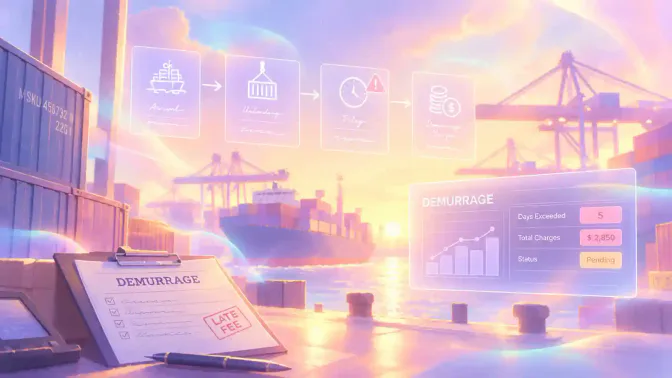
Singapore handles over 37 million TEUs annually, making it one of the world's most active container hubs. For businesses importing through PSA terminals, demurrage is among the most costly fees to manage.
A missed pickup window or a paperwork delay of just a few days can produce charges that compound quickly. These charges are not always transparent, yet they appear on shipping invoices with little warning.
This article covers the meaning of demurrage in container shipping, how charges are calculated in Singapore, how demurrage and detention differ, and practical steps businesses can take to reduce their exposure.
Key Takeaways
Demurrage starts when a container exceeds its free time at the terminal.
Tiered and backdated charges can significantly increase demurrage costs.
Demurrage and detention apply to different stages of the container cycle.
Proactive planning, communication, and software help businesses control demurrage costs.
What Is Demurrage?
Demurrage is the charge a shipping carrier applies when a loaded container remains at a port terminal beyond the agreed free time. Free time is the set number of days given to a consignee before charges begin.
For import shipments, the clock starts from the moment the vessel discharges the container at the terminal. The consignee then has a fixed window, usually three to seven days, to arrange collection.
Carriers, including DHL Global Forwarding Singapore, classify demurrage, detention, and storage as three separate charges. Each is triggered at a different stage of the container's journey through the port.
Demurrage compensates the carrier for equipment use and the occupation of terminal space. The financial impact is significant, particularly when charges escalate in tiers or are backdated to the original discharge date.
"We used to treat free time as a deadline, not a countdown. The moment we started tracking discharge dates the same way we track payment terms, our demurrage bill dropped because collection was being arranged before the container even landed."
What Is Laytime and How Does It Trigger Demurrage?
Laytime and free time both set a hard deadline before demurrage begins, though they apply in different shipping contexts. Understanding the distinction helps importers identify exactly when their cost exposure starts.
1. Laytime definition and how it is counted
Laytime is the period agreed between a shipowner and a charterer for loading or unloading cargo. It is most commonly used in bulk, breakbulk, and tanker shipping, where an entire vessel is chartered for a single cargo.
Under a voyage charter, laytime runs from the vessel's Notice of Readiness at the nominated port. It continues through the agreed loading or discharge period, with exceptions set out in the charterparty terms.
When laytime is exceeded, the charterer pays demurrage to the shipowner as compensation. The calculation of laytime and demurrage follows rates agreed in the charterparty, and precise wording matters significantly.
2. Free time periods offered by Singapore carriers
In Singapore container shipping, the equivalent of laytime is the carrier's free time period. Each major carrier operating at PSA sets its own window, and these differ significantly across the market.
| Carrier | Free Time (Singapore Import) | Tariff Model |
|---|---|---|
| ONE (Ocean Network Express) | 72 hours (3 days) | Separate D&D; backdated charges apply |
| Maersk | Typically 5 days | Combined D&D available |
| APL | 5 to 7 days | Separate D&D |
| OOCL | 5 to 7 days | Separate D&D |
| CMA CGM | Varies by tariff | Published on local Singapore tariff page |
These figures are indicative and subject to periodic revision. Carriers such as APL Singapore publish free time schedules, but policies change, so always confirm directly before a shipment arrives.
3. When laytime ends, and demurrage charges begin
The transition from free time to demurrage is precise. Demurrage begins at the exact moment free time expires, not at the end of the business day or the following morning.
For carriers like ONE that apply a 72-hour window, a single day of overrun incurs charges backdated to the original discharge date. This means the total bill covers the full elapsed period, not just the overrun days.
How Demurrage Charges Are Calculated

Demurrage is not a flat daily rate applied uniformly across all containers and carriers. The structure varies by equipment type, carrier, and the number of days elapsed since free time expired.
1. The per-container, per-day rate structure
Demurrage is billed per container per day, with rates that differ by container type. A 20-foot dry box, a 40-foot high cube, and a reefer unit each attract different tariff rates from the same carrier.
Most carriers apply a tiered structure where the first few days after free time carry a lower rate. The rate steps up in subsequent bands, increasing the cost the longer the container sits at the terminal.
2. Worked example: Singapore import, 40ft dry container
Using ONE's published Singapore tariff as a reference point, the table below shows how a single day of overrun produces a much larger charge than the daily rate alone suggests.
| Days Since Discharge | Container Status | ONE Charge Basis (Indicative, 40ft Dry) |
|---|---|---|
| Day 1 to 3 | Within 72-hour free window | No charge |
| Day 4 (1 day past free time) | Free time exceeded | Backdated to discharge; estimated SGD 315 |
| Day 7 (4 days past free time) | Tier 2 rates may apply | Charge compounds significantly above SGD 315 |
| Day 10 (7 days past free time) | Extended overrun | Multiple tier increases; bill substantially higher |
Importers who expect to pay only the daily rate multiplied by overrun days often receive invoices two to three times higher. This is the direct result of the backdated calculation method applied by carriers like ONE.
3. Escalating tiers and backdated charges explained
A container sitting ten days past free time does not accumulate ten times the day-one rate. Days one to three may be billed at the base rate, days four to seven at a higher rate, and beyond that at the top tier.
Combined with backdating, a consignee collecting on day ten faces a bill calculated from day one at each tier rate. Businesses in Singapore should treat free time expiry as a firm financial deadline, not a soft target.
Demurrage vs Detention: Understanding Both Charges
Demurrage and detention are often mentioned together, but they apply to different stages of the container cycle. Treating them as a single charge makes it harder to identify where costs are building and who is responsible.
1. What is detention in shipping?
Detention is the charge applied when a carrier's empty container is held outside the port terminal beyond the permitted free time period. Where demurrage applies inside the terminal, detention applies outside it.
When an importer picks up a laden container, the detention clock starts. The importer has a set number of free days to unpack the cargo and return the empty box to the carrier's designated depot.
If the empty is returned within the free period, no detention fee applies. Exceed those days and detention charges accrue per container per day, on the same tiered-rate model as demurrage.
2. Where demurrage ends, and detention begins
The boundary between demurrage and detention is the moment the container passes through the terminal gate. That single event stops one charge and starts another.
Once the container is picked up from the terminal, demurrage stops and the detention free time begins. The table below shows how the two charges differ across key dimensions.
| Dimension | Demurrage | Detention |
|---|---|---|
| Where it applies | Inside the terminal | Outside the terminal |
| When it starts | After discharge free time expires | After gate-out free time expires |
| When it ends | When container is picked up (gate-out) | When empty is returned to carrier depot |
| Charged by | Ocean carrier | Ocean carrier |
| Billed as | Per container, per day | Per container, per day |
3. How demurrage and detention interact in Singapore
Some carriers in Singapore pool demurrage and detention into a single combined free time tariff. Under this model, the importer has one total window covering both terminal time and empty return time.
Maersk has offered combined D&D tariffs for Singapore imports at various points. Shippers should confirm with each carrier which structure applies to their specific shipment, as policies vary and are updated regularly.
Why Singapore Businesses Face Higher Demurrage Risk
Singapore's port is among the most efficient in the world, but several structural factors make demurrage exposure higher for businesses trading through it. Understanding these risks is the starting point for managing them.
1. Port congestion and schedule disruptions at PSA
PSA Singapore consistently ranks among the world's top-performing container terminals. Despite this efficiency, vessel bunching and schedule disruptions can compress the effective free time available to importers.
When multiple ships arrive simultaneously after weather delays, discharge schedules shift, and truck appointment slots become scarce. Importers can find it difficult to collect within free time, even with documents ready.
2. Documentation bottlenecks and customs clearance delays
Customs clearance is the largest controllable risk factor for demurrage at Singapore's PSA terminals. Importers who do not have trade documents ready before the vessel arrives are significantly exposed.
Late submission of the Cargo Release Order, delays in obtaining the original Bill of Lading, or holds triggered by Singapore Customs declarations can all delay terminal pickup while demurrage accrues.
Regulated commodities such as food, chemicals, and pharmaceutical items require pre-clearance by SFA, NEA, or HSA. These inspections add time outside the importer's control.
3. Carrier-specific free time policies in Singapore
There is no single industry standard for free time in Singapore. Each carrier sets its own tariff, and carriers such as OOCL Singapore publish their schedules online, but these are updated periodically.
Importers who assume yesterday's free time applies to today's shipment are taking an avoidable risk. The tariff in place for a previous container does not guarantee the same terms apply to the next one.
| Risk Factor | Category | Mitigation |
|---|---|---|
| Vessel bunching at PSA | External | Book truck slots early; monitor ETAs actively |
| Late Bill of Lading receipt | Documentation | Use telex release where possible; follow up early |
| Singapore Customs hold or query | Regulatory | Submit declarations before vessel arrival |
| Pre-clearance inspection (SFA/NEA/HSA) | Regulatory | Factor regulatory lead times into the shipment plan |
| Truck appointment slot scarcity | Logistics | Book appointments before discharge, not after |
| Incorrect free time assumption | Planning | Confirm current tariff per carrier for each shipment |
How to Reduce Demurrage and Detention Costs
Most demurrage costs are avoidable with adequate planning and communication. The steps below focus on the points in the import cycle where businesses in Singapore have the most direct control.
1. Plan pickups and returns around free time windows
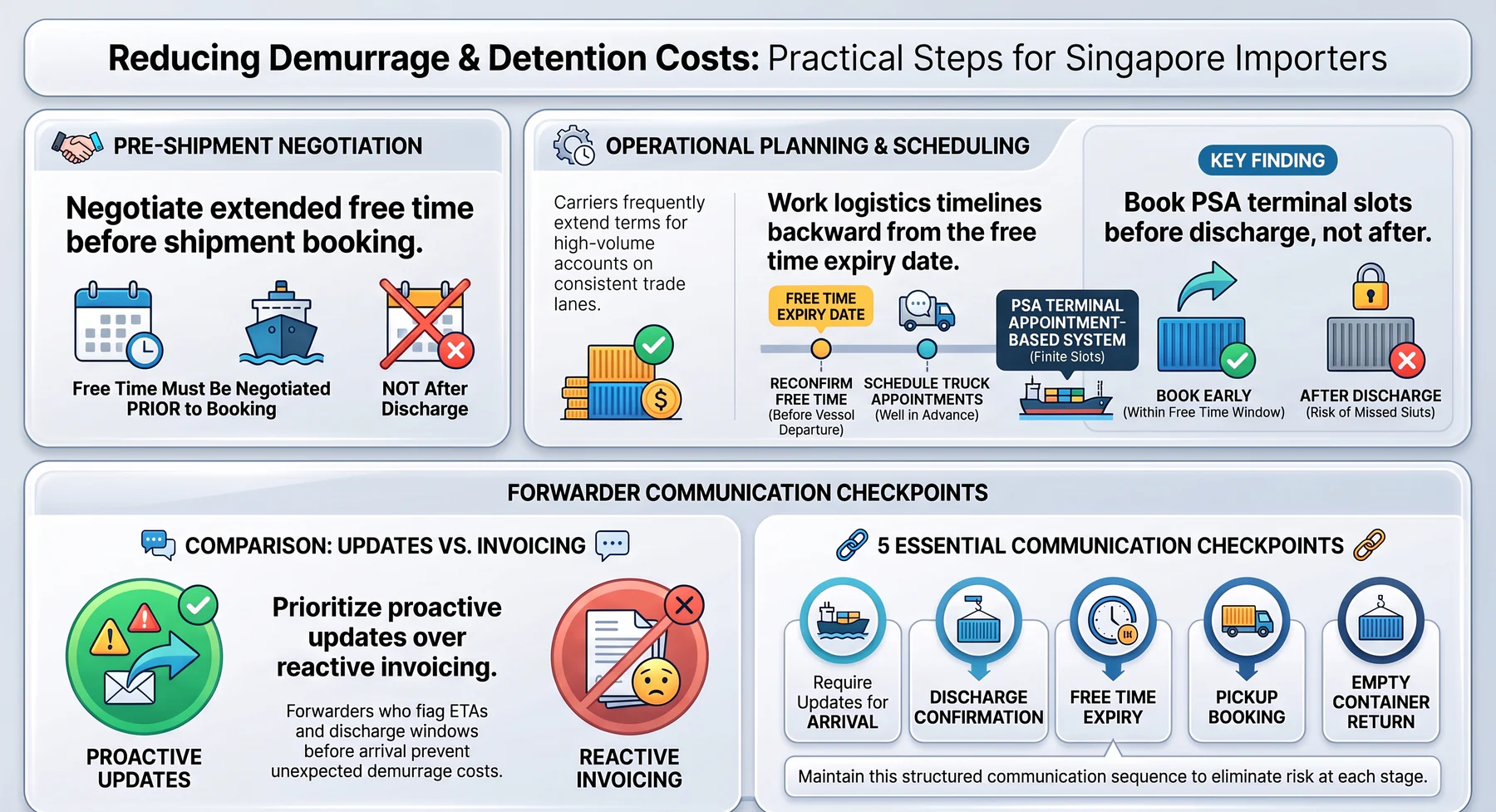
Work the logistics timeline backward from the free time expiry date. Confirm the free time with the carrier before the vessel departs, then book truck appointments accordingly. Better coordination between warehouse release and transport scheduling also supports order fulfilment in Singapore, especially when a missed pickup can trigger additional container charges.
Singapore's appointment-based trucking system at PSA terminals means truck slots are finite. Booking before discharge, not after, gives importers the best chance of securing a slot within the free time window.
2. Communicate proactively with freight forwarders
A proactive freight forwarder flags vessel ETAs, discharge windows, and free time expiry dates before cargo arrives. Reactive communication only after an invoice appears is significantly more expensive.
Set a communication cadence with your forwarder: arrival update, discharge confirmation, free time expiry date, pickup booking, and empty return. Each checkpoint, if missed, creates demurrage or detention risk.
3. Negotiate extended free time before cargo arrives
Free time is negotiable, particularly for importers with consistent volume on a trade lane. Carriers will often extend free time for accounts that move significant container numbers each month.
This negotiation must happen before the shipment is booked, not after discharge. A conversation with your carrier account manager or forwarder at the start of a relationship costs nothing.
Controlling Demurrage Costs with Inventory and Logistics Software
Manual tracking of free time expiry across multiple carriers and container types leaves too much to memory. One overlooked deadline can cost more than the margins saved elsewhere on the same shipment. Businesses managing multiple shipments can also improve supply chain visibility in Singapore by connecting shipment status, inventory levels, and logistics activity in one system.
1. Shipment tracking and automated deadline alerts
Logistics software addresses deadline risk by centralising shipment data and automatically calculating demurrage cutoffs based on discharge date and carrier-specific free time rules.
Automated alerts notify the relevant teams when a container approaches its free time limit. That lead time, even 24 to 48 hours, is often the difference between a timely pickup and a chargeable delay.
2. Faster documentation turnaround through ERP integration
Documentation delay is the most controllable internal risk factor for demurrage. When purchase orders, shipping instructions, and customs data sit in disconnected systems, delays become structural.
Businesses importing through Singapore can also review inventory management software in Singapore to compare systems that connect stock visibility with purchasing and warehouse workflows.
An integrated ERP connects procurement, logistics, and finance into a single workflow. When a purchase order is confirmed, the shipping instruction follows. When the BL arrives, customs declaration data is pre-populated.
3. How HashMicro helps Singapore businesses stay ahead of port deadlines
HashMicro's supply chain module tracks container milestones from purchase order through to goods receipt. Configurable alerts notify the relevant teams when a free time deadline or empty return date is approaching.
ERP integration connects procurement, warehouse, and finance teams so documentation workflows keep pace with port deadlines. For businesses in Singapore, this visibility reduces avoidable port charges directly.
Conclusion
Demurrage is one of the most avoidable costs in Singapore's supply chain, yet it remains consistently overlooked. Short free time windows, escalating tiers, and backdated charges all amplify the cost of brief delays. Businesses that understand how demurrage is calculated are better placed to control it, and knowing where internal processes create the most risk is the practical starting point.
With the right logistics discipline and software in place, demurrage becomes a manageable part of the import process rather than a recurring surprise. Account for it before the vessel arrives, not after the invoice does. Book a free consultation with our team to see how an integrated logistics system helps you track free time, coordinate container collection, and keep demurrage under control.

Frequently Asked Questions
Demurrage is the fee a shipping carrier charges when a container stays at the port terminal longer than the agreed free time. It is billed per container per day from the moment the free period expires.
Demurrage applies when a laden container sits inside the terminal beyond free time. Detention applies when an empty carrier container is held outside the terminal, past the permitted return period.
Laytime is the time agreed between a shipowner and a charterer for loading or unloading a cargo. It is most relevant in bulk and charter shipping, and exceeding it triggers demurrage payable to the shipowner.
Charges are billed per container per day based on the carrier tariff published for Singapore. Most carriers apply a tiered rate that escalates over time, with some backdating charges to the discharge date, significantly increasing the total bill.
Yes, but successful disputes are uncommon. Carriers may waive charges if the delay was entirely outside the control of the importer. Disputes must be raised promptly in writing with clear supporting documentation.
Confirm the free time set by the carrier before the vessel arrives, book truck slots before discharge, and have customs documents ready in advance. Proactive forwarder communication and automated deadline tracking cover most preventable scenarios.