








A construction building contractor is the business responsible for delivering a building or civil works package under a client contract. In Singapore, that may include housing, offices, warehouses, roads, drainage, bridges, mechanical and electrical services, or interior fit-out.
What Is a Construction Building Contractor?
The project owner commissions and pays for the works. The main contractor coordinates delivery and appoints subcontractors for individual packages. A subcontractor works under another contractor; a specialist trade contractor delivers a technical scope, such as piling or mechanical and electrical works. These roles can overlap.
Contractors need to coordinate scope, programme, procurement, labour, equipment, claims and cash flow. Their income depends on the contract price and measured work, while profitability depends on execution costs. A positive forecast margin does not guarantee enough cash to meet next month's payments.
How a Building Contract Works from Tender to Handover
- Review tender drawings, specifications and the bill of quantities (BoQ); complete the quantity take-off.
- Price materials, labour, equipment and subcontract packages, then add overhead, risk allowances and margin.
- Submit the bid and, following award, record the agreed scope, value, payment terms and programme.
- Create the project execution cost baseline and work packages, then begin procurement and site delivery.
- Measure completed work, prepare progress claims and track deductions and payments.
- Complete inspections, resolve outstanding work and submit handover records and the final account as required by the contract.
A lump-sum contract fixes the price for a defined scope, with payment based on agreed progress or milestones. Quantity risk generally rests with the contractor, subject to the agreement. A unit-price contract pays measured quantities multiplied by agreed rates. A combined contract can use lump sum for structure and unit rates for earthworks, requiring different measurement methods within one project.
Throughout this article, assume an illustrative SGD 2,000,000 lump-sum contract, a ten per cent down payment of SGD 200,000 and five per cent retention. These are example terms, not Singapore requirements or market benchmarks.
If the internal cost baseline is SGD 1,700,000, the initial forecast gross profit is SGD 300,000, or 15 per cent of contract value. The baseline allocates expected execution costs; the contract value is the selling price. Variations and revised cost forecasts can change the eventual result.
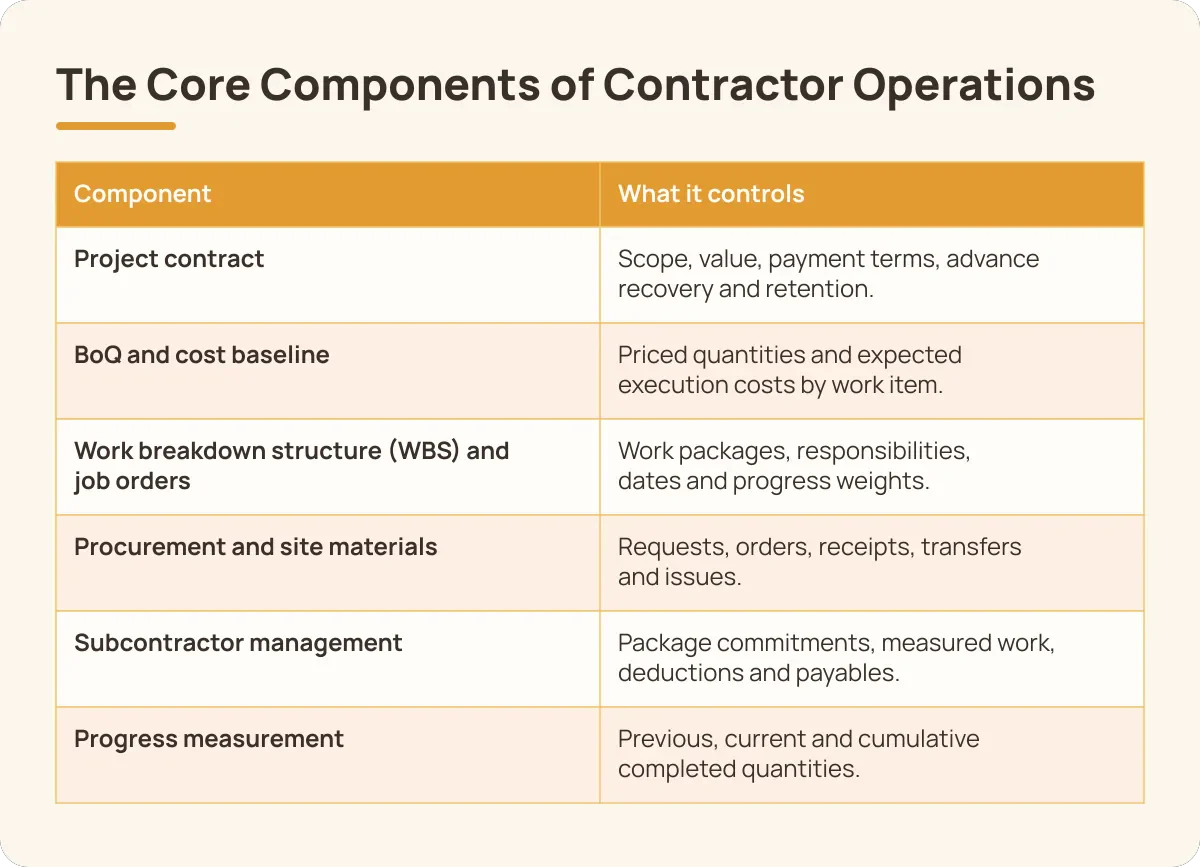
The Core Components of Contractor Operations
| Component | What it controls |
|---|---|
| Project contract | Scope, value, payment terms, advance recovery and retention. |
| BoQ and cost baseline | Priced quantities and expected execution costs by work item. |
| Work breakdown structure (WBS) and job orders | Work packages, responsibilities, dates and progress weights. |
| Procurement and site materials | Requests, orders, receipts, transfers and issues. |
| Subcontractor management | Package commitments, measured work, deductions and payables. |
| Progress measurement | Previous, current and cumulative completed quantities. |
| Billing and accounting | Claims, invoices, project costs and cash movements. |
The baseline schedule assigns dates and weights to work packages. Weighted progress equals the sum of each package's weight multiplied by its completion percentage. For example, a package weighted at one-fifth contributes ten percentage points when half complete. Plotting cumulative planned progress over time produces the baseline S-curve.
Material control follows a separate sequence: raise a request against a BoQ item, check available stock, purchase any shortage, receive deliveries at the site or transfer central stock, then record issues to the work and charge their cost to the project.
A stock count checks materials remaining on site. Construction progress measurement, sometimes called opname, establishes completed work through quantity surveys. Delivered steel does not by itself prove that installation is complete.
Owners review budgets, programme and certified contractor bills. Main contractors also need package commitments and site costs; subcontractors need records of their own quantities, material use and claims.
Progress Claims, Retention and Contractor Cash Flow
The quantity surveyor records completed work by BoQ item, distinguishing previous, current-period and cumulative quantities. Measurement supports consultant certification; the certified value then supports the progressive claim, contractual deductions and customer invoice. Submission and certification steps follow the agreement.
Continue the illustrative contract above. Assume cumulative certified work of SGD 300,000, including SGD 100,000 previously claimed. For this example, recover the advance at a ten per cent rate of each period's gross work value and retain five per cent, with both deductions calculated on that gross value.
| Current claim calculation | SGD |
|---|---|
| Cumulative certified work | 300,000 |
| Less previous gross claims | (100,000) |
| Current-period gross work | 200,000 |
| Advance recovery: ten per cent × 200,000 | (20,000) |
| Retention: five per cent × 200,000 | (10,000) |
| Current net claim before any applicable tax | 170,000 |
If the previous claim used the same deductions, cumulative advance recovery is SGD 30,000 and retention held is SGD 15,000. The unrecovered advance is SGD 170,000. Do not deduct previous net payments as though they were previous gross claims: that would distort the calculation. Actual recovery rates, retention caps and release conditions follow the contract.
Profit can coexist with a cash gap because materials, wages, equipment hire and subcontract payments fall due before customer receipts. Forecast cash using expected payment dates, rather than certified values alone.
For subcontractors, record certified package costs and track advance recovery, retention held and the net payable separately. Retention remains a separate obligation until released under the subcontract terms.
KPIs to Monitor on Every Building Project
| KPI | Formula | Management use |
|---|---|---|
| Schedule variance | Actual weighted completion percentage − planned weighted completion percentage | Identifies slippage in percentage points. |
| Forecast cost variance | Approved cost baseline − forecast final cost | Flags expected overruns; a negative value is adverse. |
| Forecast gross margin | (Forecast revenue − forecast execution cost) ÷ forecast revenue, expressed as a percentage | Shows expected project profitability. |
| Work-progress completion | Sum of package weight × package completion percentage | Tracks delivery using the agreed project weights. |
| Material usage variance | Actual quantity consumed − allowed quantity for completed work | Flags excess consumption by material. |
| Cash conversion lag | Customer receipt date − related project payment date, in days | Shows how long expenditure awaits recovery. |
| Retention outstanding | Cumulative retention held − cumulative retention released | Supports release planning and cash forecasting. |
Compare the S-curve with actual weighted progress and costs at the same reporting date. Forecast final cost should include actual expenditure, outstanding commitments and remaining uncommitted work, without counting invoiced commitments twice. Agree contractual thresholds in the contract and internal warning thresholds in project controls.
Common Mistakes and Better Controls
- Pricing an incomplete take-off: approve the BoQ and document exclusions and assumptions before bidding.
- Confusing project and company budgets: maintain an execution cost baseline for each project. RAB, where used in project records, refers to the project estimate or baseline.
- Treating progress measurement as stock counting: maintain quantity-survey evidence separately from inventory counts.
- Issuing materials without charge codes: link requests, receipts and issues to the correct project and BoQ item.
- Missing advance recovery: reconcile each claim to the contractual deduction rules and remaining advance balance.
Owner monitoring also needs a clear boundary: tracking budgets and contractor bills does not itself certify the contractor's measured work. Certification remains a separate contractual responsibility.
How HashMicro Supports Contractor Project Control
When assessing construction project management software, use the workflow above as a demonstration checklist: contract and BoQ setup, execution baseline, job orders, S-curve, material requests, receipts, issues and claim review. Check how each record connects to project costs.
Where HashMicro's Project Management module is used, WBS tasks can carry owners, weights and dates, with progress rolling up from tasks to the project. Budget carryover between periods, transfers between periods or projects, and approved budget-change requests are available with configuration.
Owner-side support is partial: an owner can keep project budgets and tasks, record certified contractor claims as vendor bills and track budget against actual expenditure. HashMicro does not provide owner-side certification of the contractor's progress measurement.
Sources
Based on supplied construction and product knowledge-base material; no external sources were used. Monetary examples exclude tax calculations. Example percentages are not statutory requirements; actual payment and deduction terms follow the signed contract.