








ERP implementation failure rarely comes from one software defect. It usually develops through several control breakdowns involving scope, ownership, data, people, technology, testing and governance. A project may appear to be on schedule while finance teams still cannot reconcile balances, warehouse staff rely on spreadsheets and managers disagree about the approved process.
This guide helps CFOs, CIOs, IT managers, operations leaders and steering committees in Singapore identify ERP implementation risks, assign preventive controls and assess go-live readiness.
Key Takeaways
ERP implementation failure usually develops through connected breakdowns in scope, ownership, data, testing, adoption and governance.
A 12-risk control matrix connects early warning signs with accountable roles and preventive actions.
Implementation partners should be assessed on delivery capability, process knowledge, governance and support, not demonstrations alone.
Go-live should be approved only when process, data, technology, people, cutover and support evidence is complete.

Why Do ERP Implementations Fail?
"ERP implementation success depends on more than software. Clear ownership, reliable data, tested processes and strong governance help Singapore businesses reduce implementation risks and prepare for a controlled go-live."
ERP projects usually fail through a series of connected control gaps. The following sections explain how these gaps develop across people, processes, data, technology and governance.
Failure as a Chain of Control Breakdowns, Not a Single Cause
Most ERP failures are the result of connected problems rather than one isolated mistake. A weak scope definition can create unnecessary customisation. Unclear ownership can delay decisions. Delayed decisions can compress testing, training and migration activities. By go-live, the project may be technically complete but operationally unprepared.
Early warning signs often appear before the launch date. These include unresolved decisions, ageing risks, incomplete data ownership, low key-user attendance, missing integration dependencies and repeated changes to acceptance criteria.
Where People, Process, Data, Technology and Governance Intersect
ERP systems connect activities that were previously managed by separate departments. A purchase order affects receiving, inventory, supplier billing, cash flow and financial reporting. If each department defines success differently, the system may work as configured while the end-to-end process still fails.
Effective implementation control therefore requires more than technical configuration. It requires approved processes, reliable data, accountable owners, realistic user participation, tested integrations and a governance structure that resolves issues quickly.
What Are the 12 Most Common ERP Implementation Failure Risks?
The following matrix connects each risk with an early warning sign, an operational consequence, an accountable role and a preventive control.
| Risk | Early warning sign | Operational consequence | Accountable role | Preventive control |
|---|---|---|---|---|
| Unclear business outcomes and scope | Requirements continue expanding without measurable success criteria | Features are configured without improving priority processes | Executive sponsor and product owner | Signed scope baseline and outcome measures |
| Weak executive sponsorship | Cross-functional conflicts remain unresolved | Decisions stall and key users return to daily work | Executive sponsor | Decision log with escalation deadlines |
| Fragmented process ownership | No owner exists for the complete workflow | Sales, warehouse and finance records do not reconcile | Process owners | Approved future-state process map |
| Poor master data quality | Duplicates and missing mandatory fields remain | Orders, stock values and reports require manual correction | Data owners and finance lead | Profiling, cleansing and reconciliation evidence |
| Under-scoped integrations | Interfaces are listed as “to be confirmed” | Transactions arrive late, fail or duplicate | IT integration lead | Dependency inventory and integration test plan |
| Excessive customisation | Every legacy exception is treated as mandatory | Testing, release and maintenance risks increase | Solution architect and process owner | Design-authority approval for deviations |
| Unrealistic timeline or budget | Critical decisions move into build or UAT | Overtime, rushed testing and change requests increase | Programme manager and sponsor | Rebaselined plan with capacity evidence |
| Insufficient user participation | Key users miss workshops and test cycles | Procedures do not match real operations | Functional leads | Named key-user allocation and attendance tracking |
| Incomplete testing | Scenarios cover only successful transactions | Exceptions, reporting and closing activities fail | Test manager and process owners | Defined exit criteria and UAT sign-off |
| Inadequate training and change management | Attendance is tracked but competence is not assessed | Users return to spreadsheets and inconsistent workarounds | Change lead and line managers | Role-based training and competency checks |
| Weak cutover planning | No owner exists for migration, freeze or rollback | Orders, receipts or opening balances are lost or duplicated | Cutover manager and business owners | Sequenced runbook and tested rollback criteria |
| Ineffective post-go-live support | Support roster and escalation tree are incomplete | Defects remain unresolved while teams improvise | Service owner and partner lead | Hypercare plan, triage rules and knowledge base |
What Do ERP Failure Case Studies Teach Decision-Makers?

Public ERP cases are most useful when their documented lessons are translated into practical controls. The sections below show how decision-makers can evaluate evidence and apply it to Singapore operations.
Lessons from Verifiable Public Cases
Public ERP case studies should be used only when the underlying facts can be verified through company disclosures, court documents, regulator filings or reputable reporting. A responsible analysis should separate documented events from later interpretations about why the project struggled.
The most useful lesson is not that one factor always causes failure. It is that decision-makers should ask which dependency was known, who owned it, what evidence was reviewed and whether the residual risk was formally accepted.
A Singapore Case on Data and Process Incompatibility
Consider a Singapore distributor that connects purchasing, warehouse receiving and finance inventory valuation. The interface may be technically available, yet stock balances can remain inaccurate when item masters, units of measure, warehouse locations and accounting mappings are inconsistent.
This is an illustrative operating scenario, not a client case study. It shows why implementation teams must test business data and end-to-end processes together. A successful interface test alone does not prove that the resulting inventory and financial records are correct.
Turning Each Lesson into a Decision Checkpoint
Convert each verified case-study lesson into a control that can be reviewed during the project. Examples include scope-change approval, migration reconciliation, integration dependency review, UAT exit criteria, rollback testing and post-go-live escalation coverage.
Each checkpoint should identify an owner, required evidence, approval authority, open exceptions and the consequence of postponing the decision.
How Can You Prevent ERP Implementation Failure Before the Project Starts?
Prevention begins before configuration starts. Strong sponsorship, clear ownership, controlled scope and realistic project capacity create the foundation for a more manageable implementation.
Executive Sponsorship and Process Ownership
The executive sponsor should protect the programme’s priorities, resolve cross-functional disputes and approve risk acceptance. Each end-to-end process should also have one business owner who can approve the future-state design and acceptance criteria.
Without clear ownership, teams may optimise local tasks while creating reconciliation problems between sales, warehouse, purchasing and finance.
Scope Control and Data Ownership
Define which processes, entities, users, integrations and reports are included. Separate mandatory controls from desirable improvements, and document assumptions that could change the timeline or budget.
Assign data owners for customers, suppliers, products, units of measure, chart-of-accounts mappings and opening balances. Data preparation should include profiling, cleansing, migration rehearsal and reconciliation.
Implementation Capacity and Acceptance Criteria
Protect key-user time for workshops, testing, training and cutover. Include operational backfill where necessary so participation does not depend on employees working indefinitely outside normal capacity.
Define acceptance criteria before configuration begins. These criteria should cover process outcomes, data accuracy, integration behaviour, reporting, user competence, cutover execution and support readiness.
How Should Singapore Businesses Choose an ERP Implementation Partner?
The right partner must provide more than a capable software platform. Singapore businesses should assess delivery discipline, industry understanding, governance and support before making a selection.
Separating Software Fit from Delivery Capability
Software fit and delivery capability are separate decisions. A system may support the required functions, while the implementation approach still lacks migration controls, testing discipline or clear decision rights.
Ask the partner to demonstrate complete business scenarios such as purchase-to-receipt, order-to-cash, stock transfer, manufacturing and month-end reporting. Review how the partner handles exceptions, approvals, data ownership and integration failures.
Industry Understanding and Post-Go-Live Support
Industry understanding matters when operations include multiple entities, outlets, warehouses, tax requirements, approval policies or high transaction volumes. Ask for process maps, sample deliverables, relevant implementation references and documented customer responsibilities.
Post-go-live support should define hypercare coverage, triage rules, response expectations, escalation contacts, knowledge transfer and the transition to steady-state support.
A Neutral Evaluation Framework Without Vendor Ranking
Use a weighted evaluation framework based on your requirements rather than a generic vendor ranking. Assess process fit, integration capability, migration controls, testing, training, governance, documentation, support and commercial transparency.
Record evidence for each score and identify assumptions that require confirmation in the proposal.
What Should Your ERP Go-Live Readiness Checklist Include?
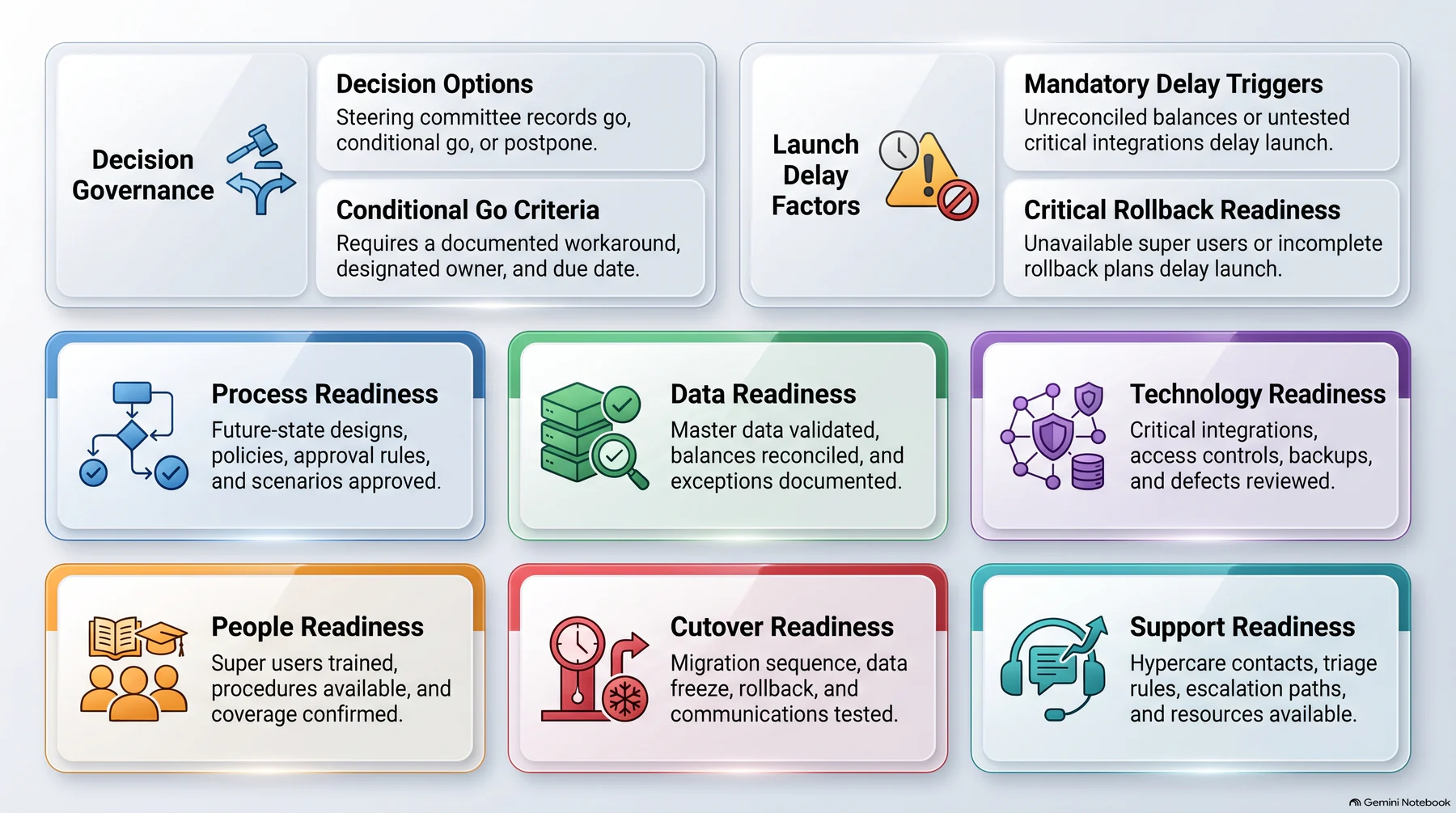
Go-live approval should be based on evidence across six readiness areas:
- Process readiness: Future-state designs, policies, approval rules and end-to-end scenarios are approved.
- Data readiness: Master data is validated, opening balances are reconciled and exceptions are documented.
- Technology readiness: Critical integrations, access controls, backups and high-priority defects have been reviewed.
- People readiness: Super users are trained, procedures are available and business coverage is confirmed.
- Cutover readiness: Migration sequence, data freeze, rollback criteria and communications are tested.
- Support readiness: Hypercare contacts, triage rules, escalation paths and knowledge resources are available.
The steering committee should record the decision as go, conditional go or postpone. A conditional go requires a documented workaround, owner and due date. Unreconciled opening balances, untested critical integrations, unavailable super users or an incomplete rollback plan should normally delay launch.
Who Owns ERP Implementation Decisions: Business, IT, or the Partner?
ERP implementation decisions require clear boundaries between business ownership, technical responsibility and partner delivery. Defining these responsibilities early reduces delays and accountability gaps.
Where Business Ownership Stops and IT Ownership Begins
The business owns the definition of a correct process, approval policy, reporting requirement, data accountability and operational acceptance. IT owns architecture, environments, security, access, integration design and technical readiness.
These responsibilities overlap during testing and cutover, so each shared activity still needs one named decision owner.
What Stays the Partner’s Responsibility
The implementation partner is responsible for configuration guidance, delivery planning, technical execution, documentation, testing coordination and issue escalation within the agreed scope.
The partner does not replace the customer’s responsibility for business policy, data ownership, key-user participation or final go-live risk acceptance.
How Can Singapore Teams Score Process Readiness Before Configuration?
Use a simple evidence-based score for each major process before configuration begins. Rate each area from 0 to 2:
| Score | Meaning |
|---|---|
| 0 | Not defined or no supporting evidence exists |
| 1 | Partially defined, with open decisions or unresolved exceptions |
| 2 | Approved, documented and supported by an accountable owner |
Assess the current process map, future-state design, policy decisions, data owner, integration dependency, acceptance criteria and key-user availability. A low score should trigger a decision or remediation action before configuration proceeds.
The score is a governance aid, not a statistical prediction of project success. It should be reviewed when scope, ownership, data or technical dependencies change.
What Should the Steering Committee Review Before Approving the Next ERP Gate?

Each project gate should be approved using evidence rather than schedule pressure. A recurring review structure helps the steering committee identify unresolved risks before they affect the next phase.
A Recurring Review Agenda for Go or No-Go Decisions
Each steering-committee review should examine completed deliverables, open decisions, risk ageing, scope changes, data quality, integration status, defect severity, user participation, budget, timeline and readiness for the next gate.
Every unresolved item should have an owner, due date, decision authority and documented business impact.
Signs a Gate Should Not Be Approved Yet
Do not approve the next gate when critical assumptions remain untested, process owners disagree about the future state, opening balances cannot be reconciled, key users are unavailable, high-severity defects remain open or the cutover and support plans are incomplete.
Schedule pressure should not replace evidence. If the project proceeds with residual risks, the sponsor should record the decision and the actions required to contain those risks.
Conclusion
ERP implementation failure is best managed as a business-control issue with technology dependencies. Clear outcomes, accountable owners, reliable data, tested integrations, active users and structured governance reduce the likelihood of disruption.
Singapore organisations should require evidence before mobilisation and go-live. Review the scope, data assessment, decision log, risk register, testing results, cutover plan and support model before approving the next stage. Schedule a free consultation to know what your company needs!

Frequently Asked Questions About ERP Implementation Failure
There is no single universal failure rate that applies to every ERP project. Risk varies according to scope, data quality, integrations, governance, user participation, implementation capacity and post-go-live support. Use leading indicators such as unresolved decisions, incomplete data ownership and ageing critical defects instead of relying on one industry-wide percentage.
Failure usually results from several connected weaknesses rather than one cause. The most common factors include unclear scope, poor master data, weak process ownership, late decisions, insufficient testing and limited user participation.
Yes, if the organisation pauses to reassess scope, ownership, data, integrations, defects, resources and governance. Recovery may require a rebaselined plan, additional data cleansing, renewed process decisions, targeted testing and stronger executive oversight.
The required duration depends on the number of entities, modules, integrations, users, transaction volumes and business scenarios. Testing should continue until critical end-to-end scenarios, exceptions, migration results, user acceptance criteria and cutover procedures have documented evidence.
Local knowledge can help with Singapore processes, tax requirements, operating practices and support coverage, but it does not remove implementation risk. Evaluate the partner’s delivery evidence, data controls, testing discipline, governance model and post-go-live support before making a decision.