







SFRS Singapore is the set of accounting standards that companies in Singapore follow when they prepare financial statements. The Accounting Standards Committee issues them, with IFRS as the basis.
The system splits into three frameworks: SFRS(I), the full FRS, and SFRS for Small Entities. Your company's size, listing status, and public accountability decide which one applies.
This article compares the three frameworks and explains who qualifies for the small entity option. It also shows how to meet ACRA requirements and keep your records ready for audit.
Key Takeaways
SFRS in Singapore refers to the Singapore Financial Reporting Standards issued by the ASC under ACRA, based on IFRS and mandatory for Singapore-incorporated companies.
SFRS vs SFRS(I) vs IFRS differ by entity type: SFRS(I) covers SGX-listed companies, full FRS covers non-listed ones, and IFRS applies only in narrow dual-listed cases.
SFRS for Small Entities is optional for companies meeting two of three tests: S$10 million revenue, S$10 million assets, or 50 employees, and no public accountability.
Best practices for SFRS reporting include yearly entity size checks, one framework applied consistently, inventory software for audit-ready valuation, and documented policies.
What Is SFRS in Singapore?
SFRS stands for Singapore Financial Reporting Standards. These accounting rules decide how Singapore entities recognise and measure transactions, then disclose them in their financial statements.
The Accounting Standards Committee (ASC) develops the standards under the Accounting Standards Act 2007. The ASC now sits under ACRA, the authority that oversees company filings.
The standards are based on IFRS Accounting Standards, so most principles match the international framework. ASC statements of applicability then set out which entities must use each version.
The term SFRS has two common meanings. It can describe the whole family of Singapore standards, or only the full FRS that the ASC still issues alongside SFRS(I).
Singapore-incorporated companies must use a framework the ASC has prescribed. Directors carry that duty under the Companies Act, as ACRA's page on financial statements explains.
"SFRS isn't a single rulebook, but a family of frameworks. Singapore companies should identify which one fits their size and accountability, as it will shape every disclosure in the accounts."
SFRS vs SFRS(I) vs IFRS in Singapore
Three names dominate most Singapore reporting discussions: SFRS, SFRS(I), and IFRS. They overlap heavily, yet each applies to a different group of entities.
1. From SFRS to SFRS(I): what changed for Singapore companies
Singapore introduced SFRS(I), or SFRS (International), to converge fully with IFRS. The ASC issues these standards and their interpretations, which follow IFRS Accounting Standards closely.
SFRS(I) became mandatory for SGX-listed Singapore-incorporated companies from annual periods starting on 1 January 2018. The IFRS Foundation tracks this in its jurisdiction page.
Non-listed companies could adopt SFRS(I) voluntarily. Those that stayed on the older framework still report under FRS volumes, which the ASC publishes for each annual period.
2. When Singapore companies can use IFRS
Singapore-incorporated companies must apply ASC-prescribed standards, so IFRS Accounting Standards do not replace SFRS(I) by default. A narrow exception exists for some dual-listed companies.
A company listed on SGX and on a foreign exchange may use IFRS Accounting Standards where the foreign exchange requires them. Confirm the conditions in the IFRS Foundation's Singapore profile first.
Because SFRS(I) aligns closely with IFRS, groups with overseas parents usually find the two easy to reconcile. Their consolidation work then involves fewer adjustments.
3. SFRS, SFRS(I), and IFRS compared side by side
The table below shows how the frameworks differ in practice. Check your entity type against each row before you choose.
| Framework | Issued by | Typically used by | Disclosure level |
|---|---|---|---|
| SFRS(I) | ASC under ACRA | SGX-listed Singapore-incorporated companies, and non-listed companies that opt in | Full |
| FRS (full SFRS) | ASC under ACRA | Non-listed companies that have not moved to SFRS(I) | Full |
| SFRS for Small Entities | ASC under ACRA | Qualifying small companies without public accountability | Reduced |
| IFRS Accounting Standards | International standard setter | Limited cases such as some dual-listed companies | Full |
SFRS(I) and IFRS share almost the same requirements, while the full FRS keeps a few timing differences. SFRS for Small Entities departs furthest, with simpler recognition and measurement rules.
Key Principles of Singapore Financial Reporting Standards
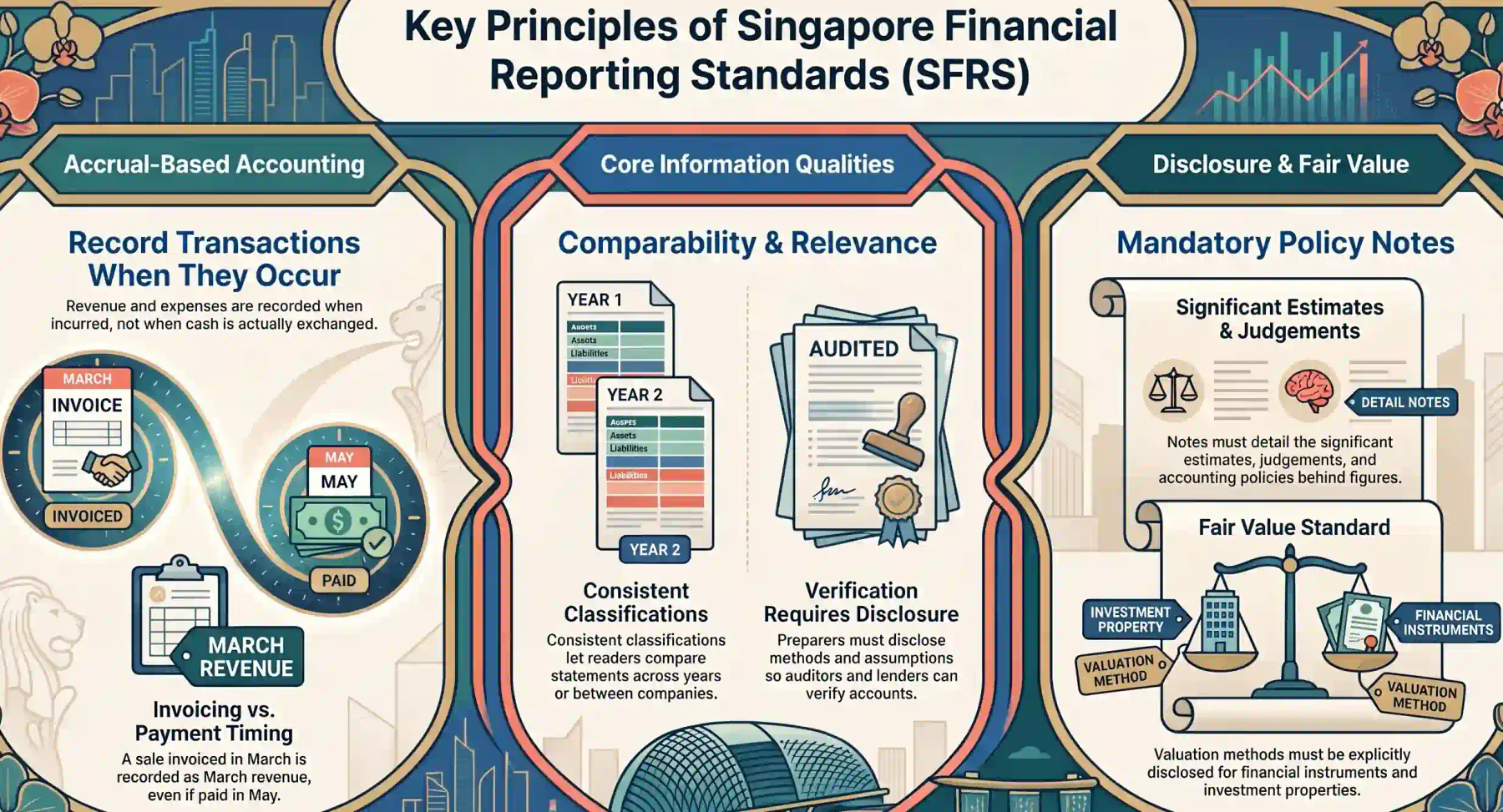
All three Singapore frameworks rest on the same reporting principles, which come from IFRS. Those principles shape how every line of a financial statement is prepared.
1. Accrual-based accounting
Singapore standards require entities to record transactions when they occur, not when cash changes hands. A sale invoiced in March therefore counts as March revenue, even if the customer pays in May.
This approach shows a company's true position in each period, although it demands more record-keeping than cash accounting. Businesses must track what customers still owe and what they owe suppliers.
2. Comparability, relevance, and verification
Comparability lets readers set one company's statements beside another's, or one year beside the next, and reach fair conclusions. Consistent policies and classification make that possible.
Relevance means the information helps readers predict outcomes or confirm earlier expectations. Verification asks preparers to disclose their methods and assumptions so that others can check them.
Auditors and lenders in Singapore rely on these qualities when they review accounts. Weak documentation in any one of them slows the review.
3. Disclosure and fair value requirements
The standards require notes on accounting policies and on the significant estimates and judgements behind the figures. These notes show how management reached its numbers.
Fair value measurement covers items such as financial instruments and investment property, and entities disclose how they set each value. Full frameworks require more detail than small entities do.
SFRS for Small Entities Explained
SFRS for Small Entities is the simplified option in Singapore's reporting system. The ASC based it on the IFRS for SMEs and first made it effective for periods beginning on or after 1 January 2011.
The ASC issued a third edition in August 2025 to follow the International Board's revised IFRS for SMEs. Use of the framework remains optional for eligible companies.
1. How SFRS for small entities differs from full SFRS
Companies using SFRS for Small Entities make fewer disclosures than those using the full framework. Recognition and measurement rules are also simpler, which shortens preparation time.
The framework applies as a complete set. A company cannot mix it with provisions from the full standards.
ACRA's XBRL filing tool update reflects these differences. Small entities, for example, need not present a prior-year reconciliation for property, plant and equipment and intangible assets.
2. Eligibility thresholds: revenue, assets, and headcount
A company must first qualify as a small entity. It needs to meet at least two of three size criteria.
The first two criteria are annual revenue and total assets of no more than S$10 million each. The third is a headcount of 50 employees or fewer.
The company must also meet these tests for two consecutive years. A newly incorporated company may apply the framework in its first two reporting periods if it is not publicly accountable.
3. Who cannot use SFRS for small entities
Publicly accountable entities cannot use the framework, regardless of their size. This group includes entities whose debt or equity instruments trade in a public market.
Institutions that hold assets for a broad group of outsiders, such as banks and insurers, also fall outside it. The ASC's statement of applicability sets out the complete test.
SFRS for Small Entities or SFRS(I): Which Fits Your Business?
Eligibility only tells you what a company may use. The better framework depends on where the company is heading and who reads its accounts.
1. Growth and IPO plans
A company that expects to list on SGX or outgrow the size criteria soon will lose access to SFRS for Small Entities. Starting with a full framework avoids a forced switch later.
Switching carries real costs, including staff training and updates to accounting systems. Those costs rarely pay off if the company would use the simpler framework for only a short time.
2. Lender and investor expectations
Some banks and investors ask for financial statements prepared under a full framework. A company that relies on external funding should confirm this preference before it adopts the simpler option.
FRS 119 adds another route, but it is narrower than it first appears. It applies to subsidiaries without public accountability whose parent prepares consolidated SFRS(I) or IFRS statements.
FRS 119 applies to periods beginning on or after 1 January 2027, and earlier adoption is permitted. ACRA's XBRL filing tools already offer a reduced disclosure option.
3. Group structure and transition costs
Subsidiaries often follow the framework their parent uses. Mixed frameworks across a group add reconciliation work at consolidation.
Transition costs also depend on how far the current system can adapt. Finance teams should list which reports and policies would change before they commit.
SFRS Compliance for Businesses in Singapore
Choosing a framework is only the first task. Companies must then prepare accounts under it and file them with ACRA on time.
1. ACRA requirements for Singapore-incorporated companies
Directors must make sure the financial statements follow the prescribed standards. ACRA sets out these obligations on its page for financial reporting duties for directors.
Companies file financial statements with their annual return, in XBRL format where required. The filing identifies the framework used, so the choice must be deliberate.
ACRA also reviews statements under its Financial Reporting Surveillance Programme. Using the wrong framework or leaving out disclosures can draw queries.
Do not confuse framework eligibility with audit exemption. A private company may qualify for an audit exemption under the small company concept, which uses separate tests.
The same accounts also support tax filings with IRAS. Consistency across every submission therefore matters.
2. Example: a Singapore SME outgrowing the S$10 million threshold
Consider an illustrative Singapore electronics distributor with S$8 million in revenue and 35 employees. It uses SFRS for Small Entities, and its total assets stay well below S$10 million.
Next year, revenue reaches S$11 million. The company still meets the asset and headcount criteria, so it still passes two of the three size tests.
Later, headcount rises to 55 and only the asset test remains. Because eligibility depends on meeting two tests across two consecutive years, the company should plan its move to a full framework now.
Its finance team must prepare fuller disclosures and align its records with the new framework. Early planning spreads that workload across the year.
3. Where to track updates from ACRA and the Accounting Standards Committee
The ASC's SFRS(I) pages list new and amended standards, with a separate volume for each annual reporting period. Review them before every year-end.
ACRA's accounting standards page links to local news and public consultations. The IFRS Foundation news page shows international changes that the ASC may adopt locally.
The ASC does not advise on how to apply the standards. Companies should consult an accounting firm or a professional body for interpretation.
Best Practices for SFRS Reporting
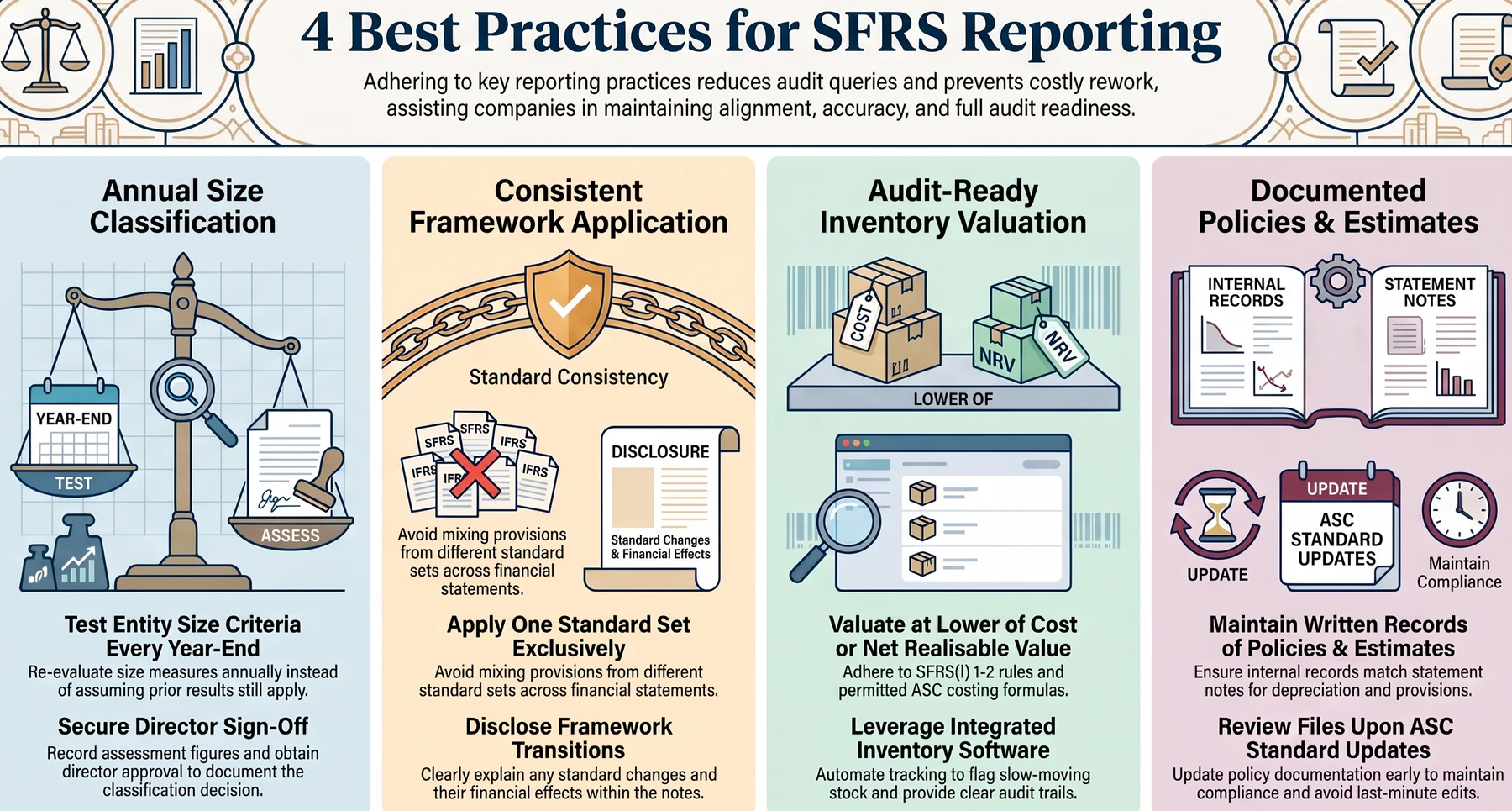
Good reporting habits reduce audit queries and rework. These practices suit companies on any of the three frameworks.
1. Classify your entity size every year
Test the size criteria at each year-end instead of assuming last year's result still holds. A shift in any of the three size measures can change eligibility.
Record the assessment and the figures behind it, and have a director sign it off. Auditors then see how the company reached its conclusion.
2. Apply one framework consistently across all statements
Choose one framework for the whole set of statements and apply it in full. As noted earlier, SFRS for Small Entities cannot be mixed with provisions from the full standards.
Consistency also applies over time. When a company changes framework, it should explain the change and its effects in the notes.
3. Keep inventory valuation audit-ready with inventory software
SFRS(I) 1-2 requires entities to measure inventory at the lower of cost and net realisable value. The ASC's SFRS(I) volumes set out the permitted cost formulas.
An integrated accounting system can record purchase costs and stock movements as they happen. It also supports a consistent costing method and flags slow-moving stock that may need a write-down.
Reliable stock records shorten year-end counts and give auditors a clear trail from purchase to valuation. Companies with several warehouses gain the most from this control.
4. Document accounting policies and estimates
Write down each accounting policy, along with the estimates behind figures such as depreciation and provisions. The notes in the statements should then match this internal record.
Review the policy file whenever the ASC issues a new or amended standard. Updating it early keeps year-end disclosures accurate and avoids last-minute rewrites.
SFRS compliance holds only when policies, disclosures and records stay aligned. Hashy AI reads size tests, policy files and disclosure notes together, then flags what needs review.






Conclusion
SFRS Singapore covers SFRS(I), the full FRS, and SFRS for Small Entities. Your size and public accountability decide which framework fits, and growth plans may favour a full one.
Amended FRS 119 adds a reduced disclosure option. Companies should run yearly eligibility checks and track ASC and ACRA updates, with professional advice on applying them.
If you want to learn more about IRFS in Singapore, then book a free consultation with our experts today and gain deep insights to improve your business.
Frequently Asked Questions
SFRS stands for Singapore Financial Reporting Standards, the accounting rules for Singapore entities. The ASC issues them under ACRA, and they are based on IFRS Accounting Standards.
SFRS(I) is the IFRS-aligned framework, mandatory for SGX-listed Singapore-incorporated companies from 2018. SFRS often means the older full FRS that some non-listed companies still use.
Companies that are not publicly accountable and meet two of three tests: revenue up to S$10 million, assets up to S$10 million, or 50 employees or fewer. The tests must hold for two years.
No, it is optional. Eligible companies may use it or stay on a full framework, but they must apply the chosen framework in full and cannot mix provisions from both.
Only in limited cases, such as some companies listed on SGX and on a foreign exchange that requires IFRS. Otherwise, Singapore-incorporated companies apply ASC-prescribed standards.