







Vendor pricelist management helps Singapore buyers order against agreed prices, units and validity dates. Reliable controls reduce pricing disputes and make supplier bills easier to review. This guide gives procurement managers and finance teams practical examples, comparison criteria and checks for choosing a workable process.
The sections below explain the workflow, evaluation criteria and practical next steps.
What is Vendor Pricelist Management?
Vendor pricelist management is how a business records, approves and updates the prices each supplier has agreed to. A good pricelist holds the product, unit, currency, quantity tiers and validity dates. Buyers then order at the agreed price instead of guessing. For Singapore firms, it also keeps GST input tax claims and supplier bills easy to check. Check the relevant requirements in IRAS, Conditions for claiming input tax.
Think of a pricelist as the menu board at a hawker stall. Everyone sees the same price before they order. Nobody argues at the counter. Procurement works the same way when the agreed price is visible to every buyer.
This guide is written for buyers, finance teams and owners of Singapore SMEs. Here is what it covers.
- What a vendor pricelist holds and how it differs from a quote or a purchase order.
- The Singapore rules that touch supplier prices and invoices.
- A worked S$ example with quantity tiers and GST.
- A checklist with a good answer and a red flag for each control.
- How to choose between a spreadsheet and a procurement system.
Pricelist, Quotation, Blanket Order and PO Compared
Many teams mix up these four documents. Each one does a different job in the buying cycle. Mixing them up leads to old prices on new orders. The table below sets them side by side.
| Document | What it records | Who issues it | When to use it |
|---|---|---|---|
| Vendor pricelist | Agreed prices, units, tiers and validity dates | Procurement, from supplier terms | Repeat items with stable specs |
| Quotation | A supplier's offer for one request | The supplier | New items or expired prices |
| Request for quotation (RFQ) | Your request for prices from suppliers | Procurement | When you need fresh, comparable offers |
| Blanket order | Price and quantity agreed over a period | Procurement and supplier together | Recurring materials called off in batches |
| Purchase order (PO) | A confirmed order for set items and quantities | Procurement | Every confirmed purchase |
A pricelist supports a decision but does not replace approval. The price must still fit the product, quantity and delivery date. Read our guide to purchase orders for the PO side of the cycle.
Picture a Jurong food manufacturer that buys flour every week. A blanket order fixes the price for six months. Each weekly PO then calls off a batch at that price. The pricelist covers smaller items like gloves and cartons.
Why Pricelists Go Wrong in Singapore Firms
Most price errors start small. A buyer picks the right item but the wrong pack size. Another uses a rate that expired last quarter. Over a year, these slips add up to real money.
The causes are usually the same across industries. Common ones look like this.
- Prices live in several spreadsheets with no single owner.
- Supplier codes do not map to your own item codes.
- Units differ, such as cartons from the supplier and pieces in your stock.
- Validity dates are missing, so old prices never expire.
- Discounts sit in emails rather than in the price record.
A Tuas engineering workshop shows the risk. It buys fasteners from three suppliers in S$ and one in US dollars. Without a currency field, a buyer once keyed a US$ price as S$. The bill came in 35% higher than the team expected.
Singapore Rules That Touch Supplier Prices
A pricelist is a commercial tool, but tax rules shape how you use it. GST is 9% in Singapore since 1 January 2024. If your business is GST-registered, you can usually claim GST on purchases as input tax. You need a valid tax invoice from a GST-registered supplier to do so. Check the relevant requirements in IMDA, InvoiceNow nationwide e-invoicing framework.
So record whether each price includes or excludes GST. Most B2B pricelists quote prices before GST. Mixing the two will distort your price variance figures. It can also lead to the wrong input tax claim.
IRAS sets out what a valid tax invoice must show. Key items are listed below.
- The supplier's name, address and GST registration number.
- An invoice number and the invoice date.
- A description of the goods or services.
- The amount before GST, the GST rate and the GST amount.
- The total amount payable, with GST shown in S$ on foreign currency invoices.
A simplified tax invoice is allowed when the total is S$1,000 or less, including GST. Check the full list in the IRAS invoicing guide. Your receiving and finance teams should know these rules well. Check the relevant requirements in IRAS, Invoicing customers (tax invoice requirements).
E-invoicing matters too. InvoiceNow is Singapore's national e-invoicing network, run by IMDA on the Peppol standard. IRAS is phasing in a GST InvoiceNow Requirement for GST-registered businesses. Ask your suppliers whether they can send InvoiceNow invoices, as structured data makes price checks easier. Check the relevant requirements in IRAS, GST InvoiceNow Requirement.
Worked S$ Example with Quantity Tiers and GST
The company, scenario and results in this example are hypothetical.
Here is an illustrative case. A Woodlands packaging distributor buys corrugated cartons for its clients. The supplier's pricelist has two tiers and a volume discount. The numbers below are fictional but realistic.
| Line | Value |
|---|---|
| Tier 1 price, below 500 cartons | S$1.20 per carton |
| Tier 2 price, 500 cartons or more | S$1.00 per carton |
| Extra discount on tier 2 | 5% |
| Order quantity | 600 cartons |
| Price before GST | 600 × S$1.00 × 0.95 = S$570.00 |
| GST at 9% | S$51.30 |
| Total payable | S$621.30 |
Now the bill arrives. The supplier charged S$1.05 per carton with no discount. The billed amount before GST is S$630.00. That is S$60.00 above the agreed price.
Price variance is the billed unit price minus the agreed unit price, times the quantity. Here it is (S$1.05 − S$0.95) × 600 = S$60.00. A clear pricelist turns this into a quick query to the supplier. Without one, the extra S$60 slips through unnoticed.
Check the order size too. A buyer who needs only 450 cartons may order 500 to reach tier 2. That saves on unit price but ties up cash and space. Compare the total spend, not just the unit price.
The Vendor Pricelist Workflow, Step by Step
A good process runs like a relay race. Each runner hands a clean baton to the next. Here the baton is the agreed price.
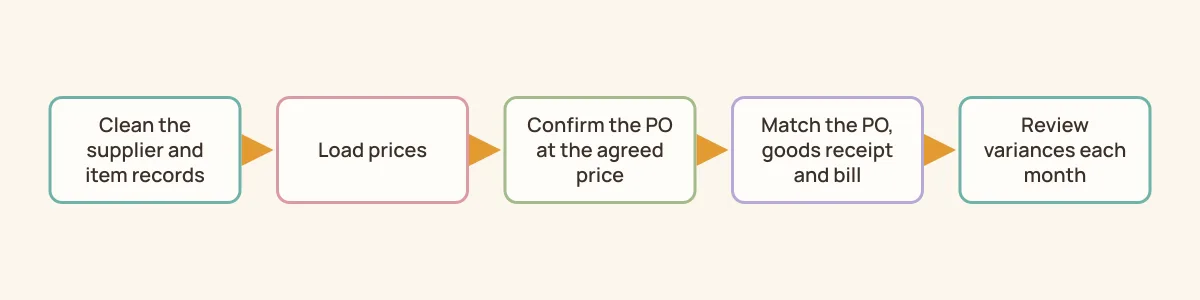
- Clean the supplier and item records first. Remove duplicates and map supplier codes to your item codes.
- Load prices with currency, unit, tiers, GST basis and start and end dates.
- Name one owner per supplier category who approves price changes.
- Let requesters raise purchase requests without a price if they do not know it.
- Use the pricelist or blanket order when a valid price exists. Run an RFQ when it does not.
- Confirm the PO at the agreed price and keep that price on record.
- Match the PO, goods receipt and bill before payment.
- Review variances each month and renegotiate where needed.
Step seven is the classic three-way match. It checks that you pay only for what you ordered and received. Our guide to three-way matching explains it in more detail.
Consider a Paya Lebar office supplies reseller. Its admin staff request stationery but never see supplier prices. Procurement fills in the price from the pricelist at the PO stage. Staff get their items, and prices stay with the people who manage them.
Pricelist Control Checklist with Red Flags
Use this checklist to test your current process or a new system. Each control lists what a good answer sounds like. It also lists the red flag to watch for.
| Control | Good answer | Red flag |
|---|---|---|
| Price owner | One named owner per supplier category | Anyone can edit any price |
| Validity dates | Every price has a start and end date | Prices never expire |
| Units and currency | Each price states its unit and currency | Units are assumed from habit |
| GST basis | Prices are marked as before or after GST | Some prices include GST and some do not |
| Change history | Old prices are kept with a reason for change | Old prices are overwritten |
| Price on the PO | The agreed price fills in on the PO | Buyers type prices by hand |
| Bill check | Bills are matched to the PO and receipt | Bills are paid on the supplier's word |
| Expiry review | Someone reviews prices due to expire each month | Expired prices are found only after a dispute |
Score each row as pass or fail. Three or more fails suggest your pricelist is a liability, not a control. Fix the owner and validity rows first, as the others depend on them.
KPIs to Track Pricelist Accuracy
Numbers show whether the process works. Track a small set each month and compare like with like. Keep units and currencies the same across periods.
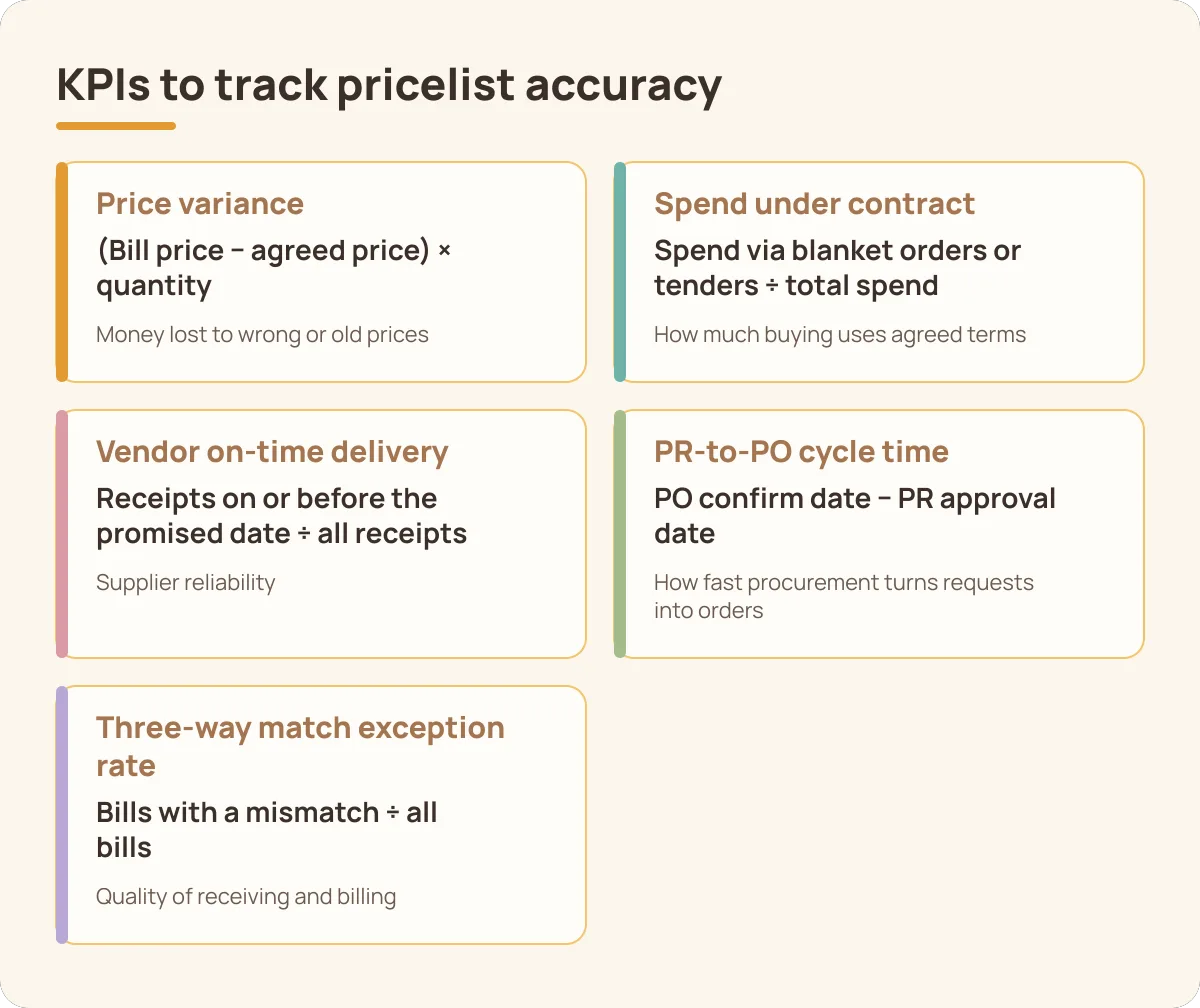
| KPI | Formula | What it tells you |
|---|---|---|
| Price variance | (Bill price − agreed price) × quantity | Money lost to wrong or old prices |
| Spend under contract | Spend via blanket orders or tenders ÷ total spend | How much buying uses agreed terms |
| Vendor on-time delivery | Receipts on or before the promised date ÷ all receipts | Supplier reliability |
| PR-to-PO cycle time | PO confirm date − PR approval date | How fast procurement turns requests into orders |
| Three-way match exception rate | Bills with a mismatch ÷ all bills | Quality of receiving and billing |
Spend under contract is like a phone plan. The more you use your plan, the less you pay for extras. Our guide to procurement spend analysis shows how to break spend down further.
Take a Kallang events company with S$400,000 of yearly supplies. If S$300,000 runs through agreed prices, its spend under contract is 75%. The other S$100,000 is where price leaks are most likely. That is where to set up new pricelists next.
Spreadsheet or Procurement System?
Small teams often start with a spreadsheet. That is fine while the supplier list is short. Problems grow as more buyers and items join. Use the table below to decide.
| Situation | Spreadsheet | Procurement system |
|---|---|---|
| Under 10 suppliers and one buyer | Usually enough | Optional |
| Several buyers or departments | Version clashes are likely | Recommended |
| Quantity tiers and discounts | Error-prone formulas | Recommended |
| Frequent price changes | History is easily lost | Recommended |
| Bills checked against POs | Manual and slow | Recommended |
A spreadsheet is like a paper map. It works on a short, familiar route. On a long trip with many turns, a GPS saves time and mistakes. A procurement system plays the GPS role for buying.
How HashMicro Supports Vendor Pricelists
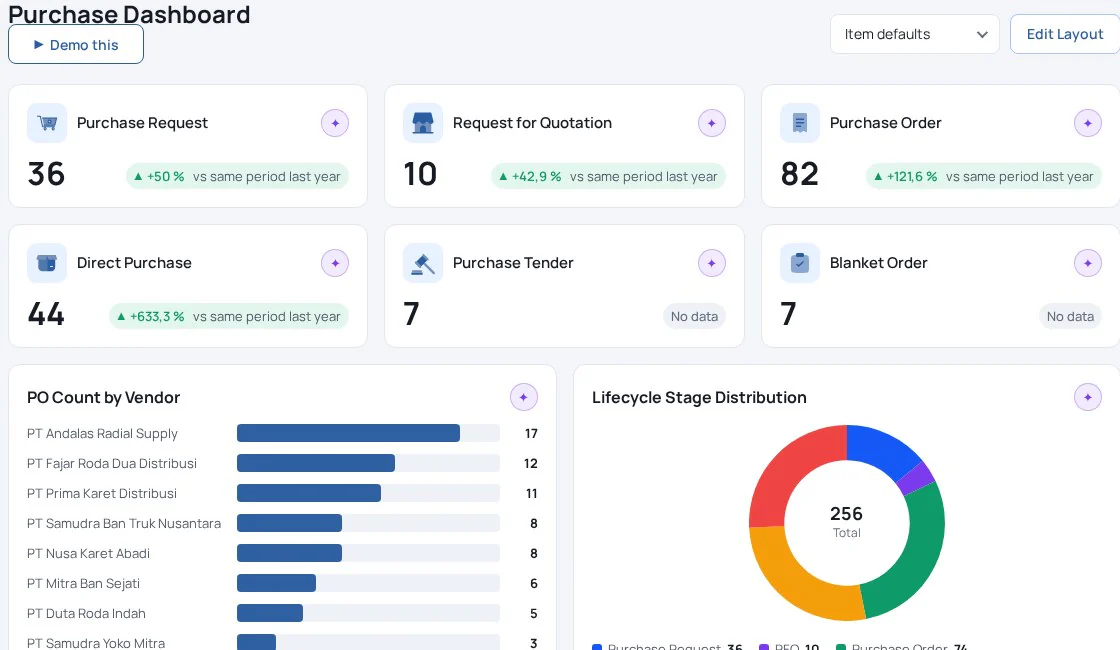
HashMicro's procurement and purchasing management system keeps vendor pricelists inside the purchasing module. Pricelist amendments have their own menu. Agreed vendor prices fill in on the purchase order by default. This cuts manual price entry by buyers.
The system supports several buying routes. Pick the one that fits each purchase.
- Purchase requests that carry only the product, quantity and date.
- RFQs when you need fresh supplier prices.
- Blanket orders that call off quantities at the contract price.
- Direct purchases that skip the RFQ step.
- Purchase tenders for formal multi-vendor bidding.
Approval rules can route requests and orders by amount, department or order type. Each PO tracks ordered, received and billed quantities. It shows a match status, such as over-billed or received but not billed. The three-way matching mode can be set to Monitoring Only or Strict.
Vendor performance templates can score suppliers on delivery, quality and price. A Supplier Performance dashboard then shows scores and spend in one view. Use these results in your next price negotiation. Our guide on negotiating with suppliers offers tactics for that talk.
Want to see it with your own prices? Book a demo and bring one supplier's real pricelist. Ask the team to load two tiers, expire one price and enter a bill above the agreed rate.
Conclusion
Start with the workflow and control requirements that matter to your team. Test those requirements with representative records before deciding on the next step.
Frequently Asked Questions
Vendor pricelist management keeps supplier prices, units, quantity breaks and validity periods organised for purchasing. A Singapore buyer ordering 100 cartons needs to know whether the quoted price applies per carton or per item. The agreed price is only one part of the buying decision; delivery charges, currency and payment terms also affect the comparison.Before selecting a solution, write down the specific record your team needs and who will maintain it. Use a small representative sample to confirm the scope with operational staff. Separate essential requirements from optional features, then ask the supplier to demonstrate the essential workflow using that sample.
Compare 2 quotations for the same item and required date. Align the unit of measure, pack quantity, currency and delivery terms before selecting a price. Record the validity period and approval. Carry the agreed basis into the purchase order, then investigate differences at receipt or billing rather than silently replacing the original supplier agreement.As a next step, draw the handover between the people involved and identify where an exception needs approval. Walk through the example with the person doing the work and the person reviewing it. Keep the supporting documents together so another team member can reproduce the result.For the connected process, read: Related workflow: purchase orders.
Project cost depends on supplier count, item data, approval rules, imports and integrations. Maintaining 50 supplier-item combinations is different from importing 5,000 historical price lines. An illustrative SGD 500 data-cleanup allowance is an internal planning example, not a licence price. Request separate charges for migration, configuration, user training, support and recurring access.Build a total-cost worksheet for the first year and later years, showing assumptions beside each line. Include internal staff time and ask who owns any extra work. Next, compare written proposals against the same scope and acceptance criteria rather than comparing headline fees with different inclusions.
A Singapore buyer comparing SGD 12 per carton with SGD 1.10 per item must check the carton size first. At 12 items per carton, the second offer costs SGD 13.20 for an equivalent carton before other charges. Document the comparison basis and retain the quotations so another reviewer can reproduce the buying decision.Treat these figures as an illustrative scenario, not a statutory threshold or promised result. Next, repeat the exercise with a recent transaction and ask its owner to explain every difference. Check the relevant official guidance for the local context, and retain the documents that support your own decision.Official local guidance: IRAS, Invoicing customers (tax invoice requirements).
Use at least 3 test cases: an expired price, a quantity break and a changed pack size. Check how the buyer sees the applicable price and how exceptions receive approval. Avoid selecting a system only because its import screen looks simple. The important test is whether an incorrect or expired rate can reach an order unnoticed.Next, record the outcome of each test and the evidence used to accept it. Name a responsible reviewer for any gap before agreeing the final scope. Ask for a repeat demonstration when a critical case fails, then use the written results to support the purchasing decision.
- Agree mandatory requirements before scoring.
- Test exceptions with supporting evidence.
- Record gaps and obtain a named owner.
Start with one supplier category and 20 frequently purchased items. Clean duplicate vendor codes and agree the price owner before loading the sample. Rehearse a price update, its approval and a resulting purchase order. Keep the old agreement available for comparison and establish who reviews changes before extending the rollout to all suppliers.Next, agree the pilot’s acceptance criteria with the people who will use the process daily. Keep an issue log with an owner and a due date for each problem. Expand only after the team can explain and reproduce the results, including the handling of a correction.
- Prepare a clean sample and assign owners.
- Rehearse the complete workflow and corrections.
- Review the results before expanding the rollout.
Purchasing, receiving and accounting must share the same order references and units. For 1 order with a partial receipt, compare the agreed price with the eventual vendor bill. Define how corrections flow between systems and who investigates mismatches. Do not assume that importing a spreadsheet also creates a monitored supplier portal or automatic external price feed.Next, create a field map and test both a normal record and a deliberate error before approving the interface. Ask who monitors failures and how corrections are replayed without duplicates. Include support responsibilities in the written scope so a future incident has a clear owner.