






Dangerous goods storage in Singapore requires more than keeping chemicals in a secure room. Businesses must classify each substance, control how it is stored, and keep records that support safe daily handling.
The process starts with the product label and safety data sheet. These details help determine the storage class, compatible materials, licence requirements, and controls needed before stock enters the warehouse.
This article explains how to manage dangerous goods storage in Singapore. It covers classes, permits, segregation, flammable liquids storage, and practical controls for safer warehouse operations.
Key Takeaways
Dangerous goods storage covers every stage from receiving to dispatch, so physical safeguards must work alongside accurate records.
NEA permit or licence or an SCDF P&FM storage licence may be necessary to have, depending on the substance and quantity.
Dangerous goods segregation relies on SDS compatibility data, so incompatible materials sit in separate, labelled zones with physical barriers.
Inventory software can link stock, locations, SDS files, and renewal dates, but it does not replace licences, SDS review, or trained judgement.

What Is Dangerous Goods Storage?
Dangerous goods storage is the controlled keeping of substances that can create fire, health, environmental, or transport risks. The controls apply from receiving and put-away to picking, repacking, and dispatch.
In practice, safe storage combines physical safeguards with accurate records. A suitable cabinet or warehouse zone matters, but so do labels, quantities, location data, staff training, and emergency access.
"Safe dangerous goods storage depends on more than a secure room. Every substance needs a correct classification and a compatible location, and staff must check the records before they handle it."
Dangerous Goods Classes and What They Mean for Storage
Dangerous goods classes describe the main hazard presented by a substance during storage and handling. Singapore businesses should use the classification shown on the label and SDS before assigning a location.
These classes do not replace a site assessment or a storage plan. They provide the starting point for choosing compatible zones, controls, and handling procedures.
This section looks at each class from a warehouse point of view. For divisions, packing groups, and label colours, see our guide to the IMDG hazard classes.
| Class | Hazard | Storage focus |
|---|---|---|
| Class 1 | Explosives | Strict access, ignition, and impact controls |
| Class 2 | Gases | Cylinder security, ventilation, and protection from damage |
| Class 3 | Flammable liquids | Approved cabinets, spill control, and ignition management |
| Class 4 | Flammable solids and related hazards | Dry conditions, separation, and controlled handling |
| Class 5 | Oxidising substances and organic peroxides | Separation from flammables and combustible materials |
| Class 6 | Toxic and infectious substances | Restricted access, exposure controls, and clear SDS access |
| Class 7 | Radioactive material | Specialist facilities, monitoring, and controlled access |
| Class 8 | Corrosive substances | Compatible shelving, bunding, and secondary containment |
| Class 9 | Miscellaneous dangerous substances and articles | Controls based on the specific hazard and SDS |
Classifying products early helps the warehouse team make consistent decisions. It also creates a common reference for procurement, safety officers, transport partners, and emergency responders.
Commercial storage options include dangerous goods storage equipment for flammable, corrosive, oxidising, toxic, and gas-cylinder hazards. Product selection should still follow the substance, quantity, and site assessment.
1. Class 1: Explosives
Class 1 covers explosive substances and articles that can react rapidly or release significant energy. Storage requires strict access control, approved facilities, and a layout that reduces ignition and impact risks.
2. Class 2: Gases
Class 2 includes gases stored under pressure, liquefied, or refrigerated. Cylinders need secure upright storage, suitable ventilation, protection from damage, and separation based on gas properties.
3. Class 3: Flammable liquids
Class 3 covers flammable liquids, which can release vapour that ignites when it reaches a suitable source. Use approved cabinets or storage areas, limit ignition sources, and control spills around containers.
4. Classes 4 to 9: Solids, oxidisers, toxic, corrosive, and miscellaneous goods
Classes 4 to 9 cover flammable solids, oxidisers, toxic substances, corrosives, radioactive materials, and other regulated hazards. Their controls vary, so the SDS must remain available at the point of storage.
Singapore Licences and Requirements for Dangerous Goods Storage
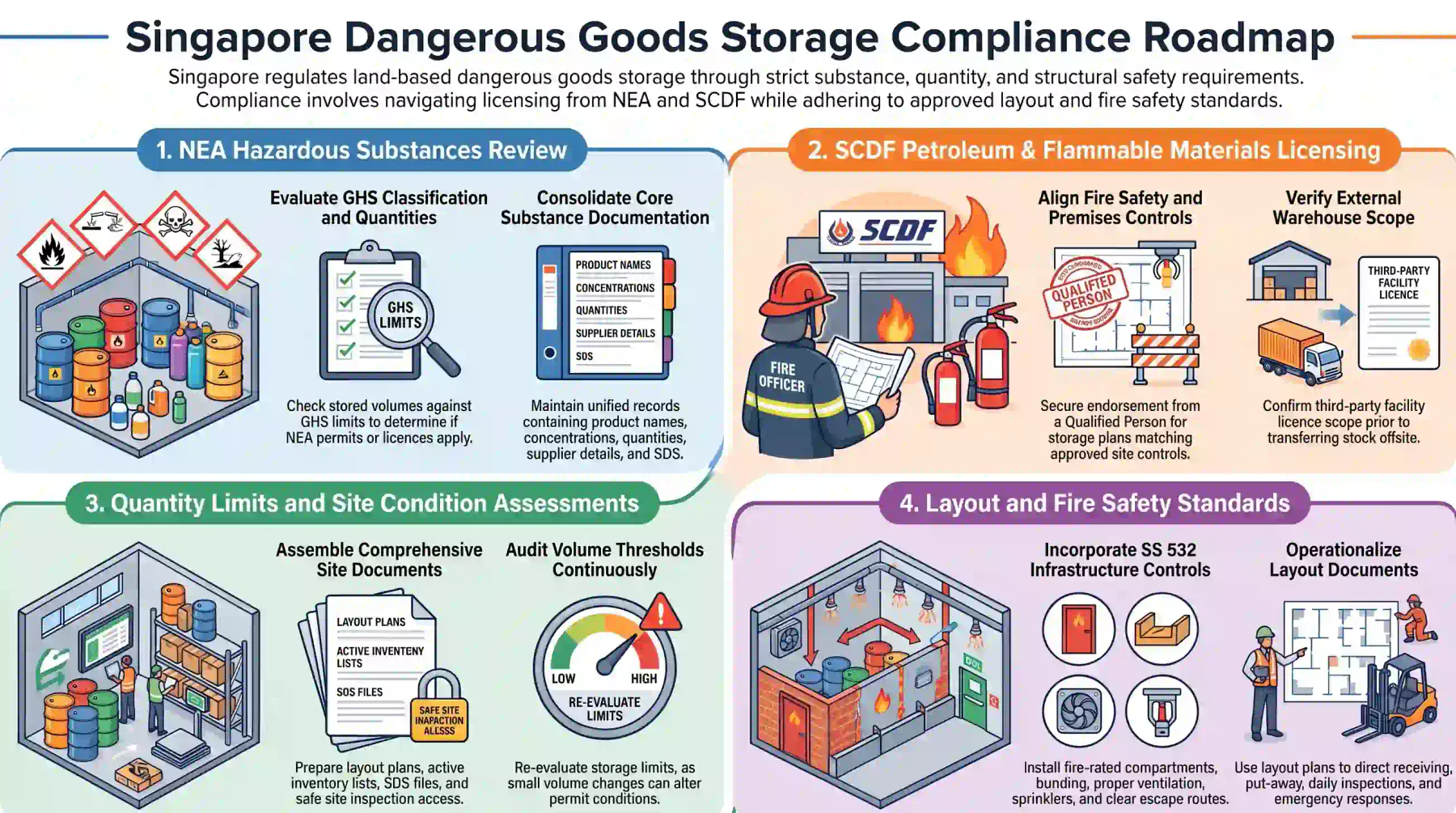
Singapore controls dangerous goods through substance, quantity, and building safety requirements. Depending on what you store, you may need an NEA Hazardous Substances Permit or Licence, an SCDF P&FM storage licence, or both.
Goods arriving by sea fall under port rules until they clear the terminal. Our guide to where NEA takes over after the port explains that handover, and the requirements below apply once the goods are stored on land.
Use a Singapore dangerous goods storage compliance checklist to map the sequence before submitting documents. The final requirement depends on the substance, quantity, premises, and proposed storage method.
1. When an NEA hazardous substances permit or licence may apply
Start by checking each substance against its GHS classification and stored quantity. The result helps determine whether the business needs an NEA permit, a full licence, or further review.
Keep the product name, concentration, quantity, supplier details, and current SDS together. This gives the reviewer and warehouse team one consistent record for each substance.
2. When an SCDF P&FM storage licence may apply
SCDF requirements focus on petroleum and flammable materials, fire safety, and the storage environment. A Qualified Person may need to endorse the storage plan, with site controls aligned to the approved premises.
Businesses using an external facility should confirm its licence scope before moving stock. A dangerous goods warehouse may help when internal space cannot meet the required controls.
3. How storage quantities and site conditions affect approval
Approval is not based on paperwork alone. Singapore businesses should prepare a layout plan, current inventory, SDS files, storage limits, fire protection details, and evidence that the site can be inspected safely.
Review the maximum quantity before receiving new stock. A small change in volume can affect the storage arrangement, permit conditions, or need for further assessment.
4. Fire safety, SS 532, and warehouse layout considerations
Fire-rated compartments, bunding, ventilation, sprinklers, escape routes, and fire appliance access should be considered during planning. The storage layout should also reflect SS 532 requirements where applicable.
Do not treat the layout as a document that only supports the application. It should guide receiving, put-away, inspections, emergency response, and future expansion.
Dangerous Goods Segregation: How to Separate Incompatible Materials
Dangerous goods segregation keeps incompatible substances apart so a leak, heat source, or damaged container does not create a larger incident. Storage decisions should follow each SDS, not only the product name or available aisle.
This section covers segregation inside the warehouse. Separation on board a vessel follows different rules, set out in our guide to IMDG stowage and separation levels at sea.
1. Use SDS compatibility information before assigning storage locations
Use the SDS to identify incompatibilities, recommended conditions, and emergency actions. Record the result in the item master so receiving and warehouse staff can see the same instructions.
Where compatibility is unclear, pause the put-away process and ask a qualified safety professional. A fast storage decision can create a larger handling risk when the hazard information is incomplete.
2. Separate flammable liquids, oxidisers, corrosives, and toxic substances
Flammable liquids should not share uncontrolled space with oxidisers, ignition sources, or incompatible corrosives. Toxic substances and gases also need dedicated zones that limit exposure and support safe access.
Use physical barriers, clear signs, and approved containers to reinforce the separation. Staff should not rely on memory when adjacent products have similar packaging.
3. Create clearly labelled storage zones and access routes
Mark each zone by class, hazard, and storage limit. Keep aisles, exits, fire appliances, spill response equipment, and ventilation points clear at all times.
Apply the same layout logic to temporary holding areas and returned goods. These locations are easy to overlook, yet they can create unsafe mixtures during busy receiving periods.
| Material type | Keep separate from | Control focus |
|---|---|---|
| Flammable liquids | Oxidisers, ignition sources, and incompatible corrosives | Approved cabinets, bunding, and fire controls |
| Oxidising agents | Flammables, organic materials, and reducing agents | Dedicated zone and clean storage conditions |
| Corrosives | Incompatible acids, alkalis, and reactive metals | Compatible shelving and secondary containment |
| Compressed gases | Heat, impact, and incompatible gases | Secured cylinders and suitable ventilation |
| Toxic substances | Food, staff areas, and incompatible chemicals | Restricted access and accessible SDS records |
Segregation also affects movement through the warehouse. Put-away rules should block an unsafe location before stock is placed there, while cycle counts should confirm that goods remain in the approved zone.
Flammable Liquids Storage: Key Controls for Singapore Warehouses
Flammable liquids storage needs controls that reduce vapour release, ignition, and spill exposure. The right arrangement depends on the liquid, quantity, container, and approved warehouse conditions.
Storage equipment should support both daily access and emergency response. It must also keep containers stable, labelled, and separated from incompatible goods.
1. Choose suitable cabinets, compartments, and approved storage areas
Choose a cabinet, compartment, or storage area designed for the liquid and quantity held. Check its construction, capacity, ventilation, fire rating, and compatibility before placing stock inside.
Do not select equipment based only on appearance or price. The cabinet should match the risk assessment, site approval, and handling routine.
2. Control ignition sources, ventilation, and electrical risks
Control ignition sources near flammable liquids, including open flames, hot work, sparks, and unsuitable electrical equipment. Keep ventilation paths clear so vapour does not accumulate around workers or equipment.
Use suitable electrical controls where the assessment requires them. Staff should also know how to close containers, report leaks, and isolate unsafe equipment.
3. Use bunding, spill containment, and fire protection equipment
Use bunding, drip trays, or secondary containment to limit the spread of leaks. Keep absorbents, spill kits, fire extinguishers, and emergency contacts close to the storage area.
Inspect containers for damage, corrosion, swelling, or loose closures. Remove unsafe packaging from active storage and follow the site procedure for quarantine or disposal.
4. Keep emergency exits and fire appliance access clear
Keep emergency exits, fire appliances, and access routes clear around flammable liquids storage. Stacked cartons or temporary pallets should never narrow a route needed during an incident.
Mark the storage area so visitors and contractors can recognise the hazard. Review the layout after every equipment change, stock increase, or incident.
Safety Data Sheet Requirements and Chemical Inventory Records
Safety data sheet requirements support safe decisions throughout the product lifecycle. The SDS explains the hazard, handling conditions, incompatibilities, emergency response, and disposal considerations.
A warehouse should treat SDS records as operational information, not paperwork stored away from the stock. The latest version should be easy to find before handling begins.
1. Keep a current SDS for every dangerous substance
Keep a current SDS for every dangerous substance stored on site. Check that the document matches the product name, supplier, concentration, and formulation in the inventory.
Review SDS files when a supplier changes, a product is reformulated, or new hazard information is issued. Remove obsolete copies from active work areas.
2. Match GHS labels, stored quantities, and chemical records
Match GHS labels, stored quantities, and chemical records before products are put away. Differences can indicate a receiving error, an unrecorded transfer, or a change that needs review.
Use a consistent item code across purchasing, warehouse, and safety records. This makes it easier to connect the correct SDS to the physical container.
3. Track SDS versions, stock movements, and inspection history
Record the SDS version date and the time it was reviewed. Keep a history of stock movements, inspections, spills, and corrective actions for each storage zone.
This history helps managers identify repeated handling issues. It also gives inspectors a clearer view of how the business controls dangerous goods over time.
4. Make SDS information accessible to workers and inspectors
Make SDS information available to workers before they handle the substance. Digital access can help, but staff should still know where printed or offline copies are kept during a system or network outage.
Use clear naming and search terms so workers can find the right document quickly. Translate instructions when needed, while keeping the official SDS and hazard information intact.
How to Design a Safe Dangerous Goods Warehouse Layout
Warehouse design should connect safety controls with the way goods actually move. A layout that looks compliant on paper can still create risk if receiving, picking, and returns use the same crowded space.
Plan the layout around hazard classes, quantities, movement paths, inspection points, and emergency access. Review the plan whenever the product range or operating process changes.
1. Plan fire-rated compartments and suitable storage levels
Plan fire-rated compartments and suitable storage levels for the hazards and quantities held. Keep heavy or unstable containers at safe heights, with shelves that can withstand the expected load.
Leave enough space for inspection and safe handling. Avoid placing containers where heat, water, impact, or falling items can damage them.
2. Define segregation zones, stacking limits, and aisle clearances
Define segregation zones with visible signs, floor markings, and storage limits. Set aisle clearances that allow staff, trolleys, and emergency responders to move without obstruction.
Use the same rules for overflow and quarantine areas. Temporary storage should have an approved location, a responsible owner, and a clear time limit.
3. Separate receiving, storage, repacking, picking, and dispatch activities
Separate receiving, storage, repacking, picking, and dispatch activities where the risk assessment requires it. This reduces the chance that open containers or damaged goods remain in busy traffic areas.
Inspect goods before they move between zones. Confirm the class, quantity, label, packaging, and destination so the next team receives accurate information.
Third-party operators such as licensed dangerous goods warehousing providers show how storage controls can work alongside warehouse management and inventory visibility.
4. Prepare an emergency response plan for each substance class
Prepare an emergency response plan for each substance class and storage zone. Include spill response, fire response, evacuation, first aid, reporting, and contact details.
Train workers with realistic scenarios and review the plan after drills or incidents. Keep emergency equipment visible, accessible, and suitable for the substances stored.
Managing Dangerous Goods Storage with Inventory Software
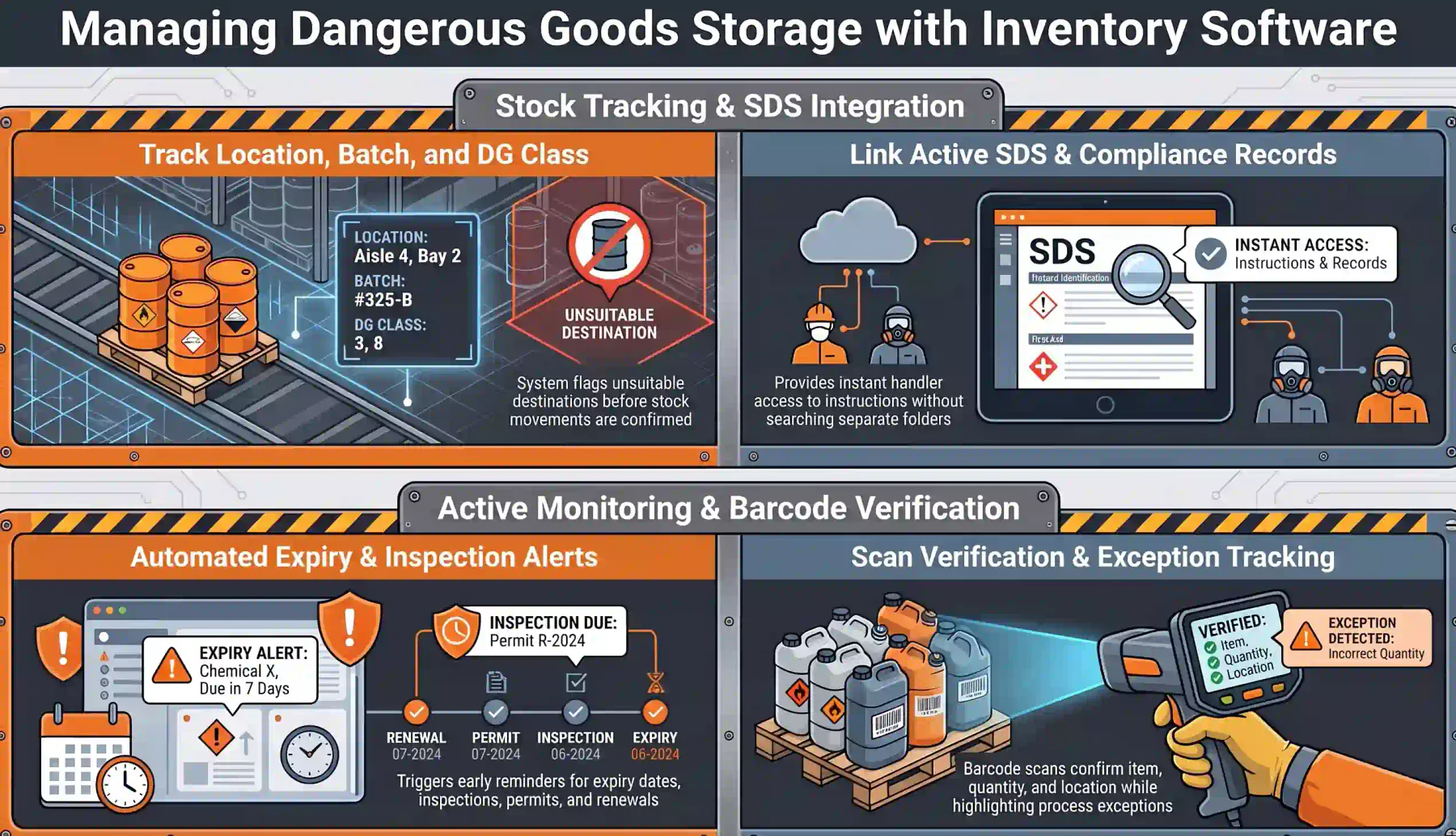
Inventory software can support dangerous goods control when it connects stock records with safety information. It gives teams a clearer view of what is stored, where it is located, and what action is due.
Software does not replace licences, SDS review, or trained judgement. It reduces avoidable errors by making approved data available during receiving, storage, counting, and dispatch.
An ERP inventory system can connect purchasing, warehouse, and compliance records. That link helps managers prevent unsafe put-away decisions while keeping stock visibility across sites.
1. Track stock by dangerous goods class, quantity, batch, and location
Track each item by dangerous goods class, quantity, batch, and location. Add storage restrictions so the system can flag an unsuitable destination before the movement is confirmed.
Use barcode scans to reduce manual entry during receiving and transfers. The record should show both the current location and the person or process that moved the stock.
2. Link SDS documents and compliance records to each item
Link the current SDS and compliance documents to the item record. Workers can then access the right instructions without searching across separate folders or email threads.
Keep document permissions simple and review them regularly. Safety information should reach the people who handle the stock, while changes remain controlled.
3. Monitor expiry dates, inspections, permits, and licence renewals
Set reminders for expiry dates, inspections, permits, and licence renewals. Early alerts give managers time to review stock, schedule checks, and correct gaps before the due date.
Use dashboards to show overdue actions and high-risk exceptions. Prioritise issues by class, quantity, location, and potential impact on operations.
4. Improve inventory accuracy with barcode and warehouse tracking
Barcode and warehouse tracking improve inventory accuracy when master data is maintained. Each scan should confirm the product, quantity, location, and movement status.
Review failed scans and manual overrides instead of ignoring them. Repeated exceptions may show that the storage map, item data, or staff process needs improvement.
Common Dangerous Goods Storage Mistakes to Avoid
Many storage incidents begin with small process gaps rather than one major failure. Reviewing common mistakes helps managers correct weak controls before they affect workers, stock, or operations.
1. Storing chemicals by convenience instead of compatibility
Storing chemicals by convenience can place incompatible materials too close together. Use approved zones and location rules, even when another aisle appears faster or more accessible.
Make the safe location visible in the system and on the warehouse floor. This gives staff one clear answer during busy receiving periods.
2. Using outdated SDS documents or incomplete labels
An outdated SDS can lead staff to use the wrong controls or emergency response. Schedule document reviews and remove old copies when a newer version is approved.
Check labels during every receipt and stock count. A damaged or incomplete label should trigger quarantine and review before the item returns to storage.
3. Exceeding approved storage quantities
Exceeding an approved storage quantity can change the risk profile of the site. Review planned purchases against the permitted limit before suppliers deliver new stock.
Use alerts for quantity thresholds and unusual increases. Escalate exceptions to the responsible safety or facilities team before acceptance.
4. Keeping safety records separate from inventory records
Keeping safety records separate from inventory records creates avoidable gaps. Teams may know what the SDS says without knowing where the product is, how much remains, or who moved it.
Connect the records through a shared item code and location reference. This supports faster checks during inspections, stock counts, and emergency response.
A Practical Dangerous Goods Storage Checklist for Singapore Businesses
Use a practical checklist to turn the storage policy into repeatable warehouse behaviour. The checklist should cover new products, daily operations, inspections, and incident follow-up.
Assign an owner and review date for every action. This makes overdue controls visible and prevents important checks from depending on memory.
1. Checks to complete before receiving a new substance
Before receiving a new substance, confirm its class, SDS, label, quantity, container, and approved storage location. Check permits and segregation requirements before the delivery is accepted.
Share the handling instructions with the receiving team. Stop the receipt if the product or paperwork does not match the purchase and safety records.
2. Daily checks for warehouse storage and handling
Daily checks should cover leaks, damaged containers, labels, access routes, ventilation, spill equipment, and fire protection. Record issues when they are found, not at the end of the month.
Keep the inspection format simple enough for routine use. Escalate high-risk findings immediately and track corrective work until completion.
3. Records to prepare before inspections and licence renewals
Before an inspection or licence renewal, review the inventory, SDS register, storage map, permits, training records, and inspection history. Resolve missing documents before the review date.
Compare the approved quantities with current stock. Update the site records when products, volumes, storage areas, or operating processes change.
4. Actions to take after a spill, incident, or storage change
After a spill, incident, or storage change, isolate the affected area and follow the emergency procedure. Record what happened, what stock was involved, and which controls failed.
Complete corrective actions before returning the area to normal use. Review the SDS, layout, training, and system records so the same issue is less likely to recur.
Conclusion
Dangerous goods storage in Singapore depends on correct classification, suitable facilities, and clear controls. Review segregation, flammable liquids storage, and SDS records when products or quantities change.
Inventory software can connect stock, locations, documents, and compliance dates, improving visibility and supporting safer, more consistent warehouse operations.
To learn more about dangerous goods storage, schedule a free consultation with our experts today. Start anytime and start scaling your operations.

Frequently Asked Questions
The class on the label and SDS decides the storage zone, the separation from incompatible goods, and the controls needed. Class 3 flammable liquids need ignition control and spill containment, while Class 5 oxidisers must stay clear of flammables.
Segregate goods by hazard class and SDS compatibility data. Keep incompatible materials in separate, clearly labelled zones with suitable containment and unobstructed emergency access.
Flammable liquids need approved storage areas, ignition control, ventilation, spill containment, and fire protection. Exact requirements depend on the liquid, quantity, container, and site approval.
Keep a current SDS for every dangerous substance on site. Make it accessible to workers and match it with the product label, quantity, location, and inventory record.
Some businesses may need an NEA Hazardous Substances Permit or Licence, an SCDF P&FM storage licence, or both. It depends on the substance, quantity, premises, and storage conditions.
Inventory software can link stock, locations, SDS files, permits, and inspection dates, and send alerts. It does not replace legal approval, safety reviews, or trained judgement.