








Software implementation cost in Singapore includes more than the licence or subscription fee. Businesses may also need to budget for configuration, customisation, data migration, integrations, training, hardware, security, support and internal staff time.
This guide explains what software implementation covers, how costs vary by business size and software type, which hidden fees to watch for, and how Singapore businesses can prepare a realistic implementation budget.
Key Takeaways
Software implementation cost covers setup, configuration, data migration, integrations, training, testing and go-live support.
The final budget depends on users, modules, data quality, customisation, integration complexity, implementation method and timeline.
Hidden costs may include internal staff time, scope changes, parallel systems, extra modules, support tiers and annual price increases.
A three-year total cost comparison gives a more realistic view than comparing licence prices or first-year quotes alone.
What Is Software Implementation Cost?
"The true cost of software implementation extends beyond the licence fee. Configuration, data migration, integrations, training and internal staff time all shape the investment Singapore businesses should plan for."
Software implementation cost is the expense of preparing, adapting and launching a software system for actual business use. It covers the work required to move from a purchased platform to a functioning solution that users can operate confidently.
What implementation covers: setup, configuration, data migration, training and go-live
Implementation commonly includes project planning, process discovery, user setup, permissions, workflow configuration, data preparation, migration, integrations, testing, training and go-live support.
For an ERP or business management system, the project may also include setting up companies, branches, warehouses, products, suppliers, customers, tax codes, approval rules, accounting structures and reporting templates.
Implementation cost vs licence or subscription fees
Licence or subscription fees pay for access to the software. Implementation fees pay for the work needed to configure and launch that software for your business.
A cloud platform may have a lower infrastructure requirement, but it can still require significant implementation work. An on-premise system may also require servers, databases, backups, network setup and internal technical resources.
Why the final bill is often higher than the quote
Initial quotations may exclude optional modules, data cleansing, custom reports, integrations, additional training, travel, extended support or change requests. Costs may also rise when the project scope is not defined clearly at the beginning.
Ask vendors to separate one-time costs, recurring costs, optional items and assumptions. This makes it easier to identify what is included before signing.
Typical Software Implementation Cost in Singapore
There is no single implementation price that applies to every business. The cost depends on the software type, number of users, number of entities, data quality, integration requirements and level of customisation.
Cost ranges by business size
| Business profile | Typical project characteristics | Main cost drivers |
|---|---|---|
| Small business or SME | One entity, limited users, standard workflows and a small number of integrations | Configuration, data migration, training and basic support |
| Mid-market business | Several departments, more users, multiple locations and connected business systems | Workflow design, integrations, reporting, testing and change management |
| Enterprise | Multiple entities, countries, warehouses, currencies or complex approval structures | Extensive migration, security, integrations, customisation and project governance |
Small implementation projects may fall within a low five-figure planning range, while larger multi-entity projects can require substantially more. These are budgeting bands rather than fixed Singapore market prices. A vendor quotation should be based on your actual scope.
Cost by software type: ERP, accounting, HR and CRM
Accounting software is often less expensive to implement when the business has simple processes, clean data and limited integrations. CRM implementation cost depends on the number of sales pipelines, customer records, automations, communication channels and reporting requirements.
HR software may require employee data migration, payroll configuration, leave rules, approval workflows and access controls. ERP implementation is usually more complex because finance, purchasing, inventory, sales, manufacturing, warehouse and HR processes may need to work together.
Cloud vs on-premise implementation costs
Cloud implementation usually reduces the need for local servers and infrastructure management. However, businesses still need to plan for configuration, migration, integrations, user training and security reviews.
On-premise implementation may require additional infrastructure, database setup, backups, network preparation and internal IT involvement. Compare the full three-year ownership cost rather than only the initial implementation invoice.
Software Implementation Cost Breakdown: Where the Money Goes

Breaking the project into cost categories helps businesses compare quotations and identify expenses that may otherwise be hidden in a broad implementation fee.
Configuration and customisation
Configuration adjusts standard settings to match the business. Examples include tax rules, user roles, approval workflows, warehouse structures, product categories, numbering sequences and reporting layouts.
Customisation involves changing or extending the standard system. Custom fields, custom reports, special calculations and unique workflows may increase development, testing and future upgrade costs.
Data cleaning and migration
Data migration may include exporting existing records, removing duplicates, standardising formats, mapping fields, validating values and importing approved data into the new system.
Common records include products, suppliers, customers, opening balances, warehouse locations, employee information, outstanding invoices and open orders. Poor data quality can increase both project time and implementation cost.
Integrations with existing systems
Integrations may connect the new software with banks, ecommerce platforms, payroll systems, payment gateways, marketplaces, logistics platforms, production equipment or tax tools.
Budget for API development, data mapping, testing, error handling, monitoring and future maintenance. A connection that works during testing may still require support when another system changes its API.
Training and change management
Training costs depend on the number of users, number of departments, complexity of workflows and training format. Businesses should also plan for onboarding new staff after go-live.
Change management may include process documentation, internal communications, user champions, training materials, feedback sessions and adoption monitoring.
Hardware, infrastructure and security
Some projects require laptops, tablets, barcode scanners, receipt printers, label printers, network upgrades, servers or additional security tools.
Security planning may include access roles, authentication, backups, encryption, audit logs, endpoint protection and disaster recovery procedures.
Post-go-live support and maintenance
After launch, users may need help with system questions, reporting changes, workflow adjustments, data corrections and new business requirements.
Clarify whether the quotation includes a warranty period, service-level agreement, support hours, ticket limits, consulting hours, upgrades and emergency assistance.
Hidden Implementation Costs Singapore Businesses Often Miss
The most difficult costs to forecast are often connected to time, scope and operating disruption rather than the software itself.
Internal staff time and productivity dips
Managers and subject matter experts may need to attend workshops, validate data, test workflows, approve configurations and train colleagues.
Productivity may temporarily decrease while users learn new processes. Include internal project time and temporary overtime in the budget.
Scope changes and extra modules
Businesses sometimes add modules after discovering new requirements during implementation. Additional finance, inventory, CRM, HR, manufacturing or reporting features can increase licences, configuration, training and support costs.
Use a written change-request process that explains how new work is estimated and approved.
Annual price increases and support tiers
Subscription prices may change at renewal. Premium support, additional users, extra storage, advanced reporting and higher transaction limits may also create recurring costs.
Ask the vendor to explain renewal assumptions and price-adjustment terms in the contract.
Running old and new systems in parallel
Some businesses operate the old and new systems together during a transition. This can improve control, but it may also create duplicate data entry, reconciliation work, additional licences and longer implementation timelines.
Set a clear cutover plan and define how long parallel operation will continue.
Factors That Affect Software Implementation Cost
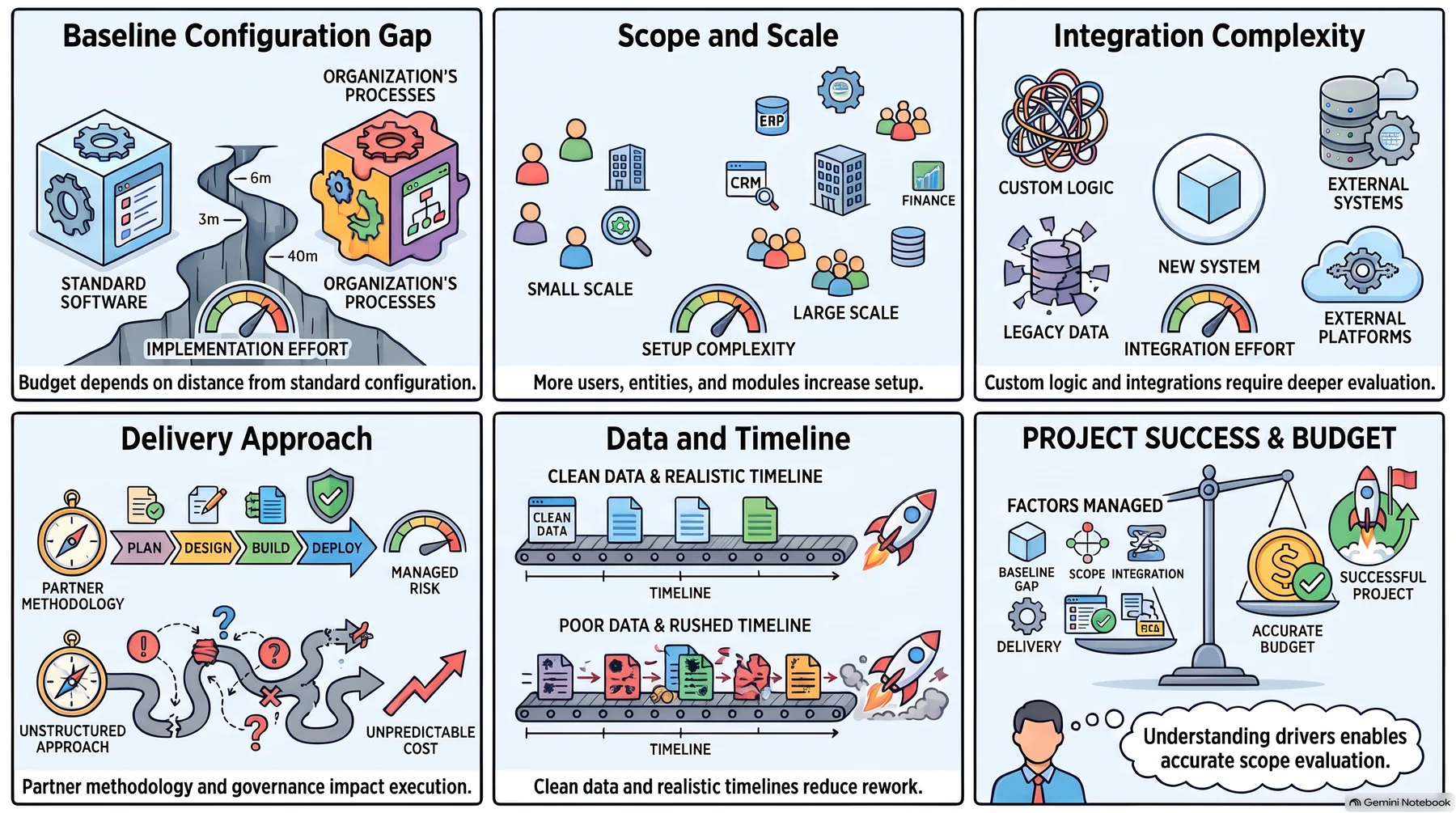
The final budget is shaped by the distance between the standard software configuration and the
way your business operates today.
Company size, users and modules
More users, departments, entities, warehouses and modules usually require more setup, testing, training and support.
A company implementing accounting and purchasing for one entity will usually have a smaller project scope than a group implementing finance, inventory, manufacturing, CRM and HR across several locations.
Customisation and integration complexity
Standard workflows are generally easier to implement than processes requiring custom logic, specialised reports or multiple external integrations.
Each integration should be assessed for data volume, frequency, security, ownership, error handling and maintenance requirements.
Implementation partner and method
Implementation partners may use different methods, such as fixed-scope delivery, phased implementation, agile configuration or a hybrid approach.
Compare the partner’s industry experience, project governance, documentation standards, training approach, escalation process and post-go-live support.
Data quality and timeline
Clean data and a realistic timeline can reduce rework. Urgent implementation schedules may require additional project resources, overtime, parallel workstreams or faster decision-making from internal stakeholders.
Worked Example: Budgeting an Implementation for a Singapore SME
The following example shows how an SME can structure its budget. It is an illustration, not a market quotation.
Assumptions
Assume a Singapore distributor has one legal entity, two warehouses, 20 users and several thousand product records. It wants to implement accounting, purchasing, inventory, sales and warehouse workflows.
The project requires data cleaning, user-role setup, approval workflows, basic reporting, barcode configuration, training, testing and two integrations.
Year-one vs three-year cost
| Cost category | Year one | Years two and three |
|---|---|---|
| Software access | Subscription or licence payment | Renewals, additional users and modules |
| Implementation | Configuration, migration, testing and go-live | Change requests and optimisation |
| Training | Initial training and user preparation | New staff onboarding and refresher training |
| Support | Post-launch support and issue resolution | Support plan, upgrades and consulting |
| Integrations | Development, mapping and testing | Monitoring and maintenance |
To calculate the three-year cost, add the initial implementation cost to three years of software access, support, integrations, internal project time, hardware and expected changes.
How to Reduce Software Implementation Cost
Cost control works best when businesses reduce rework while protecting the workflows that create operational value.
Start with core modules and scale later
Begin with the processes that have the clearest business impact. A company may start with accounting, purchasing and inventory before adding CRM, HR, manufacturing or advanced analytics.
Confirm that the platform can add modules later without requiring a complete reimplementation.
Clean your data before migration
Remove duplicate products, inactive suppliers, outdated customer records and inconsistent units of measure before migration.
Assign an owner to each data domain and approve the final migration file before importing it into the new system.
Fix the scope in writing
The implementation agreement should list modules, users, entities, integrations, reports, training sessions, migration responsibilities, milestones, acceptance criteria and support terms.
Written scope helps prevent assumptions from becoming unexpected invoices.
Train internal champions
Internal champions can support colleagues, answer routine questions and identify adoption issues after go-live. This can reduce dependence on external consultants for simple operational questions.
Government Funding for Software Implementation in Singapore

Singapore businesses should check the current Enterprise Singapore requirements before committing to a software implementation project.
The EDGE Grant: what changed in September 2026
The EDGE Grant launched on 30 September 2026. New applications under the Productivity Solutions Grant, Enterprise Development Grant and Market Readiness Assistance ceased from that date, while previously submitted or ongoing projects continue under their existing arrangements.
EDGE provides an annual grant cap of up to S$100,000 across eligible activities. Within that cap, up to S$30,000 may be used for single-function digital solutions, integrated enterprise systems and pre-scoped equipment, subject to the relevant activity requirements.
Which implementation costs may qualify
Eligibility depends on the specific EDGE activity, applicant, solution, project scope and approval terms. Some software, implementation, consultancy, equipment or internal manpower costs may be considered where the selected activity allows them.
Do not assume that every implementation invoice is claimable. Only approved cost items stated in the Letter of Offer should be included in the claim.
Application tips and common mistakes
Businesses should apply through the Business Grants Portal before starting the project or making payment to a supplier. EDGE support is administered on a reimbursement basis, so the applicant generally pays the approved costs first and submits a claim after completion.
Common mistakes include signing too early, paying a deposit before applying, submitting an incomplete quotation, including unapproved cost items, allowing a vendor to submit on the company’s behalf and treating vendor marketing claims as grant approval.
Review the latest Enterprise Singapore EDGE Grant guidance before budgeting.
How to Compare Vendor Quotes
A clear quotation should show the full implementation scope and the costs that continue after launch.
Itemised quote checklist
- Software modules and user licences
- Number of entities, warehouses and locations
- Configuration and customisation hours
- Data migration scope and responsibilities
- Integration development and testing
- Reports, forms and dashboards
- Training sessions and materials
- Project management and documentation
- Go-live support and warranty period
- Recurring support, maintenance and upgrade fees
- Additional user, storage and transaction charges
Three-year total cost template
| Cost category | Year one | Year two | Year three |
|---|---|---|---|
| Licence or subscription | Insert amount | Insert amount | Insert amount |
| Implementation | Insert amount | Insert amount | Insert amount |
| Integrations | Insert amount | Insert amount | Insert amount |
| Training and change management | Insert amount | Insert amount | Insert amount |
| Support and maintenance | Insert amount | Insert amount | Insert amount |
| Hardware and infrastructure | Insert amount | Insert amount | Insert amount |
| Internal project time | Insert amount | Insert amount | Insert amount |
Questions to ask before you sign
- What exactly is included in the implementation fee?
- Which assumptions could increase the final cost?
- How are change requests estimated and approved?
- What happens if data migration takes longer than planned?
- Which integrations are standard and which require custom development?
- What support is included after go-live?
- How are subscription increases handled at renewal?
- Can the vendor provide a three-year total cost estimate?
- Which project costs may be relevant to current grant requirements?
How HashMicro Keeps Implementation Cost Predictable for Singapore Businesses
After reviewing the main cost categories, businesses should assess whether the vendor can define scope clearly and support the implementation from planning through adoption.
Modular pricing: pay for the modules you need
HashMicro uses a modular ERP approach, allowing businesses to select the functions relevant to their operations. Depending on the agreed scope, modules may cover accounting, inventory, purchasing, sales, CRM, HR, manufacturing and warehouse management.
Modular selection can help businesses prioritise essential workflows first and expand later as requirements grow. The final cost depends on modules, users, entities, integrations, configuration and implementation services.
Local implementation, training and support
Singapore businesses should receive a clear implementation plan covering process discovery, configuration, data migration, testing, training, go-live and post-launch support.
Ask for the proposed project team, milestones, responsibilities, response times, escalation process and support coverage before approving the quotation.
Free demo and tailored quote
A free demonstration can use your actual processes, such as purchasing, receiving, inventory transfers, sales orders, invoicing, approvals and reporting.
A tailored quote should separate recurring software fees from one-time implementation charges, integrations, training, support and optional services. This gives your team a more reliable basis for comparing total cost.






Conclusion
Software implementation cost in Singapore depends on more than the licence or subscription price. Configuration, data quality, integrations, training, internal staff time, hardware, security, support and future changes can all affect the final budget.
The most reliable approach is to define the scope in writing, clean data before migration, compare three-year ownership costs and ask vendors to disclose recurring and optional fees. Businesses should also verify current EDGE Grant requirements before starting work or making payment.
HashMicro can help Singapore businesses assess their required modules, map implementation workflows and prepare a tailored ERP quotation. Request a free demo to review the expected scope, timeline and total cost for your business.
Frequently Asked Questions About Software Implementation Cost
Software implementation cost is the expense of preparing, configuring, integrating, testing and launching a software system for business use. It may include data migration, training, customisation, project management and go-live support.
The cost depends on the software type, number of users, modules, entities, data quality, integrations, customisation and timeline. A simple SME implementation may fall within a low five-figure planning range, while larger multi-entity projects can cost substantially more. A tailored quotation is required for an accurate estimate.
Licence or subscription cost pays for access to the software. Implementation cost pays for configuring, adapting, migrating, testing, training and launching the system for your business.
Implementation may take several weeks for a simple setup or several months for a multi-entity project with complex workflows, integrations, migration and testing. The timeline depends on scope, data quality, decision speed and user availability.
Some businesses may qualify for support under the EDGE Grant, depending on the selected activity, company eligibility, solution and approved cost items. EDGE launched on 30 September 2026 and replaced new EDG, MRA and PSG applications. Businesses should apply before starting work or making payment and verify the latest requirements with Enterprise Singapore.