







A finance director at a Singapore group spent eleven working days reconciling three subsidiaries' systems before seeing a group number. ERP consolidation fixes this by merging them into one shared environment.
It works by retiring or connecting the platforms each entity ended up with, often after an acquisition or a local system bought for tax rules, so every entity shares one chart of accounts and one set of records.
This article covers what ERP consolidation actually involves, the three main approaches available, the real costs and risks, and what changes after a merger or across Singapore, Malaysia, and Indonesia.
Key Takeaways
ERP consolidation reduces multiple enterprise systems down to one shared environment for finance, inventory, and customer data.
Three approaches exist: full migration, two-tier ERP, and a hybrid reporting layer, and the right one depends on how similar your entities actually are.
Post-merger consolidation works best when the operating model is settled first and the chart of accounts is unified before touching transactions.
A Singapore-headquartered group must satisfy GST, InvoiceNow, and ACRA obligations at entity level even after systems are consolidated.

What Is ERP Consolidation?
ERP consolidation reduces multiple enterprise systems down to a smaller number, usually one, so finance, operations, and customer data all live in a single environment with one set of records.
The scope runs wider than software. A consolidation project touches the chart of accounts, master data definitions, approval rules, and reporting structures across every entity involved.
ERP Consolidation vs Financial Consolidation
Financial consolidation combines the numbers, producing group statements and eliminating inter-company transactions. It is a reporting exercise that can sit on top of whatever systems already run.
ERP consolidation combines the systems themselves. It changes where transactions are recorded, not just how they are reported. A group needing faster reporting alone may not need the latter.
Why Companies End Up With Multiple ERP Systems
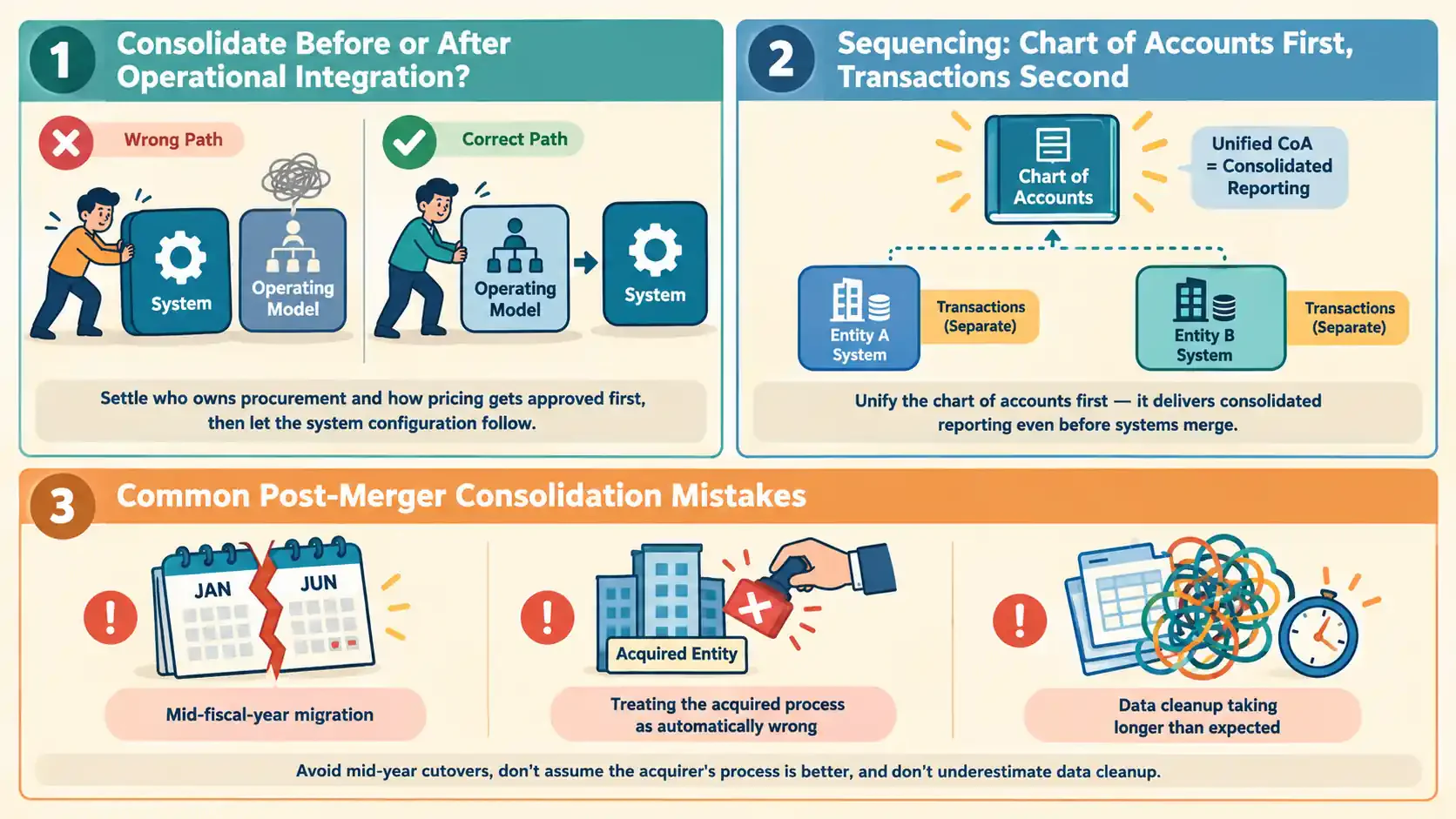
Nobody plans a fragmented system landscape. Three patterns usually produce it.
1. Separate Systems Bought for Different Departments
Each team solves its own urgent problem with a focused tool, and each one quietly duplicates a slice of ERP functionality: its own product master, its own supplier records.
Five years on, the same supplier exists in four systems under four slightly different names, and nobody can say with confidence what the company actually spends with them.
2. Mergers and Acquisitions
An acquired company arrives with its own platform and its own process logic. Integration teams get measured on commercial synergies within a year, so the systems question gets deferred.
Deferred once is reasonable. Deferred across three acquisitions produces a landscape nobody actually designed on purpose.
3. Cross-Border Expansion Across Singapore, Malaysia, and Indonesia
A Singapore holding company expands into Malaysia and Indonesia, and each market has its own tax regime, reporting format, and language expectations.
The local finance lead argues, often correctly at the time, that a locally built system handles compliance better than the group platform. So each entity buys locally.
The result is a group where every entity is individually compliant and collectively invisible, because the replacement platform has to satisfy three regulators at once.
The 3 Approaches to ERP Consolidation
There are only three real options, and the choice is driven by how similar your entities' processes actually are, not by company size or budget.
| Full Single-ERP Migration | Two-Tier ERP | Hybrid EPM Layer | |
|---|---|---|---|
| How it works | Every legacy system is retired; one platform runs the entire group | A corporate ERP runs group-level finance; subsidiaries keep operational systems | Local ERPs stay in place; a consolidation engine sits on top of them |
| Best fit | Entities that run broadly similar processes | Subsidiaries with genuinely different operating models | Acquisitive groups on mixed platforms with no appetite for migration |
| Main risk | Highest operational disruption; longest project | Integration between tiers becomes a permanent cost | Fixes the reporting symptom, not the underlying fragmentation |
| What it solves | Data fragmentation and reporting delay | Reporting delay, with operational autonomy preserved | Reporting delay only |
1. Full Single-ERP Migration: When Replacing Everything Makes Sense
Every entity moves onto one single, unified platform, one chart of accounts, one approval hierarchy. This is the only approach that genuinely removes data fragmentation rather than reporting around it.
It is also the most disruptive. Projects fail here on change management, specifically on subsidiaries never persuaded the move was in their own interest.
Choose this if your entities' core processes are more similar than different, and you have sponsorship strong enough to overrule a resisting subsidiary.
2. Two-Tier ERP: Keeping Subsidiary Systems in Place
The group runs a corporate ERP for consolidated finance and reporting, while subsidiaries continue on their own systems, feeding defined data upward on a fixed schedule.
The honest cost is that integration never finishes. Every upgrade and every mapping change becomes ongoing maintenance work, not a one-off project.
Choose this if at least one subsidiary's operating model cannot reasonably be standardised, and you can fund integration as a permanent function.
3. Hybrid EPM Layer: Consolidating Reports Without Replacing Systems
Local ERPs stay exactly as they are. A dedicated layer pulls ledger data from each one, maps it to a shared chart of accounts, and produces consolidated reporting.
It is the wrong answer when the problem is operational. If a warehouse in Johor cannot see stock in Singapore, a reporting layer will not fix that gap.
Choose this if the pain is measured in close days rather than operational blind spots, and relief is needed in a quarter rather than a year.
Benefits and Risks: What the Numbers Actually Say
Most writing on this topic asserts benefits without being honest about the trade-offs. Here is what is worth weighing before committing budget.
1. Measurable Benefits of Consolidating ERP Systems
- Lower licence and IT overhead. Running four systems means four vendor relationships and four upgrade cycles. Consolidation removes that duplicated spend directly.
- Faster close. Reconciliation work that consumes most of a multi-system close disappears once entities share a ledger structure, usually the benefit felt first.
- Fewer reporting disputes. Duplicate master records are the usual root cause of mismatched figures. One supplier record means one spend figure.
- Faster decisions. When group and entity data live together, questions that once needed a data-gathering exercise become a simple query.
"Eleven days of reconciliation is not a technology problem. It is the cost of three systems that were never designed to agree with each other."
2. Costs and Risks You Should Plan For
- Upfront investment. Licensing is the visible cost and usually not the largest. Data migration, process redesign, and internal time typically exceed it.
- Operational disruption. Expect reduced throughput around each cutover, worse if it lands during peak trading or a fiscal year-end.
- Loss of local flexibility. A standardised platform will not keep every subsidiary habit. Some are genuine regulatory needs; others are simply old.
- Change resistance. The subsidiary that liked its old system will find reasons the new one does not work, which is predictable if planned for early.
ERP Consolidation After a Merger or Acquisition
Post-merger consolidation follows different rules, since the deadline comes from the deal itself rather than from IT.
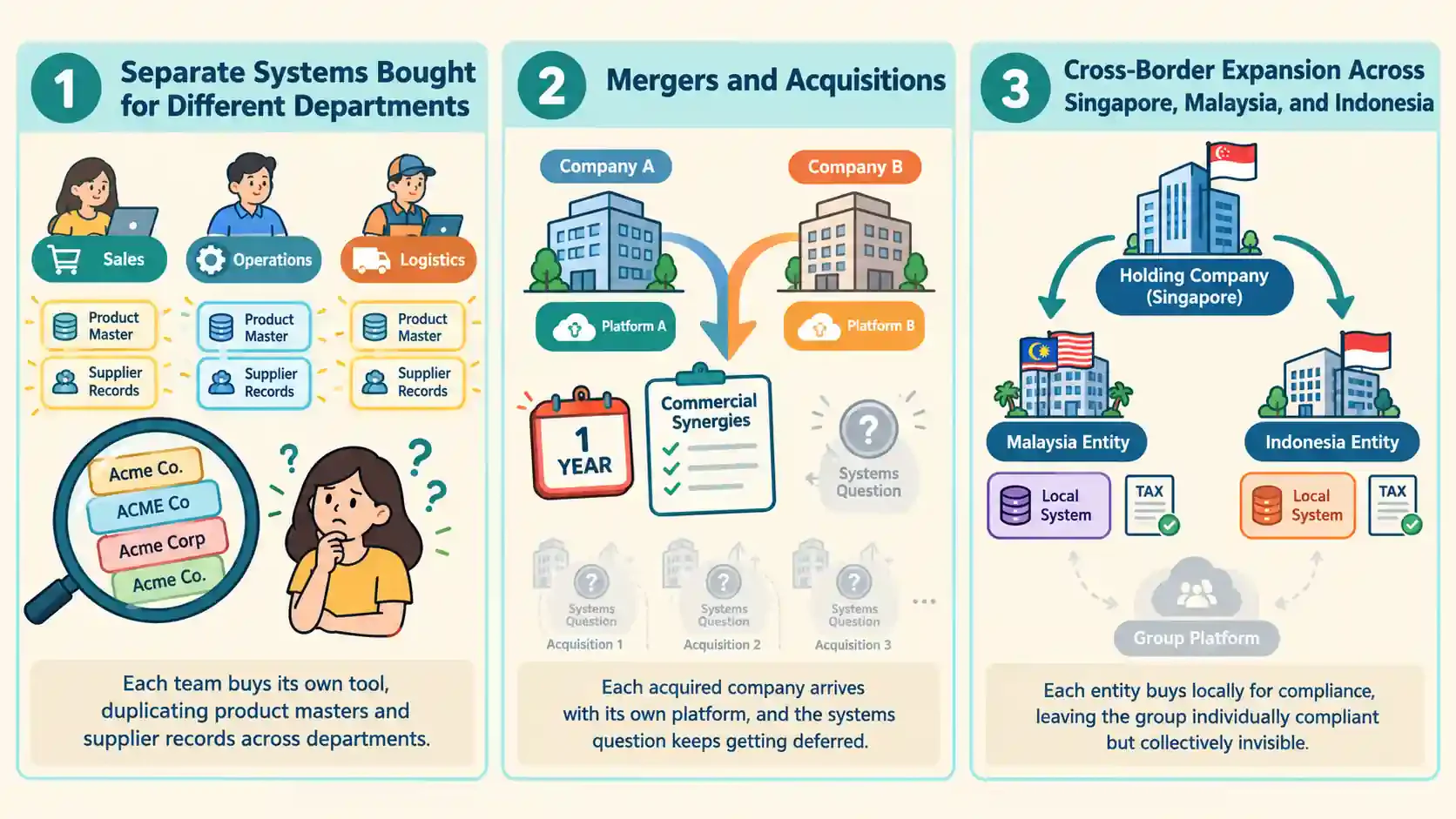
1. Consolidate Before or After Operational Integration?
The instinct is to consolidate systems first, assuming one platform makes everything else easier. In practice this gets the order backwards.
Settle the operating model first, who owns procurement, how pricing gets approved, then let the system configuration follow those decisions.
2. Sequencing: Chart of Accounts First, Transactions Second
Map and unify the chart of accounts before touching transactional data. It delivers consolidated reporting almost immediately, even while entities still run separate systems.
3. Common Post-Merger Consolidation Mistakes
Migrating mid-fiscal-year splits one year across two structures and makes the audit significantly harder. Align any cutover to a period boundary instead.
Treating the acquired entity as the problem to fix can also backfire, since sometimes its process is genuinely the better one. Master data cleanup is routinely underestimated too.
How to Decide: A 5-Point ERP Consolidation Assessment
Answer these five questions honestly before talking to any vendor.
- How different are our entities' core processes, really? Mostly similar points to full migration. Genuinely different points to two-tier.
- Where exactly does the pain show up? Reporting-only pain suits a hybrid layer at a fraction of the cost. Operational pain does not.
- Do we have one executive sponsor with authority over every entity? Without that authority, a full migration will stall.
- What are our hard local compliance constraints? List what genuinely cannot be waived, and confirm any platform satisfies all of them.
- Are we acquiring again in the next 24 months? If yes, design for repeatability rather than a one-off project.
ERP Consolidation in Singapore: What's Different Here
Most published guidance skips regional compliance entirely. For a Singapore-headquartered group, three local factors shape the project.
1. GST and IRAS Reporting Across Merged Entities
GST registration sits with each legal entity, not the group. Related companies can apply for group registration to file one consolidated return, but each member must already be individually GST-registered first.
Consolidating onto one platform does not remove that requirement. The system still needs to produce correct entity-level figures while reporting on a consolidated basis internally.
2. InvoiceNow and Peppol E-Invoicing Requirements
Singapore's InvoiceNow network runs on Peppol, and GST-registered businesses are being moved onto it in phases, starting with new voluntary registrants and extending to existing businesses by annual turnover band through to 2031.
The consolidation consequence is direct: the platform you move onto must send and receive through the network, and a cutover must not break transmission mid-period.
3. ACRA Filing for Multi-Entity Groups
Each incorporated entity keeps its own filing obligation regardless of group structure. A consolidated system must preserve entity-level statutory records that support separate annual returns.
Across the region, Singapore, Malaysian, and Indonesian entities each need their own tax logic and statutory formats inside one platform, or the fragmentation simply moves rather than disappears.
Consolidating Onto HMX
HMX is HashMicro's enterprise ERP platform, built for the structure this article describes: multiple entities and multiple markets, with finance, inventory, procurement, and operations in one environment.
For the approaches above, HMX supports full single-ERP migration for groups ready to standardise, and can also serve as the corporate tier in a two-tier model for subsidiaries that need to keep their own systems.
Entity-level tax treatment, multi-currency handling, and localisation for Singapore, Malaysia, and Indonesia sit built into the platform rather than configured as exceptions, which matters for the regional complication described above.
Hashy OS runs as HashMicro's AI layer above the ERP, working on live data rather than as a separate feature. For a group mid-consolidation, that mainly means a shared knowledge layer across entities and governed AI-assisted workflows during the transition.
Conclusion
The right approach to ERP consolidation depends on how different your entities genuinely are, not on company size or available budget.
Groups with similar processes should consolidate fully. Groups with one distinct subsidiary should run two-tier and fund the integration properly. Groups whose only pain is a slow close should start with a reporting layer.
Start with the five-point assessment above. It narrows three options to one faster than any vendor conversation, and a free consultation can help map that decision against your own structure.
Frequently Asked Questions
A group with three subsidiaries, each running its own accounting and inventory system after two acquisitions, moves all three onto one platform with a shared chart of accounts and a single product master. Month-end reconciliation between entities disappears, and group reporting becomes a query rather than a project.
In an SAP context, consolidation usually refers to combining financial data from multiple entities into group statements, typically using a dedicated consolidation module. That is financial consolidation, not system consolidation, and reducing the number of ERP platforms a group runs is a separate, vendor-independent exercise.
Timelines depend on the approach, the number of entities, and the state of the data. A hybrid reporting layer can be in place within a quarter, while a full multi-entity single-ERP migration takes substantially longer.
Licensing is typically the smaller share. Data migration, process redesign, parallel running, and internal staff time usually exceed it, so budget for change management explicitly rather than treating it as an afterthought.
Settle the shared operating model first, then configure systems to match it. Unifying the chart of accounts early delivers consolidated reporting quickly without a full migration, and cutting over mid-fiscal-year should be avoided.
Yes. A two-tier model keeps subsidiary operational systems while a corporate ERP handles group finance, and a hybrid EPM layer leaves all systems in place and consolidates only reporting. Neither removes underlying fragmentation, but both deliver consolidated reporting faster and at lower risk than full migration.