








Singapore businesses use segregation of duties to divide key responsibilities across different people. This reduces the chance that one person can create, approve, record, and conceal an improper transaction.
The control works by combining role-based access, approval limits, independent reviews, and reliable records. Together, these measures strengthen finance, procurement, payroll, inventory, and payment processes.
Key Takeaways
Segregation of duties separates transaction initiation, approval, recording, custody and review across different people to reduce errors and misuse.
Segregation of duties matters because it reduces fraud, supports reliable records, strengthens audit readiness and protects sensitive business data.
The four roles in the framework are initiating, approving, recording and independently reconciling or reporting transactions.
Common SOD conflicts include supplier creation with payment release, invoice entry with approval, payroll preparation with bank submission and stock adjustments with counts.
What Is Segregation of Duties?
Segregation of duties is an internal control that separates responsibilities within a business process. Different employees handle transaction initiation, approval, recording, custody, and review.
For example, one employee may create a supplier, another may approve the purchase, and a third may release payment. This separation makes errors easier to identify and deliberate misuse harder to complete.
The control does not require every task to belong to a different employee. Instead, businesses should prevent one person from controlling the full transaction lifecycle without independent oversight.
"Segregation of duties works when no single person can initiate, approve, record, and review the same transaction, because independent oversight makes errors and misuse visible early. "
Why Segregation of Duties Matters for Singapore Businesses
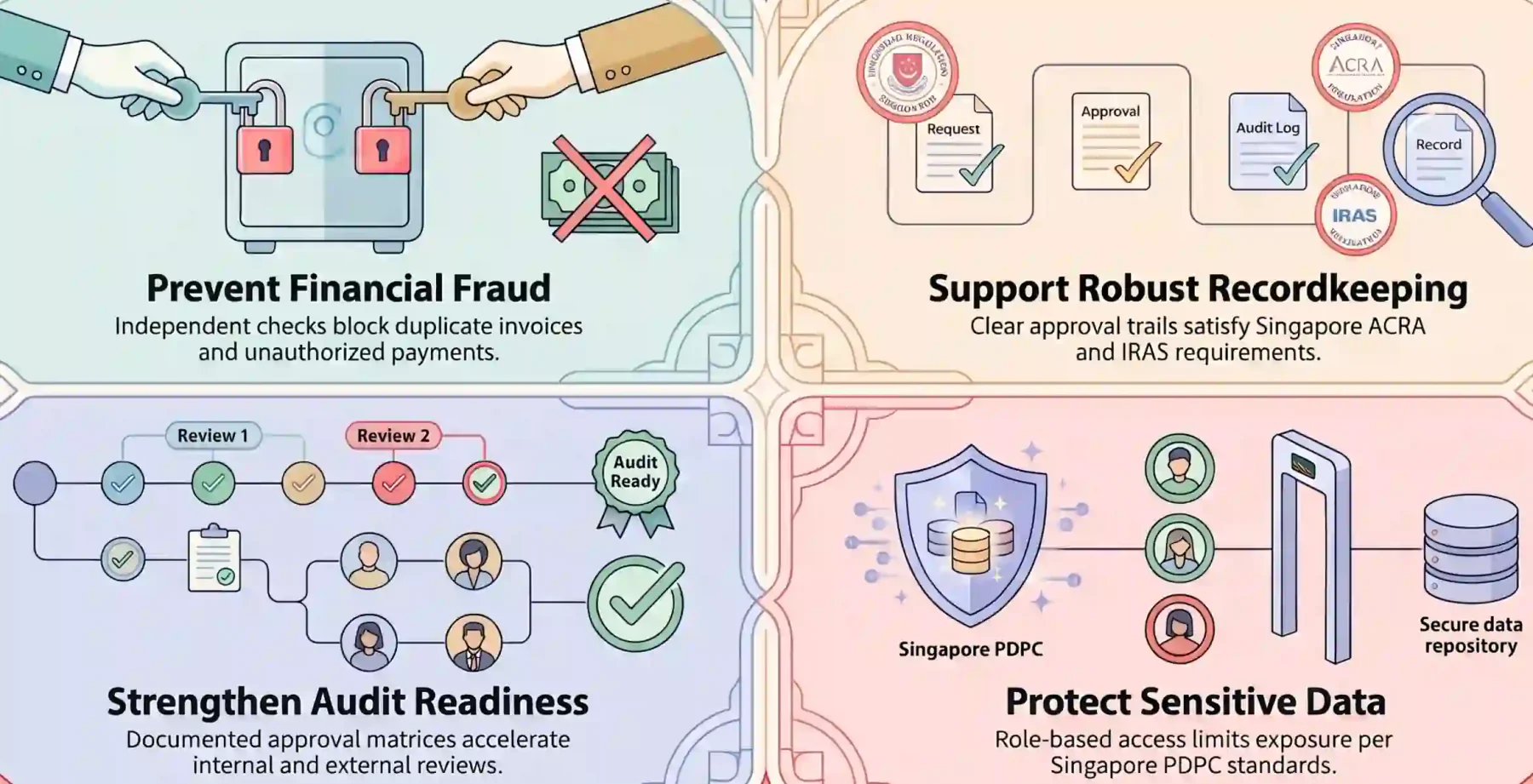
SOD helps businesses protect financial information, reduce process risks, and maintain clearer accountability. It also gives managers and auditors stronger evidence that important transactions received appropriate review.
1. Reducing fraud and financial errors
When one person controls several connected activities, mistakes can pass through the process without challenge. Separating responsibilities creates review points before money, stock, or records change hands.
For instance, the employee who enters a supplier invoice should not approve the same invoice and release its payment. Independent checks make duplicate invoices, incorrect amounts, and suspicious suppliers easier to detect.
2. Supporting financial recordkeeping
Singapore businesses need reliable financial records to support reporting, tax administration, and management decisions. IRAS-approved accounting software can help maintain complete records with evidence of who prepared, reviewed, and approved each transaction.
The Accounting and Corporate Regulatory Authority provides corporate compliance information for Singapore businesses. Businesses should also consult IRAS recordkeeping guidance when defining document retention and review practices.
3. Strengthening audit readiness
Auditors and finance leaders need to understand how transactions move through the business. A documented approval matrix shows who can request, review, approve, record, and reconcile each activity.
An effective control framework also preserves approval dates, comments, changes, and exception decisions. These records reduce time spent reconstructing decisions during internal or external reviews.
4. Protecting sensitive business data
Finance, payroll, supplier, and customer records often contain sensitive information. Restricting access by role limits unnecessary exposure and reduces the chance of unauthorised changes.
Businesses should align access reviews with their wider data protection practices. The Personal Data Protection Commission provides Singapore guidance on protecting personal data and managing access responsibly.
The Four Roles in a Segregation of Duties Framework
A practical SOD framework separates four responsibilities across a transaction or business process. The exact job titles may differ, but the control objective remains consistent.
| Responsibility | Typical activity | Independent check |
|---|---|---|
| Initiate | Create a request, order, invoice, or adjustment | Reviewer checks business need |
| Approve | Confirm authority, value, and supporting documents | Approver validates compliance |
| Record | Post the transaction to the accounting or stock ledger | Reconciliation checks accuracy |
| Review | Reconcile, monitor, and investigate exceptions | Reviewer reports unusual activity |
1. Requesting or initiating a transaction
The initiator identifies a business need and creates the request. This may involve a purchase requisition, supplier setup, payroll change, customer credit, or inventory adjustment.
The initiator should provide complete supporting information. However, that person should not approve the request or complete the final payment or posting without review.
2. Reviewing and approving the transaction
The approver checks the purpose, value, documents, and policy requirements. Approval should follow the business’s approval matrix and delegation of authority.
Higher-value or higher-risk transactions may require multiple approvers. The system should also escalate overdue approvals and preserve the approval history.
3. Recording the transaction in the accounts
The recording role posts the approved transaction to the accounting, purchasing, payroll, or inventory records. This person confirms that the entry matches the authorised source documents.
Recording should happen only after approval is complete. If the recorder can change the approval or supporting documents, the business should apply additional access restrictions.
4. Reconciling and reporting the results
The reviewer compares records against bank statements, supplier statements, stock counts, payroll reports, or supporting schedules. This role should operate independently from the person who prepared the original transaction.
Regular reconciliation helps identify duplicate payments, missing documents, unusual adjustments, and timing differences. Managers can then investigate exceptions before they become larger control failures.
Common SOD Conflicts in Business Processes
SOD conflicts occur when one user receives combinations of access that create excessive control over a process. Businesses should review these combinations across finance, procurement, payroll, sales, inventory, and system administration.
1. Supplier creation and payment release
A user who creates a supplier and releases payment could add a false supplier and direct funds to an unauthorised account. Procurement system can separate supplier maintenance, invoice approval, and payment execution through controlled workflows.
Supplier changes should also trigger independent review. Bank account changes deserve additional verification because they can redirect legitimate payments.
2. Invoice entry and invoice approval
A user who enters and approves invoices can create unsupported or duplicate expenses. The business should require another authorised employee to verify the supplier, amount, purchase order, and receipt.
Three-way matching can strengthen this control where purchase orders, goods receipts, and invoices are available. Exceptions should require documented approval before payment proceeds.
3. Payroll preparation and bank file submission
Payroll staff need access to sensitive employee and salary records. However, the person preparing payroll should not also approve the final payroll report and submit the bank file.
A separate reviewer should check employee changes, unusual payments, leavers, and total payroll values. The bank submission should then require a second authorised user.
4. Inventory receiving, adjustments, and stock counts
A warehouse employee who receives stock and approves inventory adjustments could hide shortages or inflate quantities. Receiving, adjustment approval, and stock count review should have separate responsibilities.
Businesses should compare stock movements with purchase documents and physical counts. Frequent adjustments should trigger a review by finance, operations, or an assigned control owner.
5. Customer refunds, credits, and ledger posting
A user who issues customer credits and posts ledger entries could conceal unauthorised refunds. Businesses should separate refund requests, approval, payment processing, and accounting records.
Refund thresholds can determine when additional approval is required. The business should also monitor repeated refunds, unusual timing, and credits issued soon after sales.
6. User access administration and access reviews
System administrators can create users, assign permissions, and alter access settings. If they also approve transactions, they may bypass the controls applied to other employees.
Access administration should remain separate from business approvals where practical. Managers should review active users, role changes, and leavers at scheduled intervals.
How to Create an Approval Matrix and Delegation of Authority
An approval matrix shows who may request, approve, record, and review each type of transaction. A delegation of authority sets the value limits and conditions attached to those approvals.
1. Map responsibilities across each process
List the main processes first, such as purchasing, payroll, sales, and inventory. Then record who initiates, approves, records, and reviews each activity.
Compare the matrix with actual system access, not just job titles. Any user who holds two incompatible roles should be corrected or covered by a compensating control.
2. Set approval limits by role and transaction value
Assign approval limits based on transaction value, risk, and the approver’s seniority. Non-standard items, such as new suppliers or one-off payments, should require an additional approver.
Write each limit down with the exact amount and the document it applies to. Specific limits prevent inconsistent decisions and give auditors clear evidence.
3. Assign backup approvers and escalation paths
Name an alternate approver for each role so urgent transactions do not wait for one person. The alternate should hold the same authority level and must not be the person who raised the request.
Set escalation rules for overdue approvals, such as a time limit before the request moves to a senior manager. This keeps payments and purchases moving without bypassing review.
4. Document exceptions for small finance teams
Small teams cannot always separate every task. Record each exception, explain why full separation is not possible, and name the person responsible for the compensating control.
Set a review date for every exception and ask a director or business owner to sign it off. Exceptions without an owner or expiry date often become permanent gaps.
5. Review the matrix when roles or processes change
Update the matrix whenever someone joins, leaves, changes role, or takes over a process. New systems and approval workflows can also change who holds which access.
Schedule a full review at least once a year and compare it with current user permissions. Keep dated versions so auditors can see who held authority at any point.
How Small Singapore Businesses Can Implement Segregation of Duties
Small businesses often have only two or three people handling finance, so full separation is rarely possible. The goal is to keep at least one independent check on every high-risk transaction.
1. Separate payment approval from payment execution
The person who approves a payment should not be the one who releases it in the banking portal. Even in a small team, a director can approve while an accounts staff member executes.
Where the owner is the only approver, they should review the invoice and payee details before approving. Approving a batch without checking documents weakens the control.
2. Use dual authorisation for high-value transactions
Require two authorised users to confirm payments above a set value, new payee setups, and changes to supplier bank details. Corporate banking platforms commonly support this control.
Set the threshold according to the business’s risk and cash flow rather than copying another company’s limit. Review it when transaction volumes or supplier numbers change.
3. Add independent bank reconciliation reviews
Someone who does not post or release payments should review the monthly bank reconciliation. They should check unusual payees, round amounts, duplicate payments, and unexplained adjustments.
If one person handles every finance task, a director or external accountant can perform the review. Sign and date the reconciliation so the review is evidenced.
4. Rotate duties and perform periodic spot checks
Rotate tasks such as invoice entry, payment preparation, and reconciliation where staffing allows. A different person handling the same process can reveal errors that went unnoticed.
Add unannounced spot checks on samples of invoices, refunds, and stock adjustments. Compare each sample with source documents, approvals, and the person who processed it.
5. Apply compensating controls when full separation is not possible
When one person must handle several steps, add oversight elsewhere. Examples include owner review of exception reports, locked approval limits, and monthly management reviews of payments and journals.
Compensating controls reduce risk but do not remove it. Document them in the approval matrix so auditors can see why each control exists and who monitors it.
Using ERP Software to Strengthen Internal Controls
ERP software places approvals, access, and transaction records in one system, which makes segregation of duties easier to enforce consistently. It also reduces reliance on manual checks and email approvals.
1. Assign role-based access across finance and operations
Role-based access limits each user to the screens and actions their job requires. A purchasing officer, for example, can raise orders but cannot approve them or release payment.
Build roles around tasks rather than individuals, and test each role for conflicts before assigning it. This makes onboarding and role changes easier to control.
2. Automate approval workflows and escalation rules
Workflow rules route each request to the right approver based on value, department, or transaction type. They also record who approved, when, and with what comments.
Escalation rules send overdue requests to a backup approver or manager. This keeps work moving without letting staff skip steps or approve outside their authority.
3. Detect SOD conflicts before transactions are completed
Some ERP systems can check user roles against conflict rules and warn administrators before access is granted. Others block a user from approving a transaction that the same user created.
Preventive checks work better than finding conflicts after payment. Teams should still review conflict reports regularly, because roles and permissions drift over time.
4. Maintain audit trails for approvals and changes
A good audit trail records who created, changed, approved, or deleted each record, along with the date and time. This gives auditors direct evidence of how transactions were handled.
Restrict who can edit or delete audit logs, and review changes to supplier bank details, approval limits, and user permissions. These changes carry some of the highest fraud risk.
5. Connect purchasing, inventory, accounting, and payment controls
When purchasing, inventory, accounting, and payments share one system, the purchase order, goods receipt, invoice, and payment can be matched automatically. Exceptions are flagged before payment.
A single record also reduces duplicate entry and conflicting data between departments. Finance teams can then review a transaction from request to payment in one place.
When finance, procurement and payroll roles stay separated, teams can review control gaps before they become costly errors. Hashy AI helps identify conflicting access, overdue approvals and unusual transactions.






Conclusion
Segregation of duties divides initiation, approval, recording, and review so no single person controls a whole transaction. Clear roles, approval limits, and independent reviews reduce errors, fraud, and audit risk.
Small Singapore businesses can still apply the control through dual authorisation, independent reconciliations, and documented compensating controls. ERP software helps enforce them.
To learn more about segregation of duties and how you can optimise it with your own ERP, you can book a free consultation with us today. Start anytime and scale your business even further.

Frequently Asked Questions
Segregation of duties means splitting a transaction across different people, so no one person can start, approve, record, and review it alone. This makes errors and misuse easier to catch.
The four roles are initiating a transaction, approving it, recording it in the accounts, and reconciling or reporting the results. Each role should be held by a different person where possible.
An approval matrix is a document that shows who can request, approve, record, and review each type of transaction, including the value limits and backup approvers for each role.
Delegation of authority sets who can approve what, and up to which value. Segregation of duties ensures the same person cannot control every step of a transaction. Businesses need both.
Common conflicts include creating a supplier and releasing payment, entering and approving invoices, preparing payroll and submitting the bank file, and adjusting stock while counting it.
Yes. Small teams can separate payment approval from execution, use dual authorisation, add independent bank reconciliation reviews, and document compensating controls where full separation is not possible.
ERP software enforces role-based access, routes approvals through set workflows, flags conflicting permissions, and keeps audit trails. This reduces manual checks and gives auditors clear evidence.