











 Limited to 100 registrants

A certificate of origin states which country produced your goods, and that fact sets the duty your buyer pays on arrival. For Singapore exporters, it also decides whether a free trade agreement saves any money.
This article compares the two main certificate types and explains how Form D works for ASEAN shipments. It then covers Singapore's digital application process, the document fields, and common manual errors.
Exporters who ship on several routes must prepare and defend origin claims for every consignment. A reliable process protects preferential rates and delivery deadlines.
Key Takeaways
A certificate of origin is an official document declaring where goods were made, letting customs set the applicable tariff and confirm FTA eligibility on arrival.
Certificate types in Singapore cover preferential COs for FTA duty reductions, non-preferential ordinary COs for compliance, and self-certification for approved exporters.
Applying for a certificate requires registering your product or premises, submitting digitally since August 2026, and collecting within one month of approval.
Simplifying management with an ERP like HashMicro keeps costing, invoices and trade records in one system, reducing errors and supporting five-year retention.
What Is a Certificate of Origin?
A certificate of origin is an official trade document that declares the country where goods were made or substantially processed. It travels with the shipment, and the importer presents it to customs.
Customs officers use it to fix the tariff rate and clear import permits or letter of credit conditions. Without it, importers cannot claim preferential duty under an FTA.
Singapore Customs or an authorised body issues the certificate once the exporter's cost and production records pass review. That assessment is why exporters build origin claims months before shipment.
| Feature | Details |
|---|---|
| Purpose | Confirms country of manufacture or substantial transformation |
| Issued by | Singapore Customs and five authorised bodies |
| Prepared by | The Singapore exporter or their declaring agent |
| Main types | Preferential CO, non-preferential (ordinary) CO |
| Required for | FTA duty claims, LC compliance, import permit conditions |
"Exporters often treat a certificate of origin as paperwork, but it is really proof of cost. Accurate production records decide whether a claim passes customs review."
Types of Certificate of Origin in Singapore
Singapore separates certificates by whether they carry a tariff benefit. Your trade route and its agreement decide which type you need.
1. Preferential certificate of origin
A preferential certificate of origin lets the importing country apply a reduced or zero tariff under a specific FTA. Singapore has roughly 27 FTAs, and each has its own CO form and origin criteria.
Goods must meet that agreement's Rules of Origin, usually a minimum regional value content or a change in tariff classification. An authorised body or Singapore Customs checks eligibility first.
| FTA | CO Form | Applicable Trade Route |
|---|---|---|
| ASEAN Trade in Goods Agreement | Form D | Intra-ASEAN exports |
| ASEAN-China FTA | Form E | Singapore to China |
| ASEAN-India FTA | Form AI | Singapore to India |
| EU-Singapore FTA | Registered exporter statement | Singapore to EU member states |
| RCEP | Origin declaration | Singapore to any RCEP member |
2. Non-preferential certificate of origin
A non-preferential certificate, or ordinary CO (OCO), confirms where goods were made without a duty reduction. Banks request it for letters of credit, and some countries require it for import permits.
It carries no tariff benefit, yet it is more common for re-export traders and for markets without an active agreement. It also supports anti-dumping and quota checks at the border.
From 1 August 2026, Singapore Customs and its authorised bodies accept OCO applications only through their digital platforms. Paper submissions have ended, and no grace period applies.
3. Self-certification and the approved exporter scheme
Under some agreements, no third party issues a certificate at all. Instead, an approved or authorised exporter declares origin on the commercial invoice or in a standalone origin declaration.
ATIGA works this way through its Approved Exporter Scheme, and RCEP lets approved producers declare origin themselves for qualifying shipments. Both remove the wait for a third-party certificate.
Self-certification also shifts legal responsibility onto the exporter. Destination customs can audit the declaration later and demand the cost and production records that support it.
| Feature | Preferential CO | Non-Preferential CO | Self-Certification |
|---|---|---|---|
| Tariff benefit | Yes, FTA reduction | No | Yes, FTA reduction |
| Issued by | Singapore Customs or an authorised body | Singapore Customs or an authorised body | The approved exporter |
| Applies to | ATIGA, ACFTA, AIFTA, EUSFTA, RCEP | All trade routes | ATIGA, RCEP |
| Audit exposure | Standard customs verification | Lower complexity | Exporter bears full liability |
What Is Form D Certificate of Origin?
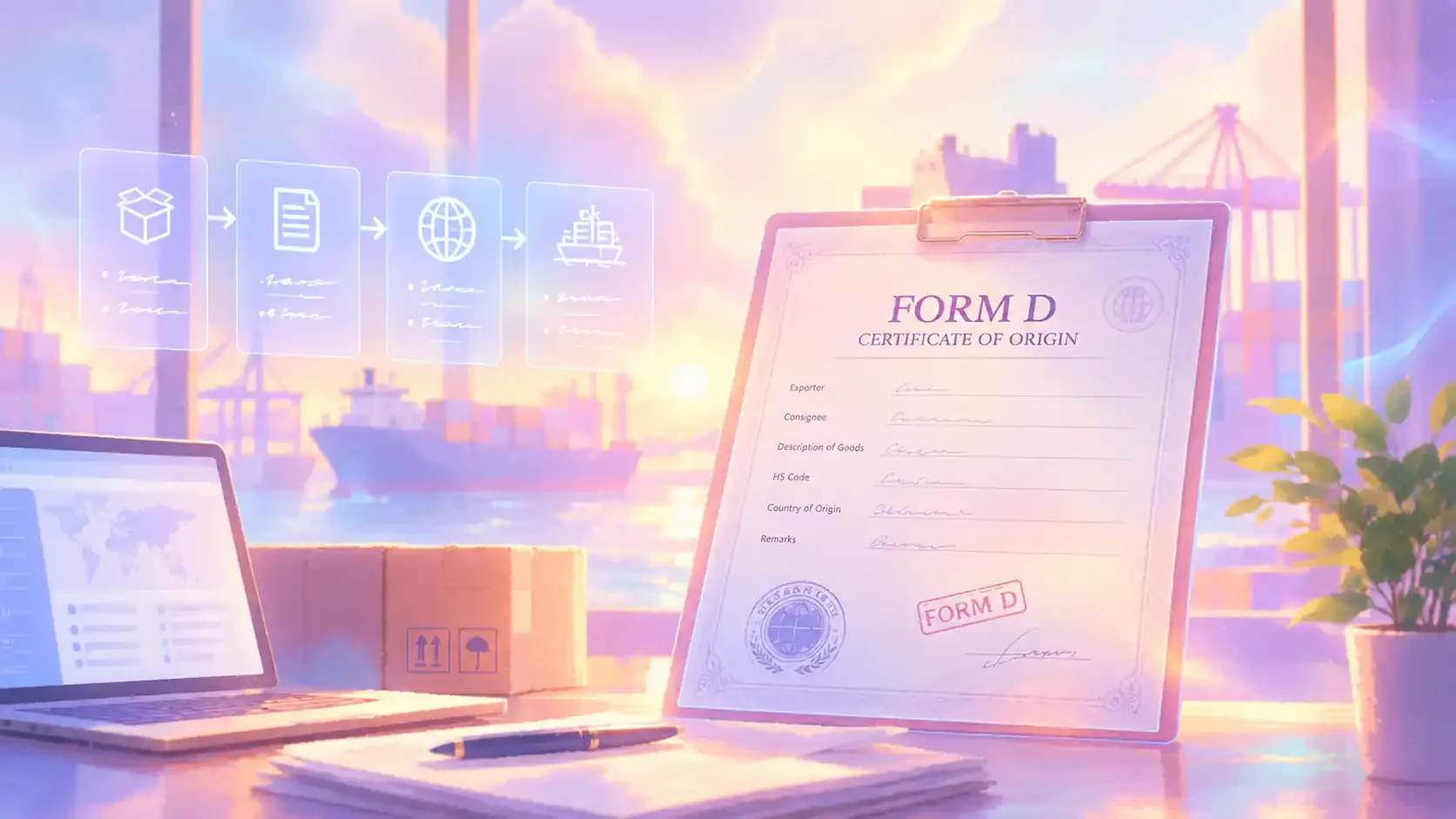
Form D is the preferential certificate of origin under the ASEAN Trade in Goods Agreement (ATIGA). It supports reduced or zero tariffs between ASEAN states, and most Singapore exporters use it.
A valid Form D can remove import duty entirely in most ASEAN markets. On many manufactured goods, Indonesia applies MFN tariffs of 5-15%, and a qualifying Form D zeroes that cost for the buyer.
Goods qualify under ATIGA with 40% regional value content of the FOB price or a Change in Tariff Classification at the 6-digit HS level. IFG Shipping's breakdown of ATIGA Form D explains both tests.
Reaching 40% is a costing exercise, since only ASEAN-sourced materials and production costs count. Form D also cannot replace Form E on ASEAN-China shipments, a frequent cause of rejected claims.
Certificate of Origin Requirements for Singapore Exporters
Issuing bodies assess origin from cost figures, not product descriptions, and check the same records every time. A claim holds only when it meets the threshold and has complete supporting documents.
1. The 25% local content threshold
Ordinary certificates follow the Singapore Customs origin criteria. Goods qualify if they are wholly obtained here or contain at least 25% local content of the finished product's ex-factory price.
Local content includes Singapore-sourced materials and direct labour, plus production overhead. It leaves out profit and selling or administrative expenses, so the calculation follows factory cost.
Preferential certificates skip the 25% test. Each agreement sets its own rule, and ATIGA and RCEP both need 40% regional value content of the FOB price or a 6-digit HS tariff classification change.
| Cost Element | Ordinary CO | Preferential CO (ATIGA) |
|---|---|---|
| Applicable threshold | 25% local content | 40% regional value content |
| Valuation base | Ex-factory price | FOB price |
| Singapore materials and labour | Counts | Counts as ASEAN content |
| ASEAN-sourced materials from other member states | Does not count | Counts under cumulation |
| Imported non-originating materials | Does not count | Does not count |
| Profit, selling and admin costs | Excluded | Excluded |
2. Supporting documents required for your application
Each application needs the invoice, packing list, transport document, and TradeNet export permit for that consignment. The issuing body cross-checks them with the certificate fields before certifying.
Origin evidence comes next. New product lines and first-time applicants need a Manufacturing Cost Statement, and preferential claims also need the bill of materials and production records.
| Document | Ordinary CO | Preferential CO |
|---|---|---|
| Commercial invoice | Required | Required |
| Packing list | Required | Required |
| Bill of lading or air waybill | Required | Required |
| Export permit via TradeNet | Required | Required |
| Manufacturing Cost Statement | For new products | Required |
| Bill of materials or production records | Where origin is queried | Required |
3. Record-keeping obligations and audit readiness
Exporters in Singapore must keep trade records for at least five years. A relevant agreement may set a longer period for preferential claims, and the longer rule governs.
Post-clearance audits are routine across ASEAN, and customs can query a claim years after arrival. The exporter then has to produce the cost statement and bill of materials.
Missing records can void an otherwise valid claim, because customs then reassesses the importer at MFN rates and may add penalties. Audit readiness therefore depends on disciplined filing.
How to Apply for a Certificate of Origin in Singapore
The application sequence is fixed, and since August 2026, both certificate types go through digital submission. First-time applicants must also register their premises or products before applying.
1. Registering your product or manufacturing premises
Manufacturers register their premises with Singapore Customs using the Manufacturer's Application Form, which lists equipment, workforce, and suppliers. Traders register the product line instead.
A Manufacturing Cost Statement follows for each product and becomes the reference for every later certificate on that line. Review takes around seven working days when the submission is complete.
Update the statement whenever your bill of materials or supplier mix changes materially. Otherwise, an audit may reveal certificates issued against a superseded statement.
2. Submitting via eCO: what changes from August 2026
From 1 August 2026, exporters can no longer lodge OCO applications on paper at a chamber counter. CrimsonLogic's note on the mandate outlines the transition for manual filers.
Preferential certificates already went through electronic submission, so the change only ends the last paper channel. Singapore Circular 07 of 2026 governs the switchover, with no grace period.
Applicants register with their chosen issuing body, then submit applications and track approvals on one platform. An open API also lets ERP systems push application data, avoiding re-entry.
3. Processing times, validity, and collection
Applications referencing an existing TradeNet permit usually take one to three working days, while first-time cost statement reviews take longer. Exporters must collect within one month of approval.
Exporters who cannot collect in person can authorise a representative by letter. Each certificate covers one consignment only, so frequent exporters repeat the cycle for every shipment.
| Stage | Typical Timeframe |
|---|---|
| Premises or product registration | One-time, varies with completeness |
| Manufacturing Cost Statement review | About 7 working days |
| Ordinary CO application via the digital platform | 1-3 working days |
| Preferential CO application | 1-3 working days where records are on file |
| Collection after approval | Within 1 month |
Certificate of Origin Sample: What the Document Must Contain
Both certificate types follow a standardised layout, and the usual sample is a numbered box form. Knowing the mandatory fields helps you prepare applications and spot problems before shipment.
1. Mandatory fields on every certificate
Every certificate names the exporter and consignee and describes the goods, with the HS code, quantity, weight, and country of origin. The permit number and invoice reference link it to the shipment.
Preferential certificates add a criterion box showing which origin rule the goods meet, such as RVC 40% or CTC at the 6-digit level. An incomplete box alone can make the claim fail at import.
| Field | Ordinary CO | Preferential CO (Form D) |
|---|---|---|
| Exporter name and address | Required | Required |
| Consignee name and address | Required | Required |
| Country of origin | Required | Required |
| HS code | Required | Where applicable |
| Description, quantity, weight | Required | Required |
| Export permit number | Required | Required |
| Invoice number and date | Required | Required |
| Origin criterion | Not applicable | Required |
| Issuing authority signature and stamp | Required | Required |
2. Common errors that cause rejection or delays
Rejected certificates most often result from a goods description that does not match the commercial invoice. A one-word difference in the product name can trigger a query at the border.
Form and route mismatches follow closely, since a Form D cannot support an ACFTA claim on Chinese imports. Dimerco's comparison of Form D and Form E shows how each behaves on ASEAN-China lanes.
| Error | Consequence | How to Avoid It |
|---|---|---|
| Description differs from the invoice | Query or rejection at customs | Generate the certificate from the invoice record |
| Wrong form for the trade route | Preferential claim denied | Maintain a form-to-agreement mapping per customer |
| Blank origin criterion box | Claim invalid on arrival | Complete the criterion for every product line |
| HS code mismatch with the destination tariff | Tariff misclassification | Verify codes against the destination schedule |
| Certificate expires before shipment | New application required | Time the application to the actual departure date |
Simplifying Certificate of Origin Management with Trade Software
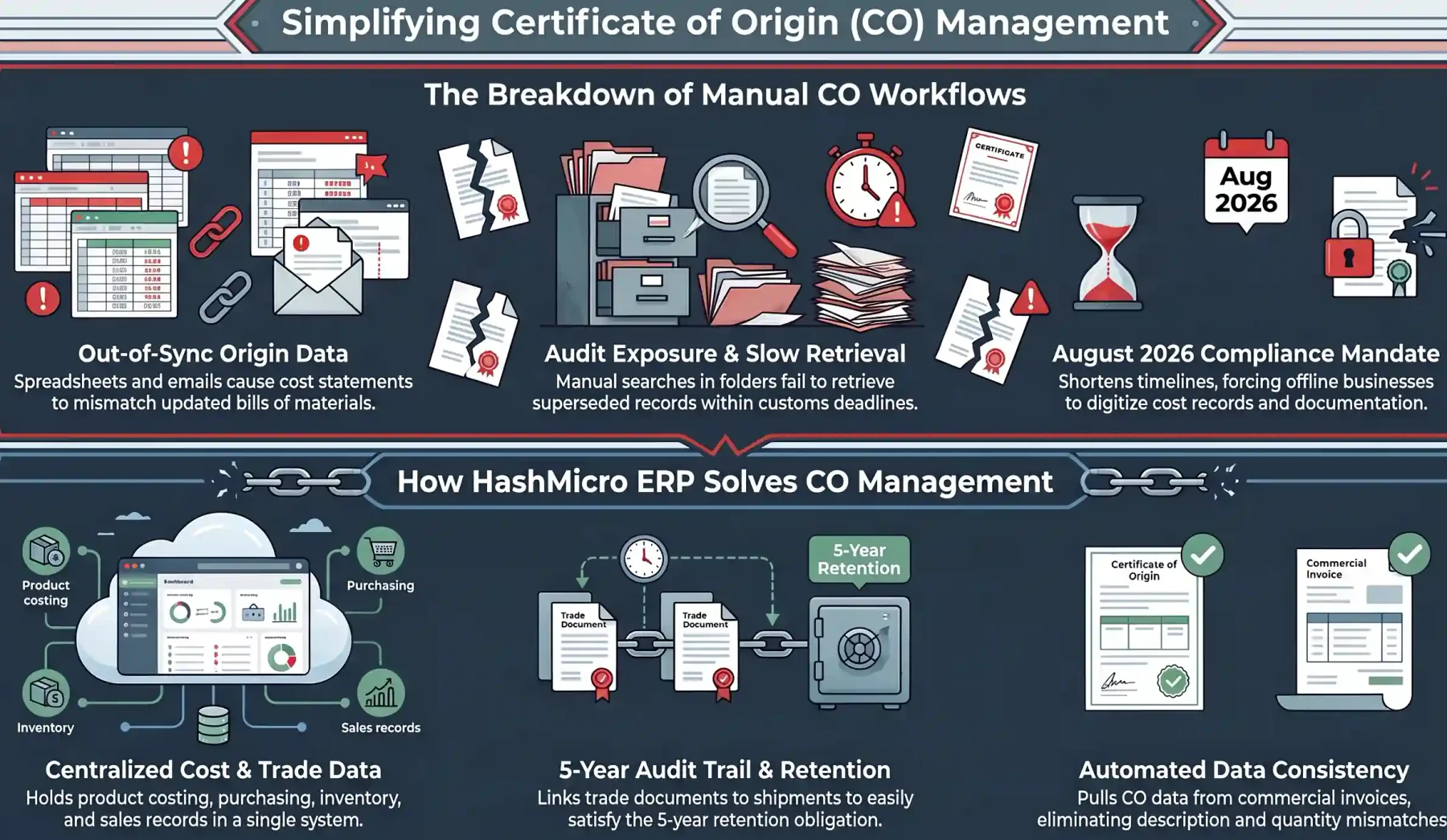
Manual certificate handling works while a company files a few certificates a month on one route. It fails once the company adds more FTAs and shipments, because audit exposure grows with them.
1. Where manual CO workflows break down
Most teams keep origin data in spreadsheets and emails, so versions go out of sync. A cost statement drafted six months ago may no longer match the bill of materials, yet certificates still use it.
Audit requests expose the same weakness, since teams rarely retrieve a superseded cost statement or export permit within the customs deadline. Staff end up searching folders and cabinets by hand.
The August 2026 mandate shortens the timeline for businesses that still hold origin data offline. These businesses must change their documentation practice and digitise cost records at the same time.
2. How HashMicro supports Singapore exporters
An ERP improves the input side of the process. HashMicro holds product costing, purchasing, inventory and sales records in one system, so cost statement figures are ready when an export order arrives.
Centralised document storage covers retention. Trade documents and cost statements stay linked to each shipment with an audit trail, which supports the five-year obligation without manual filing.
Because the system pulls certificate data from the same records as the commercial invoice, description and quantity mismatches become rare. HashMicro's Singapore ERP keeps that data consistent online.
Origin documentation holds only when cost data and trade records stay in sync. Hashy AI reads cost statements, invoices, and permits together, then flags what needs review.






Conclusion
The certificate type you file determines what your buyer pays at the destination, so choose it early. The two types carry different thresholds, and mixing them up costs the full MFN duty.
Singapore's fully electronic submission for ordinary certificates ends paper filing, so record quality now matters most. Exporters with centralised cost and product data simply switch channels.
To learn more about certificates of origin, book a free consultation with us today. We can show how your business can optimise its origin documentation and trade records.
Frequently Asked Questions
A certificate of origin is an official document stating which country produced the exported goods. Customs uses it to set the applicable tariff and to confirm compliance with trade agreements and import permits.
A preferential CO gives reduced or zero duty under a specific free trade agreement once goods meet its Rules of Origin. A non-preferential CO confirms origin without tariff benefits and supports letter of credit needs.
Form D is the preferential certificate of origin issued under ATIGA for shipments between ASEAN states. Goods need at least 40% ASEAN regional value content or meet a Change in Tariff Classification at 6-digit HS level.
Singapore Customs and five authorised bodies issue certificates of origin, including the SCCCI, the SICC and the Singapore Manufacturing Federation. Since 1 August 2026, exporters file ordinary CO applications online.
Issuing bodies usually process ordinary certificate applications within one to three working days when permit and cost records are on file. A first-time Manufacturing Cost Statement review takes about seven days.