






The IR8A form is Singapore’s official record of employee remuneration. Employers use it to report each employee’s employment income to the Inland Revenue Authority of Singapore (IRAS), including salary, bonuses, director’s fees, benefits-in-kind, and other taxable income.
Employers must prepare an IR8A for each eligible employee, regardless of the company’s size or industry. Since YA 2025, employers with five or more employees must submit employment income information electronically through the Auto Inclusion Scheme (AIS).
The submission period runs from 1 February to 1 March each year, with the information sent directly to IRAS for employees’ tax returns.
Key Takeaways
The IR8A form records employee remuneration details required for annual tax reporting in Singapore
AIS provides employers with a structured way to submit IR8A information electronically to IRAS
A clear IR8A compliance checklist helps employers manage annual reporting requirements accurately and on time
What Is the IR8A Form in Singapore?

Form IR8A is the annual return in which an employer declares what it paid each employee during the preceding calendar year. For filings made in 2026, the form covers income earned from 1 January to 31 December 2025, assessed under YA2026.
The form is not a tax computation. It declares salary, bonus, allowances, director's fees, CPF, and benefits that IRAS uses to assess the employee's own tax liability.
Three supporting documents travel with it when relevant: Appendix 8A for benefits-in-kind, Appendix 8B for share option gains, and Form IR8S for excess or voluntary CPF contributions. Each one is prepared per employee, not per company.
Who Must Submit the IR8A Form?
The obligation sits with the employer, and it is wider than most payroll teams assume.
1. The employer obligation and who qualifies as a liable employer
Every employer operating in Singapore must prepare Form IR8A for employees who received employment income during the year, regardless of company size, profitability, or whether the employee ends up paying tax.
2. Which types of workers require an IR8A filing
Full-time and part-time staff, Singapore citizens and PRs, foreign employees on work passes, company directors including non-resident directors, pensioners, and employees who resigned or were posted overseas during the year all require a Form IR8A.
3. Liable employers vs non-liable situations: a quick reference
You still file for an employee who earned below the tax threshold or worked only part of the year; you do not file IR8A where there was no employment relationship at all, such as payments to a genuine independent contractor or an overseas entity's own staff.
What Information Goes on the IR8A Form
The form opens with identity data: full name as per NRIC or FIN, identification number, date of birth, designation, and the exact employment start and cessation dates. Mismatched NRIC or FIN details are the single most common cause of rejected submissions.
The income block captures gross salary, bonus with its declaration date, director's fees, commission, allowances, gratuity, notice pay, ex-gratia payments, and retirement benefits. Each figure must reconcile to your payroll ledger for the calendar year, not your financial year.
Deductions and contributions follow: employee CPF, donations deducted at source, insurance premiums, and any tax borne by the employer on the employee's behalf. Benefits-in-kind and share gains are reported on Appendix 8A and 8B respectively.
IR8A Submission via the Auto Inclusion Scheme (AIS)
AIS lets employers transmit employment income data straight to IRAS, which then pre-fills it into the employee's tax return. Participation is mandatory for employers with five or more employees in the preceding year, or any employer that received the Notice to File Employment Income of Employees Electronically.
For AIS employers, electronic submission replaces the hardcopy IR8A entirely. The data is due by 1 March, and the figures you transmit become the employee's auto-included income — so accuracy carries more weight than speed.
Employers below the threshold and without a notice may still join voluntarily, and most do. Non-AIS employers must instead hand each employee a completed hardcopy IR8A and the relevant appendices by 1 March.
How to Submit IR8A via AIS: Step-by-Step
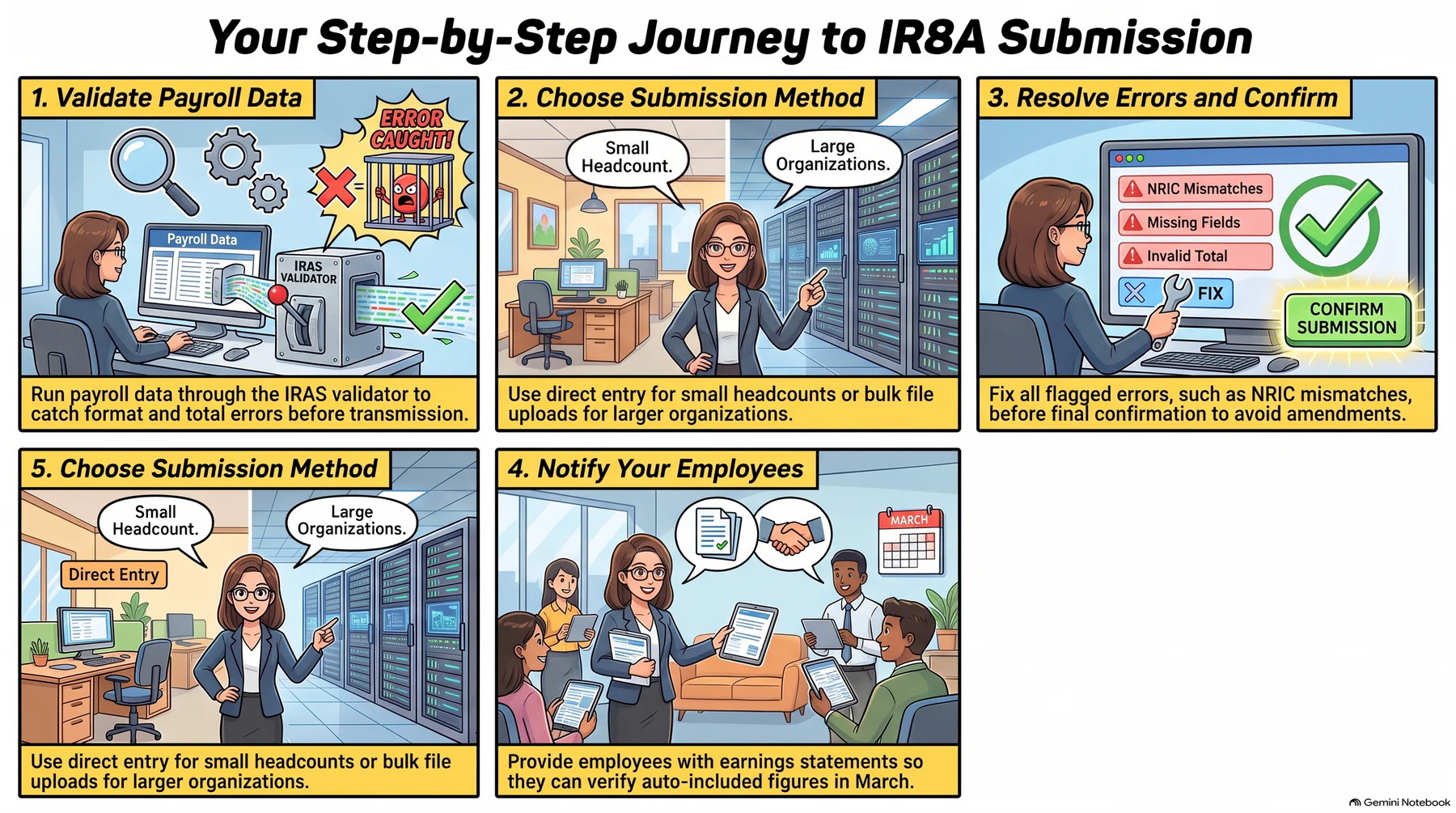
The submission itself is straightforward once your data is clean; the work sits upstream.
1. Log in to myTax Portal with CorpPass from 1 February onwards
Access myTax Portal using CorpPass with the Submission of Employment Income e-Service assigned to the filing officer — IRAS opens the submission window early in January, so confirm the authorisation is live before you need it.
2. Compile and validate your employment income data
Export the full calendar-year payroll data for every employee and run IRAS's Validation and Submission Application or your payroll system's built-in validator to catch format and totals errors before transmission.
3. Choose your submission method: direct entry or bulk file upload
Small headcounts can be keyed in directly through the portal's online application, while larger employers upload a validated text file generated from payroll software integrated with AIS.
4. Resolve validation errors before confirming your submission
Fix every flagged error — unmatched NRIC or FIN, invalid employment dates, CPF exceeding statutory limits — then re-validate, because a submission confirmed with wrong figures must be corrected through a separate amendment.
5. Understand your post-submission obligations for employees
Keep the acknowledgement reference, and give each employee a statement of their reported earnings so they can verify the auto-included figures when their own filing opens in March.
IR8A Deadline, Penalties, and Amendment Process
The deadline is 1 March each year, making 1 March 2026 the cut-off for income earned in 2025. There is no extension granted as a matter of course, and late submission is treated as an offence, not an administrative delay.
Failure to file, or filing without reasonable excuse, exposes the employer to a fine of up to $5,000 under the Income Tax Act, with imprisonment of up to 12 months in default of payment. Repeated non-compliance also puts the employer on IRAS's review radar for subsequent years.
Errors are corrected by submitting an amendment record for the affected employee rather than refiling the whole batch. Amend as soon as the error is found, tell the employee, and document the reason — amendments made after the employee has filed create rework on their side.
How HR Software Streamlines IR8A Compliance for Singapore Businesses
Most IR8A compliance challenges start with fragmented data. When payroll, leave, claims, and benefits are stored across separate spreadsheets, HR teams have to reconcile them manually each January, increasing the risk of mismatches and missing income details.
An integrated HR and payroll system keeps CPF calculations, taxable allowances, and benefits-in-kind organised throughout the year. This allows IR8A data to be generated from up-to-date records, while AIS-ready exports reduce manual formatting and validation issues. HashMicro’s HRM and payroll software supports CPF and SDL calculations, Appendix 8A and 8B data capture, and AIS-format IR8A generation.
With payroll data already organised, HR teams can also use AI to simplify routine tasks and quickly surface relevant information. Hashy helps bring this extra layer of support to everyday HR workflows, so your team can spend less time checking records manually.






IR8A Compliance Checklist for Singapore Employers in 2026
Run these six checks between January and the 1 March deadline.
1. Confirm whether your headcount triggers mandatory AIS participation
Count every employee on your payroll during 2025, five or more makes AIS mandatory for the 2026 submission, and so does a Notice to File from IRAS regardless of headcount.
2. Verify NRIC/FIN details for all employees before preparing IR8A data
Match every identification number, legal name, and date of birth against the actual NRIC, FIN, or work pass record, since IRAS validates on exact match and will reject anything else.
3. Reconcile payroll CPF totals against CPF Board contribution statements
Compare your full-year employee CPF figures line by line with CPF Board records and resolve any variance before it reaches the IR8A, as mismatches here often signal a wage classification error.
4. Identify employees who require Appendix 8A, 8B, or IR8S attachments
Flag anyone who received housing, a company car, or other benefits-in-kind (8A), exercised share options or awards (8B), or had excess or voluntary CPF contributions (IR8S).
5. Open your AIS submission on myTax Portal from 1 February onwards
Submit well ahead of 1 March 2026 rather than in the final week, so there is room to clear validation errors without missing the statutory deadline.
6. Address any post-filing amendments before the assessment closes
Monitor employee queries through March and submit amendment records promptly, keeping a short log of what changed and why for your audit trail.
Conclusion
IR8A compliance is much easier when payroll, CPF, and benefits data are kept accurate throughout the year. With the right records in place, employers can approach the 1 March deadline with fewer errors and less last-minute reconciliation.
The key is to confirm whether AIS applies to your business, check each employee’s identification and income details, and submit the required information early enough to resolve any validation issues.
If your payroll data is still spread across multiple files, it may be time to streamline the process. Consult with HashMicro’s Singapore team for free to explore how an AIS-ready payroll setup can support your HR and payroll processes.
FAQ
Form IR8A is the annual declaration employers submit to IRAS reporting each employee's employment income, salary, bonus, allowances, director's fees, CPF, and benefits for the preceding calendar year.
The deadline is 1 March 2026, covering income earned from 1 January to 31 December 2025. AIS employers submit electronically; non-AIS employers must give employees their hardcopy IR8A by the same date.
All employers in Singapore, for every employee who received employment income during the year — including part-timers, foreign pass holders, company directors, pensioners, and staff who left mid-year.
AIS transmits employment income data directly to IRAS for pre-filling into employees' tax returns. It is mandatory for employers with five or more employees in the preceding year, or any employer that received IRAS's Notice to File.
IR8A is the annual income declaration for all employees. IR21 is a tax clearance form filed when a foreign or SPR employee ceases employment or leaves Singapore, normally at least one month before the last day, with final monies withheld.
Late or non-filing is an offence under the Income Tax Act, carrying a fine of up to $5,000 and imprisonment of up to 12 months in default of payment. Errors should be corrected through an amendment record as soon as they are found.
A hardcopy IR8A is not required under AIS, but IRAS expects employers to provide a statement of earnings so employees can verify their auto-included income when filing.