








Choosing a warehouse management system becomes more challenging as inventory volumes grow, fulfilment requirements change, and businesses expand across multiple locations. While Blue Yonder WMS supports complex warehouse operations, it may not be the right fit for every company's budget, technology environment, or operational needs.
Singapore businesses evaluating warehouse management software should consider more than the number of available features. Implementation complexity, integration with existing systems, ongoing costs, and scalability all influence whether a platform can support daily operations effectively.
This article compares seven Blue Yonder WMS alternatives in 2026, including their key capabilities, potential limitations, and suitability for different business requirements.
Key Takeaways
Compare the 7 best Blue Yonder WMS alternatives to understand their key capabilities and suitability for different warehouse operations.
Review what to check before migrating from Blue Yonder to prepare your inventory data, integrations, and warehouse workflows.
Explore which Blue Yonder alternative fits your warehouse based on your business size, fulfilment requirements, and existing ERP systems.
Blue Yonder WMS Alternatives at a Glance

Blue Yonder WMS is designed to support warehouse execution, inventory management, and complex distribution processes. However, alternatives may offer a better fit depending on a company's warehouse structure, existing software, and fulfilment requirements.
The following comparison highlights seven platforms worth considering, from enterprise warehouse management systems to solutions focused on ecommerce and integrated business operations.
Use this overview as a starting point, then evaluate each vendor against your actual workflows, integration needs, and implementation budget.
| WMS software | Best suited for | Main consideration |
|---|---|---|
| Manhattan Active Warehouse Management | Large enterprises | Complex implementation requirements |
| SAP Extended Warehouse Management | SAP users | Configuration and specialist expertise |
| HashMicro WMS | Integrated warehouse and ERP workflows | Confirm required features and integrations |
| Oracle Fusion Cloud Warehouse Management | Oracle users | Existing system compatibility |
| Infios Warehouse Management | Complex distribution operations | Deployment and configuration scope |
| Logiwa IO | Ecommerce and 3PL fulfilment | Fit for non-ecommerce workflows |
| Deposco Bright Warehouse | Retail and omnichannel fulfilment | Integration and specialised requirements |
Why Businesses Consider Alternatives to Blue Yonder WMS
Although Blue Yonder supports complex warehouse operations, businesses may explore alternatives to find a better fit for their budget, existing systems, and operational requirements.
1. Implementation Complexity and Total Cost of Ownership
Implementing a WMS involves software fees, configuration, data migration, integration development, employee training, and ongoing support. Businesses should compare the total cost of ownership rather than relying on initial quotations alone.
2. Integration with ERP, Ecommerce, and Automation Systems
A WMS needs to exchange accurate information with ERP software, ecommerce platforms, accounting systems, courier services, and warehouse equipment where required. Businesses should confirm which integrations are native and which require middleware or custom development.
3. Suitability for Mid-Market and Growing Businesses
Smaller and mid-market businesses may prioritise inventory accuracy, efficient picking, and multi-warehouse visibility over advanced enterprise features. The ideal solution should meet current requirements while accommodating realistic growth in SKUs, orders, and warehouse locations.
"The right WMS should improve warehouse efficiency, connect business workflows, and support long-term growth."
The 7 Best Blue Yonder WMS Alternatives
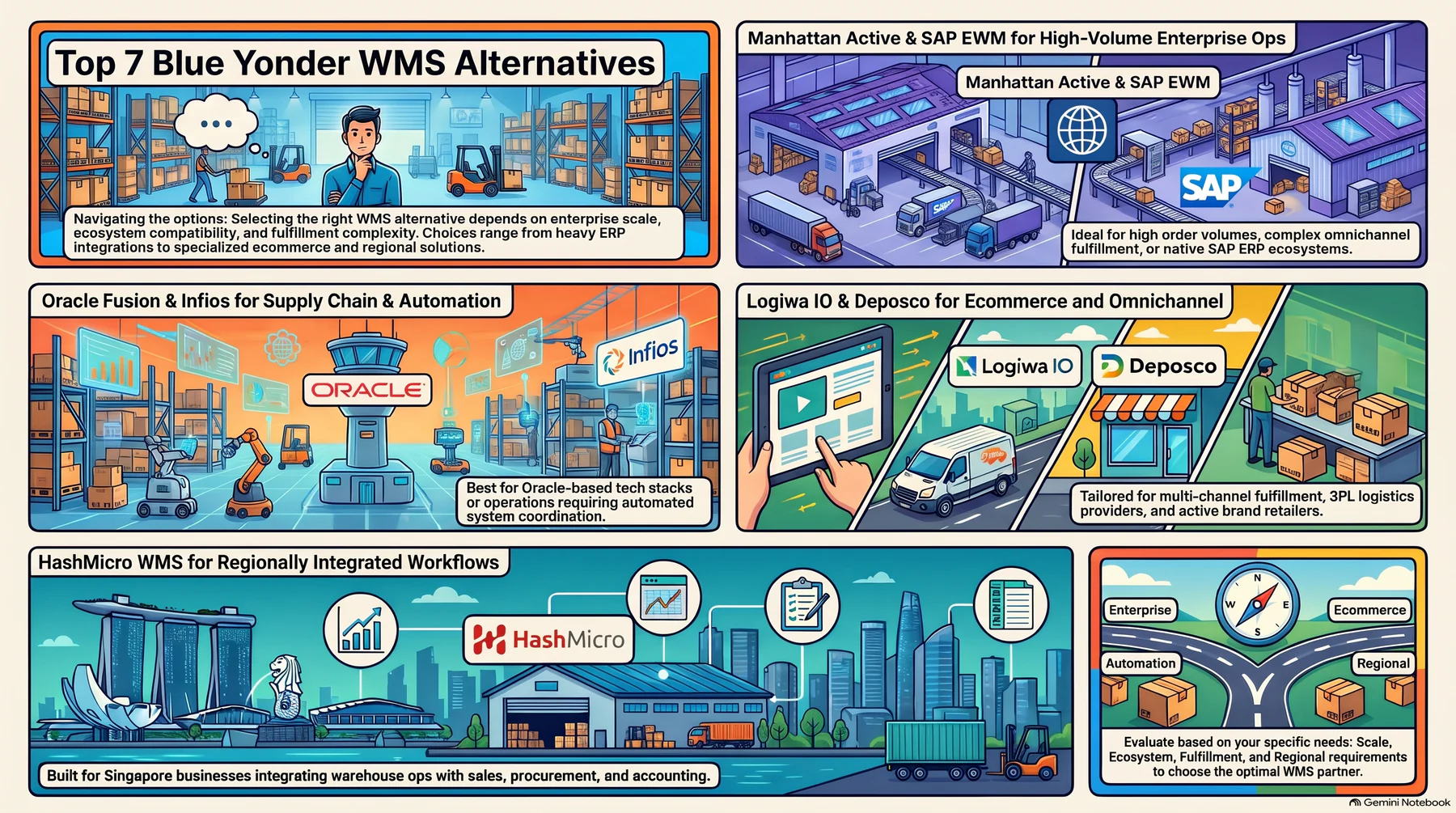
These seven alternatives offer different approaches to warehouse management, from enterprise-level distribution to ecommerce fulfilment and integrated ERP workflows.
1. Manhattan Active Warehouse Management
Manhattan Active Warehouse Management is a cloud-based platform designed for complex warehouse execution and omnichannel fulfilment. It supports sophisticated distribution requirements, making it worth evaluating for large retailers and enterprises managing high order volumes, multiple facilities, and demanding warehouse processes.
2. SAP Extended Warehouse Management
SAP Extended Warehouse Management (SAP EWM) supports detailed warehouse operations within the broader SAP ecosystem. It is particularly relevant to enterprises already using SAP for finance, procurement, manufacturing, or supply chain management, although implementation complexity and specialist configuration requirements should be considered.
3. HashMicro WMS
HashMicro WMS is worth considering for Singapore businesses seeking warehouse management connected to inventory, sales, procurement, and accounting workflows. Its published capabilities include multi-location stock visibility, warehouse transfers, stock counting, barcode and QR scanning, and pick, pack, and ship processes; businesses should confirm the exact functionality and integrations required for their operations through a HashMicro WMS consultation.
4. Oracle Fusion Cloud Warehouse Management
Oracle Fusion Cloud Warehouse Management provides cloud-based warehouse management capabilities for businesses seeking to coordinate warehouse execution with broader supply chain operations. It is particularly relevant to companies using Oracle applications, although businesses should evaluate integration requirements, licensing, and implementation scope before selecting the platform.
5. Infios Warehouse Management
Infios provides warehouse management and supply chain execution solutions for businesses with demanding distribution requirements. Formerly associated with Körber Supply Chain Software, the company is worth evaluating for warehouse operations that require coordination between fulfilment processes, distribution activities, and automation systems.
6. Logiwa IO
Logiwa IO focuses on warehouse management for ecommerce fulfilment and third-party logistics providers. Its capabilities are relevant to businesses handling orders across multiple sales channels or fulfilling products for different clients, although specialised manufacturing and industrial warehouse requirements should be assessed separately.
7. Deposco Bright Warehouse
Deposco Bright Warehouse is an option for retailers, distributors, and fulfilment businesses managing inventory across multiple channels. Companies can evaluate it for warehouse execution and omnichannel fulfilment, while confirming compatibility with their existing enterprise applications, specialised workflows, and local integration requirements.
Which Blue Yonder Alternative Fits Your Warehouse?
The best choice depends on your warehouse complexity, business priorities, existing software, and the level of integration your operations require.
1. Best Alternative for Enterprise-Level Operations
Manhattan Active Warehouse Management is worth evaluating for enterprises with complex distribution networks and demanding fulfilment requirements, while Infios may suit businesses looking for warehouse execution capabilities alongside broader distribution operations.
2. Best Alternative for SAP or Oracle Users
SAP EWM is a natural candidate for businesses already operating within the SAP ecosystem, while Oracle Fusion Cloud Warehouse Management is relevant to companies using Oracle applications; both should be assessed against existing integrations and implementation requirements.
3. Best Blue Yonder Alternative for Mid-Market Businesses
HashMicro WMS is worth considering for mid-market companies seeking warehouse visibility and connected inventory, procurement, sales, and accounting workflows, provided its available features and implementation scope meet the business's requirements.
4. Best Alternative for Ecommerce and 3PL Fulfilment
Logiwa IO is relevant to ecommerce and third-party logistics businesses that prioritise order processing, while Deposco Bright Warehouse is worth evaluating for retail and omnichannel fulfilment operations.
5. Best Alternative for Integrated ERP Workflows
HashMicro WMS may suit businesses that want warehouse processes connected with wider ERP workflows, helping teams coordinate stock movements, purchasing, sales orders, and accounting records through a more integrated operational environment.
What to Check Before Migrating from Blue Yonder
Before switching systems, businesses should assess their existing data, connected applications, warehouse processes, and implementation requirements to minimise disruption.
1. SKU, Location, Batch, and Inventory Data Migration
Review SKU records, product descriptions, units of measure, warehouse locations, bin assignments, stock balances, batch numbers, and serial numbers where applicable. Outstanding orders, stock transfers, and returns should also be assessed, with migrated inventory reconciled before go-live.
2. ERP, Ecommerce, Carrier, and Scanner Integrations
List every connected application and device, including ERP systems, ecommerce platforms, marketplaces, courier services, barcode scanners, and warehouse equipment. Test standard transactions and exceptions to confirm that stock levels, order statuses, and shipment records remain consistent across systems.
3. Receiving, Picking, Packing, and Dispatch Workflows
Map the warehouse's existing processes from receiving and putaway through replenishment, picking, packing, dispatch, and returns. Test representative scenarios in the new WMS to confirm that operational rules, stock movements, and connected records behave as expected.
4. Training, Testing, and Change Management
Prepare role-specific training for warehouse operators, supervisors, and relevant office teams before launch. User acceptance testing should involve the people who perform daily warehouse tasks, while contingency procedures should be established for unexpected issues during go-live.
5. Implementation and Ongoing WMS Costs
Request a breakdown of software fees, configuration, migration, integrations, hardware, training, upgrades, and ongoing support. Compare total costs over several years and assess whether the expected operational improvements justify the investment.
Conclusion
The best Blue Yonder WMS alternative depends on your warehouse requirements, existing systems, and budget. While Manhattan, SAP EWM, Oracle, and Infios suit different enterprise needs, Logiwa IO and Deposco Bright Warehouse are worth considering for ecommerce and omnichannel fulfilment.
For businesses seeking to connect warehouse operations with inventory, procurement, sales, and accounting, HashMicro WMS is another option to explore. The key is to choose a solution that fits your current workflows while supporting future growth.
Consult with our experts for free to discuss your warehouse management needs, explore HashMicro WMS capabilities, and find out how an integrated solution can help improve warehouse efficiency and streamline your business operations.
FAQ
The best option depends on warehouse size, operational complexity, and existing software. HashMicro WMS is worth evaluating for businesses seeking connected warehouse and ERP workflows, while Logiwa IO may suit ecommerce-focused operations.
SAP EWM is particularly relevant to businesses using SAP applications, while Manhattan Active Warehouse Management is designed for complex warehouse execution and omnichannel fulfilment. Blue Yonder also supports sophisticated warehouse operations, so the best choice depends on integration requirements, implementation complexity, and total cost.
Common migration data includes SKU records, stock quantities, warehouse locations, bin assignments, batch information, and serial numbers where applicable. Outstanding orders, transfers, and returns should also be reviewed before migration.
Yes. Integration may use native connectors, APIs, middleware, or custom interfaces, depending on the systems involved. Businesses should test purchase orders, goods receipts, sales orders, stock movements, and financial updates to confirm data consistency.