






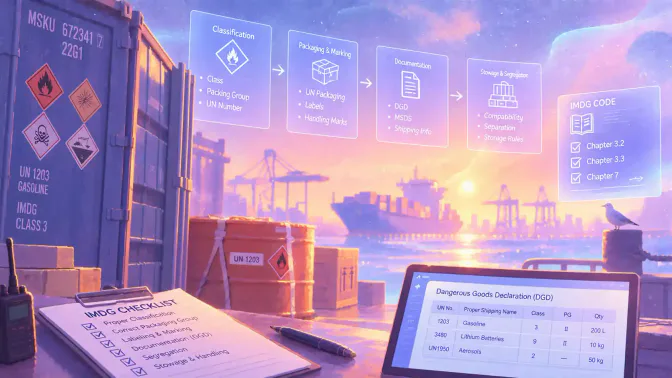
Dangerous goods are substances and articles that threaten health, safety, property or the environment in transit. The IMDG Code sorts them into nine classes by primary hazard.
Every dangerous goods shipment moving through the Port of Singapore is declared against that classification. Get the class wrong and every document after it inherits the error.
Below, you will find all nine classes, the labels that mark them, and how classification works in practice. We also cover segregation rules and what changes once cargo reaches your warehouse.
Key Takeaways
Dangerous goods are substances that can cause harm in transit, classified under the IMDG Code, with MPA and NEA covering the same consignment at different stages.
The nine dangerous goods classes run from explosives to miscellaneous, with divisions, packing groups and subsidiary risks setting packaging and labelling requirements.
Storing dangerous goods in Singapore falls under NEA licensing once cargo leaves the terminal, with both substance type and held quantity triggering obligations.
Managing compliance in daily operations means linking SDS to each SKU, holding class and UN number as item attributes, and tracking quantities against licence limits.
What Are Dangerous Goods?
Dangerous goods, also called hazardous materials or hazmat, are substances capable of causing harm while being transported. The definition reaches further than most businesses expect.
Aerosols, perfumes, paint, pool chlorine, lead-acid batteries, dry ice and adhesives all qualify. So does every lithium battery sitting inside a laptop.
The test is not how dangerous a product feels in normal use. It is whether the substance meets the criteria for one of nine hazard classes. A carton of power banks counts as dangerous goods. A carton of steel bolts does not.
Behind those classes sits the International Maritime Dangerous Goods Code, published by the International Maritime Organization. Chapter VII of the SOLAS Convention gives it legal force.
The Code applies to packaged dangerous goods on cargo and passenger ships on international voyages. It sets classification, packaging, labelling, documentation and stowage requirements for every class.
Revisions arrive on a two-year cycle, so the edition in force changes regularly. Always work from the current amendment rather than an older printed copy.
In Singapore, the IMDG Code operates alongside domestic law, and two authorities cover the same consignment at different moments. Knowing where one hands over to the other prevents most compliance gaps.
The MPA (Dangerous Goods, Petroleum and Explosives) Regulations 2005 govern how dangerous goods enter the Port of Singapore. They also set how you declare them and how terminals handle them.
The Maritime and Port Authority of Singapore administers that regime. You must declare the goods before they enter port limits, and quantity limits apply at berths.
Once the container clears the terminal and the goods sit on land, the National Environment Agency takes over. That handover catches businesses out, and we return to it below.
One more distinction matters before the classes themselves. The class numbers look identical across transport modes, but the rules attached to them differ.
| Framework | Transport mode | Published by |
|---|---|---|
| IMDG Code | Sea freight | International Maritime Organization (IMO) |
| IATA DGR | Air freight | International Air Transport Association (IATA) |
| ADR | Road transport (Europe) | UNECE |
Air rules are the strictest of the three. Dangerous goods accepted for sea freight are not automatically accepted by air, and the IATA Dangerous Goods Regulations cap lithium batteries more tightly.
So a classification that clears an IMDG booking needs re-checking when the consignment switches to air. Treat each mode as a separate approval.
"A product does not need to feel dangerous to count as dangerous goods. If it meets the criteria for one of the nine hazard classes, it must be classified, packed, marked and declared accordingly."
The 9 Dangerous Goods Classes Under the IMDG Code
The nine classes are organised by primary hazard. Several classes then split into divisions that separate hazards of different character within the same class.
An article presenting more than one hazard carries a primary class plus one or more subsidiary risks. The table below sets out all nine with examples and label colours.
| Class | Divisions | Hazard | Example goods | Label |
|---|---|---|---|---|
| 1 | 1.1 to 1.6 | Explosives | Fireworks, detonators, signal flares | Orange diamond |
| 2 | 2.1, 2.2, 2.3 | Gases | LPG, nitrogen, aerosols, chlorine | Red, green or white diamond |
| 3 | None | Flammable liquids | Paints, solvents, adhesives, perfumes | Red diamond |
| 4 | 4.1, 4.2, 4.3 | Flammable solids, self-heating, water-reactive | Matches, metal powders, carbide | Red-striped or red-blue diamond |
| 5 | 5.1, 5.2 | Oxidisers and organic peroxides | Pool chlorine, hydrogen peroxide, bleach | Yellow diamond |
| 6 | 6.1, 6.2 | Toxic and infectious substances | Pesticides, lead compounds, biological samples | White diamond, skull or biohazard |
| 7 | None | Radioactive material | Medical isotopes, gauges | White-yellow diamond, trefoil |
| 8 | None | Corrosives | Sulphuric acid, caustic soda, lead-acid batteries | Black-and-white diamond |
| 9 | None | Miscellaneous | Lithium batteries, dry ice, magnetised material | Black-striped diamond |
1. Class 1 to 4: explosives, gases, flammable liquids and solids
Class 1 covers explosives: fireworks, detonators, propellants and signal flares. Divisions 1.1 to 1.6 separate them by how each substance behaves on initiation.
Most commercial container lines decline Class 1 outright. Confirm acceptance with your carrier before you produce the cargo.
Class 2 covers gases across three divisions. Division 2.1 holds flammable gases such as LPG, 2.2 non-flammable non-toxic gases such as nitrogen, and 2.3 toxic gases such as chlorine.
Aerosol cans sit in Class 2.1 whenever the propellant is flammable. That pulls ordinary consumer goods into scope, including deodorants, spray paint and cleaning products.
Class 3 covers flammable liquids, and most exporters meet it first. The deciding parameter is flash point, because the class captures liquids with a closed-cup flash point below 60 degrees Celsius.
That brings in paints, varnishes, adhesives, solvents, perfumes and some high-strength alcoholic products. A trade description tells you nothing here, whereas the flash point on the safety data sheet does.
Class 4 splits three ways. Division 4.1 covers flammable solids such as matches and certain metal powders, while 4.2 covers substances liable to spontaneous combustion.
Division 4.3 covers substances that emit flammable gas on contact with water. That matters for mineral and chemical shipments, where a wet container is a genuine possibility.
2. Class 5 to 9: oxidisers, toxics, radioactives, corrosives and miscellaneous
Class 5 covers oxidising substances and organic peroxides, including pool chlorine, industrial bleach and concentrated hydrogen peroxide. Oxidisers feed a fire rather than start one.
For that reason, stowage keeps Division 5.1 well clear of Class 3 flammable liquids. The two together turn a contained spill into a sustained fire.
Class 6 separates toxicity from infection. Division 6.1 covers toxic substances such as pesticides and many industrial chemicals, while 6.2 covers infectious substances.
Division 6.2 includes diagnostic and biological materials, which carry their own packaging regime. A general forwarder rarely handles them without specialist support.
Class 7 covers radioactive material, from medical isotopes to industrial measuring equipment. It requires specialist carriers and specific transport indices.
Class 8 covers corrosives: sulphuric acid, hydrochloric acid, sodium hydroxide and lead-acid vehicle batteries. The hazard extends to the ship itself, so packaging integrity carries extra weight.
Class 9 holds miscellaneous dangerous goods, and it is the least intuitive of the nine. Lithium batteries, dry ice, magnetised material and environmentally hazardous substances all sit here.
Most businesses convinced they never ship dangerous goods are in fact shipping Class 9. A pallet of laptops qualifies.
3. Packing groups I, II and III
Within most classes, the IMDG Code assigns a packing group that grades the degree of danger. That group then sets the minimum packaging performance level you may use.
| Packing group | Degree of danger | Minimum packaging performance level |
|---|---|---|
| PG I | High | X |
| PG II | Medium | Y, and X is also acceptable |
| PG III | Low | Z, and X or Y are also acceptable |
A PG I flammable liquid needs X-grade UN-certified packaging, whereas a PG III substance may be packed to Z-grade. Packaging tested to a higher level always satisfies a lower requirement.
The reverse never applies. Classes 1, 2, 5.2, 6.2 and 7 carry no packing group, because other criteria grade their hazard.
4. Subsidiary risks and marine pollutants
A single substance often presents more than one hazard. A flammable liquid that is also corrosive carries Class 3 as its primary class and Class 8 as a subsidiary risk.
Both labels then go on the package. Subsidiary risks also feed into segregation, so you cannot treat them as a documentation detail.
Separately, dangerous goods may be classified as a marine pollutant, which triggers its own marking regardless of class. A substance can be a marine pollutant without being especially hazardous to people.
That marking is one of the most commonly missed items on an otherwise correct declaration. Checking it costs nothing before the container leaves.
Dangerous Goods Labels and Placards
Dangerous goods labels are the diamond-shaped hazard marks applied to individual packages. Each class carries its own colour and symbol, so a handler identifies the hazard without reading a document.
Red signals flammable, green non-flammable gas, yellow oxidiser, and black-and-white corrosive. Those colours stay consistent wherever the package travels.
Placards do the same job at a different scale. A label goes on the package, while a placard is the enlarged version applied to all four sides of a container or cargo transport unit.
Placards also carry the UN number and, where required, the marine pollutant mark and the elevated-temperature mark. Correctly labelled pallets inside an unplacarded container still make a non-compliant shipment.
How Dangerous Goods Are Classified
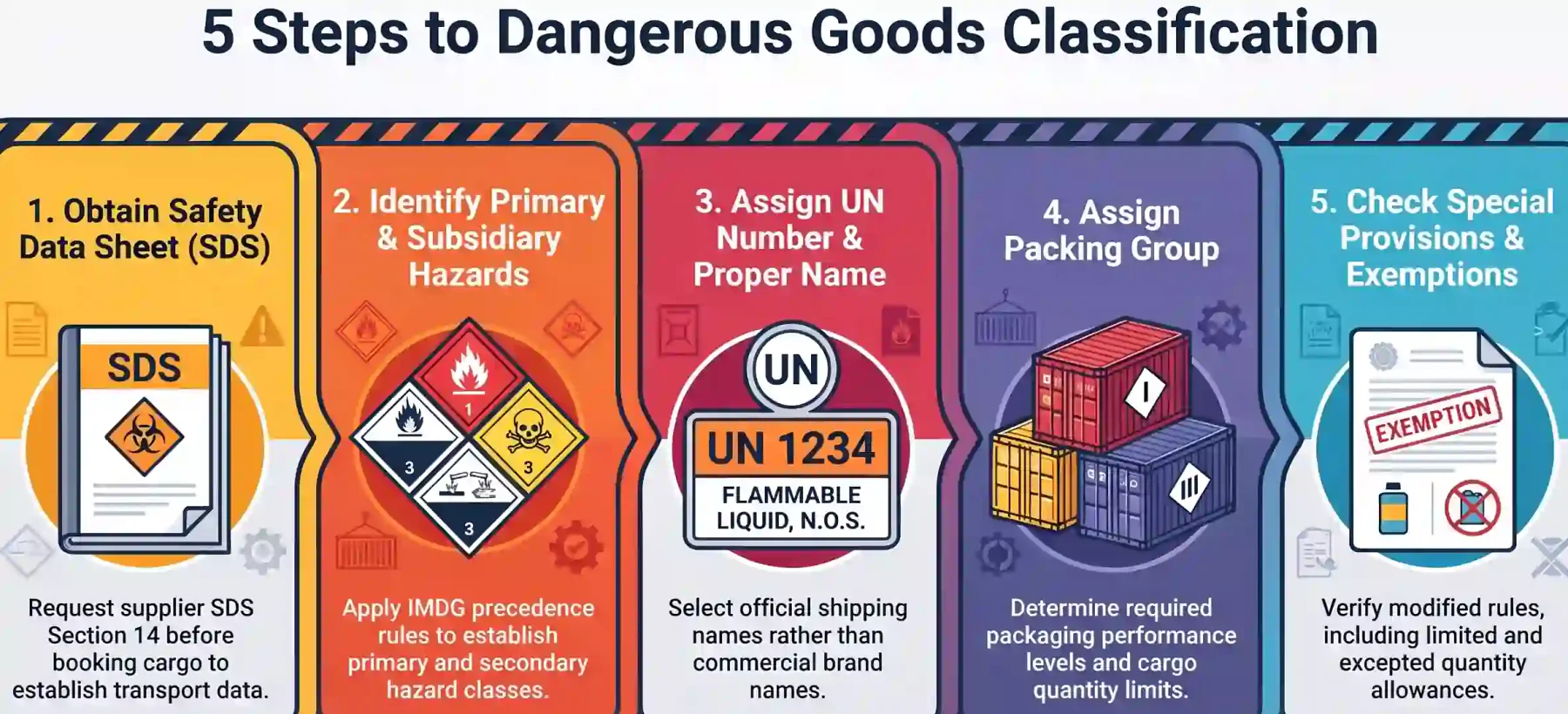
Dangerous goods classification runs in a fixed order. Every stage depends on the one before it, so skipping ahead creates errors you only find at the booking desk.
- Get the safety data sheet from your supplier. Section 14 carries the transport information: UN number, proper shipping name, class and packing group.
- Identify the primary hazard. Where a substance presents several hazards, the precedence rules in the IMDG Code decide which class leads and which become subsidiary risks.
- Find the UN number and proper shipping name. "Flammable liquid, n.o.s." is a valid proper shipping name, whereas "Industrial Cleaner XY" is not.
- Assign the packing group. That choice determines the minimum packaging performance level and affects the quantity limits you may ship.
- Check special provisions and exemptions. Many entries carry provisions that modify standard requirements, including limited quantity and excepted quantity allowances.
Request the safety data sheet before you place the order, not after the cargo is booked. A declaration built on a missing sheet rarely survives the carrier's review.
Where the data sheet and your own product knowledge disagree, resolve it before booking. The shipper signs the declaration, so the shipper carries the consequence of getting it wrong.
1. Lithium batteries: UN 3480, 3481, 3090 and 3091
Lithium batteries are Class 9, and they create the most common dangerous goods exposure for businesses that never considered themselves DG shippers. The chemistry decides the UN number.
Packing configuration decides it too, because a battery travelling alone is declared differently from one inside equipment. The table below sets out the four entries.
| UN number | Battery type | Condition |
|---|---|---|
| UN 3480 | Lithium ion | Batteries alone, such as power banks and spare packs |
| UN 3481 | Lithium ion | Contained in, or packed with, equipment |
| UN 3090 | Lithium metal | Batteries alone, including non-rechargeable coin cells |
| UN 3091 | Lithium metal | Contained in, or packed with, equipment |
Two further conditions apply. Lithium ion cells and batteries shipped alone face a state of charge limit, which is why most consumer electronics leave the factory part-charged.
Small consignments may also qualify for reduced requirements under Special Provision 188, subject to watt-hour and lithium-content thresholds. That provision reduces requirements rather than removing them.
So shipments qualifying under SP 188 still need correct marking and carrier approval. Check the thresholds against the current edition rather than an internal summary.
[VERIFY: SP 188 watt-hour and gram thresholds, the state of charge percentage, and the amendment that introduced them. Take these from official IMO or IATA sources.]
Dangerous Goods Segregation Requirements
Segregation governs which dangerous goods may travel near each other. Most businesses read the rules once and never build them into daily handling, which is where violations begin.
The Code sets four levels of separation, and each one carries a different physical consequence on board. The list below moves from the least to the most restrictive.
- Away from: kept apart, yet permitted in the same compartment or hold, with a minimum horizontal separation.
- Separated from: placed in different compartments or holds when stowed under deck.
- Separated by a complete compartment or hold from: separated vertically or horizontally by an intervening space.
- Separated longitudinally by an intervening complete compartment or hold from: the strictest level, requiring both separation and distance.
You read the requirement between any two classes off the segregation table in the Code. In practice, a handful of pairings account for most violations, and the table below covers them.
| Class | Must be kept clear of | Reason |
|---|---|---|
| 3 Flammable liquids | 5.1 Oxidisers, 5.2 Organic peroxides | An oxidiser accelerates a liquid fire |
| 4.3 Water-reactive | 8 Corrosives, especially aqueous acids | Contact with water releases flammable gas |
| 5.1 Oxidisers | 1 Explosives, 3, 4 | An oxygen source beside a fuel source |
| 8 Corrosives | 4.3, 5.1, 7 | Leakage damages the neighbouring packaging |
| 6.2 Infectious | Foodstuffs | Contamination risk |
Carry one point forward from this section. Segregation logic does not stop at the ship's rail, because the same incompatibilities apply on a warehouse rack.
If Class 5.1 cannot sit beside Class 3 in a hold, it cannot sit beside it on aisle four either. The chemistry does not change when the container doors open.
Dangerous Goods Documentation for Sea Freight
Every dangerous goods sea shipment carries documents beyond the commercial invoice and packing list. Two of them do the heavy lifting, and carriers add a third layer on top.
| Document | What it covers | Who issues it |
|---|---|---|
| Dangerous Goods Declaration | UN number, proper shipping name, class, subsidiary risks, packing group, packaging | Shipper or authorised agent |
| Safety data sheet | Composition, hazards, first aid, firefighting measures, transport classification | Manufacturer or supplier |
| Carrier declaration and approval | Line-specific format, booking approval, lane acceptance | Shipping line |
The Dangerous Goods Declaration is the primary document. It states the UN number, the proper shipping name, the class and any subsidiary risks, the packing group, and the packaging details.
It also carries a shipper certification that the goods are correctly classified, packed, marked and labelled under the IMDG Code. The signatory holds legal responsibility for that accuracy.
Incorrectly completed declarations remain the most common reason a booking is rejected. The safety data sheet is the document you verify the declaration against.
An SDS gives composition, physical properties, hazard identification, first aid and firefighting measures, and transport classification. Section 14 holds the transport entries you need.
Carriers then add their own layer. Most major lines require booking approval well ahead of vessel cut-off, a declaration in their own format, and sometimes a check at the container freight station.
Some lines decline specific classes on specific trade lanes, so confirm acceptance for your class and lane before cargo is produced. Corrections become impossible once cut-off passes.
Getting this wrong has a specific name: undeclared dangerous goods. Under Singapore's port regime, bringing dangerous goods into port limits without proper declaration is an offence.
Consequences include removal of the cargo from the terminal at your expense and financial penalties. Carriers also refuse future bookings from shippers who repeat it.
Storing Dangerous Goods in Singapore: Where NEA Comes In
Once a container clears the terminal and the goods sit on land, the governing authority changes. A business can be fully compliant at the port and still fall short inside its own warehouse.
The National Environment Agency regulates hazardous substances in Singapore through a licensing regime. That regime covers import, use, storage and sale.
Two things trigger obligations: the nature of the substance, and the quantity you hold. Below a threshold quantity you may hold a substance without a storage licence, and above it you need one.
A licence also brings site conditions with it. Check both triggers against the current NEA list rather than assuming last year's position still holds.
[VERIFY: the hazardous substances list and the quantity thresholds that trigger an NEA licence. Quote them from the Management of Hazardous Substances page on nea.gov.sg, not a secondary source.]
Beyond the licence itself, compliant storage means segregating incompatible classes on the rack and matching ventilation to the hazard. Liquids that could escape need bunding or secondary containment.
Safety data sheets belong at the point of storage, not in a head-office folder. Held quantities must also stay inside the licensed limit at all times.
That last requirement is where businesses quietly drift out of compliance. Nobody decides to exceed the limit, yet a delivery arrives and no one tracks the running total.
Managing Dangerous Goods Compliance in Daily Operations
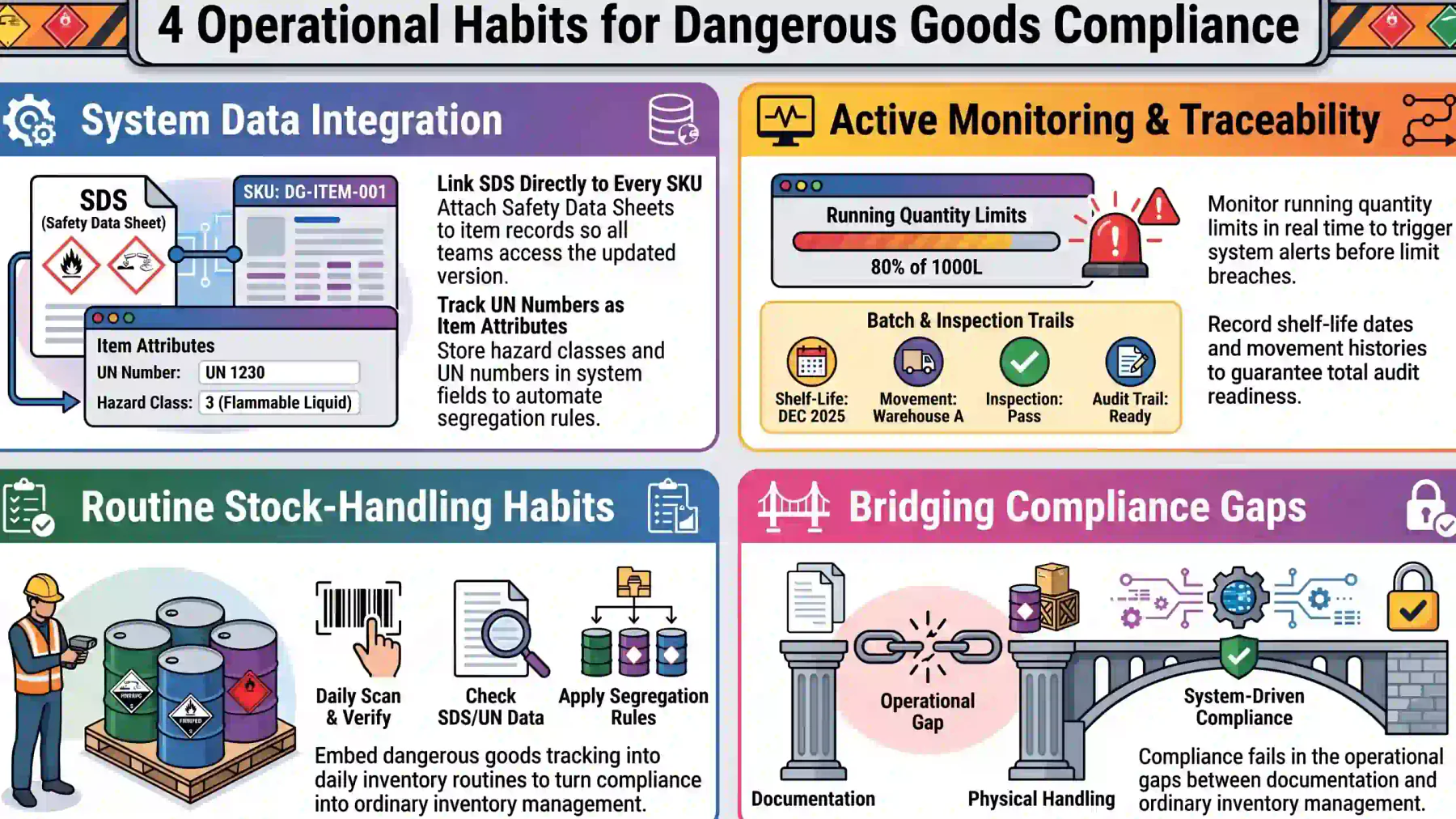
Compliance fails in the gaps between documents. The classification is correct and the licence current, yet a shipment still gets held because whoever did the putaway did not know what was in the carton.
Four operational habits close those gaps. Each one turns a compliance question into a routine stock-handling task.
1. Linking safety data sheets to every SKU
A safety data sheet only helps where the decision happens. Attach it to the item record instead of a shared folder, and the warehouse operator, the buyer and the declarer all read the same version.
When a supplier supersedes a sheet, you replace it in one place. Nobody then works from a version that expired two revisions ago.
2. Tracking class and UN number as item attributes
Class, division, UN number and packing group belong on the item master, not in the memory of one experienced staff member. Fields let the system check a putaway against segregation rules.
The check then happens before the pallet goes down rather than after. Those same fields populate a declaration without anyone retyping them, which removes the transcription errors behind most rejections.
3. Quantity thresholds and licence limits
Licence limits work as running totals, not annual figures. Holding class-level and substance-level quantities visible against their threshold keeps the position clear at any moment.
An alert before the limit beats an audit finding after it. That single change turns a compliance risk into ordinary stock control.
4. Batch, expiry and audit trail for inspections
Many dangerous goods carry a shelf life, and degraded product can be more hazardous than fresh. Batch and expiry tracking handles that half of the problem.
A movement history covering who received, moved and dispatched each batch handles the other half. When an inspector asks how a substance was stored six months ago, the answer either exists or it does not.
An inventory management system carrying hazard attributes, SDS links and item-level traceability folds compliance into normal stock handling. Manual workarounds then disappear.
Chemical manufacturing operations keep documentation and physical stock in step the same way. To map this to your own operation, request a free consultation with our team.
Hazard compliance holds only when class data and stock records stay in sync. Hashy AI reads UN numbers, licence limits and safety data sheets together, then flags what needs review.






Conclusion
The nine dangerous goods classes decide everything that follows. They set the packaging you may use, the labels you apply, what your cargo may sit next to, and what your declaration must say.
In Singapore, two regimes cover the same goods at different points. MPA governs the consignment while it moves through the Port of Singapore, and NEA governs it once the goods are stored on land.
If you want to learn more about dangerous goods, then schedule a free consultation with our experts and learn the best practices for your inventory management.

Frequently Asked Questions
Class 1 explosives, 2 gases, 3 flammable liquids, 4 flammable solids, 5 oxidisers, 6 toxic and infectious substances, 7 radioactive material, 8 corrosives and 9 miscellaneous, including lithium batteries.
The IMDG Code is the International Maritime Dangerous Goods Code, published by the IMO. It is mandatory under SOLAS Chapter VII and sets classification, packaging, labelling, documentation and stowage rules.
Yes. Lithium batteries are Class 9, whether shipped alone or inside equipment. UN 3480 and 3481 cover lithium ion, UN 3090 and 3091 cover lithium metal. Reduced requirements may apply under SP 188.
The IMDG Code governs sea freight and the IATA Dangerous Goods Regulations govern air freight. Air rules are stricter, with tighter limits on lithium batteries, and some goods accepted by sea cannot fly at all.
Both, at different stages. MPA regulates dangerous goods entering and handled within the Port of Singapore. NEA regulates import, use, storage and sale of hazardous substances once goods are on land.
Undeclared dangerous goods are an offence under the Singapore port regime. The cargo can be removed from the terminal at cost to the shipper, financial penalties apply, and carriers may refuse future bookings.