











 Limited to 100 registrants

Many enterprises can point to a successful pilot. A small group tests a tool, results look promising, and a presentation follows. The trouble begins afterward, as scaling a pilot into daily practice across departments demands far more than a larger license count.
It requires clear ownership, dependable data, adjusted workflows, and people who understand why their routines are changing. Organizations that treat the pilot as the finish line often find that usage flattens within a quarter, while the investment continues to accrue cost.
Key Takeaways
Pilots rarely scale on their own, because wider rollout loses the advantages of narrow scope; governance, ownership, and planning for ordinary users must fill that gap.
Data foundations come first; Scattered records, inconsistent naming, and tools sitting outside daily workflows limit what any AI deployment can deliver.
Measuring what matters means tracking process outcomes, time saved, and error rates, not login counts, with measures defined before deployment and reviewed regularly.
An integrated platform like HashMicro connects finance, HR, inventory, and CRM data in one system, giving AI features reliable inputs and a natural fit in daily work.
Why Pilots Rarely Scale on Their Own

A pilot succeeds partly because conditions are unusually favorable. Participants are volunteers, support is close at hand, and the scope is narrow. Once the tool reaches a wider audience, those advantages vanish. Employees who never asked for the change must learn it while carrying a full workload.
Successful AI adoption depends on recognizing that gap early and planning for the ordinary user rather than the enthusiast. Managers need to know what good usage looks like, and employees need to see how the tool fits the work they already do.
Governance shapes the outcome as well. Someone must decide which use cases receive funding, which data may be used, and how results are judged. Without those decisions, teams pursue disconnected experiments that never combine into a lasting capability.
"Without someone deciding which use cases get funded, which data is in scope, and how results are measured, AI adoption produces a collection of disconnected experiments that never compound into lasting capability."
Data Foundations Come First
Models are only as useful as the information behind them. Reporting on enterprise AI success points to proprietary data as a central factor in results, which places data quality and access on the critical path. Records scattered across disconnected systems, inconsistent naming, and unclear permissions all limit what an AI tool can deliver. Cleaning and connecting that information rarely feels exciting, yet it often separates a working deployment from a stalled one.
Integration deserves equal attention. Tools that sit outside the systems where employees spend their day tend to be forgotten. Embedding AI into existing processes, such as approvals, reporting, or customer handling, raises the chance that people will use it without special effort. Guidance on AI workflow automation shows how routine tasks can be connected so that automation supports the work instead of interrupting it.
Training That Changes Behavior
A single onboarding session seldom produces lasting habits. People forget most of what they hear within days unless it is reinforced during real tasks. Effective programs combine short lessons, practice with actual company data, and follow-up support that appears at the moment of need. Research and commentary on business data in corporate training illustrate how usage information can reveal where employees struggle and which materials deserve revision.
Role-specific instruction matters too. A finance analyst and a customer service agent face different risks and opportunities, so a generic course wastes time for both. Content tailored to daily tasks respects employee time and produces faster confidence. Managers also play a decisive part. When leaders use the tools in their own work and discuss the results openly, teams follow. When they treat AI as someone else's project, adoption stalls regardless of the quality of the software.
Measuring What Matters
Counting logins tells an organization very little. Better indicators include how often a tool changes a process outcome, how much time a workflow saves, and whether error rates fall. These measures should be defined before deployment so that results are not reinterpreted afterward to fit expectations. Regular review also reveals where resistance sits, whether in a particular department, a specific workflow, or a certain level of seniority.
Feedback loops complete the picture. Employees who can report problems and see them addressed develop trust in the program. Those who receive no response gradually return to older methods. Teams that publish small improvements, even modest ones, signal that the effort is ongoing rather than abandoned.
Culture, Trust, and Realistic Expectations
Concern about job security, accuracy, and privacy shapes how people respond to AI. Ignoring those concerns rarely makes them disappear. Plain communication about what the tools will and will not do, along with clear rules for review of machine-generated output, builds the confidence needed for regular use. Human oversight should be described as a standing feature of the process, not a temporary safeguard.
Sound planning also depends on realistic timelines. Structural change takes longer than a product demonstration suggests, and organizations that budget for gradual progress tend to sustain momentum. Broader lessons on strategies for successful business apply here, since disciplined execution and steady communication matter as much for AI programs as for any other major initiative. Even in settings far removed from the office, such as discussion of digital systems in student life, the pattern holds that technology succeeds when it fits how people actually work and learn.
Moving From Experiment to Capability
Moving past the pilot stage means shifting from a project mindset to an operating one. Ownership, data, training, measurement, and culture each need attention, and none can be delegated entirely to a technology team.
Enterprises that build these foundations deliberately find that AI becomes part of ordinary work rather than a novelty that fades once the initial enthusiasm passes.
How an Integrated Platform Like HashMicro Supports Scaling
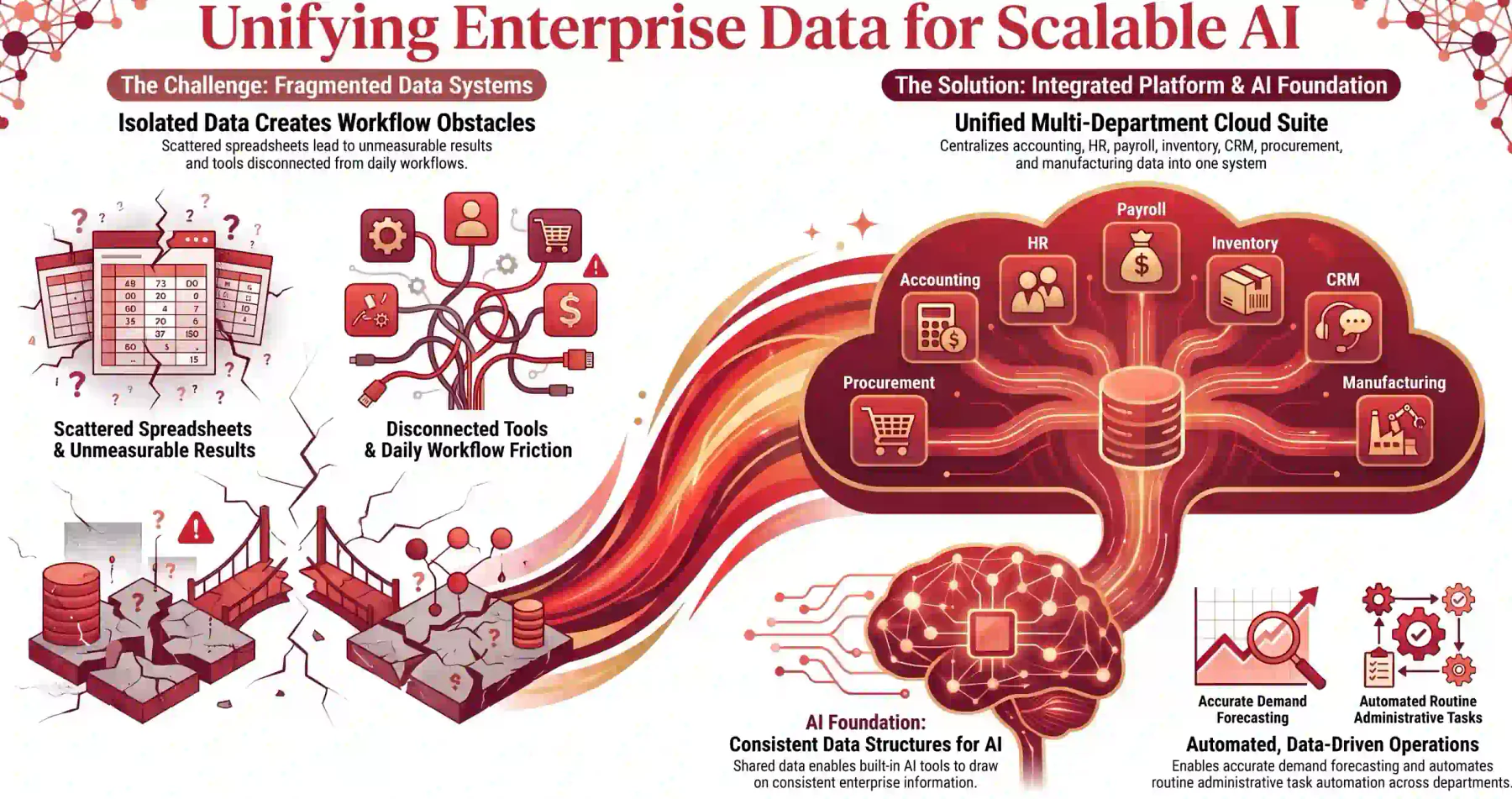
Many of the obstacles described above, such as scattered data, tools that sit outside daily work, and results that are hard to measure, come from fragmented systems. An integrated ERP platform addresses these problems at the source. HashMicro is one example.
Its cloud-based suite covers areas such as accounting, HR and payroll, inventory, CRM, procurement, and manufacturing, so the data an AI tool depends on sits in one connected system instead of in isolated spreadsheets.
This matters for the data foundations discussed earlier. When sales, stock, and financial records share a common structure, AI features can draw on consistent information. HashMicro's modules are integrated and come with built-in AI and automation meant to support data-driven decisions across departments, from demand forecasting to automating administrative work.
Enterprise AI scales only when data, workflows and oversight stay connected. Hashy AI reads adoption signals, training gaps and exceptions together, then flags what needs review.






Conclusion
A successful pilot shows that AI can work. Scaling it shows that it can last. That shift depends on clear ownership, connected data, role-specific training, and measurement that goes beyond logins. Human oversight should stay part of the process.
An integrated foundation makes this easier. When finance, inventory, sales, and HR run on one system, AI has reliable data to work with and fits naturally into daily routines. HashMicro's AI-powered ERP and its assistant, Hashy, bring these processes and automation together in one place.
Ready to move beyond the pilot stage? Schedule a free demo with HashMicro and see how it can fit your team's workflows.

FAQ
Pilots succeed under narrow, controlled conditions, but scaling removes those advantages. Broader rollout reaches employees who did not volunteer, support thins out, and governance gaps emerge. Without clear ownership, data readiness, and training for ordinary users, adoption flattens within a quarter.
AI tools depend on accurate, connected data. Businesses need consistent naming conventions, integrated systems, and clear access permissions before deployment. Records scattered across disconnected platforms limit what any AI deployment can achieve, regardless of how capable the software is.
Track process outcomes rather than logins. Useful measures include time saved on workflows, reductions in error rates, and how often AI output changes a decision. Define these measures before deployment and review them on a regular schedule.
A single onboarding session rarely produces lasting habits. Effective training combines short lessons, practice with real company data, and follow-up support at the moment of need. Role-specific content respects employee time and builds confidence faster than a generic course.
An integrated platform places all the data AI tools rely on, including sales, inventory, HR, and finance records, in one connected system. This removes the fragmented data problem that stalls many deployments. HashMicro includes built-in AI and automation designed to support data-driven decisions across departments.