








Every year, high schools must fit SAT prep into a calendar already packed with state tests, AP courses, and semester finals. Without a clear plan, test prep becomes an afterthought, and students end up stressed.
The solution is to build prep into the existing academic calendar, supported by a school management software that keeps schedules, student data, and assessment results in one place.

Strategic Calendar Mapping Across Academic Milestones
Successful test preparation relies on backward design. High school scheduling coordinators should begin by plotting major national test windows alongside local district milestones.
The spring semester presents the highest concentration of testing constraints. Digital SAT administration windows often overlap with mid-term evaluations, spring break, and the ramp-up period for spring Advanced Placement exams. Identifying these overlap zones early prevents schools from scheduling intensive review sessions during weeks when student bandwidth is already depleted.
This mapping process is far easier when every milestone lives in one centralized digital calendar instead of scattered spreadsheets and email threads. With a school management system, coordinators can view exam windows, class schedules, and school events side by side, spot conflicts instantly, and share the same timeline with teachers, students, and parents.
Term planning requires distinguishing between general coursework demands and targeted review windows. Mapping a clear sequence gives teachers and students predictable targets rather than unexpected workload surges.
Identifying Student Groups for Targeted Preparation Time
Not every student enters the testing cycle with the same baseline skills or post-secondary goals. A blanket scheduling approach often leaves underprepared students struggling while advanced learners disengage.
Schools can organize their cohort by evaluating historical PSAT scores and core course performance:
- Eleventh graders aiming for competitive merit scholarships require early, high-intensity review modules focused on advanced reasoning
- Students needing foundational skill building benefit from embedded support during daily advisory or English and Math intervention periods
- Seniors taking late autumn attempts need short, targeted refreshers immediately following summer break
By segmenting the student body early, administrators can allocate physical space, staffing resources, and schedule adjustments where they will have the greatest impact. Integrating SAT test prep environments allows coordinators to identify precise skill gaps across these distinct cohorts before setting final schedules.
A school management software makes this process faster because student profiles, grades, and past test scores are already stored in one place. Instead of compiling data manually from different teachers, coordinators can filter students by performance and assign them to the right preparation groups in minutes.
A school management software makes this process faster because student profiles, grades, and past test scores are already stored in one place. Instead of compiling data manually from different teachers, coordinators can filter students by performance and assign them to the right preparation groups in minutes.
Establishing Baseline Benchmarks to Track Growth
Setting realistic checkpoints keeps both educators and students grounded throughout the preparation timeline. Without clear baseline data, instruction often devolves into generic test familiarity rather than measurable skill acquisition.
An initial benchmark test in early autumn provides the data needed to set personalized improvement goals. School staff should schedule interim assessments every six to eight weeks to track progress across specific content domains, such as algebra functions or reading passage analysis.
When benchmark results are recorded in the school's academic system, each student's progress becomes visible over time rather than buried in separate files. Teachers, counselors, and even parents can see the same growth data, which makes conversations about next steps far more productive.
These checkpoints serve as diagnostic indicators rather than evaluative grades. When students see incremental progress mapped against clear data points, confidence increases, and test anxiety drops significantly.
Selecting Practice Materials That Support Real-Time Tracking
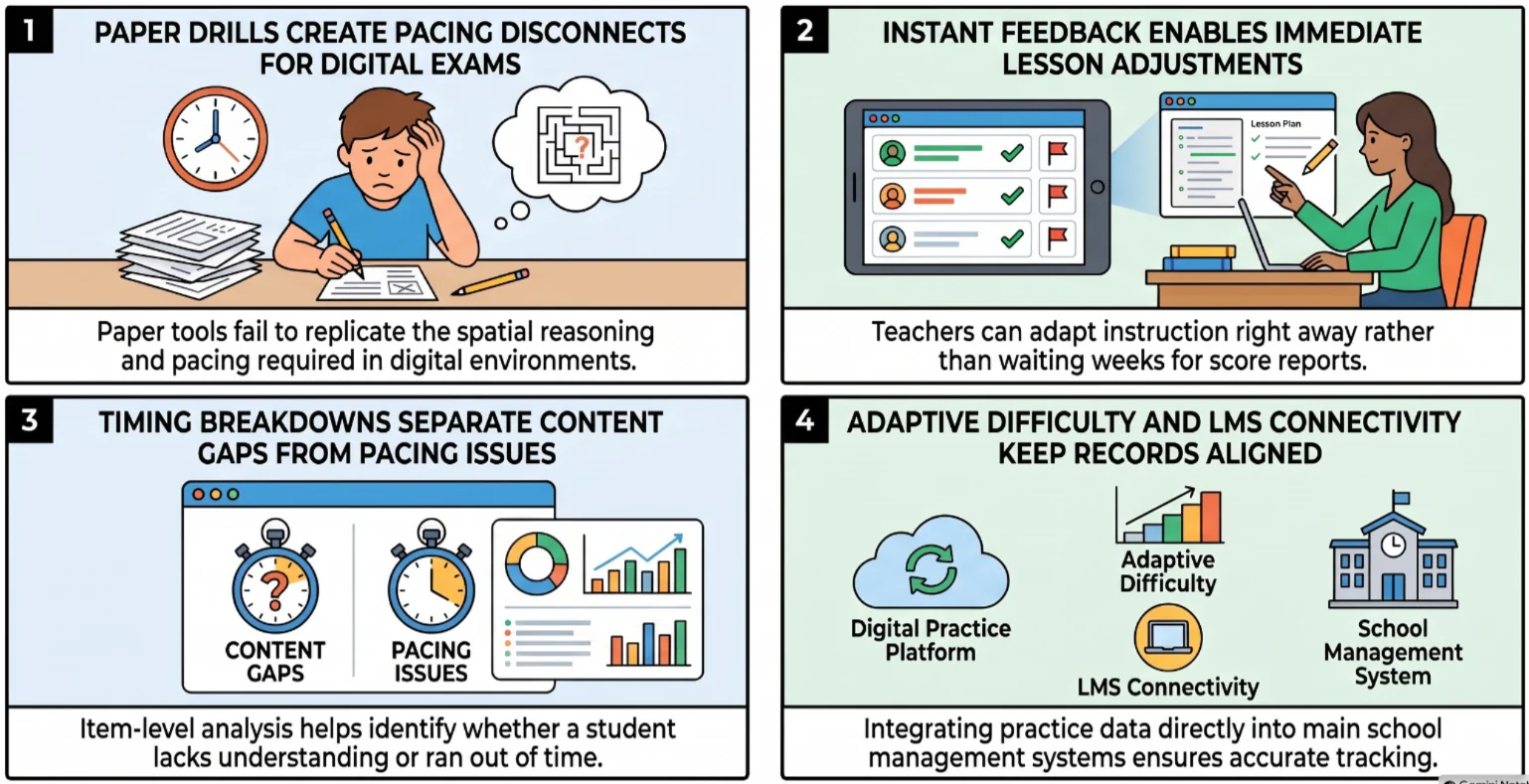
The shift to digital testing modalities requires practice tools that mirror actual testing conditions. Paper-based drills for a digital exam format create a disconnect in pacing and spatial reasoning.
Practice platforms with integrated analytics give educators immediate visibility into student performance. Research shows that different instructional time allocations affect overall student academic growth. Digital platforms that provide instant feedback let teachers adjust lesson focus immediately rather than waiting weeks for score reports.
Effective practice tools should offer item-level analysis, timing breakdowns by question type, and adaptive difficulty. This granular data helps teachers determine whether a student is struggling with content comprehension or simply running out of time during specific module sections. Ideally, these tools should connect with the school's main management system so that practice data and academic records stay aligned.
Adjusting Schedules When Progress Stalls
Even the most meticulously designed academic calendar requires flexibility. Mid-semester diagnostics often reveal that certain classrooms or student cohorts have hit a score plateau.
When diagnostic indicators signal a pause in growth, administrators must be prepared to modify time allocations. Effective intervention strategies include:
- Reallocating twenty minutes of weekly homeroom or advisory periods toward specific weak domain drills
- Offering drop-in tutoring blocks during lunch or afternoon study halls led by subject-matter teachers
- Creating temporary weekend or evening virtual review sessions ahead of major test dates
Making these changes manually can disrupt the entire master schedule. With automated timetable features, schools can rearrange sessions, assign available teachers and rooms, and notify affected students without creating new conflicts.
Agile adjustments prevent small learning gaps from snowballing into larger hurdles as test day approaches. Flexibility ensures the master schedule serves students' learning needs rather than imposing rigid constraints. Applying time management tips to further optimize outcomes will help students even further, especially as exam dates draw close.
Simplify SAT Prep Planning with HashMicro School Management Software
Every strategy above depends on accurate data and well-coordinated schedules. This is where HashMicro School Management Software can help schools move from reactive planning to a structured, data-driven approach.
HashMicro's school management solution covers processes from admission to final exam results, with features such as smart timetable and class generation, student and staff records, curriculum and progression tracking, fee and billing management, and self-service portals. For SAT preparation, this means coordinators can build review schedules, track student progress, and manage resources from a single dashboard.
Another advantage is accessibility. The software comes with unlimited user licenses, so students, teachers, staff, and parents can all access it without additional costs. Schools can also customize the system to match their own processes, making it easier to adapt preparation programs to each cohort's needs.
Conclusion
Integrating test preparation into the school calendar is an ongoing refinement process rather than a single seasonal effort. By analyzing year-over-year score trends alongside master calendar success metrics, high schools can continuously sharpen their approach.
However, sustaining this process is difficult when schedules, student data, and assessment results are spread across disconnected tools. A school management software gives administrators the visibility and flexibility they need to plan ahead, respond quickly when progress stalls, and keep every stakeholder aligned.
Not sure where to start? Consult with HashMicro's experts to discuss your school's scheduling challenges and see how HashMicro School Management Software can fit your academic calendar. You can also schedule a free demo to explore the features and workflows firsthand. Take the first step toward a more organized, data-driven SAT preparation program today.