







A missing bearing can stop a production line long before finance sees the cost. Spare parts inventory management exists to close that gap by keeping the right component in the right place.
It covers how businesses record, store, reserve, issue, and reorder maintenance parts. In Singapore, it also has to handle imported components, regional warehouses, and GST on every shipment.
This article explains how spare parts inventory management works and which operating model suits Singapore businesses. Use it to shape your requirements before you book any vendor demonstration.
Key Takeaways
Spare parts inventory management tracks, stores, reserves, issues and replenishes maintenance components by location, supplier, cost and repair history.
Spare parts operating models classify critical, repairable, consumable, obsolete and surplus items so each receives the right owner, policy and review cycle.
Integrated parts control connects maintenance, warehouse, procurement and finance to reduce delays, duplicate purchases, unapproved buying and reporting gaps.
Singapore spare parts management must account for 9% import GST, customs documents, cross-border stock ownership, regional warehouses and supplier governance.

What Is Spare Parts Inventory Management?
Spare parts inventory management is the process of tracking, storing, and replenishing the components that keep equipment running. It ties each part to a location, supplier, cost, and repair history.
Unlike ordinary stock, spare parts follow demand that arrives without warning. A pump seal may sit untouched for a year. Then a line stops, and that same seal becomes urgent overnight.
Sound stock inventory management principles still apply. However, spare parts add criticality, repairability, and long lead times, so software must record every reservation, issue, and return.
"Spare parts inventory management is less about holding more stock and more about knowing which part sits where, who owns it, and what it will cost when a machine stops."
Which Spare Parts Inventory Operating Model Fits Your Enterprise?
The right operating model depends on what drives your daily decisions. Finance-led businesses govern stock through purchasing and approvals, whereas maintenance-led teams start from the work order.
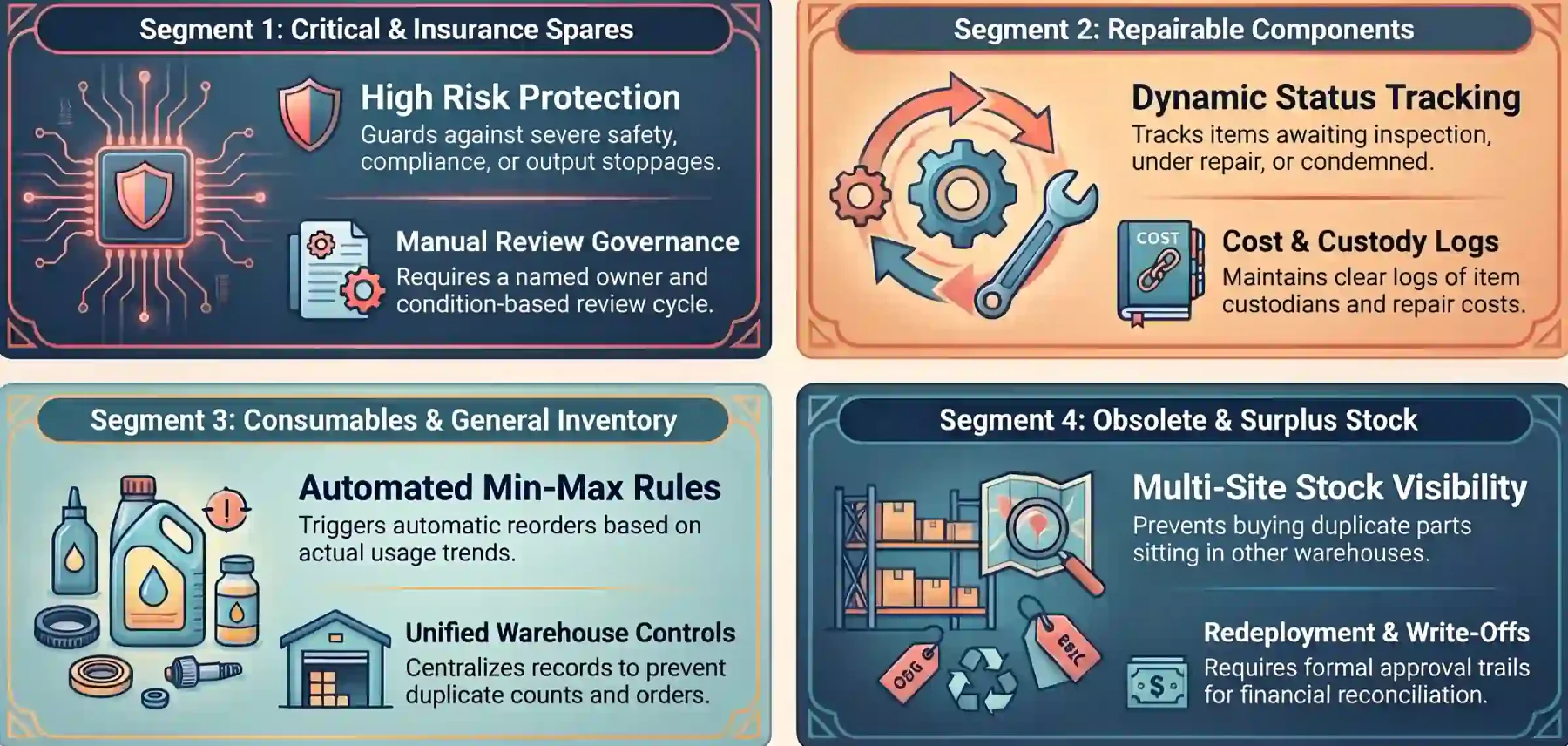
Before choosing software, sort your parts by how they behave. The four groups below each call for a different stocking policy, owner, and review cycle, so the system has to support all of them.
1. Critical and insurance spares
Critical spares are parts whose absence could threaten safety, compliance, or output, such as a motor controller. Insurance spares are costly items held because replacement would be slow.
Neither group suits automatic reorder rules. Each needs a named owner, a condition record, and a periodic review, so that holding costs stay justified against the risk of a stoppage.
2. Repairable components
Pumps and circuit boards can be removed, repaired, tested, and returned to service. That cycle makes them harder to track than a consumable, because each unit changes status as it moves.
The system should show whether a unit is available, awaiting inspection, under repair, or condemned. It should also record who holds the unit and what repairs have cost the business so far.
3. Consumables and general inventory
Seals, lubricants, and fasteners are issued often and cost little. Min-max or reorder-point rules suit them well, provided the thresholds follow actual usage rather than old estimates.
General inventory covers items that are not maintenance-specific but share the same warehouse and purchasing controls. Keeping them in one system avoids duplicate records and conflicting counts.
4. Obsolete and surplus stock
Parts linked to retired equipment or closed projects tie up cash and shelf space. Clear visibility stops teams from buying duplicates of items already sitting in another warehouse.
Review these items on a schedule and decide whether to redeploy them to another site or write them off. Each decision needs an approval trail so that finance can reconcile the adjustment.
Why Integrated Parts Control Matters to Maintenance and Operations
Maintenance teams need dependable availability, while procurement and finance need traceable transactions. A spreadsheet shows that a part exists, but it rarely shows whether the part is reserved.
Take a planned pump service at a Singapore plant. The request creates a parts requirement for the seal. The warehouse then checks what is available and what other jobs have already reserved.
If a seal is short, the team follows its procurement processes and raises a request with an approved supplier. Receiving then records the imported item, updates its location, and attaches documents.
The technician issues the seal to the work order, and any unused part returns to the shelf with its condition noted. Finally, finance receives the purchase and inventory entries for reconciliation.
This sequence removes ambiguity, but it does not replace policy. Teams must still decide who may reserve stock, who approves emergency buying, and when a repairable is written off.
Without connected records, businesses tend to meet the same problems again and again. The most common ones are listed below, and each traces back to a record that is missing or out of date.
- Maintenance delays occur because the system shows stock that is unavailable or unsuitable.
- Duplicate purchases happen when warehouse and procurement records disagree.
- Emergency buying goes ahead without a clear approval trail.
- Reorder decisions drift when issues, returns, or substitutions go unrecorded.
- Repairables vanish from view while an external workshop services them.
- Finance reports cannot link a purchase to its receipt, issue, and work order.
For Singapore operations, regional visibility matters most when parts cross borders or sites share stock. The aim is not to hold more inventory but to coordinate service, cash, and supplier timing.
Spare Parts Inventory Management Requirements in Singapore
Import GST applies to almost all goods brought into Singapore, and IRAS sets the standard rate at 9% since 1 January 2024. GST-registered businesses can usually claim it back as input tax.
Your system should therefore store import documents against each receipt and keep GST separate from item cost. That separation lets finance reconcile purchases without manual adjustments.
Customs clearance also shapes lead times. Imported parts need declarations through Singapore Customs, so late paperwork can hold a critical component at the border even after the supplier ships.
Regional stock adds another layer. When a Singapore warehouse supplies sites in other countries, the system must track ownership, transfer status, and each site's reorder policy separately.
Supplier governance matters as well, because imported parts often come from one overseas source. Approved supplier lists, quotation history, and delivery terms belong on the part record.
What Features Should You Compare in Spare Parts Inventory Software?
The strongest comparisons tie each feature to a business problem and a named user. Ask every vendor to prove it with a realistic scenario, not a slide deck or a glossy sales brochure.
The table below pairs each stakeholder with the capability they rely on and one question worth asking in a demonstration. Use it as a scoring sheet during vendor sessions and record each answer.
| Stakeholder | Capability to compare | Operational outcome | Vendor verification question |
|---|---|---|---|
| Technicians | Work-order links, reservations, issues, and returns | Parts attach to the correct job and asset | Can a technician reserve, issue, and return a part against a sample work order? |
| Warehouse staff | Bin locations, serial or batch tracking, and cycle counts | Physical and system stock can be reconciled | Show a warehouse transfer and a stock adjustment with its audit history. |
| Procurement officers | Requisitions, supplier records, approvals, and receiving | Shortages become controlled purchases | How does a shortage become an approved request and then a receipt? |
| Finance teams | Valuation, transaction history, account mapping, and export | Inventory movements can be reconciled | Which transaction details can finance review and export? |
| Operations leaders | Multi-location visibility, criticality policies, and dashboards | Decisions reflect site and regional exposure | Can managers compare available, reserved, on-order, and repairable stock by location? |
| IT administrators | Roles, permissions, integrations, data export, and logs | Access and data ownership stay governed | How are permissions set, and what happens when an integration fails? |
1. Item master and data governance
Item numbering, duplicate detection, units of measure, and supersession rules decide whether the catalogue stays clean. Ask who approves new part records and how the system flags near-duplicates.
Supplier part numbers and attachments such as datasheets also belong on the record. Without them, buyers waste time matching a catalogue entry to the right quotation or purchase order.
2. Location, serial and batch control
Bin locations and cycle counts let warehouse staff reconcile physical and system stock. Where traceability matters, ask how the system records serial numbers, batches, custody, and status.
For repairables, confirm that the workflow separates available, awaiting inspection, under repair, and condemned units. A transfer between warehouses should leave a full audit history.
3. Maintenance and procurement links
Technicians should reserve, issue, and return parts against a work order without leaving the job screen. That link keeps every cost tied to the correct asset. Reports then show spend by job.
On the buying side, a shortage should become an approved requisition, then a purchase order, then a receipt. Test that chain end to end and check that it connects to your asset tracking system.
4. Reporting and permissions
Managers need to compare available, reserved, on-order, and repairable stock by location. Finance needs valuation, transaction history, and an export that it can reconcile with the ledger.
IT administrators should confirm how roles, approval thresholds, and logs are configured. They should also ask what happens when an integration fails halfway through a stock transaction.
5. Mobile usability
Test mobile screens in the actual warehouse, not in a meeting room. Ask a user to scan a part, confirm its bin, reserve it, issue it, and record a return. Note every extra tap or error.
Check that the same approval and naming rules apply on desktop and mobile. Differences between the two are a common source of data errors after launch, especially for approvals raised in the field.
Industry Use Cases for Spare Parts Inventory Management
Spare parts risk looks different in every sector. The four examples below show how stock policy, supplier timing, and ownership change with the operating environment and the cost of downtime.
Use these scenarios as a checklist when you map your own sites. The same part can be critical in one setting and routine in another, so context often matters more than the part itself.
1. Manufacturing and electronics
Production lines depend on sensors and drives that often arrive from overseas. A single missing controller can idle a line, so these parts usually earn a critical rating and a named owner.
Planned shutdowns add another demand pattern. The system should reserve parts weeks ahead and release them automatically if the job is cancelled, so that stock does not stay locked up.
2. Marine and offshore operations
Vessels and offshore sites cannot wait for a courier. Teams therefore hold larger insurance stocks, and they need to see what each vessel, yard, and warehouse currently carries at any moment.
Repairables such as pumps and winches also travel between sites and workshops. Tracking custody and repair status prevents a unit from disappearing somewhere between the yard and the vessel.
3. Facilities and building management
Facilities teams maintain lifts and chillers across many buildings and tenants. Parts tend to be low in value but high in variety, so clean item records matter more than deep safety stock.
Contractors often collect parts from site stores after hours. Mobile issue and return, with approval rules for each building, keeps those movements visible and tied to the right work order.
4. Logistics and distribution
Warehouses rely on conveyors and forklifts that must stay available during peak periods. Downtime delays orders at once, so fast-moving wear parts need firm and regularly reviewed reorder points.
Shared stock across depots adds complexity. Visibility by location lets one depot lend a belt or battery to another instead of placing a costly rush order with an overseas supplier.
ERP vs CMMS vs Specialist MRO Software: Which Route Fits?
Choose an ERP-led route when finance, purchasing, and inventory control sit at the centre. Choose a CMMS when technicians and work orders lead, and consider specialist MRO for complex repairables.
Many enterprises combine two systems rather than force every workflow into one. In that case, agree which system owns finance, purchasing, assets, and maintenance records before integration begins.
| Requirement signal | ERP-led route | CMMS-led route | Specialist MRO route |
|---|---|---|---|
| Finance-led control | Strong fit for purchasing, valuation, approvals, and accounting | Often needs integration with finance | Depends on the ERP connection |
| Technician-led work | Suitable when maintenance modules are mature | Usually the central strength | Strong for complex assets |
| Multi-site inventory | Strong when warehouses share governance | Validate depth by site and storeroom | Often built for network complexity |
| Complex repairables | Validate repair and custody workflows | Suitable for status tracking | Often a core use case |
| Reliability analytics | May need extra modules | Stronger where work history is central | Potentially strong, subject to evidence |
| Implementation effort | Broad, because scope is cross-functional | Narrower, but still needs data work | Can be high, since processes are specialised |
For multi-site manufacturing, an ERP-based inventory management system may govern finance and procurement while a CMMS coordinates technicians. Facilities teams may favour mobile execution instead.
Distribution and construction businesses often need shared stock visibility and supplier coordination across several sites. Let the operating scenario decide the route, not the software label.
How to Choose the Right System for Your Enterprise
Choose by scoring operational fit and implementation readiness against documented requirements, not by counting features. Agree the weighting before demonstrations and record evidence for each score.
The questions below work well in an RFP or a workshop. They push vendors and internal teams to describe real workflows instead of general capabilities. Ask every vendor the same questions.
- Which parts, locations, suppliers, and work orders will be migrated?
- Who owns the item master and approves new or changed records?
- How will critical spares be classified and reviewed?
- What happens when a part is unavailable, substituted, returned, or sent for repair?
- Which systems stay authoritative for finance, purchasing, assets, and maintenance?
- Can the provider demonstrate our workflow with sample data instead of slides?
- Which assumptions affect project timing, cost, integrations, and support?
Score each answer against evidence, and record limitations as carefully as strengths. Timing and cost depend on scope, data quality, and integrations, so no single score proves suitability.
If disconnected purchasing and stock records are causing delays, talk to our team about the ERP capabilities that fit your operation. A short workflow review usually shows where the gaps sit.
Implementation Priorities for Singapore Operations
Implementation quality often decides whether a promising system becomes a reliable tool. Start with a controlled data set instead of migrating every historical record, however old.
Agree naming standards, duplicate rules, units of measure, locations, and ownership before loading anything. Settle criticality, opening balances, and obsolete stock treatment at the same time.
Include warehouse, maintenance, procurement, finance, IT, and site representatives in user acceptance testing. Test exceptions too, such as partial receipts, substitutions, and cancelled work orders.
Also test a part reserved at one site but needed at another, and a repairable that returns damaged. These cases expose gaps that normal scenarios tend to hide until real users meet them.
Singapore teams should document import approvals, supplier terms, and cross-border stock ownership before launch. Doing so prevents disputes once stock starts moving between countries.
After go-live, schedule cycle counts, master-data reviews, and permission checks. Adoption improves when the system removes duplicate entry and matches how technicians actually work.
Best Practices for Spare Parts Inventory Management
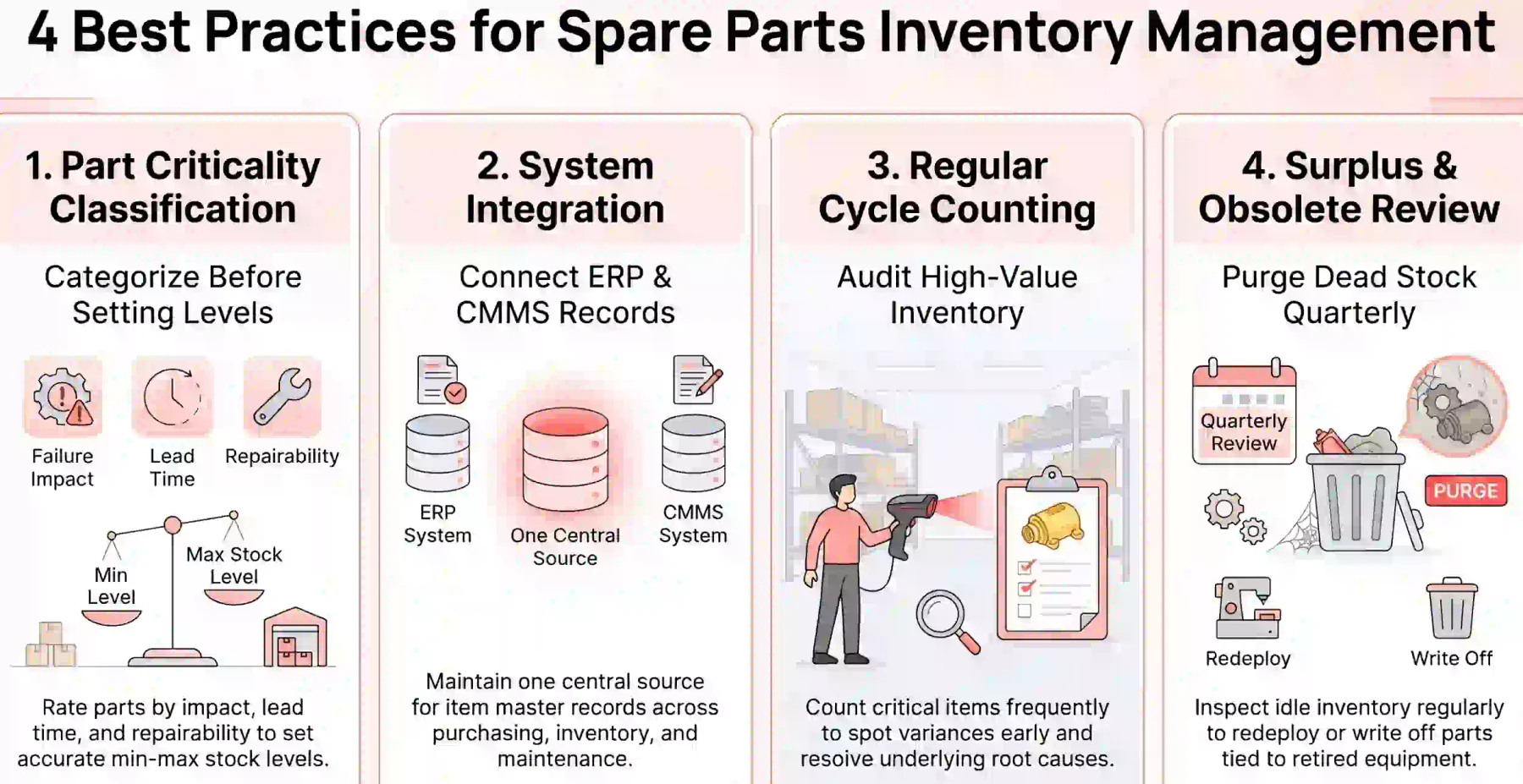
These practices apply whichever system you choose. Each one targets a specific failure, from avoidable stockouts to cash locked in parts nobody uses. Start with the first if you are unsure.
1. Classify parts by criticality before setting stock levels
Rate each part by failure impact, lead time, and repairability before choosing min-max values. A critical imported sensor deserves a different policy from a low-cost seal used across several assets.
Review the ratings whenever equipment or suppliers change. Stale classifications cause stockouts on one shelf and excess inventory on the next. Assign the review to a named planner.
2. Use an ERP system to connect purchasing, stock and work orders
An ERP system keeps requisitions, receipts, stock movements, and finance entries in one record. Reviewing ERP system features before selection also clarifies which modules your process needs.
If a CMMS already runs maintenance, integrate it instead of duplicating part records. Name one system as the source for the item master so that numbers never conflict between teams.
When spare parts, purchasing and maintenance records stay connected, teams can review stock risks before a breakdown delays operations. Hashy AI helps identify replenishment gaps, duplicate purchases and repairable-part exceptions.






3. Run regular cycle counts on critical and high-value items
Count critical and high-value parts more often than slow, low-cost ones. Frequent counts catch mismatches before a technician finds an empty bin during a breakdown. Log each result in the system.
Investigate every variance and record its cause. Patterns such as repeated misissues usually point to a training gap or a flaw in the process. Share the findings with warehouse and maintenance teams.
4. Review obsolete and surplus stock on a fixed schedule
Hold a quarterly review of items with no recorded movement. Flag parts tied to retired or replaced assets, then decide whether another site can use them or finance should write them off.
Record each decision with an owner and an approval. That trail answers audit questions and stops the same dead stock from being reordered by a different buyer. Keep it attached to the part record.
Conclusion
The right spare parts system fits your operating model, connects purchasing to maintenance, and stays governable after launch. Compare ERP, CMMS, and specialist MRO routes using the same scenarios.
In short, strong spare parts control starts with rating parts by criticality and keeping purchasing, stock, and work orders in one record. Cycle counts and import GST checks then close the gaps.
To learn more about spare parts inventory management or improve your business operations, book a free consultation with our experts. They will review your workflow and suggest practical next steps.

Frequently Asked Questions
Choose ERP when finance, purchasing, and multi-site stock need one governed record. Choose a CMMS when technicians and work orders lead. Validate integration and data ownership before deciding.
Rate each part by failure impact, lead time, repairability, and service level. Assign an owner and approval rule to each class, then test it against maintenance history, not a single fixed formula.
Ask for a scenario on sample create a part, reserve it, raise a purchase request, receive it, issue it to a work order, and return it. Then check the audit history and permissions.
Prepare part numbers, descriptions, units of measure, categories, criticality, locations, suppliers, reorder rules, and opening balances. Agree who owns data cleansing before migration begins.
Import GST applies to almost all imported goods at 9%, and registered businesses can usually claim it as input tax. Store import documents with each receipt and keep GST separate from item cost.