








Singapore's carbon tax is a fixed-price charge on the direct greenhouse gas emissions of large industrial facilities, introduced under the Carbon Pricing Act 2018 and run by NEA.
For the 2026 emissions year, the rate sits at S$45 per tonne of carbon dioxide equivalent, up from S$25 in 2024 and 2025.
This article covers who the tax applies to, how liability is calculated, when carbon credits can offset it, and what penalties and reporting duties come with it.
Key Takeaways
Singapore’s carbon tax applies a fixed S$45 per tonne rate for 2026, rising from S$25 in 2024 and 2025 under a published trajectory to 2030.
Liability is assessed per facility, not per company, with the full tax applying from the first tonne once a facility crosses 25,000 tCO2e a year.
Eligible International Carbon Credits can offset up to 5% of taxable emissions, but most facilities will find the saving marginal compared to the full tax rate.
Capturing emissions data inside the systems already recording transactions reduces verification friction and under-declaration risk ahead of each reporting cycle.

What Is Carbon Tax in Singapore?
Carbon tax in Singapore is a levy on each tonne of greenhouse gas a covered facility releases directly, in force since 1 January 2019 under the Carbon Pricing Act 2018.
The mechanism stays simple: Singapore fixes a price per tonne instead of capping emissions and letting a market set it. A transition framework still protects competitiveness for selected emissions-intensive sectors.
The tax covers six greenhouse gases recognised under the UNFCCC, including carbon dioxide and methane, converted into a common tonnes-of-CO2-equivalent unit using global warming potential factors.
The tax applies only to direct emissions released at the facility itself. Emissions in purchased electricity are taxed upstream at the generator, though the cost still passes through to tariffs.
Who Must Pay Carbon Tax in Singapore?
Liability sits at facility level, not company level. A business running three sites in Singapore is assessed separately on each one's own annual direct emissions.
- 2,000 tCO₂e or more a year: reportable facility. Register with NEA and submit an annual emissions report, even though no tax is payable at this level.
- 25,000 tCO₂e or more a year: taxable facility. Register, submit a verified Monitoring Plan and emissions reports, and pay carbon tax on total direct emissions.
The tax applies from the first tonne once a facility crosses 25,000 tCO₂e, not just the excess. A facility at 25,001 tonnes pays tax on all of it.
Taxable facilities concentrate in refining, electronics manufacturing, chemicals, power generation, and waste-to-energy. Most retail and logistics businesses sit well below both thresholds.
Carbon Tax Rate in Singapore: 2024 to 2030 Roadmap
Budget 2022 set this rate path to give industry a long runway for abatement investment.
| Emissions year | Rate (S$ per tCO₂e) | Cost on 30,000 tCO₂e |
|---|---|---|
| 2019 – 2023 | S$5 | S$150,000 |
| 2024 – 2025 | S$25 | S$750,000 |
| 2026 – 2027 | S$45 | S$1,350,000 |
| By 2030 | S$50 – S$80 (indicative) | S$1,500,000 – S$2,400,000 |
One point gets missed often: the rate follows the emissions year, not the payment year. Tax settled in 2026 covers 2025 emissions, charged at S$25, not S$45.
The jump from S$5 to S$45 in three years is the real planning signal. A charge once treated as trivial is now a seven-figure annual cost for many facilities.
How Carbon Tax Is Calculated and Paid
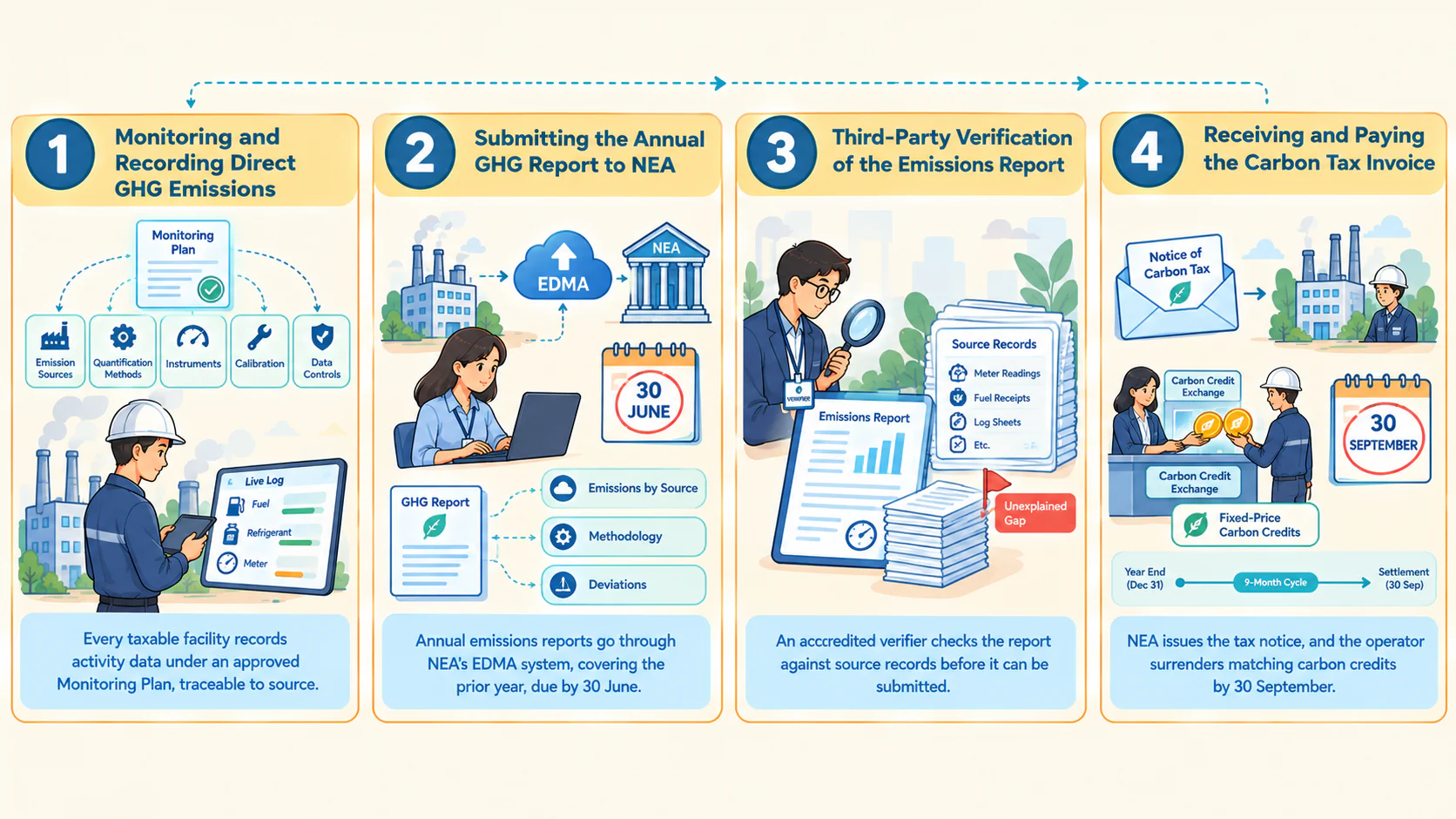
The calculation itself is simple: verified emissions, less eligible offsets, times the rate. Payment works through a credit-surrender mechanism rather than a normal tax bill.
1. Monitoring and recording your direct GHG emissions
Every taxable facility runs under an approved Monitoring Plan covering emission sources, quantification methods, instruments, calibration, and data controls.
Activity data such as fuel draw or refrigerant top-ups needs recording as it happens, with each figure traceable to a meter reading or purchase record, keeping emissions data ready for reporting.
2. Submitting your annual GHG report to NEA
Emissions reports go through NEA's EDMA system each year, covering the preceding calendar year and due by 30 June.
The report sets out emissions by source and gas, the methodology used, and any deviation from the approved Monitoring Plan during the year.
3. Third party verification of your emissions report
Taxable facilities need an accredited verifier to check their report before submission, confirming the figures match the underlying records and approved methodology.
Common findings include data pulled from summary spreadsheets with no link to source documents, or unexplained gaps in meter readings. Schedule verification early.
4. Receiving and paying your carbon tax invoice
NEA issues a Notice of Carbon Tax after assessing the verified report. The operator then buys and surrenders matching Fixed-Price Carbon Credits by 30 September.
The full cycle runs about nine months past year end: data collection, verification, reporting by 30 June, and settlement by 30 September.
Using International Carbon Credits (ICCs) to Reduce Your Carbon Tax Liability
From the 2024 emissions year, taxable facilities can surrender eligible credits to offset up to 5% of taxable emissions, with the rest settled at the full rate.
1. What qualifies as an ICC under Singapore's framework
Eligibility sits well below the broader voluntary carbon market, since credits must align with Article 6 of the Paris Agreement. In practice, this requires:
- A corresponding adjustment from the host country, so the reduction is not double-counted toward both nations' targets.
- An Implementation Agreement between Singapore and the host country governing the transfer.
- A qualifying vintage and project start date within the framework's defined window.
- Verification against an approved methodology, with no double issuance or double claiming.
Because the eligible list changes over time, confirm credits against current criteria before buying. Voluntary-market validity does not guarantee tax-offset eligibility.
2. Where to source carbon credits in Singapore: Climate Impact X and SGX
Climate Impact X, backed by SGX, DBS, Standard Chartered, and Temasek, runs Singapore's main carbon credit exchange and auction platform.
Credits can also come through bilateral deals, brokers, or direct offtake arrangements, trading faster execution for better pricing on larger volumes.
Whichever route is used, the operator stays responsible for confirming the credits meet Singapore's eligibility rules at the point of surrender.
3. When buying ICCs makes financial sense versus paying the full tax rate
The test is a direct price comparison: credits make sense once their fully delivered cost sits below the prevailing tax rate.
That delivered cost includes fees, registry charges, due diligence, and admin time, which can matter more on smaller volumes.
Consider a facility emitting 30,000 tCO₂e in the 2026 emissions year:
- Liability without offsets: 30,000 × S$45 = S$1,350,000
- Maximum ICC offset: 5% of 30,000 = 1,500 tCO₂e
- Remaining FPCC liability: 28,500 × S$45 = S$1,282,500
- Gross saving available: S$67,500, less the delivered cost of 1,500 credits
A S$30-per-tonne credit against a S$1.35 million liability nets roughly S$22,500, around 1.7%. Most facilities treat this as a marginal optimisation, not a strategy.
Penalties for Non Compliance with the Carbon Pricing Act
The Carbon Pricing Act creates offences at every stage: registering, reporting accurately, and paying what is assessed.
1. Failure to register as a reportable facility
Crossing 2,000 tCO₂e requires registering with NEA within the statutory window, and exposure accumulates for every period a facility stays unregistered, even without intent, such as after a capacity expansion.
2. Late or inaccurate GHG reporting
Missing the 30 June deadline is an offence on its own, regardless of tax owed, and it also compresses the time left before the 30 September payment date.
3. Civil penalties for under declared emissions
Where assessed emissions exceed what was declared, the operator owes the shortfall plus a penalty, making under-declaration costlier than accurate reporting.
An operator who cannot substantiate a figure cannot defend it at assessment, and penalty applies regardless of intent.
How ERP Software Streamlines Carbon Tax Compliance for Singapore Businesses
Most of what a verifier needs already exists somewhere in the business, just scattered across separate systems and teams.
1. The GHG data problem: why manual tracking creates audit risk
Fuel purchases sit in procurement, consumption in maintenance logs, and production in manufacturing records, usually combined once a year into one spreadsheet.
That spreadsheet rarely shows when a figure was entered, who entered it, or what document supports it, and a verifier assesses evidence, not intent.
The stakes rise with the rate. A 1,000-tonne uncertainty was a S$5,000 question in 2019; at S$45 a tonne, it is a S$45,000 one.
2. What to look for in ERP software for carbon tax compliance
The useful capability is not a standalone carbon calculator, but the ability to capture emissions data inside the system already recording the transaction.
- Transaction-level capture: fuel and feedstock quantities recorded against the purchase and consumption entries already in the system.
- Versioned emission factor libraries: factors applied by source type, with the applicable version kept against each past calculation.
- Full audit trail: creation, modification, and approval history on every emissions-relevant record.
- Facility boundary mapping: assets and cost centres tagged to match the approved Monitoring Plan exactly.
- Controlled adjustment workflow: corrections routed through approval with a recorded reason.
- Reporting aligned to submission: emissions by source and gas, with drill-down to supporting transactions.
- Multi-facility segregation: separate reporting entities, since liability is assessed per facility.
3. How HashMicro's ERP supports sustainability reporting and NEA submissions
HashMicro's ERP software treats emissions data as an attribute of transactions already happening, so fuel purchases and consumption carry into the emissions view without re-entry.
Configurable emission factor tables and a full audit trail support what a verifier checks, since facilities and assets are already structured for reporting.
Across multiple sites, the same structure tracks each facility's threshold through the year instead of leaving it as an annual surprise.
"A spreadsheet built once a year cannot prove when a number was entered or where it came from. At forty-five dollars a tonne, that gap is no longer survivable."
Carbon Tax Compliance Checklist for Singapore Businesses in 2026
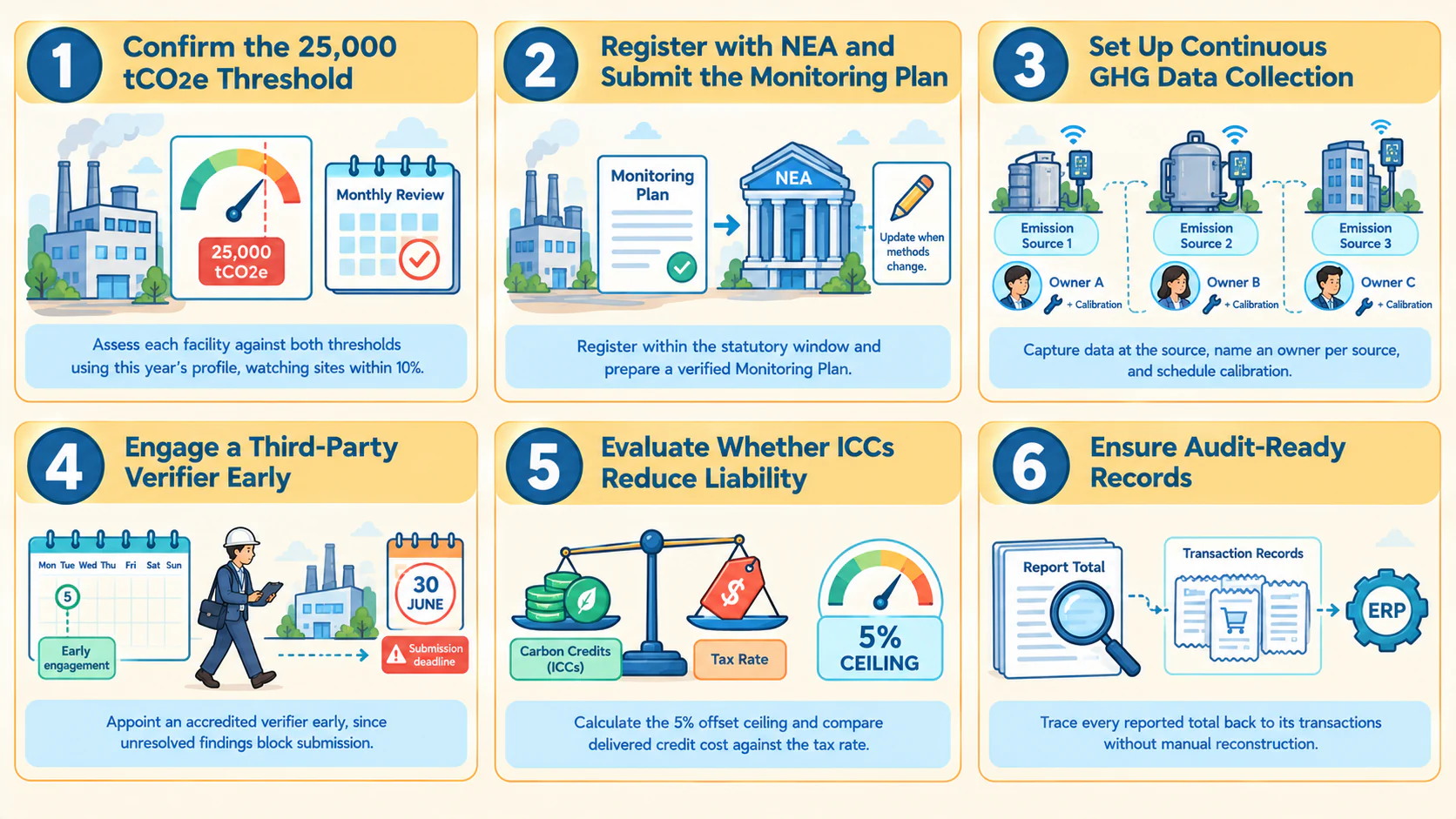
Score your facility against these six steps before the next reporting cycle starts.
1. Confirm whether your facility meets the 25,000 tCO₂e threshold
Assess each facility against both thresholds using this year's operating profile, not a historical baseline, and watch any site within 10% of either line monthly.
2. Register with NEA and submit your Monitoring Plan
Register within the statutory window once a threshold is met, and for taxable facilities, prepare and verify a Monitoring Plan, updating it when methods change.
3. Set up continuous GHG data collection across emission sources
Move data capture into the systems recording the transaction itself, name owner per source, calibration schedule for every instrument involved.
4. Engage a third party verifier before the submission deadline
Appoint an accredited verifier early in the year, not near 30 June, since unresolved findings block submission and compress the path to 30 September.
5. Evaluate whether ICCs reduce your total tax liability
Calculate the 5% offset ceiling on projected emissions, then compare delivered credit cost against the tax rate, checking eligibility before any purchase.
6. Ensure your ERP or reporting system generates audit ready records
Trace a reported total back to its supporting transactions. If that trace needs manual reconstruction, the control will not survive verification.
Conclusion
Singapore's carbon tax has moved from a nominal charge to a real operating cost. At S$45 per tonne, a facility right at the threshold already faces a seven-figure annual bill.
Capturing emissions data where transactions already happen cuts verification friction and under-declaration risk. Get a free consultation to see how it applies to your facility.

Frequently Asked Questions
The carbon tax rate for the 2026 emissions year is S$45 per tonne of carbon dioxide equivalent, applying to emissions released from 1 January 2026 and payable in 2027. Carbon tax settled during calendar 2026 relates to 2025 emissions and is charged at the earlier rate of S$25 per tonne. The published trajectory points to S$50 to S$80 per tonne by 2030.
Carbon tax is payable by operators of facilities in Singapore that emit 25,000 tCO2e or more of direct greenhouse gas emissions in a calendar year. Liability is assessed per facility rather than per company, and the tax applies to total emissions from the first tonne once the threshold is crossed. Facilities emitting 2,000 tCO2e or more must register and report annually but do not pay carbon tax.
Yes. From the 2024 emissions year, taxable facilities may surrender eligible International Carbon Credits to offset up to 5% of their taxable emissions. Credits must meet Singapore’s eligibility criteria, which require a corresponding adjustment from the host country and an Implementation Agreement with Singapore, among other conditions. Credits valid in the voluntary carbon market are not automatically eligible for carbon tax offset.
Failing to submit an emissions report by the 30 June deadline is an offence under the Carbon Pricing Act, regardless of whether carbon tax is ultimately payable. A late submission also compresses the remaining time before the 30 September payment deadline. Submitting information that is false or misleading is treated more seriously and can attract prosecution.
Most SMEs fall below both the 2,000 and 25,000 tCO2e thresholds and have no direct registration, reporting, or payment obligation. However, carbon tax paid by power generation facilities is reflected in electricity tariffs, so smaller businesses experience the cost indirectly. Larger manufacturers should verify their own direct emissions rather than assume exclusion based on company size.
Singapore sets a fixed price per tonne of emissions and lets the quantity of emissions adjust in response. An emissions trading scheme instead caps total emissions and allows the market to determine the price of allowances. The fixed-price approach gives businesses cost certainty for planning abatement investment, whereas an ETS gives certainty over the emissions outcome but exposes participants to price volatility.
Operators notify and register their facility with the National Environment Agency through its Emissions Data Monitoring and Analysis (EDMA) system once the applicable threshold is met. Taxable facilities must additionally prepare and submit a Monitoring Plan documenting emission sources, quantification methodology, and internal controls, subject to verification. Registration must be completed within the statutory timeframe after the threshold is crossed.