










 Limited to 100 registrants

A two-tier ERP strategy pairs one corporate ERP for group governance with separate ERP systems at subsidiary or regional level, letting local entities run processes headquarters cannot standardise everywhere.
Singapore headquarters usually reach this question after an acquisition, during regional expansion, or once a smaller entity cannot realistically adopt the same processes as the parent company.
This article compares Tier 1 and Tier 2 responsibilities, governance controls, implementation risks, and a six-step readiness checklist to help you decide if the model fits.
Key Takeaways
Two-tier ERP splits group governance from local execution, but only works when responsibility boundaries are explicit.
Tier 1 and Tier 2 systems divide ownership differently across accounts, customer data, compliance, and intercompany activity.
Governance only holds up when master data, vendor approval, and integration standards are agreed before go-live.
A six-step readiness checklist helps decide whether two-tier ERP or a single platform actually fits your organisation.

How a Two-Tier ERP Strategy Balances Control and Local Autonomy
Two-tier ERP works only when each tier's role is defined clearly from the start.
1. Defining two-tier ERP in practical terms
A two-tier ERP strategy connects a corporate ERP with local ERP systems, keeping group oversight while letting subsidiaries handle transactions where local rules genuinely differ.
Consider a Singapore headquarters with a regional subsidiary. Group Finance may want one chart of accounts, while the subsidiary needs different purchasing approvals or tax settings.
2. Where control stays centralised and where autonomy is granted
The architecture usually includes four connected parts.
- A Tier 1 ERP for corporate finance, consolidation, group procurement rules, and executive visibility.
- One or more Tier 2 ERP systems for local sales, purchasing, inventory, or service execution.
- Integration services that exchange master data, transactions, balances, and exceptions.
- Governance rules defining who owns records, approves changes, and resolves differences.
Boundaries must stay explicit, since the technology alone cannot decide who owns data ownership, period close, or exceptions.
- Tier 1 to Tier 2: policies, approved master data, and reporting calendars give local teams a controlled framework.
- Tier 2 to Tier 1: sales, purchasing, and financial events preserve group visibility without duplicating local tasks.
- Both directions: intercompany status and exceptions move between tiers to support reconciliation.
Tier 1 ERP vs Tier 2 ERP: Which Responsibilities Belong Where?
Responsibilities usually split along the lines below, though the exact allocation depends on the organisation.
1. What headquarters and Tier 1 systems typically own
Tier 1 usually maintains the group chart of accounts, sets identifier rules for customer records, collects balances for consolidation, and owns interface standards across entities.
2. What subsidiaries and Tier 2 systems typically own
Tier 2 configures local workflows within approved boundaries, creates or enriches local records, posts local transactions, and applies local requirements once headquarters reviews them.
| Responsibility | Typical Tier 1 role | Typical Tier 2 role | Governance question |
|---|---|---|---|
| Scope and users | Group finance, executives, shared services | Local finance, sales, operations | Which decisions must be common across entities? |
| Process ownership | Defines minimum standards for close and controls | Configures local workflows within boundaries | Where is variation permitted, and who approves it? |
| Chart of accounts | Maintains group accounts and mappings | Uses local accounts mapped to group codes | Who approves a new account or mapping change? |
| Customer and supplier data | Sets identifiers and approval policy | Creates or enriches local records | Which system is the system of record for each field? |
| Products and locations | Governs shared product taxonomy | Maintains local SKUs or service locations | How are local codes reconciled with group codes? |
| Financial consolidation | Collects balances and eliminations | Posts local transactions and closes local books | What evidence supports each reported balance? |
| Intercompany activity | Defines reconciliation thresholds | Creates invoices, receipts, or service charges | Who investigates an unmatched item? |
| Local configuration | Limits changes affecting group reporting | Applies approved local tax or workflow settings | Which changes require central review? |
| Integrations | Owns interface standards and release controls | Supplies local endpoints and test data | Who is accountable when a message fails? |
| Compliance requirements | Sets control expectations and policy | Applies current local requirements after review | Has finance confirmed the applicable rules and date? |
| Change control | Coordinates releases affecting multiple entities | Tests and adopts changes in local operations | Can a subsidiary defer a release, and under what conditions? |
3. Where Tier 3 fits for smaller entities
Some groups add a Tier 3 layer for entities too small for the standard Tier 2 template, such as a basic accounting package or shared-service data entry.
Tier 3 typically feeds summarised figures into Tier 1, and works best when an entity's volume does not justify a full local ERP.
Why Organisations Adopt a Two-Tier ERP Strategy
Most groups consider two-tier ERP when they need group visibility but cannot justify one identical design everywhere.
1. Growth through acquisition and multi-entity structures
A newly acquired company may need to transact quickly while the group assesses process alignment, rather than waiting for a shared template.
A business unit with distinct customers or products may also need genuine autonomy, not a legacy preference left unchallenged.
2. Cost and complexity limits of a single ERP rollout
Entering markets with different operating practices forces a choice: which activities must be standardised first, and which can stay local.
A highly controlled Tier 1 environment can suit large entities poorly for small ones, and uneven process maturity adds further risk.
A single ERP instance stays preferable when processes are already similar and the corporate template is configurable enough to roll out together.
Key Benefits of Two-Tier ERP When Governance Is Designed Well
Each benefit below only holds if a specific condition is met.
1. Faster local deployment and lower total cost of ownership
A focused Tier 2 rollout can avoid waiting for every corporate requirement to be redesigned, and effort can be staged by entity.
The warning sign is a permanent unplanned system that finance stops reviewing once it goes live.
2. Room for subsidiary-specific customisation without disrupting headquarters
Local teams can configure workflows for their own customers or warehouses, as long as the boundary stays documented and enforced.
A Tier 2 approach also gives acquired entities a governed landing zone, provided someone owns the integration work.
How Does Two-Tier ERP Work in Practice?
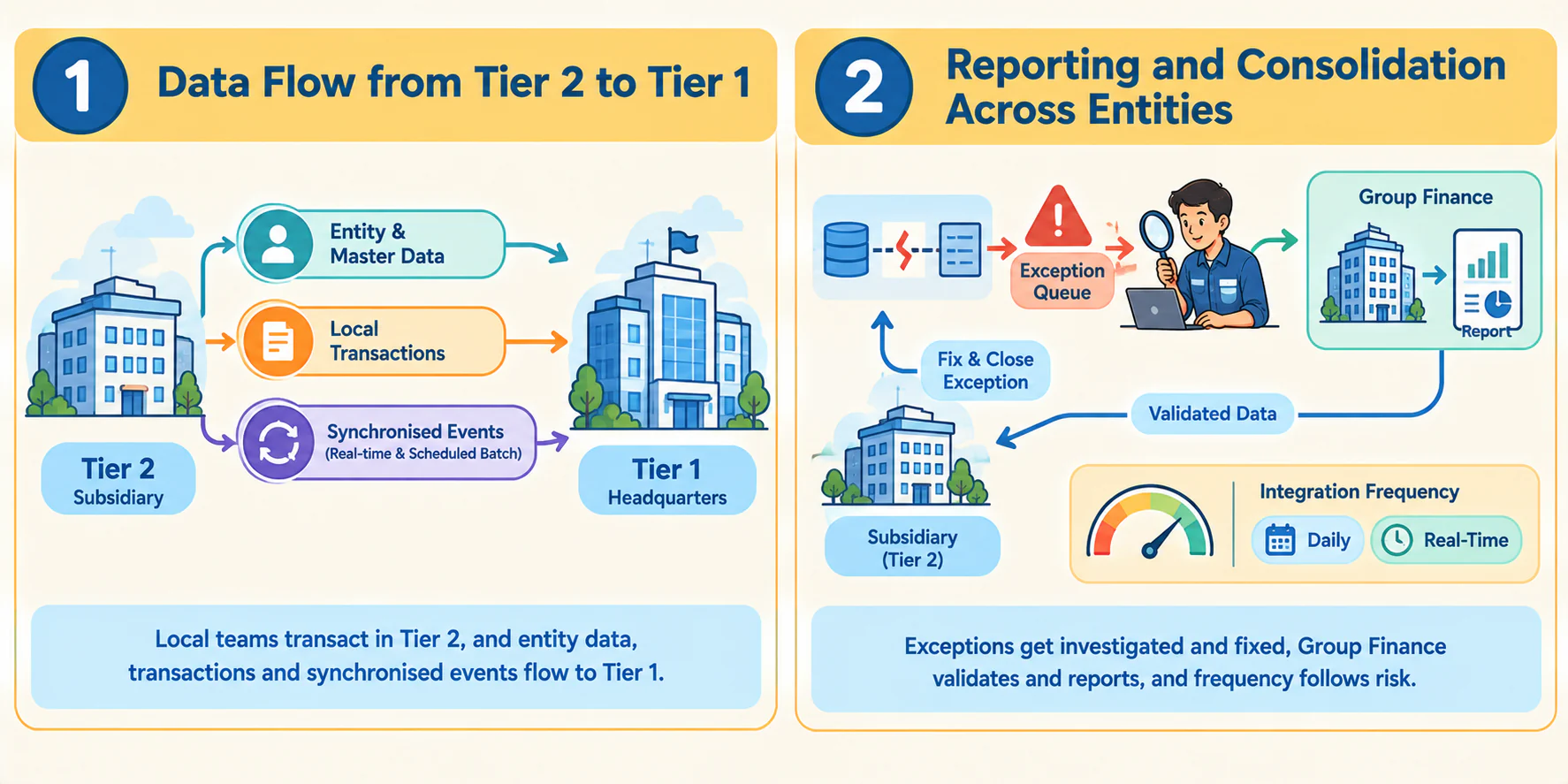
Local teams transact in Tier 2, and agreed data moves to Tier 1 for group reporting.
1. Data flow from Tier 2 systems to the corporate Tier 1 system
- Entity and master data: define accounts, customers, and approval roles, recording what is created centrally versus locally.
- Local transactions: the subsidiary records orders, receipts, or service activity in Tier 2 using approved workflows.
- Synchronised events: interfaces send transactions and balances to Tier 1, either in real time or in scheduled batches.
2. Reporting and consolidation across entities
A failed message or unmatched balance enters an exception queue, and the assigned team investigates and records the fix.
Group Finance then validates submissions and prepares management reporting, sending feedback to the subsidiary when needed.
Integration frequency should follow process risk. A daily feed may suit reporting, while an order event may need faster confirmation.
Governance, Master Data and Integration Controls for Two-Tier ERP
Governance needs explicit ownership for master data, mappings, and exceptions, or mismatches become a normal operating condition.
1. Setting a single source of truth for master data
- Master-data ownership: corporate finance sets group standards, local finance validates accuracy, and IT enforces the rules.
- Account mapping: corporate finance owns the group chart, while local finance confirms postings before they close.
- Reconciliation: local finance reconciles books, IT provides the audit trail, and the sponsor accepts residual risk.
2. Approved vendor lists versus letting subsidiaries choose freely
An approved Tier 2 vendor list keeps integration patterns and support consistent once more than one subsidiary connects to Tier 1.
Letting each subsidiary pick its own system can suit distinct needs, but shifts support cost onto whoever finds the mismatch first.
3. Integration standards that keep Tier 1 and Tier 2 systems aligned
Use these questions in an architecture workshop:
- Who owns the record and each critical field?
- Who approves a change, and what evidence is required?
- How are integration failures detected and assigned?
- How are differences reconciled, documented, and aged?
- Who can stop a release when controls are incomplete?
Current GST and financial reporting requirements set by ACRA should be confirmed with qualified advisers before configuration.
"Two-tier ERP does not fail because of the technology choice. It fails when nobody has agreed who owns a number before the two systems start exchanging it."
Two-Tier ERP Examples for Singapore and Regional Operations
The scenarios below are illustrative and do not represent verified client outcomes.
1. Multinational headquarters using Singapore as a regional hub
A Singapore Tier 1 environment can govern account mappings for a regional distribution entity, while Tier 2 handles local purchasing.
A manufacturer opening a new unit can apply the same pattern, letting corporate policy govern product identifiers centrally.
2. Growing enterprises adopting Tier 2 ERP within a larger group structure
An acquired business with a different billing workflow does not need immediate migration into the group's main system.
The group can connect selected financial events to Tier 1 instead, with a review gate after the first reporting cycles.
3. IRAS and CPF compliance considerations at the local entity level
A Tier 2 entity in Singapore still carries its own GST registration and reporting duties to IRAS, separate from group reporting.
Local payroll must also meet CPF Board contribution rules, so master data should confirm which system files these figures.
Two-Tier ERP Implementation Challenges and Risk Controls
The table below covers the main risks; three of them need a closer look.
| Risk | Typical consequence | Practical control |
|---|---|---|
| Different customer or product codes | Duplicate reporting and fulfilment errors | Identifier policy, duplicate checks, and approval workflow |
| Failed integration messages | Missing postings or delayed visibility | Monitoring, retry rules, and incident records |
| Unclear intercompany responsibility | Aged mismatches and late close | Trading-partner rules and reconciliation thresholds |
| Local process drift | Loss of control and difficult support | Design authority and periodic review |
| Excessive access | Data leakage or unauthorised changes | Role design and access recertification |
| Scope expansion | Budget and timeline pressure | Stage gates and measurable acceptance criteria |
1. Integration failures and data mismatches
A failed message usually surfaces as a missing posting, not an obvious error, so monitoring and a named owner matter most.
2. Vendor sprawl across multiple subsidiaries
Without an approved vendor list, each subsidiary can end up on a different system, making every future integration harder.
3. Change management across headquarters and local teams
Testing should include failed messages and month-end scenarios, proving someone can catch a failure, not just that it works once.
Should You Choose Two-Tier ERP or a Single ERP Platform?
A few signs point clearly toward one option over the other.
1. Signs a single ERP platform is still the better fit
- Most entities use the same products, customers, and accounting policies.
- Consolidation delays come from process inconsistency, not local legal requirements.
- The business lacks resources to run integrations and exception queues.
- A common data model would materially simplify controls and analytics.
- The proposed Tier 2 system mainly duplicates functions already in Tier 1.
2. Signs your business has outgrown a single-platform approach
- A subsidiary's legal or tax requirements cannot fit the corporate template without major disruption.
- Acquisitions need onboarding in stages rather than immediate migration.
- Local teams routinely build manual workarounds just to keep transacting.
A Six-Step Readiness Checklist for Two-Tier ERP Planning
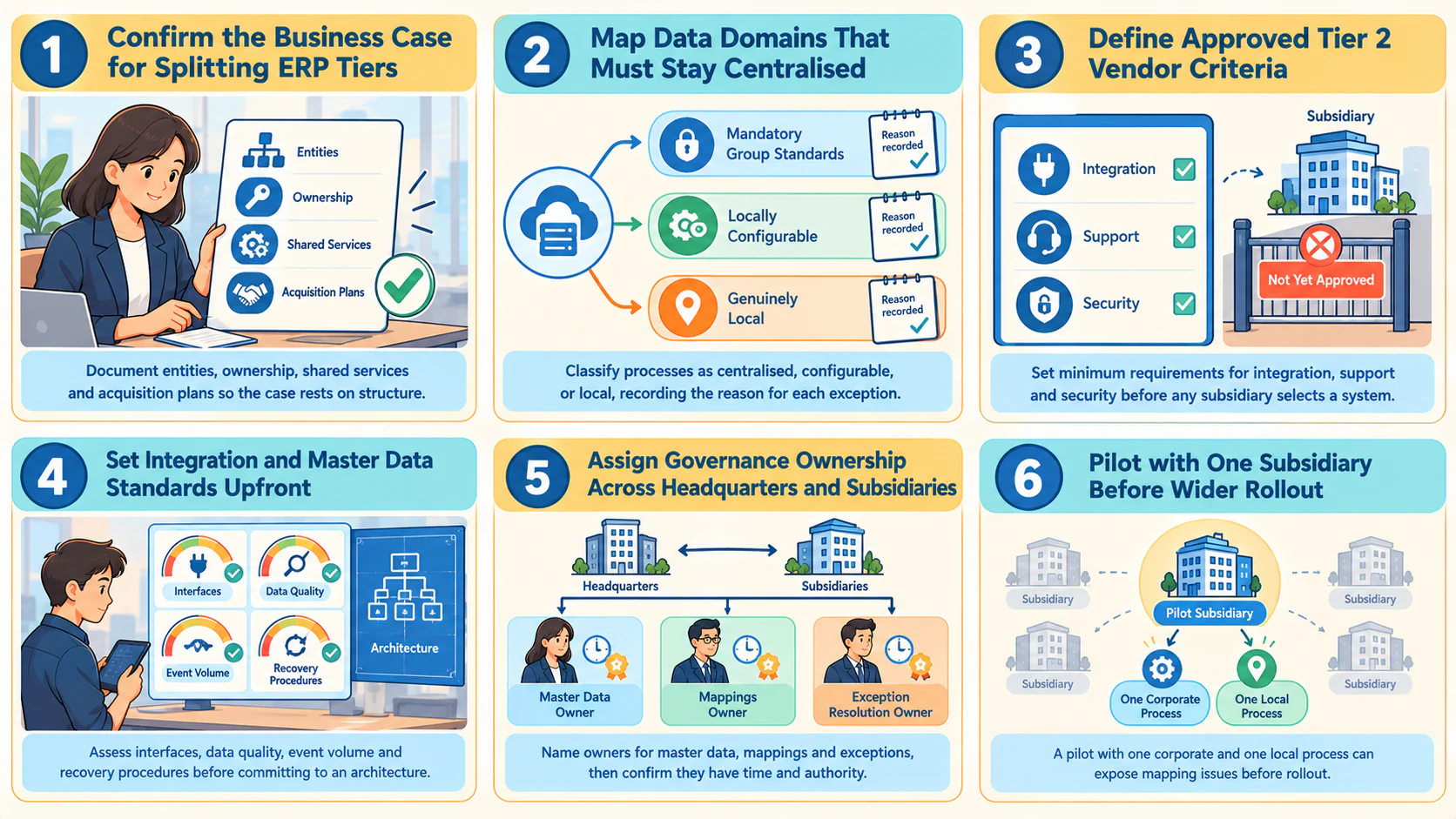
Score each step below with documented evidence rather than intuition.
1. Confirm the business case for splitting ERP tiers
Document entities, ownership, shared services, and acquisition plans so the case rests on structure, not preference.
2. Map data domains that must stay centralised
Classify processes as mandatory group standards, locally configurable, or genuinely local, recording the reason for each exception.
3. Define approved Tier 2 vendor criteria
Set minimum requirements for integration, support, and security before any subsidiary selects a local system.
4. Set integration and master data standards upfront
Assess interfaces, data quality, event volume, and recovery procedures before committing to an architecture.
5. Assign governance ownership across headquarters and subsidiaries
Name owners for master data, mappings, and exception resolution, then confirm they have the time and authority.
6. Pilot with one subsidiary before wider rollout
A pilot involving one corporate process and one local process can expose mapping issues before the architecture is approved.
Conclusion
A two-tier ERP strategy works when a group needs common governance but subsidiaries have real operational differences, not just legacy habits.
Compare a single instance, a phased template, and a two-tier design before choosing. Get a free consultation to test the fit against your own data.
Frequently Asked Questions
The answer depends on process variation, local requirements, acquisition conditions, integration maturity, and governance capacity. Compare the cost and control implications of a common template, a single instance, and a two-tier model rather than assuming subsidiary autonomy requires a separate ERP.
Define ownership rules for customers, suppliers, products, locations, chart-of-accounts mappings, and entity identifiers. Use approval workflows, reconciliation, and exception monitoring, while recognising that the right system of record varies by organisation and data domain.
Review entity structure, reporting requirements, local process variation, integration events, financial mappings, access rights, GST or other applicable requirements, and support ownership. Confirm every regulatory statement against current authoritative guidance.
Use the six-step readiness checklist covering business case, data domains, vendor criteria, integration standards, governance ownership, and a pilot rollout. Document evidence for each step and run a representative pilot before committing to a permanent architecture.
It can be, once a smaller business has more than one entity or a subsidiary with genuinely different processes. Below that threshold, a single ERP instance with a configurable template is usually simpler to run and cheaper to support.
Not usually. Two-tier ERP exists to separate group governance from local execution across more than one entity, so a single-entity business gains little from the added integration and governance overhead.
Timelines vary with entity count, data quality, and integration complexity, so avoid committing to a fixed duration before scoping. A representative pilot with one subsidiary is a more reliable way to estimate effort than a generic industry benchmark.