










 Limited to 100 registrants


Storage cost per pallet is the total amount you pay to keep one pallet of goods in a warehouse for a set period, usually a week or a month. It covers the base rate plus handling and extra fees.
To work it out, divide your total monthly storage spend by the number of pallets you hold, then compare the result across providers. This article covers the formula and the Singapore factors behind it.
Key Takeaways
Storage cost per pallet is the total fee to store one pallet for a set period, covering the base rate plus handling and extra charges.
Calculate storage cost per pallet by dividing base, handling and other fees by average pallets stored, then compare each quote monthly.
Warehouse storage costs depend on pricing model, pallet size, handling frequency, contract length and hidden charges added to the weekly rate.
Warehouse storage costs in Singapore reflect industrial rents, limited land, 9 percent GST and choosing 3PL storage or your own rented warehouse.
What Is Storage Cost per Pallet?
Storage cost per pallet is a unit rate that lets you compare warehouse options on equal terms. Providers quote by pallet or by area, so converting every quote to one pallet keeps the comparison fair.
Most Singapore businesses track this figure monthly, although many 3PL providers quote weekly. The cost also changes with pallet size and how long the stock stays in the facility.
The table below shows the quoting methods you will meet most often. Each one needs converting before you can compare it with the others.
| Pricing basis | What you pay for | Best suited to |
|---|---|---|
| Per pallet per week | One pallet position for each week | Short-term or overflow storage |
| Per pallet per month | One pallet position for each month | Steady, long-term stock |
| Per square foot | Floor area, regardless of pallet count | Bulky or irregular goods |
| Per cubic metre | Space used, including height | Goods stored in tall racking |
"A low pallet rate means little until handling and extra fees are added. Converting every quote to one cost per pallet is the only fair way to compare providers."
How to Calculate Storage Cost per Pallet
The calculation needs only your monthly storage invoices and your average pallet count. The sections below cover the formula, a worked example, and how to read the result.
1. The storage cost calculation formula
The basic storage cost calculation formula divides your total storage spend by the average number of pallets stored. Use the average count, because pallet numbers rise and fall during the month.
Handling fees include inbound receiving and outbound picking. Other charges cover insurance and admin fees, so include them or the result will look lower than it really is.
2. Worked example with a pallet storage cost calculator
A pallet storage cost calculator applies the same formula to your own figures. The example below uses illustrative Singapore dollar amounts for a business that holds 200 pallets on average.
| Cost item | Monthly amount (SGD) |
|---|---|
| Base storage fees | 3,000 |
| Inbound handling | 600 |
| Outbound picking | 900 |
| Admin and insurance | 300 |
| Total monthly cost | 4,800 |
| Average pallets stored | 200 |
| Cost per pallet per month | 24.00 |
Dividing S$4,800 by 200 pallets gives S$24 per pallet per month. Base storage alone would be S$15, so handling and other fees add 60 percent to the headline rate.
3. What your cost per pallet means
A single figure tells you little until you compare it with a benchmark. Start with your own past months, since inventory holding costs shift over time, and with quotes from other providers.
A rising figure with a stable pallet count usually points to higher handling or extra fees. A falling figure with fewer pallets may signal poor space use.
The table links common patterns to their usual cause. Use it as a first check before you open a discussion with your provider.
| Result pattern | Likely cause | Action |
|---|---|---|
| Cost rises, pallet count flat | Handling or extra fees increased | Review the invoice line by line |
| Cost rises, pallet count falls | Fixed charges spread over fewer pallets | Renegotiate minimum terms |
| Cost falls, pallet count rises | Volume pricing or better density | Confirm the pricing tier still applies |
What Drives Warehouse Storage Costs?
Several factors move the rate you pay, and some of them sit outside the headline quote. Understanding each one helps you predict your invoice before it arrives.
1. Pricing models: per pallet, per square foot, or per cubic metre
Per-pallet pricing is simple and suits goods that stack in standard racking. Per square foot or per cubic metre pricing suits bulky or irregular goods that do not fit a standard pallet.
2. Pallet size, weight, and stacking height
Oversized or overweight pallets use more rack space, so providers often charge a premium for them. Goods that cannot be stacked also cost more, because they occupy a full vertical slot.
3. Handling fees: inbound, outbound, and picking
Handling fees can rival the base storage rate for fast-moving stock. A pallet that moves in and out weekly generates far more handling charges than one that sits for a quarter.
4. Storage duration and minimum contract terms
Short-term storage usually carries a higher weekly rate than a long contract. Minimum terms also matter, because you pay for committed pallet positions even when they sit empty.
5. Hidden charges that inflate the weekly rate
Admin fees and after-hours access charges can sit outside the quoted rate. Ask for a full schedule of charges before you sign, so the invoice holds no surprises.
The table below summarises how each driver affects the rate. It also shows what to check in a quote before you accept it.
| Cost driver | Effect on your rate | What to check |
|---|---|---|
| Pricing model | Changes how space is charged | Whether the basis suits your goods |
| Pallet size and weight | Premium for oversized loads | Maximum height and weight per pallet |
| Handling frequency | More movements, higher fees | Inbound and outbound rates per pallet |
| Contract length | Longer terms often lower the rate | Minimum pallet commitment |
| Extra charges | Raise the real cost per pallet | Full schedule of charges |
Warehouse Storage Costs in Singapore
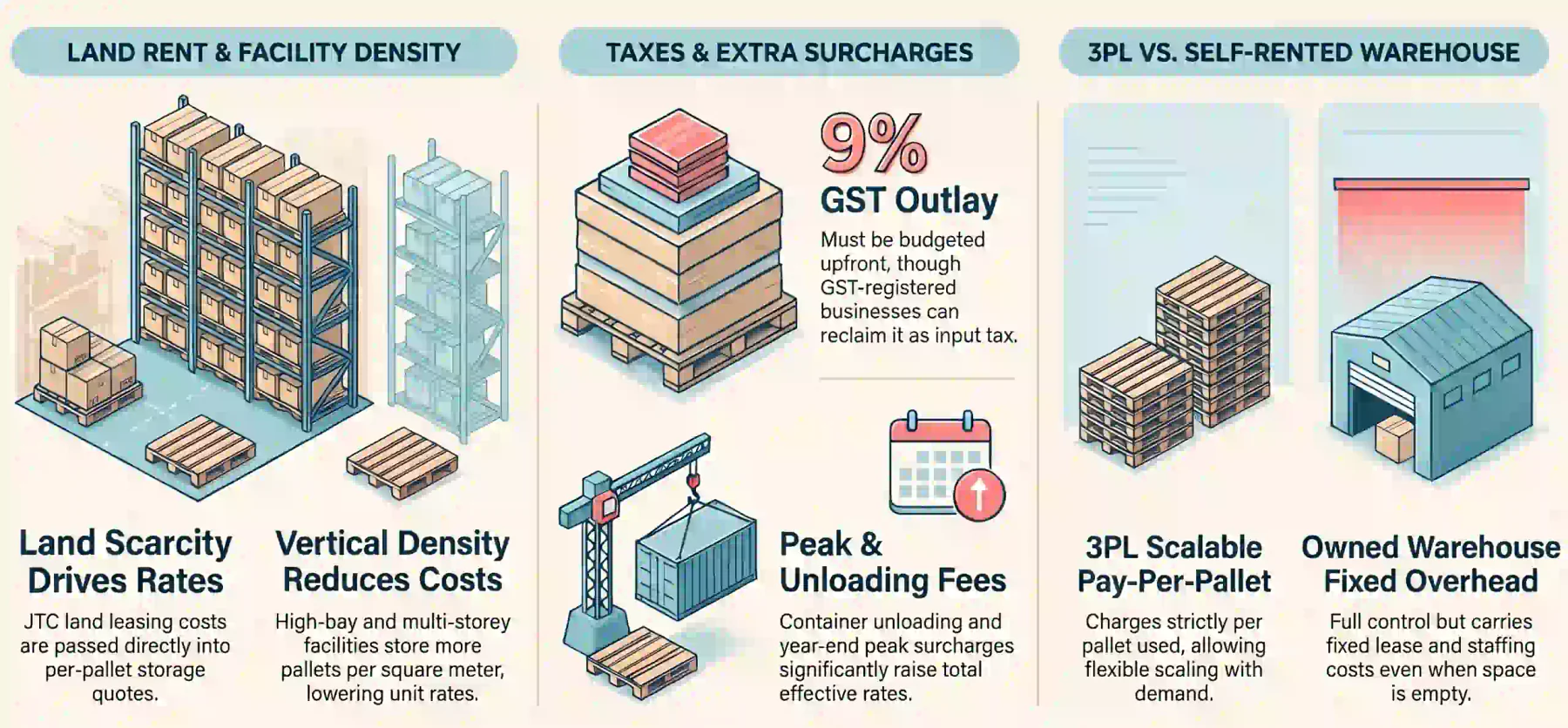
Singapore pallet rates reflect local land and rental conditions as much as warehouse operations. The sections below explain what shapes a local quote and how to read it.
1. How industrial rents and limited land affect pallet rates
Land is scarce in Singapore, and JTC develops and leases a large share of its industrial space. Operators pass their rental costs on through the pallet rate, so location and building type affect your quote.
Multi-storey and high-bay facilities can store more pallets per square metre of land. That density often lowers the cost per pallet, though the building itself may carry a higher rent.
2. GST and other charges to add to a Singapore quote
Check whether a quote includes GST, which stands at 9 percent in Singapore. A GST-registered business can usually claim it back as input tax, but you still need to budget for the cash outlay.
Ask also about container unloading fees and peak season surcharges, which many providers list separately. These lines can raise the effective rate noticeably during busy periods such as year-end.
3. 3PL pallet storage versus renting your own warehouse
A 3PL storage provider charges per pallet and lets you scale space up or down. Renting your own warehouse gives you control, but you carry the full lease and staffing cost whether the space is full or not.
The table compares the two options on the points that matter most for cost. Neither suits every business, so match the choice to your volume pattern.
| Option | Cost structure | Flexibility | Better when |
|---|---|---|---|
| 3PL pallet storage | Variable, charged per pallet | High | Volumes fluctuate through the year |
| Own rented warehouse | Fixed lease plus staffing | Low | Volumes are high and stable |
How to Compare Pallet Storage Quotes
Quotes rarely use the same structure, so a direct comparison of headline rates can mislead you. Use the sections below to put every quote on the same basis.
1. Convert every quote to a cost per pallet per month
Turn weekly rates into monthly figures by multiplying by 52 and dividing by 12. Then add handling and fixed charges, and divide by the pallets you expect to store.
Do the same for area or volume quotes by estimating how many pallets fit that space. Keep the assumptions in a sheet so you can update them as quotes change.
The table below uses illustrative figures and assumes each pallet moves in and out once a month. It shows how two quotes look after conversion.
| Provider | Quoted rate (SGD) | Monthly storage | Handling per pallet | Monthly cost per pallet |
|---|---|---|---|---|
| Provider A | 5.00 per week | 21.67 | 4.00 | 25.67 |
| Provider B | 20.00 per month | 20.00 | 7.00 | 27.00 |
Provider B looks cheaper on the headline rate. Its higher handling fee makes it the more expensive option once both quotes are converted.
2. Questions to ask your warehouse provider
Ask what the rate includes and how the provider measures one pallet position. Confirm when fees can change, since some contracts allow reviews during the term.
Also ask how damaged goods are handled and whether minimum terms apply to every position. Written answers make later disputes easier to resolve.
3. Warning signs of a low rate that costs more later
A very low weekly rate often comes with high handling fees or strict minimum terms. Vague descriptions of included services are another warning sign.
Request a sample invoice from the provider. Comparing it with the quote shows quickly whether the headline rate reflects what you will really pay.
How to Reduce Warehouse Storage Costs
Once you know your cost per pallet, you can act on the factors you control. The most effective changes usually involve stock levels and space use rather than the rate itself.
1. Right-size inventory and remove slow-moving stock
Every idle pallet pays the same storage rate as a fast mover. A quarterly review of ageing stock shows which items to discount or clear.
Just-in-time replenishment reduces the number of pallets you hold at any time. It works best when suppliers deliver reliably and lead times are short.
2. Improve pallet density and racking use
Consolidating part-filled pallets frees positions you would otherwise pay for. Taller stacking, where the goods and warehouse racking allow it, raises density further.
Check each pallet's footprint against the position it occupies. Pallets that overhang or leave unused height waste space you are charged for.
Racking and layout changes require investment. Businesses can review the support schemes listed by Enterprise Singapore, as some may help fund operational upgrades.
3. Negotiate tiered rates and flexible terms
Providers often offer lower rates for higher volumes or longer commitments. Ask for tiered pricing that reduces the rate as your pallet count grows.
Flexible terms matter as much as price. A contract that lets you release unused positions protects you during slower months.
4. Use overflow storage for seasonal peaks only
Permanent space sized for peak demand sits half empty for most of the year. Overflow storage lets you pay a higher short-term rate only when you need the extra capacity.
The table ranks these actions by their effect and the effort they need. Start with the low-effort items, because they need no contract changes.
| Cost reduction action | Typical effect | Effort |
|---|---|---|
| Clear slow-moving stock | Fewer pallets stored | Low |
| Consolidate part-filled pallets | Fewer positions paid for | Low |
| Negotiate tiered rates | Lower rate per pallet | Medium |
| Use overflow storage for peaks | Lower fixed commitment | Medium |
Tracking Pallet Storage Costs with Inventory Software
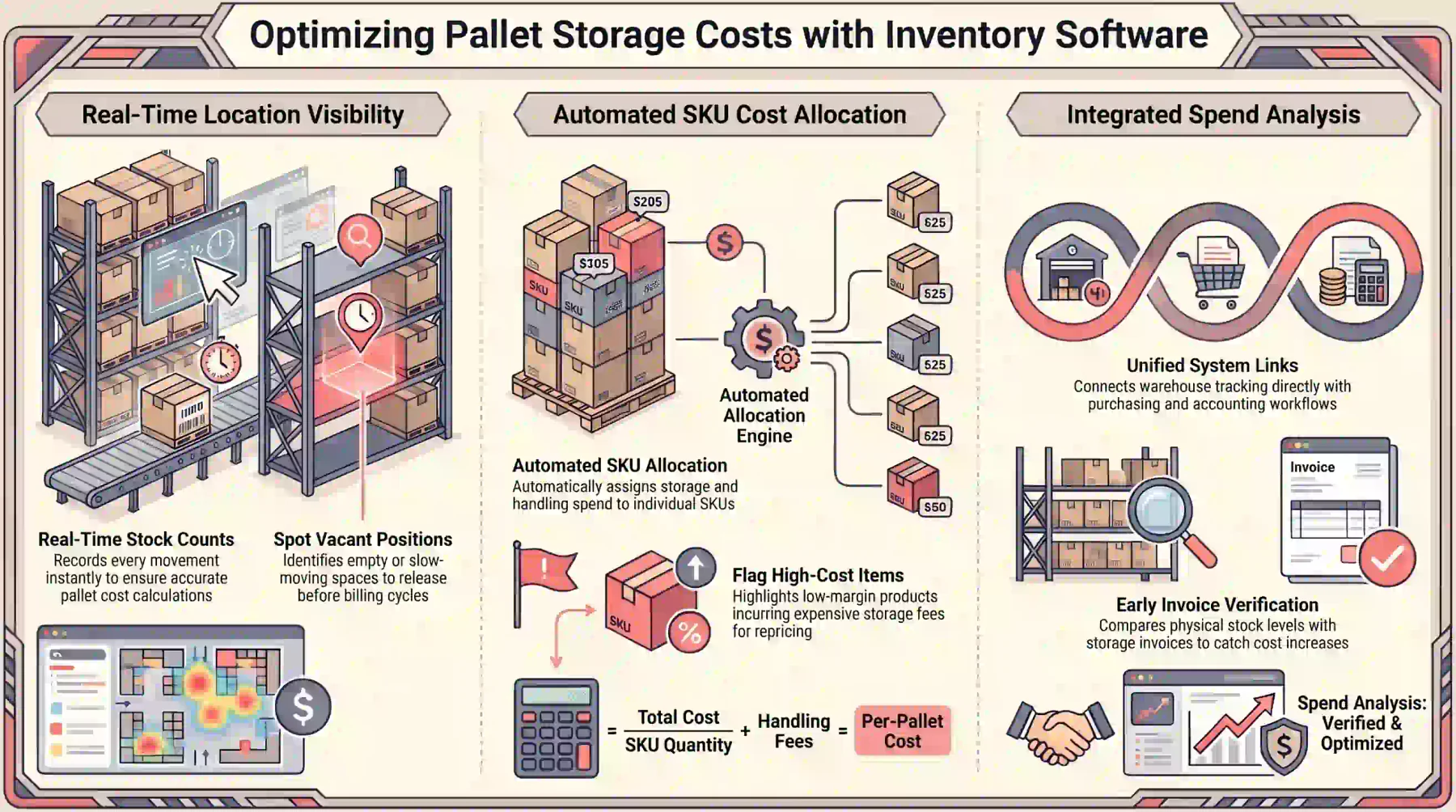
Spreadsheets work for a handful of pallets, but they struggle once stock moves daily across several locations. Inventory software keeps the data behind your cost per pallet accurate and current.
1. Real-time pallet and bin location visibility
Your cost per pallet depends on an accurate pallet count. Inventory software records every movement as it happens, so the average you divide by reflects real stock.
Location tracking also shows which positions sit empty or hold slow-moving goods. That helps you release space before the next billing cycle.
2. Automating storage cost allocation by SKU
Dividing storage spend across products by hand takes time and invites errors. Software can allocate storage and handling costs to each SKU using the pallets and movements recorded.
With costs allocated, you see which products earn their space. Low-margin items with high storage costs become easy to spot and reprice.
3. How HashMicro supports Singapore warehouses
HashMicro provides inventory management software for Singapore businesses, with stock tracking across warehouse locations. It links stock data to purchasing and accounting in one system.
Teams can then compare stock levels with storage invoices and spot cost increases early. Book a demo to see how the software fits your warehouse.
Pallet costs are easier to control when stock counts, locations and storage invoices stay connected. Hashy AI helps teams review those records and spot cost increases early.






Conclusion
Storage cost per pallet gives you one figure to compare providers and track your own efficiency. The formula is simple, but it only works when handling and extra fees sit alongside the base rate.
In Singapore, land costs and GST also shape the final quote. Convert each offer to a monthly cost per pallet, then act on stock levels and density, and use inventory software to keep the data accurate.
If you want to learn more about storage cost per pallet, then you can book a free consultation with our experts today and start optimizing your operations.
Frequently Asked Questions
Storage cost per pallet is the total cost of keeping one pallet in a warehouse for a set period, usually a month. It includes the base rate plus handling fees and other charges.
Add your base storage fees to your handling and other charges, then divide by the average pallets stored. Use a monthly period so results stay comparable across providers.
The formula is (base storage fees + handling fees + other charges) ÷ average pallets stored. A pallet storage cost calculator applies it to your own invoice figures.
Costs vary by provider, location, pallet size, and handling needs, so no single figure fits every business. Request several quotes and convert each to a monthly cost per pallet.
Handling fees and admin charges are often quoted separately, and GST is added on top. Ask for a full schedule of charges so you can see the complete cost.