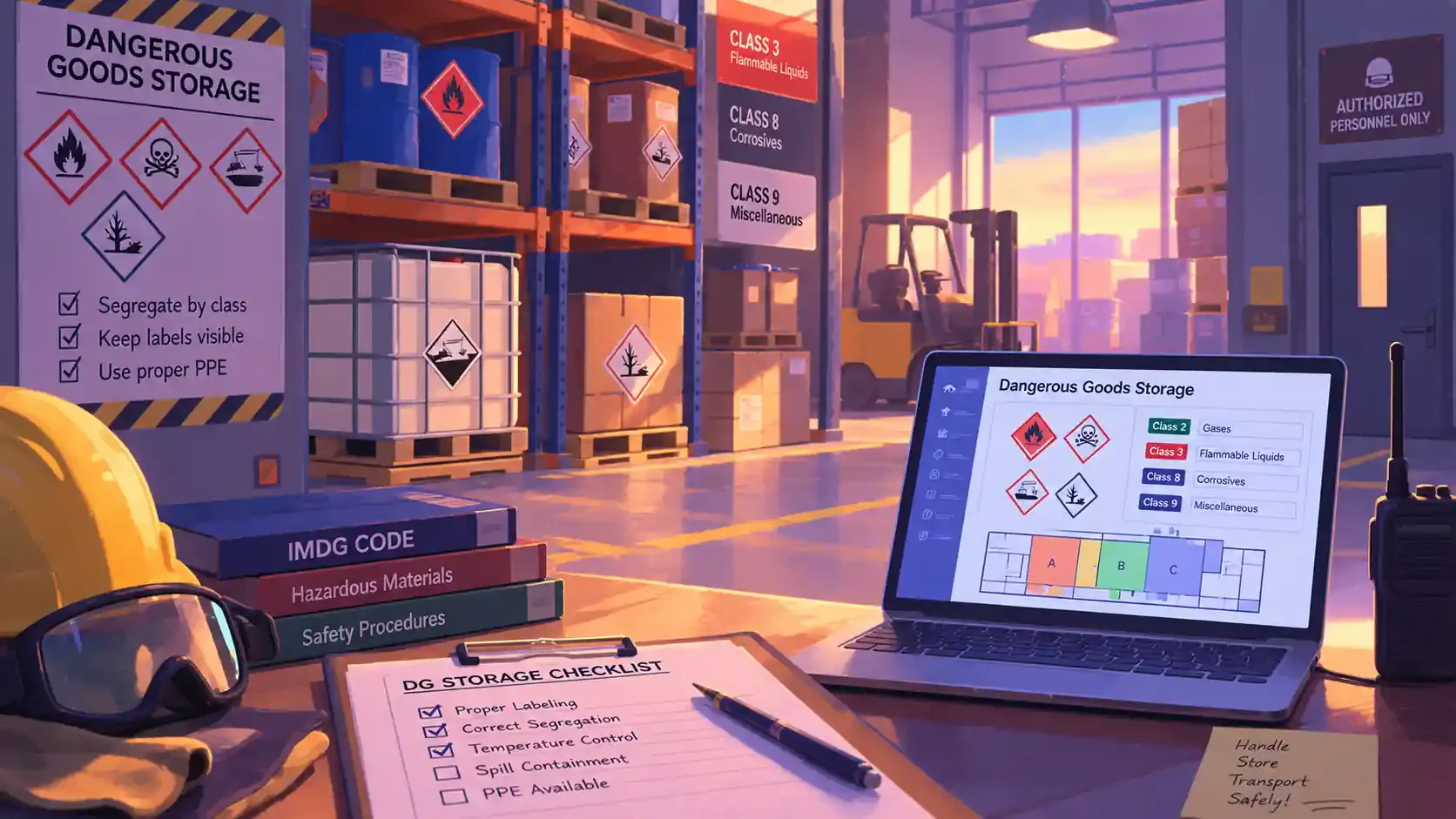








A warehouse management system (WMS) can improve receiving, put-away, picking, packing, shipping and inventory visibility. However, the total cost depends on more than the software license. Businesses must also budget for implementation, data migration, hardware, training, integrations, support and future upgrades.
This guide explains warehouse management system cost in Singapore, compares common pricing models, identifies hidden fees and shows how to estimate return on investment for SMEs, distributors and larger enterprises.
Key Takeaways
WMS pricing depends on users, warehouses, SKUs, order volume, features, integrations and deployment model.
The total cost includes software, implementation, hardware, training, support, maintenance and future upgrades.
Cloud WMS usually reduces upfront capital spending, while on-premise systems may require more internal infrastructure and maintenance.
The right WMS should be evaluated by total cost of ownership, implementation effort, operational fit and expected ROI.
What Is a Warehouse Management System and What Does It Cost?
A warehouse management system is software that controls warehouse activities and connects inventory data with purchasing, sales, accounting and fulfilment workflows. It helps teams manage stock from receipt through storage, picking, packing and dispatch.
What a WMS covers: receiving, put-away, picking, packing and shipping
A WMS can support goods receiving, barcode scanning, put-away rules, location management, stock transfers, picking, packing, dispatch and stocktaking. More advanced systems may also support multi-warehouse visibility, replenishment rules, batch tracking, expiry management and warehouse analytics.
Typical cost ranges for SMEs, mid-market businesses and enterprises
WMS costs vary significantly. A small business with one warehouse and simple requirements may need a relatively limited subscription and implementation package. A mid-market distributor may require multiple locations, integrations, scanning devices and workflow configuration. Larger enterprises may need complex integrations, advanced automation, dedicated support and multi-entity deployment.
Use these categories as planning bands rather than fixed market prices. The most reliable budget comes from a vendor quote based on users, warehouses, transaction volume, modules, integrations and implementation scope.
Why WMS quotes vary widely between vendors
One vendor may quote only the software subscription, while another includes configuration, training, support and integrations. Some providers price per user, while others charge by warehouse, order volume, feature package or transaction count. Always ask for a full three- to five-year cost view before comparing proposals.
WMS Pricing Models Explained
"The cost of a warehouse management system depends on more than the licence fee. User numbers, warehouse locations, SKU volume, order complexity, integrations and deployment choices all shape the total investment."
Before comparing vendors, understand how WMS providers structure their pricing. The pricing model affects upfront investment, recurring costs, scalability and the total cost of ownership over time.
Subscription pricing: per user, feature or order volume
Software-as-a-service WMS platforms usually charge monthly or annual subscription fees. Pricing may depend on the number of users, warehouses, enabled features, order lines, transactions or storage locations. Subscription pricing lowers upfront spending but creates a recurring operating cost.
Perpetual license plus annual maintenance
A perpetual license involves a larger upfront payment for the right to use the software. Businesses may then pay annual maintenance for support, updates and bug fixes. This model can suit companies with internal IT resources, but infrastructure and upgrade costs must be included in the budget.
Tiered and modular pricing
Tiered pricing groups features into packages such as basic, professional and enterprise editions. Modular pricing allows businesses to add functions such as barcode scanning, advanced analytics, multi-warehouse management or automation as requirements grow.
Open-source and “free” WMS: what you still pay for
Open-source software may reduce license costs, but businesses still pay for hosting, configuration, security, custom development, integrations, support and upgrades. A free license does not mean a zero-cost implementation.
What Drives Warehouse Management System Cost

The final cost of a WMS depends on how closely the system must match your warehouse operations. Factors such as users, locations, SKUs, order volume, required features, integrations and deployment model can all affect the overall investment.
Number of users, warehouses and SKUs
More users, warehouses and products usually require more configuration, access control, master data preparation and support. A system serving one site has fewer deployment requirements than a platform supporting several warehouses or legal entities.
Order volume and transaction complexity
High order volumes increase the need for automation, performance capacity, scanning and integration. Complex transactions such as split shipments, returns, kitting, cross-docking, batch allocation or multi-step approvals can also increase implementation effort.
Required modules and features
Barcode scanning, RFID, replenishment, stock allocation, batch tracking, expiry management, multi-warehouse control, dashboards and advanced analytics can affect the final cost. Select features based on operational requirements rather than buying every available add-on.
Customisation and ERP or ecommerce integrations
Integrations with accounting, ERP, ecommerce, transport management, marketplaces and carriers may require API development, mapping, testing and ongoing monitoring. Custom workflows can also increase both implementation time and support costs.
Cloud versus on-premise deployment
Cloud deployment usually includes hosting, security maintenance and platform updates in the subscription. On-premise deployment may require servers, backups, network upgrades, database administration and internal technical support.
Cost Breakdown: Where the Money Goes
Understanding the main cost categories makes it easier to compare vendor quotes and identify expenses that may not appear in the headline license price.
Software license or subscription fees
This is the visible part of the WMS budget. Confirm whether the quote includes users, warehouses, mobile access, reporting, API access, storage, support and future feature upgrades.
Implementation, configuration and data migration
Implementation may include process mapping, warehouse setup, user roles, item master preparation, location structures, integrations, testing and go-live support. Data migration can become expensive when product, supplier, customer and location records need extensive cleaning.
Hardware: barcode scanners, mobile devices, label printers and RFID
Warehouse teams may require scanners, tablets, mobile computers, label printers, network equipment and charging stations. RFID can add tag, reader, antenna and installation costs. Hardware should be assessed alongside environmental conditions and worker workflows.
Training, change management and support
Users need training on receiving, put-away, picking, packing, stock transfers, stocktakes and exception handling. Businesses should also budget for refresher training, onboarding new employees and post-launch support.
Maintenance, upgrades and hidden costs
Hidden costs can include extra users, additional warehouses, API usage, premium support, report development, custom workflows, data storage, hardware replacement, integration monitoring and consultancy. Ask vendors to list every optional or recurring charge.
Cloud vs On-Premise WMS: Total Cost of Ownership
The payment structure is only one part of the decision. Businesses should also compare the long-term ownership costs, implementation effort and internal resources required by each deployment model.
Upfront capital expenditure versus ongoing operating expenditure
Cloud WMS generally shifts spending towards recurring operating expenditure. On-premise systems may require greater upfront capital expenditure for licenses, servers, implementation and security controls.
Five-year total cost of ownership comparison
Compare five-year costs rather than the first invoice. Include subscription or license fees, implementation, hardware, support, maintenance, upgrades, internal IT time, integrations and possible replacement costs.
Implementation timeline and time to value
Cloud platforms can reduce infrastructure preparation, but implementation still depends on data quality, process complexity and integration requirements. A faster go-live can improve time to value, provided testing and training remain adequate.
Which model suits Singapore SMEs and distributors?
Cloud WMS often suits SMEs and distributors that want predictable infrastructure costs and limited internal IT responsibility. On-premise deployment may suit businesses with strict infrastructure policies, existing technical teams or specialised control requirements.
Worked Example: Budgeting a WMS for a Singapore Distributor
A practical budgeting example shows how warehouse size, user numbers, order volume and required features can affect the total investment and expected payback.
Assumptions: users, warehouse locations and monthly order lines
Assume a distributor operates two warehouses, has 20 operational users, manages several thousand SKUs and processes 10,000 order lines per month. The business requires receiving, barcode scanning, put-away, picking, packing, stock transfers, reporting and accounting integration.
Year-one versus year-three cost estimate
Year-one costs usually include implementation, data migration, configuration, training, hardware and the first subscription or license payment. By year three, the business should also account for recurring subscriptions, support, device replacement, new integrations, additional users and feature expansion.
Estimating payback from fewer picking errors and faster put-away
Estimate the annual value of reduced picking errors, fewer stock adjustments, faster receiving, lower overtime and improved stock availability. Divide the initial investment by the expected annual benefit to estimate the payback period.
How to Reduce Warehouse Management System Cost in Singapore
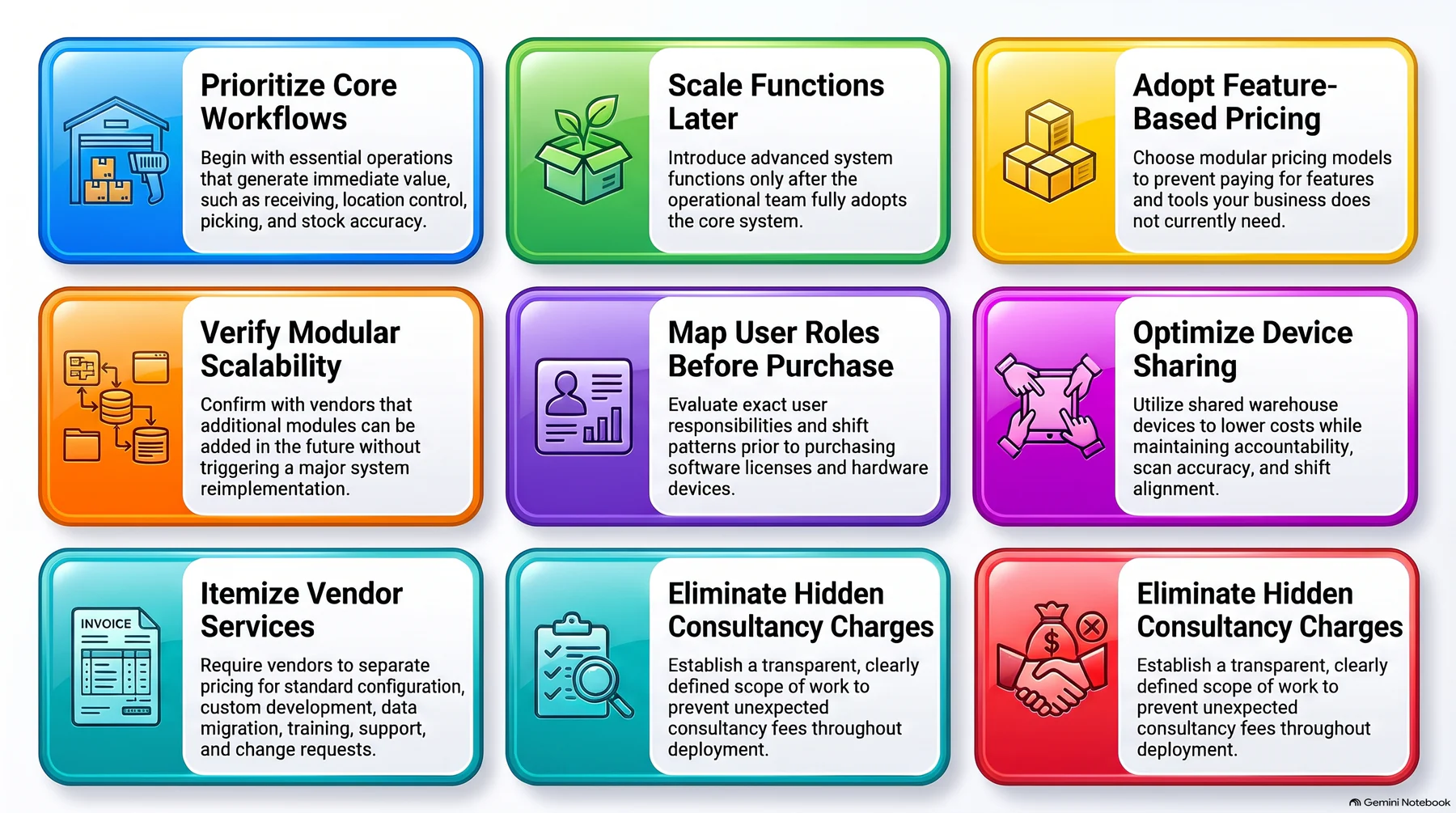
Once the main cost drivers are clear, businesses can reduce unnecessary spending by prioritising essential workflows, controlling implementation scope and selecting features that support measurable operational improvements.
Start with core modules and scale later
Begin with the workflows that create the greatest operational value, such as receiving, location control, picking and stock accuracy. Add advanced functions after the team adopts the core system.
Choose modular, feature-based pricing
Modular pricing can prevent businesses from paying for features they do not yet need. Confirm that additional modules can be added without a major reimplementation.
Limit unnecessary user licenses and device spending
Map user roles before purchasing licenses and devices. Shared warehouse devices may reduce spending, but the arrangement must still support shift patterns, accountability and scan accuracy.
Negotiate implementation scope, support and service-level terms
Ask vendors to separate standard configuration, custom development, data migration, training, support and future change requests. Clear scope reduces unexpected consultancy charges.
Government Grants and Funding for WMS in Singapore
Government support may help reduce the upfront cost of a WMS, but eligibility depends on the current scheme, approved activities, solution requirements and application timing. Businesses should confirm the rules before committing to a vendor.
EDGE Grant: current replacement for PSG and EDG applications
Singapore’s EDGE Grant launched on 30 September 2026 and replaced new applications under the Productivity Solutions Grant and Enterprise Development Grant. Businesses should check the current activity list and eligibility requirements before selecting a WMS vendor.
How integrated enterprise systems and digital solutions may fit EDGE support
Some digitalisation activities may qualify for support when they meet the relevant scheme requirements. Eligibility depends on the activity, solution, applicant and application timing. A vendor’s claim that a product is “grant eligible” does not guarantee approval for every business.
EDGE grant caps, support levels and eligible activities
Enterprise Singapore states that EDGE provides an annual grant cap of up to S$100,000 for eligible activities, with support levels and sub-caps depending on the activity and applicant. Confirm the latest requirements through the official EDGE guidance before budgeting.
SMEs Go Digital and pre-approved digital solutions
Businesses should also check whether a proposed solution appears under relevant pre-approved digital solution channels. Solution pre-approval and company grant approval are separate decisions, so both should be confirmed.
Common grant application mistakes
Common mistakes include applying after work has started, signing a vendor contract too early, submitting an incomplete scope, assuming every feature qualifies and failing to retain supporting documents. Businesses should verify the application sequence before committing to the purchase.
Measuring ROI: Is a WMS Worth the Cost?

After reviewing the investment and available funding, businesses should measure whether the WMS can deliver enough operational savings and productivity gains to justify its total cost.
Picking accuracy and the cost of fulfilment errors
Measure incorrect shipments, returns, redelivery charges, customer credits and staff time spent correcting errors. A WMS can create value when barcode validation and guided picking reduce these costs.
Labour productivity and put-away time
Track receiving time, put-away time, picking lines per hour, packing productivity and overtime. Compare the baseline before implementation with the same measures after stabilisation.
Inventory accuracy, carrying costs and stockouts
Improved inventory accuracy can reduce emergency purchases, excess stock, stockouts and manual reconciliation. Include the value of better purchasing decisions and warehouse capacity planning.
Break-even analysis by order volume
A WMS may achieve payback faster when order volume and warehouse complexity are high. Calculate the required monthly savings at different order volumes to understand the break-even point.
Building a practical WMS ROI model
Include measurable benefits such as fewer errors, reduced labour hours, lower stock adjustments, faster receiving, improved inventory accuracy and reduced stockouts. Compare these benefits with the complete implementation and ownership cost.
How to Choose a WMS Vendor in Singapore
A clear ROI model helps narrow the shortlist, but the chosen vendor must also support the warehouse’s workflows, integrations, growth plans and local operational requirements.
Location management, scanning and real-time visibility
Test whether the system can manage warehouses, zones, bins, put-away rules, barcode scanning, stock movements, stocktakes and real-time availability.
ERP, accounting and ecommerce integration
Confirm how the WMS exchanges item, order, supplier, inventory, invoice and payment data with the systems your business already uses.
Scalability across warehouses, users and transaction volume
Ask how the system handles additional locations, users, SKUs, order lines, product categories and business entities. A low starting price may become expensive if expansion requires a full platform change.
Local support, onboarding speed and service-level agreements
Review implementation experience, response times, support channels, escalation processes, training resources and service-level commitments for Singapore customers.
Questions to ask before requesting a quote
- Which features and users are included in the base price?
- Are integrations, reports and mobile access included?
- What is the expected implementation timeline?
- What data migration work is included?
- Which costs recur after the first year?
- Can the vendor provide a five-year total cost estimate?
HashMicro Warehouse Management System for Singapore Businesses
Once you understand the total cost, pricing model and expected ROI, the next step is to assess how a WMS fits your current warehouse operations. HashMicro helps Singapore businesses connect inventory, warehouse, purchasing, sales and accounting workflows in one ERP environment, with configuration based on their operating requirements.
Inventory and warehouse features: multi-warehouse, barcode and automated restocking
HashMicro can connect warehouse operations with inventory records, barcode workflows, stock movement visibility and replenishment processes. Businesses can use a tailored configuration based on their warehouse structure, product range and operating procedures.
Integration with accounting, purchasing and sales in one ERP
Connecting warehouse data with accounting, purchasing and sales can reduce duplicate entry and improve visibility from procurement through fulfilment and invoicing. This integrated approach can also support more consistent stock valuation and operational reporting.
Modular pricing, implementation scope and grant considerations
HashMicro pricing depends on the modules, users, warehouses, integrations, configuration and implementation requirements selected. Businesses should assess grant eligibility independently and apply according to the latest Singapore funding rules.
How to request a tailored quote and free demo
A tailored demonstration can use your warehouse layout, product catalogue, order volume, barcode process, integrations and reporting requirements. This gives your team a clearer view of the required scope and expected total cost.






Conclusion
Warehouse management system cost in Singapore depends on more than the licence fee. Businesses should compare subscription or licence charges, implementation, data migration, hardware, training, integrations, support, maintenance and future upgrades. The best WMS should also fit the warehouse’s operating model and deliver measurable improvements in accuracy, productivity, fulfilment speed and inventory control.
HashMicro can help Singapore businesses assess their warehouse requirements, estimate the total cost of ownership and connect key ERP processes in one environment. Request a tailored quote and free product demonstration, or book a free consultation to discuss your warehouse management needs.
Frequently Asked Questions
The cost depends on users, warehouses, SKUs, order volume, features, integrations, hardware, implementation and deployment model. Small businesses may need a limited subscription and setup package, while larger distributors and enterprises may require a more extensive implementation and support budget.
SaaS WMS usually charges recurring subscription fees and includes hosted infrastructure. On-premise WMS usually requires a larger upfront investment for licences, servers, security, maintenance and internal IT support.
Implementation cost depends on warehouse complexity, data quality, configuration, integrations, training, testing and go-live support. Ask vendors to separate implementation, migration, customisation and training costs in the quotation.
Some businesses may qualify for Singapore digitalisation support, depending on the current scheme, activity, solution and applicant criteria. EDGE launched on 30 September 2026 and replaced new PSG and EDG applications. Businesses should verify eligibility through Enterprise Singapore before signing with a vendor.
The time to ROI depends on order volume, warehouse complexity, implementation quality and measurable savings. Businesses should compare picking accuracy, labour productivity, put-away time, stock adjustments and stockouts before and after implementation.