






Inventory write-offs occur when stock can no longer generate recoverable value because it has expired, become obsolete, been damaged, lost, or cannot be sold. Recording these losses accurately helps Singapore businesses maintain reliable financial statements, support tax documentation, and reduce cash tied up in dead stock.
Key Takeaways
An inventory write-off removes stock with no recoverable value from the accounting records.
Write-downs reduce inventory to its net realisable value when stock still has some value.
Singapore businesses should maintain stock-count records, approval documents, valuation evidence and disposal proof.
Regular ageing reviews, cycle counts, demand forecasting and inventory software can reduce write-offs.

What Is an Inventory Write-Off?
"Accurate inventory write-offs help Singapore businesses protect profit, maintain reliable stock records, and prevent dead stock from draining cash flow."
An inventory write-off is the accounting process of removing stock from the balance sheet because it has no recoverable value or cannot be sold or used in normal business operations.
Common examples include expired products, damaged goods, obsolete stock, goods destroyed by fire or flooding, and inventory confirmed as lost or stolen.
A complete write-off normally reduces both the inventory balance and the company’s profit. If the stock can still be sold at a lower price, the business may need to record a write-down instead.
Inventory Write-Off Journal Entries and Examples
The accounting entry depends on whether the stock has no recoverable value or still retains some net realisable value. The examples below show the common treatments.
| Method | Journal Entry | Explanation |
|---|---|---|
| Direct write-off method |
|
Removes inventory that has no recoverable value and records the loss as an expense. |
| Allowance or reserve method |
|
Creates an allowance for expected inventory impairment while the stock remains recorded. |
| Disposal after allowance |
|
Removes the inventory balance when the goods are physically disposed of. |
| Worked example in S$ |
|
A distributor holds 500 obsolete units at S$40 each. The carrying cost is S$20,000. Expected clearance proceeds are S$2,500 and disposal costs are S$500, producing an NRV of S$2,000. The inventory remains recorded at S$2,000. |
If the inventory later becomes completely unsaleable, the remaining balance should be written off.
Inventory Write-Off vs Write-Down vs Shrinkage
Inventory losses can take different forms, and each one affects valuation and reporting differently. The following distinctions help businesses choose the correct accounting treatment.
1. Inventory write-off: stock with no recoverable value
A write-off applies when inventory cannot reasonably generate future economic benefits. For example, expired medicine that cannot legally be sold should be removed from inventory at its full carrying value.
2. Inventory write-down: stock reduced to net realisable value
A write-down applies when inventory still has value, but its expected selling value is lower than its recorded cost. Net realisable value is generally the estimated selling price less the costs required to complete and sell the item.
For example, stock costing S$10,000 may have an expected selling price of S$7,000 and selling costs of S$500. Its NRV is S$6,500, requiring a write-down of S$3,500.
3. Shrinkage: loss from theft, damage or counting errors
Shrinkage is the difference between recorded inventory and the quantity physically available. It may result from theft, breakage, misplaced goods, incorrect receiving quantities, unrecorded transfers, or counting errors.
Why Inventory Write-Offs Matter for Singapore Businesses

Write-offs affect more than the inventory balance. They influence reported profit, tax records, audit evidence, working capital and storage costs.
1. Keeping profit and stock values accurate
Leaving unusable inventory at its original cost overstates assets and may overstate profit. Recording the loss produces more accurate inventory, gross profit, working capital, and current-asset figures.
2. Supporting IRAS tax deduction and record-keeping requirements
IRAS recognises stock obsolescence and specific provisions for obsolete stock as potentially deductible business expenses, subject to the facts and supporting evidence.
Businesses should retain ageing reports, stock-count sheets, photographs, expiry records, approval forms, disposal certificates, supplier correspondence, and accounting schedules.
3. Strengthening audit readiness and lender confidence
A documented write-off process shows that the business reviews stock regularly, applies a consistent valuation policy, separates approval from warehouse handling, and maintains evidence for adjustments.
4. Reducing storage costs and cash tied up in dead stock
Dead stock occupies warehouse space and ties up cash. Timely identification helps businesses reduce handling costs, release storage capacity, and improve purchasing decisions.
Common Causes of Inventory Write-Offs
Understanding why stock loses value helps businesses address the underlying operational weaknesses before they create repeated losses.
1. Obsolete or slow-moving stock
Technology changes, product redesigns, discontinued lines, regulatory changes, and shifting customer preferences can make stock obsolete.
2. Expired or perishable goods
Food, beverages, pharmaceuticals, cosmetics, and other time-sensitive goods may become unsaleable after their expiry date. Batch tracking and expiry alerts help prevent this outcome.
3. Damaged or deteriorated items
Products may be damaged during receiving, storage, picking, transport, or handling. Before writing them off, assess whether they can be repaired, repackaged, returned, discounted, or recycled.
4. Theft, loss and misplaced stock
Missing inventory may result from theft, delivery discrepancies, warehouse losses, or weak location controls. Investigate the cause before posting an adjustment.
5. Counting and recording errors
Duplicate receipts, incorrect units of measure, wrong SKU selection, unrecorded transfers, and spreadsheet errors can create inaccurate inventory balances.
6. Poor demand forecasting and overbuying
Overestimating demand can create excess stock, especially for seasonal, promotional, or trend-sensitive products. Purchasing decisions should consider sales history, lead times, open orders, and current stock.
How to Write Off Inventory Step by Step
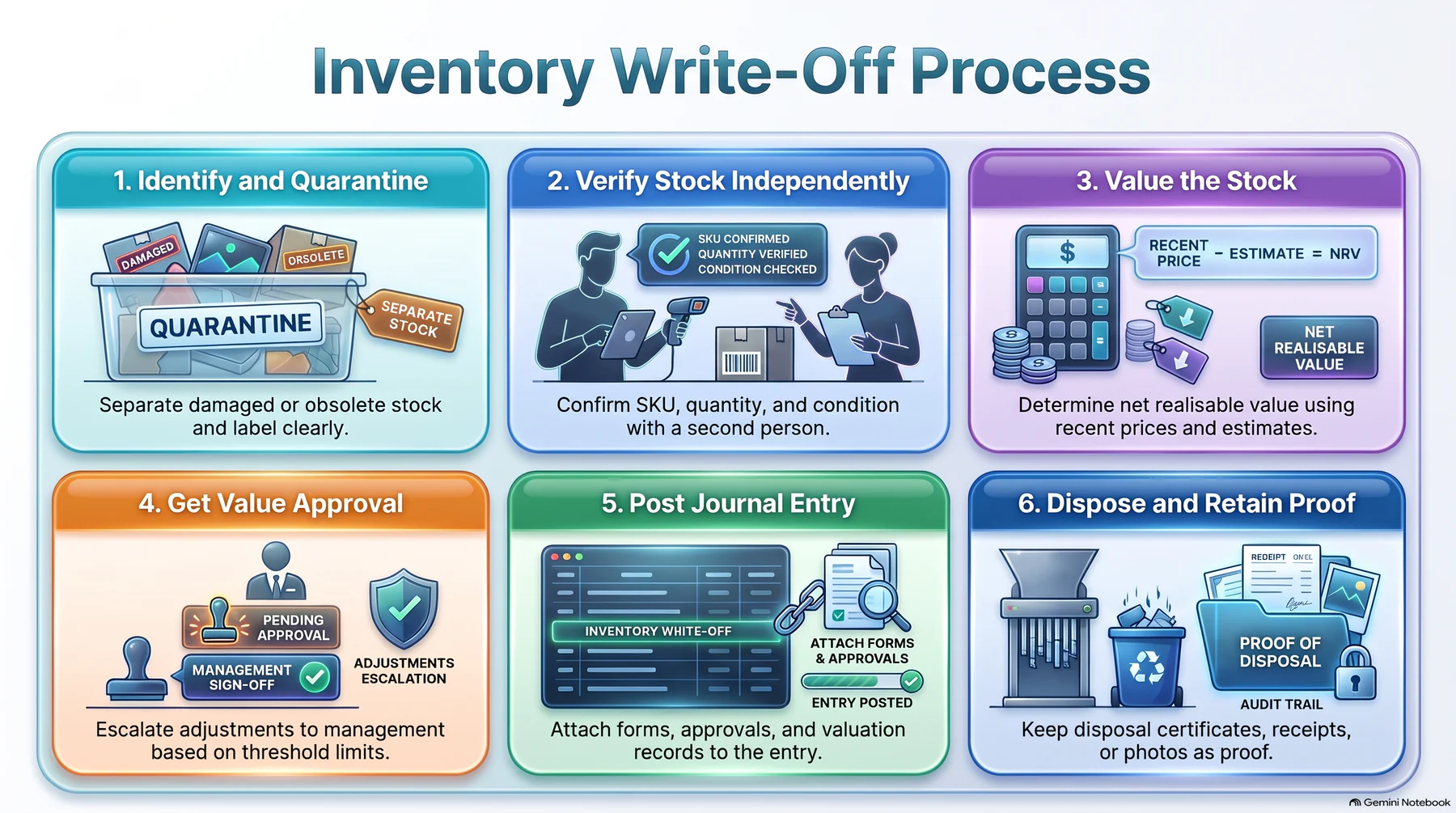
A controlled write-off process protects the business from inaccurate records, unauthorised adjustments and unsupported tax claims.
1. Identify and quarantine affected stock
Separate damaged, expired, obsolete, or disputed goods from saleable inventory and label them clearly as pending inspection or disposal.
2. Verify quantity and condition with a second person
Independent verification should confirm the SKU, batch or serial number, quantity, unit cost, location, condition, reason for adjustment, and estimated recoverable value.
3. Value the stock at net realisable value or zero
Decide whether the goods should remain at cost, be written down to NRV, or be written off completely. Use recent selling prices, repair estimates, supplier credits, and disposal quotes as evidence.
4. Get approval based on value thresholds
Set approval levels according to the value and cause of the loss. High-value, unusual, repeated, or suspected fraudulent adjustments should be escalated to finance management or a director.
5. Post the journal entry with supporting documents
The accounting entry should reference the write-off form, stock-count report, approval record, valuation calculation, disposal evidence, and any insurance or supplier documents.
6. Dispose of the stock and keep proof
Keep disposal certificates, collection receipts, photographs, authorised sign-offs, or other evidence showing that the goods were destroyed, recycled, returned, or otherwise disposed of.
Inventory Write-Off in Singapore: Accounting, Tax and GST
Singapore businesses should consider accounting standards, corporate tax evidence and GST requirements when recording and disposing of inventory.
1. Lower of cost and net realisable value under SFRS(I) 1-2
SFRS(I) 1-2 requires inventory to be measured at the lower of cost and NRV. Cost may include purchase costs, conversion costs, and other costs required to bring inventory to its present location and condition.
2. Corporate tax deduction and documentation
Inventory obsolescence may be deductible when it is a genuine business expense supported by appropriate evidence. Businesses should not assume that every accounting provision is automatically tax deductible.
3. GST considerations for goods disposed of or destroyed
GST treatment depends on whether the goods retain market value and whether input tax was claimed. Where obsolete goods have no market value, output tax may not be required if the relevant IRAS conditions are met and disposal evidence is retained.
How to Reduce Inventory Write-Offs
Preventing write-offs requires earlier action across purchasing, warehousing, stock counting and supplier management.
1. Improve demand forecasting and order sizes
Use historical sales, seasonality, promotions, supplier lead times, minimum order quantities, and open orders to set more accurate purchasing levels.
2. Keep real-time stock visibility across locations
A central system should show available, reserved, in-transit, damaged, quarantined, and branch-level stock to prevent duplicate purchasing and unrecorded transfers.
3. Review ageing and turnover reports every month
Monthly reviews should identify products with no movement, approaching expiry, low turnover, high value, or repeated adjustments.
4. Run regular cycle counts
Count high-value, fast-moving, and high-risk items more frequently. Investigate differences by product, location, employee, shift, and transaction type.
5. Negotiate flexible supplier terms and return rights
Supplier return windows, smaller minimum order quantities, consignment stock, buy-back arrangements, and product exchange rights can reduce the cost of excess or defective stock.
Using Inventory Management Software to Control Write-Offs
Inventory management software can connect these controls and provide timely evidence before stock becomes unusable.
1. Track stock in real time across warehouses
Integrated software provides a single view of stock across warehouses, branches, retail outlets, and goods in transit.
2. Flag slow-moving and ageing items early
Automated alerts can identify products approaching expiry, below target turnover, held beyond a defined age, or repeatedly adjusted.
3. Automate write-off approval workflows
Workflows can route adjustments to the correct approver based on value, warehouse, reason code, product category, and employee role.
4. Keep audit trails for adjustments and disposals
The system should record who created and approved the adjustment, what changed, when it changed, why it changed, and which documents support it.
5. Connect inventory, purchasing and accounting
Connecting these functions helps businesses link purchase costs, stock movements, sales demand, inventory valuation, write-offs, expenses, and supplier claims.
Conclusion
Inventory write-offs help Singapore businesses present accurate stock values and financial results when goods lose their recoverable value. Businesses should distinguish complete write-offs from write-downs and shrinkage, then follow a documented process covering inspection, approval, journal entries, disposal, tax evidence and GST review.
HashMicro can help your business improve inventory visibility, automate stock controls and connect inventory processes with purchasing and accounting. Request a free consultation to discuss your inventory management requirements.

Frequently Asked Questions About Inventory Write-Offs
An inventory write-off removes stock from the accounting records when it has no recoverable value because it is expired, damaged, obsolete, lost, stolen or destroyed.
A write-off removes the full value of unusable inventory. A write-down reduces inventory to its net realisable value when the stock can still be sold or used at a lower value.
The usual direct entry is: Dr Inventory write-off expense and Cr Inventory. The amount equals the carrying value of the inventory being removed.
Stock obsolescence and certain specific provisions may be deductible, subject to Singapore tax rules and sufficient supporting evidence. The deduction is not automatic.
Common causes include obsolescence, expiry, physical damage, theft, misplaced stock, counting errors, poor record-keeping and inaccurate demand forecasts.
Businesses can improve demand forecasting, review ageing reports, run cycle counts, use expiry alerts, negotiate supplier return rights and strengthen warehouse controls.
It tracks stock across locations, identifies ageing products, monitors expiry dates, supports approval workflows, maintains audit trails and connects inventory data with purchasing and accounting.