











 Limited to 100 registrants


Receiving goods is one of the first activities that determines how accurately a warehouse manages its inventory. When deliveries are not checked, recorded, or stored properly, businesses may face stock discrepancies, misplaced products, and delays in order fulfilment.
A structured warehouse receiving process helps warehouse teams verify incoming goods, identify delivery issues, and maintain accurate inventory records.
By following consistent procedures, businesses can improve stock visibility, reduce receiving errors, and ensure goods are ready for their next stage of operation.
Key Takeaways
Understand the key steps in the warehouse receiving process from delivery preparation to putaway.
Follow a practical warehouse receiving checklist to improve accuracy and prevent receiving errors.
Discover how a WMS improves warehouse receiving operations through automation and inventory tracking.

What Is the Warehouse Receiving Process?

The warehouse receiving process refers to the activities involved in accepting, checking, recording, and storing goods delivered to a warehouse. It begins before a shipment arrives and continues until the received inventory is verified and transferred to its designated storage location or next operational stage.
This process connects purchasing, suppliers, warehouse operations, and inventory management. Warehouse staff must confirm that delivered products match the purchase order (PO), inspect their condition, and record the quantities received. Any differences must be documented and addressed before the goods become available for use or sale.
An effective receiving process helps businesses maintain inventory accuracy and avoid unnecessary operational costs. It also provides reliable records of incoming stock, making it easier to trace discrepancies and coordinate with suppliers when delivery issues occur.
Key Steps in the Warehouse Receiving Process
A consistent receiving workflow allows warehouse teams to handle incoming deliveries systematically. Although procedures may vary depending on the type of goods and warehouse operations, most businesses follow six essential steps.
1. Prepare for Incoming Deliveries
Preparation begins before goods arrive at the warehouse. Purchasing and warehouse teams should coordinate with suppliers to confirm delivery schedules, expected quantities, product details, and receiving requirements. An advance shipping notice (ASN) can provide shipment information in advance, allowing staff to arrange dock appointments, allocate unloading equipment, and prepare sufficient storage space.
2. Check Delivery Documents and Unload Goods
When a shipment arrives, warehouse staff should verify the delivery order, packing list, and purchase order before unloading. They should also inspect vehicle seals and external packaging for visible damage or signs of tampering. For imported shipments in Singapore, additional customs documentation and permits may be required depending on the goods and applicable import requirements. Any irregularities should be recorded before unloading proceeds.
3. Count and Inspect Received Goods
After unloading, warehouse staff must compare physical shipments against the quantities and product details stated in the receiving documents. Full counting involves checking every item, while sampling examines selected portions of a shipment to reduce inspection time. Staff should also inspect product conditions, packaging, SKUs, lot numbers, serial numbers, and expiry dates where applicable, separating damaged or questionable goods from accepted inventory.
4. Record Received Quantities and Verify Inventory
Once counting and inspection are complete, warehouse staff should record the actual quantities received and compare them against the purchase order. Receiving records should include product codes, quantities, supplier details, receipt dates, and inspection results. Any differences should be documented separately, while verified goods can proceed to the inventory system to maintain accurate stock information.
5. Handle Receiving Discrepancies
Receiving discrepancies may involve missing quantities, excess stock, damaged products, or incorrect items. Warehouse teams should determine whether the affected goods should be accepted, held for further inspection, or rejected. Products placed on hold should be moved to a designated quarantine area, while supporting evidence such as photographs and delivery documents should be retained for supplier communication and claims.
6. Stage and Put Away Received Goods
After verification and approval, accepted goods can move to the staging or putaway area. Warehouse staff assign storage locations based on product type, dimensions, storage requirements, stock rotation rules, and available capacity. For example, perishable products may follow first-expired, first-out (FEFO) procedures. Once goods reach their designated locations, staff should confirm the movement in the inventory system.
Warehouse Receiving Methods
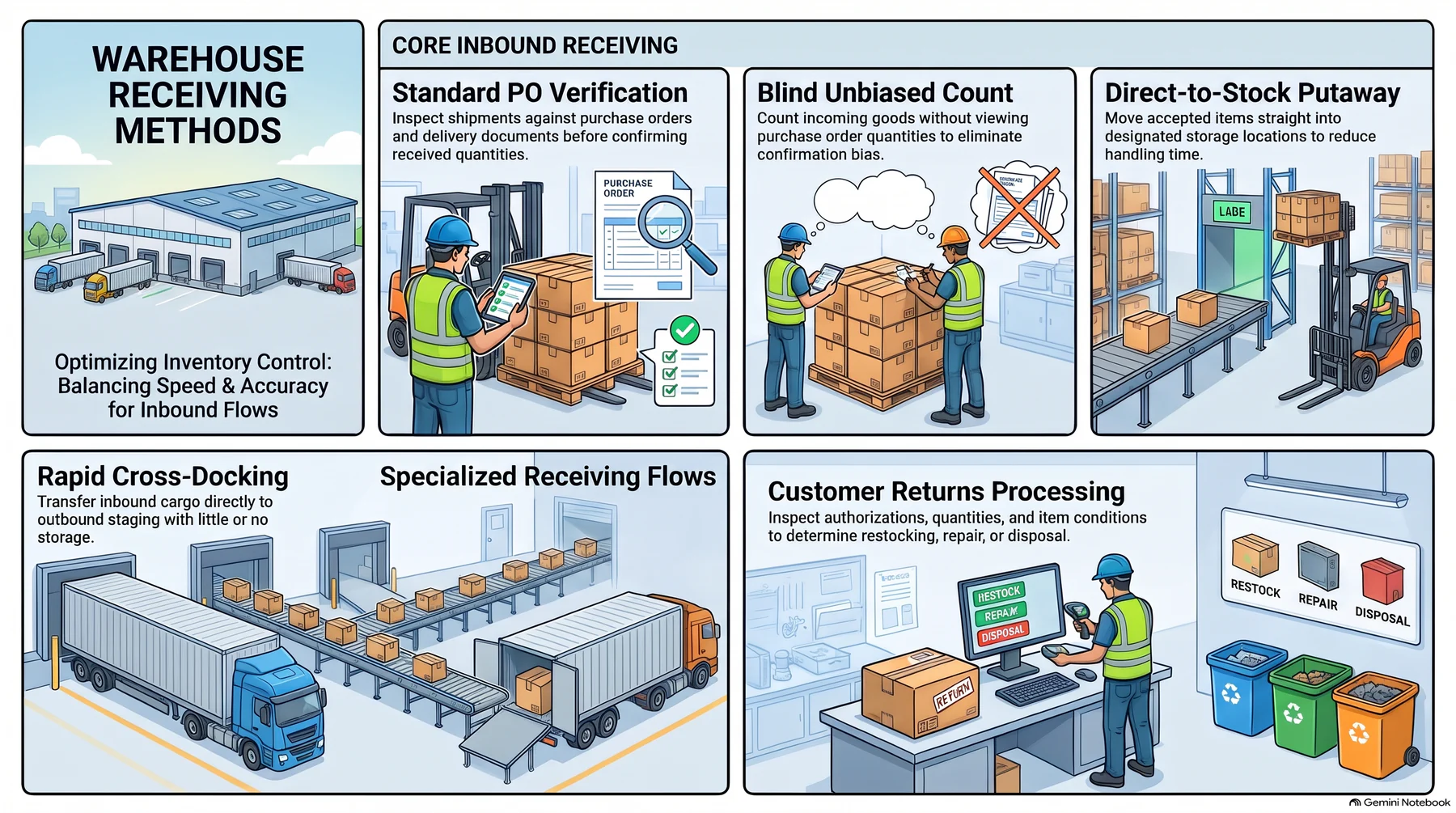
Businesses can use different receiving methods depending on their inventory characteristics, warehouse layout, supplier arrangements, and operational requirements. Understanding these approaches helps warehouse managers select a process that balances receiving speed with inventory accuracy.
1. Standard Receiving
Standard receiving involves checking incoming goods against the purchase order and delivery documents before confirming the received quantities. Warehouse staff inspect the shipment, verify product details, and record discrepancies. This method is suitable for businesses that require consistent verification and documentation, particularly those handling regular supplier deliveries.
2. Blind Receiving
Blind receiving is a method in which warehouse staff count and record physical goods without initially viewing the expected quantities listed in the purchase order. The recorded count is then compared against the order to identify discrepancies. This approach encourages independent verification and can help reduce errors caused by automatically confirming quantities shown in delivery documents.
3. Direct-to-Stock Receiving
Direct-to-stock receiving allows accepted goods to move directly into their designated storage locations after verification. This reduces unnecessary handling and can make inventory available sooner. It works well for predictable deliveries with clear documentation and minimal inspection requirements, provided all necessary receiving checks are completed first.
4. Cross-Docking
Cross-docking involves transferring incoming goods directly from the receiving area to an outbound staging or dispatch area, with little or no long-term storage. For example, a distributor may consolidate newly received products with other shipments for delivery to retail outlets. This method reduces storage requirements and works best when inbound and outbound schedules are well coordinated.
5. Returns Receiving
Returns receiving involves accepting products sent back by customers, retail outlets, or other business locations. Staff must verify return authorisations, product identities, quantities, and physical conditions before deciding whether items can be restocked, repaired, refurbished, or disposed of. Proper documentation helps maintain accurate inventory records and prevents unsuitable products from returning to available stock.
"An efficient warehouse receiving process is the foundation of accurate inventory management. When every delivery is properly checked and recorded, businesses can reduce errors and maintain better control over their stock"
Warehouse Receiving Checklist
A warehouse receiving checklist helps staff follow consistent procedures for every incoming shipment. Businesses can adapt the following checklist based on their product types, supplier requirements, and warehouse procedures.
1. Before Delivery Arrival
Review the purchase order and expected delivery details.
Confirm the supplier and estimated arrival time.
Check the ASN or available shipment information.
Schedule the receiving dock or unloading area.
Prepare the necessary equipment and handling tools.
Ensure sufficient space is available for incoming goods.
2. During Unloading and Document Verification
Confirm the supplier and delivery reference.
Check the delivery order and packing list.
Match shipment details against the purchase order.
Inspect vehicle seals and external packaging where applicable.
Record visible damage or signs of tampering.
Unload goods using appropriate handling procedures.
3. During Counting and Quality Inspection
Verify product descriptions and SKUs.
Count the actual quantities received.
Compare physical quantities with delivery documents.
Inspect packaging and product conditions.
Check lot numbers, serial numbers, and expiry dates where required.
Separate damaged, incorrect, or questionable goods.
4. Before Accepting and Recording Goods
Record actual quantities received.
Document shortages, excess quantities, and damaged items.
Determine whether goods should be accepted, held, or rejected.
Obtain the necessary approval for exceptions.
Update the inventory system with verified information.
Assign storage locations for accepted goods.
Confirm the completion of receiving records.
Common Warehouse Receiving Problems and How to Prevent Them
Receiving errors can affect inventory accuracy, storage efficiency, and order fulfilment. Identifying common problems helps warehouse managers improve procedures and establish preventive controls.
1. Quantity Discrepancies Between Orders and Deliveries
Quantity discrepancies occur when delivered goods differ from the quantities stated in the purchase order or delivery documents. These differences may result from supplier picking errors, incomplete shipments, or incorrect counting. Businesses can prevent recurring issues by verifying physical quantities, using barcode scanning, documenting discrepancies, and reviewing supplier delivery performance.
2. Damaged Goods and Incorrect Shipments
Products may arrive with damaged packaging, broken components, incorrect specifications, or labels that do not match the purchase order. Warehouse staff should inspect incoming goods before accepting them into available inventory and separate unsuitable items for further investigation. Retaining photographs and supporting documents also helps businesses resolve supplier claims and clarify responsibility.
3. Delays During Unloading and Inspection
Receiving delays can occur when multiple deliveries arrive simultaneously, unloading equipment is unavailable, or warehouse staff are not prepared for incoming shipments. Poor dock scheduling and insufficient receiving space can also create congestion. Businesses can reduce these delays by coordinating delivery appointments, reviewing ASN information in advance, and allocating sufficient staff and equipment.
3. Inaccurate Receiving Records and Inventory Updates
Manual data entry, incomplete documentation, and delayed system updates can cause receiving records to differ from actual stock quantities. These errors may lead to inaccurate inventory availability and difficulties during stock reconciliation. Businesses should establish standard recording procedures, use integrated inventory systems, and conduct regular receiving record reviews to identify errors early.
How WMS Improves the Warehouse Receiving Process
A warehouse management system (WMS) helps businesses coordinate receiving activities and maintain more accurate inventory records. Instead of relying entirely on manual documents and spreadsheets, warehouse teams can use a centralised system to record incoming goods, verify quantities, and monitor inventory movements.
1. Barcode Scanning and ASN Matching
Barcode scanning allows warehouse staff to identify products and record quantities by scanning their labels, reducing manual data entry and related errors. When integrated with ASN information, a WMS can help compare expected shipment details with physically received goods and flag differences for further verification.
2. Real-Time Inventory Updates
A WMS can update inventory records as receiving transactions are confirmed, giving warehouse teams better visibility into received quantities and storage locations. This helps purchasing, sales, and warehouse teams work with consistent stock information while reducing delays caused by manual updates. Businesses should configure stock availability rules to prevent goods awaiting inspection from being treated as available prematurely.
3. Lot, Serial Number, and Expiry Date Tracking
A WMS can support the recording and monitoring of lot numbers, serial numbers, and expiry dates during receiving. These details help businesses trace products throughout warehouse operations and identify specific inventory batches when issues arise. For example, food distributors can use expiry information to support FEFO stock rotation, while electronics distributors can track individual products for warranty claims.
4. Receiving Records and Audit Trails
A WMS can maintain receiving records containing shipment quantities, timestamps, product identifiers, and transaction statuses. Depending on the system configuration, it may also record user activities and changes made during receiving. These records help managers investigate discrepancies, review warehouse performance, and support inventory audits.
Warehouse Receiving KPIs to Monitor
Warehouse receiving KPIs help managers evaluate how efficiently and accurately incoming goods are handled. Monitoring these measurements makes it easier to identify operational weaknesses and assess the impact of process improvements.
1. Receiving Accuracy
Receiving accuracy measures how closely the quantities or items recorded during receiving match the actual goods delivered. The formula is: Receiving Accuracy = (Number of Correctly Received Items / Total Items Received) × 100%. A higher percentage indicates more consistent receiving records and can help managers evaluate counting procedures, supplier delivery quality, and barcode scanning effectiveness.
2. Dock-to-Stock Time
Dock-to-stock time measures how long goods take to move from the receiving dock to their designated storage locations and become available in the inventory system. The formula is: Dock-to-Stock Time = Time Inventory Becomes Available − Time Goods Arrive at Receiving Dock. A shorter time generally indicates more efficient receiving and putaway operations, provided necessary inspection procedures are not compromised.
3. Receiving Discrepancy Rate
Receiving discrepancy rate measures the proportion of incoming receipts that contain differences between expected and actual delivery information. The formula is: Receiving Discrepancy Rate = (Number of Receipts with Discrepancies / Total Receipts) × 100%. A lower rate generally indicates more consistent receiving operations, while recurring discrepancies may highlight supplier issues or weaknesses in warehouse verification procedures.
Conclusion
An effective warehouse receiving process provides the foundation for accurate inventory management and efficient warehouse operations. By preparing for deliveries, verifying documents, inspecting goods, recording quantities, and following proper putaway procedures, businesses can reduce receiving errors and maintain better stock visibility.
However, maintaining consistency becomes more challenging as shipment volumes, product varieties, and warehouse activities increase. Implementing a WMS can help businesses automate receiving records, improve inventory visibility, and monitor stock movements more accurately.
With HashMicro's warehouse management system, businesses can streamline warehouse activities and gain better control over inventory operations. Consult with HashMicro's experts for a free demo to explore how warehouse management software can support your receiving and inventory management requirements.
FAQ
Receiving in a warehouse is the process of accepting, inspecting, verifying, and recording goods delivered by suppliers or returned by customers. It ensures that incoming products match the expected quantities and specifications before they are stored or moved to another operational area.
The warehouse receiving process generally involves six steps: preparing for incoming deliveries, checking delivery documents and unloading goods, counting and inspecting products, recording received quantities, handling discrepancies, and staging and putting away accepted goods. Following these steps helps businesses maintain accurate inventory records and reduce receiving errors.
An advance shipping notice (ASN) is an electronic or documented notification sent by a supplier to inform a business about an upcoming shipment. It typically contains product descriptions, quantities, shipment references, and estimated delivery times, allowing warehouse teams to prepare resources and verify incoming goods.
Blind receiving is a method in which warehouse staff record physical quantities without initially viewing the expected quantities in the purchase order. This encourages independent counting and helps reduce the risk of automatically confirming incorrect quantities, making it useful for businesses that need stronger receiving verification controls.
Common warehouse receiving documents include the purchase order (PO), delivery order (DO), packing list, supplier invoice, and advance shipping notice (ASN). For imported shipments, businesses may also need relevant customs permits and supporting import documentation depending on the goods and applicable Singapore import requirements.