








Safety data sheets protect your people, yet many enterprises still scatter them across shared drives, email attachments, and printed binders. MSDS management solves this by treating every sheet as a controlled record with a clear owner, version, and review date. This guide explains how Singapore enterprises can organise MSDS and SDS records, meet audit expectations, and keep chemical information accurate across every site.
We cover the difference between MSDS and SDS, the 16-section document structure, the roles that own each stage of the document lifecycle, and a 15-point checklist your team can apply immediately. We also look at where ERP workflows support chemical data governance, and where specialist judgement still matters.
Key Takeaways
MSDS is a legacy term that many businesses still use, while SDS is the current term in chemical safety documentation under GHS and the SS 586 standard.
A controlled MSDS process links current documents with suppliers, product records, locations, accountable owners, and review evidence.
The WSH Act and the SS 586 standard expect every hazardous chemical to have a current 16-section SDS, with review at least every five years.
Use the 15-point checklist to identify whether your MSDS records are absent, partly controlled, or consistently controlled across operations.
What Is MSDS and How Does It Differ From SDS?
"Many teams still search for MSDS files even when suppliers now issue SDS documents. The safest approach is to treat both terms as part of the same controlled record, while standardising the official register around SDS for GHS and SS 586 alignment."
Before setting up filing rules or review workflows, your team needs a shared understanding of the terminology. The three terms below refer to the same family of documents, but they carry different expectations.
MSDS defined in plain English
An MSDS, or Material Safety Data Sheet, is a document that describes a chemical product's hazards, handling requirements, and emergency measures. The supplier or manufacturer prepares it, and it travels with the product through purchasing, storage, and use. A typical sheet covers first aid measures, fire-fighting guidance, personal protective equipment, and disposal considerations.
MSDS vs SDS vs safety data sheet: terminology comparison
SDS, or safety data sheet, is the current term under the Globally Harmonised System of Classification and Labelling of Chemicals, known as GHS. Singapore applies GHS through the SS 586 standard series, which uses the term safety data sheet. MSDS is the legacy name, so both labels often point to the same document.
| Term | Status | Where you will see it |
|---|---|---|
| MSDS | Legacy term | Older supplier files, informal usage, internal searches |
| SDS | Current GHS term | New supplier documents, SS 586 references |
| Safety data sheet | Full current term | Standards, regulations, audit documents |
For example, a folder of supplier PDFs may mix both labels even when every file describes a current product. The terms matter because naming decides whether people find the document.
Why mixed terminology creates filing and search problems
Mixed naming splits one chemical's records across several folders. A worker searching for "SDS hydrochloric acid" will not find a file named "MSDS hydrochloric acid", even when both sit in the same drive. Duplicates then appear, one stays current, and the other misleads an auditor or a responder. Standardising file names, register entries, and search aliases removes this risk early.
What Information Does an MSDS or SDS Contain?
A sheet is only useful when your team knows its layout. GHS fixes a 16-section structure, so every compliant document follows the same order.
The 16-section structure at a glance
- Identification of the substance and the supplier
- Hazards identification
- Composition and information on ingredients
- First aid measures
- Fire-fighting measures
- Accidental release measures
- Handling and storage
- Exposure controls and personal protection
- Physical and chemical properties
- Stability and reactivity
- Toxicological information
- Ecological information
- Disposal considerations
- Transport information
- Regulatory information
- Other information, including revision details
Sections 1 to 8 guide daily operations, while sections 9 to 16 support planning, transport, and compliance reviews.
Sections operations teams use most
Supervisors and operators rely most on sections 2, 4, 7, and 8. Section 2 summarises the hazards, section 4 guides first aid, section 7 explains safe handling and storage, and section 8 lists exposure limits and PPE. Printing or bookmarking these sections at the point of use saves time during checks and incidents.
Document metadata to track
Track the supplier name, product identifier, revision date, and issue date for every sheet. Add the version number, the sites that use the product, and the next review date. These fields turn a folder of PDFs into a register you can audit, sort, and reconcile against your chemical inventory.
Why Does MSDS Management Matter for Singapore Businesses?
Singapore takes a structured approach to chemical safety, and documentation sits at its centre. The pressures below make controlled records a practical need rather than a paperwork exercise.
Singapore's workplace safety expectations for chemical users and suppliers
The Workplace Safety and Health Act places duties on employers and occupiers to keep workplaces safe, which includes giving workers the information they need to handle chemicals safely. Suppliers share this duty when they provide hazardous substances. The SS 586 standard series applies GHS hazard communication in Singapore, covering labels and the 16-section safety data sheet. Agencies such as MOM and NEA also control specific substances, so documentation expectations can extend beyond one rulebook.
Audit readiness and incident response
During an inspection or a customer audit, the first questions are practical. Can you show a current sheet for every chemical on site? Can responders reach first aid and fire-fighting guidance within minutes? Controlled records answer both questions without a scramble through inboxes and cabinets. ISO 45001 and ISO 14001 audits apply the same pressure on document control.
The risk of outdated sheets: the 5-year review cycle and revision triggers
SS 586 aligns with the GHS expectation that suppliers review each sheet at least every five years. Revisions can also come sooner: a formulation change, new hazard data, or a regulatory update. A sheet from 2014 may describe a product that no longer exists, and relying on it during an incident creates real risk. Set review reminders so outdated sheets surface before an inspector finds them.
Good practice vs legal obligation: what depends on your substance and industry
Exact obligations depend on what you store and which industry you operate in. The WSH Act sets general duties for all workplaces, while subsidiary regulations and agency licensing add substance-specific requirements for flammables, toxics, and environmentally hazardous chemicals. Treat a complete, current SDS set as the baseline of good practice, then confirm any extra duties for your substances with your EHS adviser.
Who Should Own Each Part of the MSDS Lifecycle?
MSDS records fail when everyone assumes someone else maintains them. Assigning each stage to a function keeps the lifecycle moving.
Procurement: collecting SDS from suppliers
Procurement requests the SDS at purchase order stage, before goods arrive. Making the sheet a condition of delivery prevents the common gap where stock reaches the warehouse first and paperwork follows weeks later. Buyers should also record the supplier contact for future revision requests.
Warehouse and operations: availability at point of use
Warehouse teams and operators need the sheet where they handle the product, not only in a head office drive. Options include printed sets at storage areas, QR codes that open the current version, and terminals connected to the register. The test is simple: a worker should reach the right sheet in under a minute.
EHS and compliance: review and approval
EHS verifies each new sheet against the 16-section structure, checks that product identifiers match the inventory, and approves it for use. The function also tracks review dates, requests updated versions from suppliers, and retires superseded copies. Clear approval authority prevents unofficial edits.
Finance and IT: system access and record retention
Finance often holds the supplier and purchasing data that links each chemical to its vendor, while IT manages access rights, backups, and retention rules. Together they keep records available for the period your audit and retention policies require, and they control who can edit or delete a sheet.
How Should Enterprises Organise and Maintain MSDS Records?

Structure decides whether your records stay usable as the inventory grows. The practices below work for a single site and scale across a regional network.
Build one controlled record per chemical, not scattered folders
Create one master record for each product from each supplier, then attach every site to that record instead of copying files into local folders. One controlled record means one current version, one review date, and one clear owner. Site lists inside the record show exactly where the product appears.
Version control, review dates and approval workflow
Give each sheet a version number, record its issue and revision dates, and set the next review before the five-year mark. Route new versions through EHS approval, then replace the visible copy in one action. Superseded versions move to an archive that auditors can still reach, so history stays traceable.
Site-level availability, access permissions and audit trail
Permissions should follow roles: operations read and retrieve, EHS edits and approves, IT administers access. Every view, edit, and download lands in an audit trail, which turns inspection questions into a quick report instead of an investigation.
Handling legacy MSDS files during the transition to SDS
Old-format sheets deserve a deliberate transition, not a mass deletion. Flag each legacy file, request a GHS-format SDS from the supplier, and keep the old sheet archived until the replacement passes review. Communicate the change to sites so no one prints the outdated version.
15-Point MSDS Management Checklist for Enterprise Operations
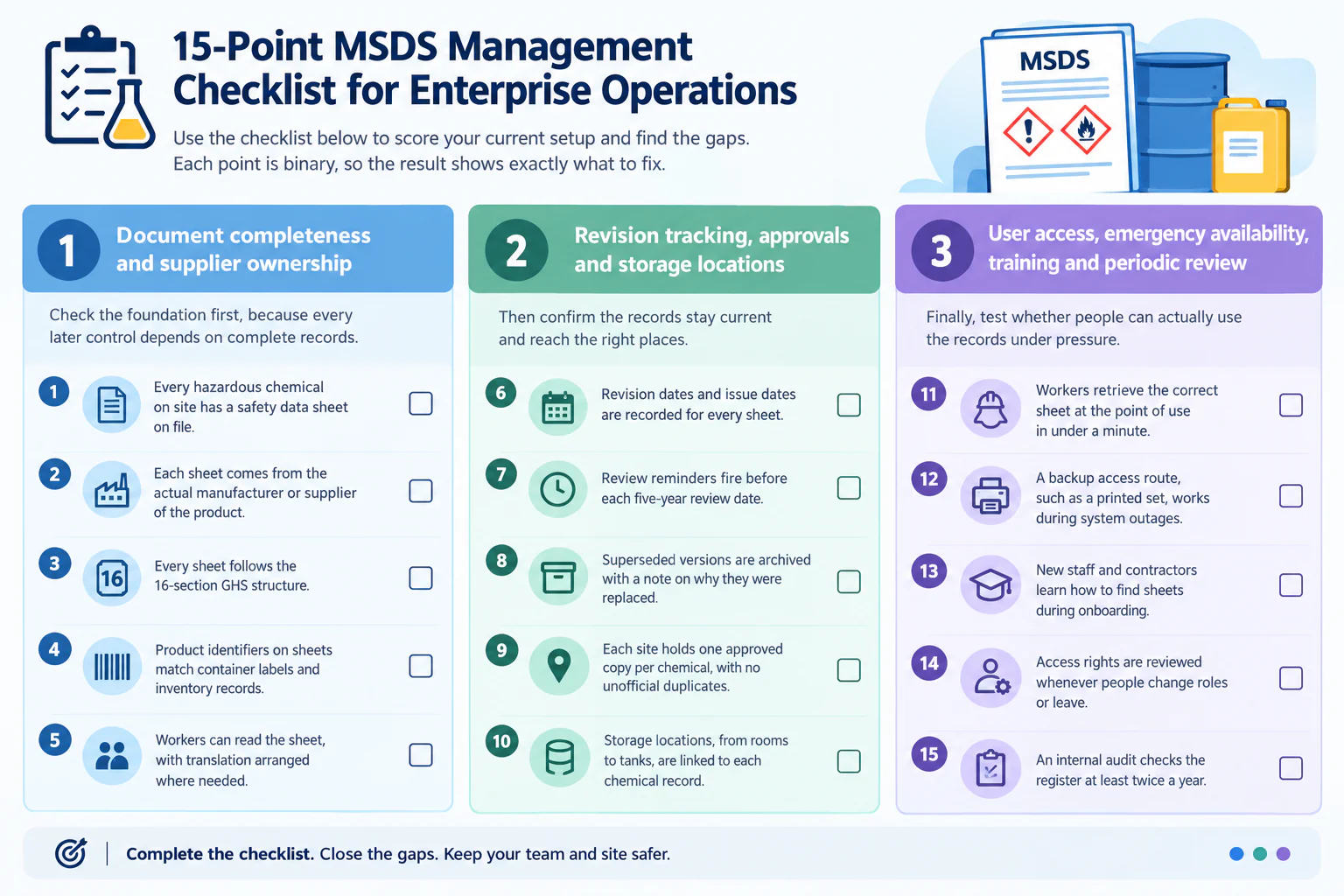
Use the checklist below to score your current setup and find the gaps. Each point is binary, so the result shows exactly what to fix.
Document completeness and supplier ownership
Check the foundation first, because every later control depends on complete records.
- Every hazardous chemical on site has a safety data sheet on file.
- Each sheet comes from the actual manufacturer or supplier of the product.
- Every sheet follows the 16-section GHS structure.
- Product identifiers on sheets match container labels and inventory records.
- Workers can read the sheet, with translation arranged where needed.
Revision tracking, approvals and storage locations
Then confirm the records stay current and reach the right places.
- Revision dates and issue dates are recorded for every sheet.
- Review reminders fire before each five-year review date.
- Superseded versions are archived with a note on why they were replaced.
- Each site holds one approved copy per chemical, with no unofficial duplicates.
- Storage locations, from rooms to tanks, are linked to each chemical record.
User access, emergency availability, training and periodic review
Finally, test whether people can actually use the records under pressure.
- Workers retrieve the correct sheet at the point of use in under a minute.
- A backup access route, such as a printed set, works during system outages.
- New staff and contractors learn how to find sheets during onboarding.
- Access rights are reviewed whenever people change roles or leave.
- An internal audit checks the register at least twice a year.
Where Can ERP and Chemical Data Workflows Support Governance?
Chemical data already flows through your purchasing, inventory, and warehouse processes, which makes an ERP-connected approach practical. The workflows below connect safety documents to operational records.
Linking safety data sheets to item and supplier master data
Attach the current SDS to the item record, then link it to the supplier who provides the product. Purchasing can then check that a sheet exists before the first order, and new supplier versions flow to one place instead of many inboxes.
Connecting SDS records to purchasing, inventory and warehouse locations
Goods receipt checks can prompt the team when a chemical arrives without a sheet on file. Location links show which warehouse, room, or tank holds each product, so availability at the point of use stops depending on memory.
Batch, expiry and quantity tracking for chemical stock
Batch numbers, expiry dates, and quantities complete the picture for chemicals with shelf lives. Teams can apply first expiry, first out allocation, plan disposal before stock degrades, and trace which batches sit in which locations when a supplier revises a sheet.
What ERP does not replace
An ERP keeps records structured and connected, but it does not author SDS documents or interpret regulations. Suppliers produce the sheets, and EHS professionals judge hazards, exposure controls, and compliance duties. Treat the ERP as the connective layer between documents, stock, and people.
The right digital tools can make this process easier by keeping safety information organized, connected, and accessible. This is where AI-powered tools like Hashy AI can add value.






How Do You Choose an MSDS Management Approach?
The right approach depends on your inventory size, headcount, and how often sheets change. Compare the three common models below, then test your shortlist against real retrieval scenarios.
Manual folders and spreadsheets: when they still work
A shared drive and a spreadsheet can work for a small company with a short chemical list and few changes. The model breaks down as sites, products, and staff multiply, because nothing enforces versions, review dates, or access control.
Dedicated EHS or SDS management platforms
Dedicated platforms manage large libraries, supplier requests, and compliance reporting in one place. They suit enterprises with hundreds of substances or strict audit demands. The trade-off is another system to fund and maintain, separate from daily operations.
ERP-connected approach: where it fits
An ERP-connected approach fits enterprises that already run purchasing, inventory, and warehouse processes in one system. Safety documents attach to the items, suppliers, and locations teams use daily, so governance rides on existing workflows instead of a parallel process.
Questions to ask before you decide
Answer these before committing to a model:
- How long does retrieving one sheet take today?
- Which team requests updated sheets from suppliers, and how fast do they arrive?
- Can every site reach a current sheet during an outage?
- What will an auditor ask for, and how quickly can we produce it?
- Which system already holds our item, supplier, and location data?
Conclusion
MSDS management turns scattered safety documents into controlled records that protect workers and satisfy auditors. The essentials stay consistent: one record per chemical, clear ownership across procurement, operations, EHS, finance, and IT, version control with five-year reviews, and availability at the point of use. Enterprises that connect these records to purchasing, inventory, and warehouse data gain a governance layer that grows with the business.
HashMicro's ERP connects chemical inventory, batch and expiry tracking, supplier records, and document storage in one system, giving Singapore enterprises a practical base for MSDS governance.Book a free demo to see how your chemical records, stock, and purchasing workflows can work together.
FAQ
Suppliers review sheets at least every five years under GHS-aligned practice, and sooner when a formulation changes or new hazard information appears. Users should check the revision date on each sheet and request a current version when the five-year mark passes or the product changes.
SDS is the current term under GHS and SS 586, while MSDS remains widely understood as the legacy name. Keep MSDS as a search alias so older references still find the record, but label controlled documents and registers as SDS to match audits and supplier documents.
The supplier or manufacturer prepares and provides the sheet when it supplies the hazardous chemical. The user then keeps the current version available at the workplace, maintains worker access, and requests updates when revisions appear.
Request a current sheet from the supplier in writing and record the request date. Until the new version arrives, restrict use where practical and brief supervisors on the gap. If the supplier cannot provide a sheet, treat that as a sourcing risk and escalate through procurement.
For many enterprises, ERP document management linked to items, suppliers, and locations covers storage, access control, and audit trails. A dedicated EHS platform adds value when you need authoring support, regulatory content libraries, or chemical risk assessments. Match the choice to your inventory size and audit obligations.