








Purchase order software cost in Singapore depends on more than a monthly subscription. Your budget also covers implementation, integrations, training, support and the internal time needed to change purchasing habits.
A low headline fee can rise when you add users, approval levels, purchase order volume or accounting connections. Compare the full cost over three years so your estimate reflects how the system will operate after launch.
This article explains the main cost layers and the factors that move them. For businesses comparing purchase order software Singapore options, the checks below keep the shortlist focused.
Key Takeaways
Purchase order software records requests, approvals, supplier orders, receipts and invoice checks in one traceable workflow.
Purchase order software cost in Singapore includes subscriptions, implementation, integrations, training, support and internal labour.
Purchase order system cost depends on users, order volume, approval complexity and accounting or supplier integrations.
Total purchase order software cost is best calculated over three years, including one-time, recurring, variable and internal labour costs.
What Is Purchase Order Software?
Purchase order software records each request, approval, supplier order and receipt in one workflow. It replaces scattered spreadsheets and inboxes with a traceable record of what was requested, authorised and received.
Most systems connect purchase requisitions to purchase orders, goods received notes and invoice checks. That sequence helps finance confirm that the quantity, price and supplier match before payment.
The software may sit inside an ERP, connect to accounting software or run as a standalone procurement software platform. A Singapore procurement buying guide compares these models by workflow fit, integration effort and support needs.
"Purchase order software records every request, approval and receipt in one workflow, so its cost is best judged by the spending control it provides, not by the subscription fee alone."
How Much Does Purchase Order Software Cost in Singapore?
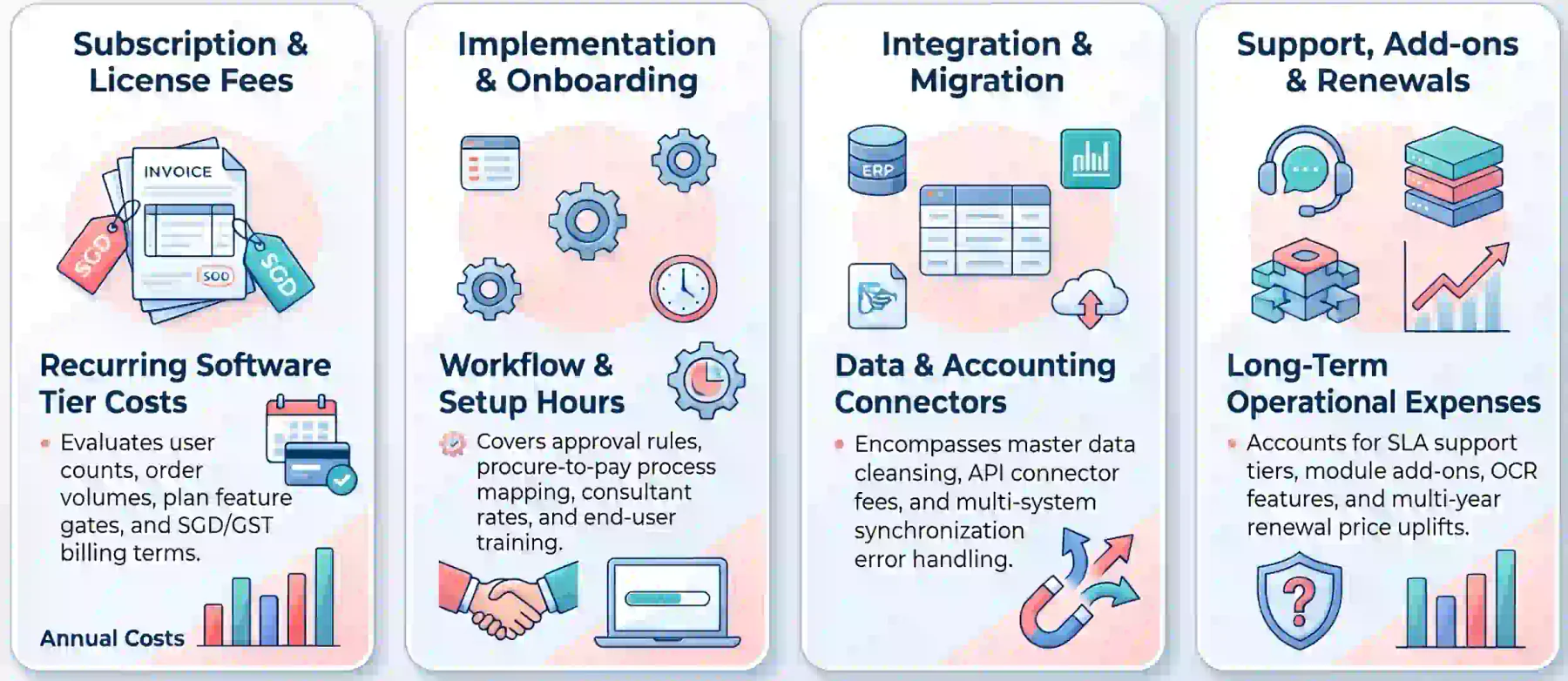
The total purchase order system cost has recurring and one-time components. Separate them in your budget so a low subscription does not hide the work required to launch and maintain the workflow.
1. Subscription and licence fees
Subscription fees are the visible part of purchase order software pricing. They may follow a flat account fee, user count, order volume or plan tier, while quote-only models can apply to tailored workflows.
Compare the plan that includes your required features, rather than the cheapest entry tier. A purchase order cost overview notes that purchase orders and accounting connections can sit behind higher tiers.
Ask for the quote in SGD and confirm whether GST is included. Record the billing basis, minimum term, annual uplift and charges for extra users or purchase orders.
2. Implementation and onboarding costs
Implementation covers process mapping, configuration, roles, approval thresholds and testing. It can be modest for a standard workflow, but complex purchasing rules increase consultant hours.
Onboarding also takes staff time. Buyers, requesters, approvers and finance users need training, practice records and a clear cutover date so old spreadsheets do not run in parallel for months.
A Singapore SME buying checklist should test the full procure-to-pay flow from request to payment. That includes quotes, purchase orders, goods received notes and invoice matching.
A purchase order buyer's guide links software value to approval control, committed spend and invoice visibility. Use those outcomes when estimating payback, not just admin hours.
3. Integration, data migration and training costs
Integration and migration costs arise when the system must exchange suppliers, items, tax codes, stock data or invoices with accounting and inventory tools. The effort depends on data quality and system count.
Clean supplier and item masters before migration. Missing details required on a GST tax invoice, duplicate records and inconsistent units can create costly rework.
Ask whether the vendor includes an API, standard connector, import templates or paid integration work. Also confirm who owns error handling when a synchronisation fails.
4. Support, add-ons and renewal costs
Support may include email, chat, phone assistance, account management and upgrades. Check response targets and whether help is included or charged separately.
Add-ons can cover approval flows, document storage, OCR, supplier portals, analytics or extra warehouses. Renewal costs may rise when usage crosses a tier or an introductory contract ends.
The per-user pricing model shows how costs can scale as teams expand, while other tools charge by order volume or modules. Use these models to ask how your own costs would change at 12 and 36 months.
What Drives Purchase Order System Cost?
Two businesses can choose the same product and pay different totals. The main difference comes from workflow scale, the control level required and the systems that must share data.
Estimate each driver using current monthly records and expected growth. This makes your purchase order automation software cost easier to defend than a budget based only on a vendor's starting plan.
| Cost driver | Questions to quantify | Why it changes cost |
|---|---|---|
| Users and roles | Who requests, approves, buys and receives? | Licences and access levels may vary |
| Purchase order volume | How many orders and amendments occur monthly? | Transaction tiers can increase with usage |
| Approval workflows | How many thresholds and exception routes apply? | Complex rules require more setup and testing |
| System connections | Which accounting, inventory or supplier tools must sync? | Each interface adds mapping and monitoring work |
1. Number and type of users
More users can increase licence fees, but user type matters as well. Occasional requesters may need limited access, while buyers, approvers and finance staff need broader permissions.
Map users by role before requesting quotes. Ask whether the vendor charges for view-only access, supplier access, mobile approvals or separate legal entities.
2. Monthly purchase order volume
Monthly purchase order volume affects plans that price by transactions or document limits. Seasonal peaks can push a business into a higher band even when the annual average looks low.
Use at least 12 months of order history where possible. Include blanket orders, amendments, cancellations and purchase requests if the vendor counts them separately.
3. Approval workflows and automation needs
Approval workflows add cost when they require multiple levels, spend thresholds, cost centres or exception routing. They also add implementation effort because each path needs testing.
Start with the approvals that protect budget and compliance. A simple route for low-value buys and a stronger route for high-value purchases can control cost without removing oversight.
4. Connections to accounting and supplier systems
Connections to accounting software, inventory, payroll or supplier portals can improve data accuracy, but each interface adds mapping, testing and monitoring. Older systems may need custom work.
Confirm which records must sync and how often. Ask whether the system connects to the InvoiceNow network, and who handles failed imports and changes to GST or chart-of-accounts data.
How Do You Calculate the Total Cost?
Use one time horizon for every quote, including the work your team must do. A three-year view makes setup fees, recurring charges and likely growth easier to compare.
1. A three-year total cost formula
Add licence fees, setup, integration, migration, training, support and internal labour. Then include expected charges for extra users, orders or modules during the same period.
Use this formula: three-year cost = one-time costs + 36 months of recurring costs + expected variable charges. Keep GST treatment consistent across quotes so the figures remain comparable.
2. Worked example for a Singapore business
Consider a Singapore company creating 120 purchase orders each month. The figures below are illustrative assumptions in SGD, not a vendor quote or a market average.
| Cost item | Calculation | Three-year cost |
|---|---|---|
| Software subscription | S$450 × 36 months | S$16,200 |
| Implementation | One-time fee | S$3,000 |
| Integration and migration | One-time fee | S$2,400 |
| Training | One-time fee | S$900 |
| Support | S$120 × 36 months | S$4,320 |
| Internal setup labour | Estimated staff time | S$1,500 |
| Total | All cost items | S$28,320 |
The subscription accounts for S$16,200 of the S$28,320 total. The remaining S$12,120, or about 43% of the full cost, sits outside the subscription.
3. Cost per purchase order and break-even point
At 120 orders a month, the company would process 4,320 orders in three years. Dividing S$28,320 by that volume gives an estimated software cost of S$6.56 per order.
Suppose automation saves 15 minutes per order and staff time costs S$32 an hour. That is S$8 saved per order, or S$34,560 across 4,320 orders, before any error savings.
On those assumptions, the three-year net benefit is S$6,240. The break-even volume is about 99 orders a month, but lower adoption or shorter time savings would change the result.
When Is Purchase Order Automation Software Worth the Cost?
Automation makes financial sense when it removes enough repeat work or costly mistakes to cover its full cost. Test the case against your current process before committing to a plan.
1. Compare software costs with manual processing
Measure how long staff spend preparing orders, chasing approvals and correcting invoice mismatches. Include receiving and finance work, since the purchase order is only one part of the process.
Apply an hourly labour cost to time that the system can realistically save. Count it as a cash saving only if staffing costs will fall; otherwise, record the work that freed time can support.
2. Measure time saved and errors avoided
Track a sample of recent orders from request to invoice. Record approval delays, duplicate orders, incorrect quantities and time spent resolving supplier questions.
Then run the same sample through a product demo or pilot. Compare the results and include any remaining manual checks, since software rarely removes every exception.
3. Decide which workflows need automation
Prioritise approval routing, order creation or invoice matching where delays and rework are measurable. A small team with few orders may need only basic controls at first.
For larger teams, automate frequent, repeatable work before adding complex rules. This keeps implementation costs aligned with the benefits you can verify.
How Can Inventory Software Improve Purchase Order Cost Control?
Inventory management software can connect purchasing decisions to stock levels and goods received. That visibility helps buyers avoid ordering stock already on hand and notice short deliveries before invoice approval.
It can also show item history and reorder needs in one place when the systems share reliable data. Ask a vendor to demonstrate your own stock and ordering workflow before adding this capability to the budget.
For businesses considering HashMicro inventory software, include the inventory and purchasing connection in the demo. Compare the combined cost with the time and errors your team expects to save.
Purchase order costs are easier to control when requests, approvals, receipts and invoices stay connected. Hashy AI helps teams review those records and spot exceptions before payment.






What Should Singapore Businesses Check Before Signing?
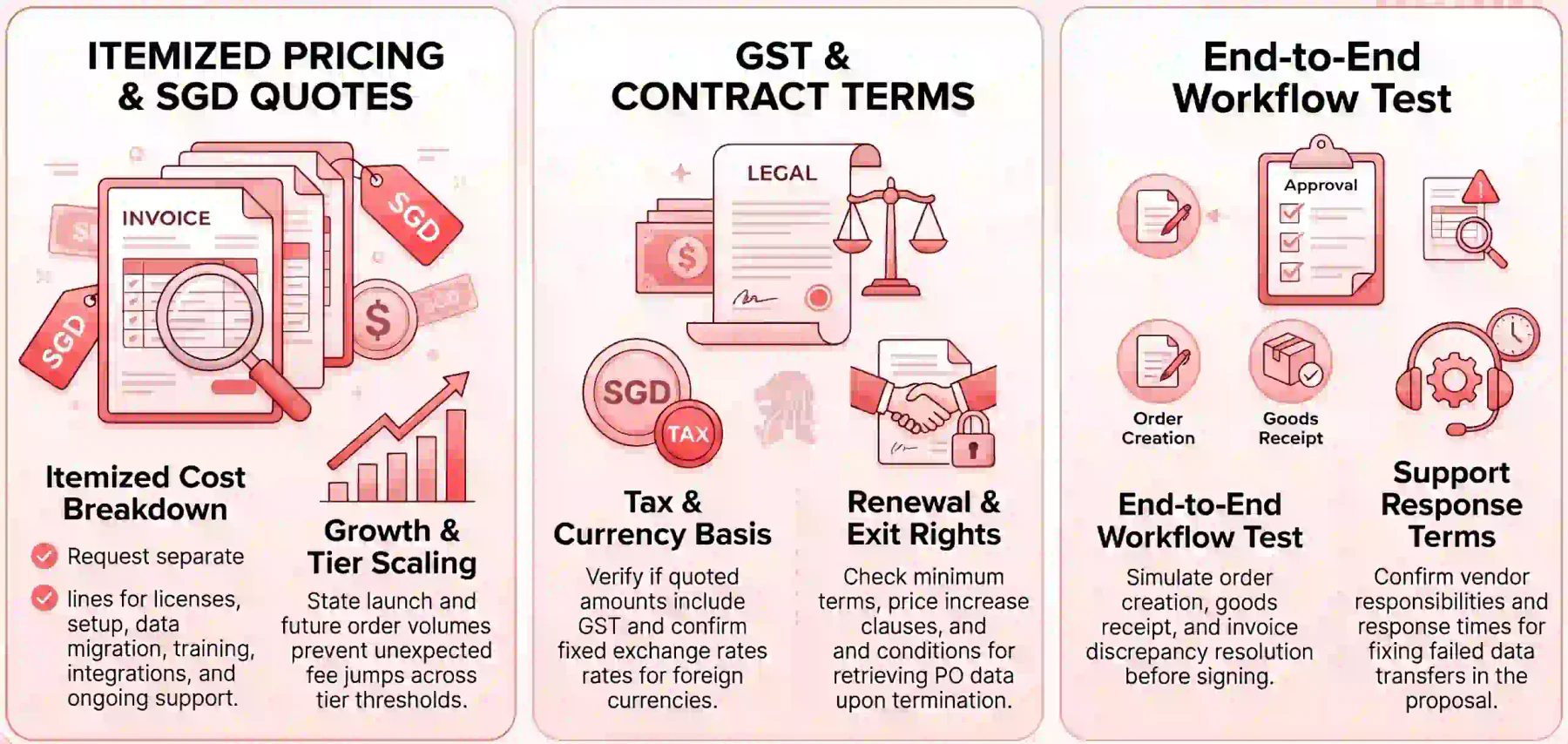
Use the same scenario with every shortlisted vendor so the quotes are comparable. Give each supplier your user roles, monthly order volume, approval rules and required connections.
1. Request an itemised quote in SGD
Ask for separate lines for licences, setup, migration, training, integrations and support. Request the price of added users, orders, entities and modules over the contract term.
State your expected order volume at launch and after growth. A quote built around the current minimum may become misleading if the next tier starts soon after rollout.
2. Confirm GST, contract terms and renewal charges
Check whether each quoted amount includes GST and whether any foreign currency fee is converted at a fixed rate. Compare the same tax basis across all vendors.
Review the minimum term, renewal notice, price increase clauses and exit conditions. Confirm what happens to your purchase order data and documents if the contract ends.
3. Test purchasing, receiving and accounting workflows
Run a sample request through approval, purchase order creation and goods receipt. Then test an invoice with a quantity or price difference to see how staff resolve it.
Check who fixes failed data transfers and how quickly support responds. Ask the vendor to include these responsibilities and any related fees in the proposal.
Conclusion
Purchase order software cost includes more than the subscription. Setup, integrations, training, support and staff time can change the three-year budget substantially.
Compare full quotes in SGD and calculate cost per order against the time and errors you can save. A short pilot can then test approvals, GST handling and accounting connections before you commit.
To learn more about the costs of purchase order software, you can book a free consultation with our team today and learn what's best for your business.
Frequently Asked Questions
There is no single Singapore price because vendors bill by users, orders, modules or a tailored quote. Add implementation, integration and support to the subscription before comparing totals.
Common exclusions include setup, migration, custom connections, training and premium support. Ask the vendor to list inclusions and exclusions in writing before signing.
Costs can rise when you add users, legal entities, modules or monthly orders. Check tier thresholds and renewal terms against your expected growth, not just current usage.
It can be worthwhile when repeat orders, approvals or invoice checks use enough staff time. Measure your current process first, then compare the savings with the full cost.
Divide the full cost over a chosen period by the orders processed in that period. Include setup and support, then compare the result with your current processing costs.