






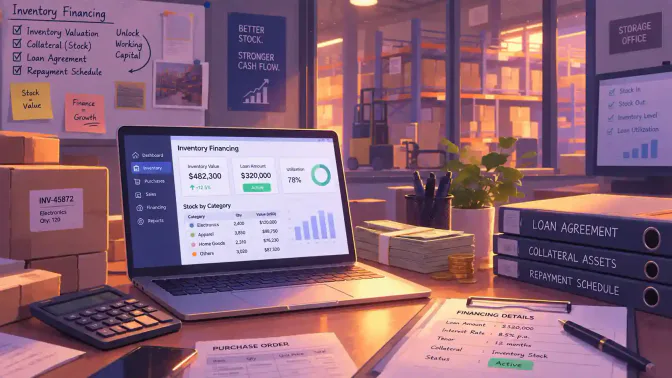
Inventory financing lets a business borrow against the stock it already owns or is about to buy. The inventory itself acts as collateral, so cash stays free for payroll, rent and supplier deposits.
A lender appraises your stock, advances a share of that value, then collects as the goods sell. Advance rates usually sit between 20 and 80 per cent, depending on how quickly the inventory turns.
For importers and distributors in Singapore, that timing gap decides whether a peak season turns profitable. This article covers how the facility works, what it costs, and when it beats the alternatives.
Key Takeaways
Inventory financing is short term funding secured against stock you own or are buying, advancing part of appraised value and repaid as the goods convert into sales.
How inventory financing works starts with an appraised borrowing base, then an advance rate of 20 to 80 per cent, drawdowns against shipments and repayment from sales.
Inventory financing for Singapore businesses runs through banks, fintech lenders, floor stock financiers and the Enterprise Financing Scheme Trade Loan via a participating bank.
Use inventory management software to strengthen your borrowing base for accurate counts, continuous valuation, and ready turnover and ageing reports that lift your advance rate.
What Is Inventory Financing?
Lenders group this facility under asset-based lending, because the loan rests on what you own rather than on forecast profit. That single distinction shapes the pricing, the paperwork, and the reporting.
Inventory financing is short-term funding secured against raw materials, work in progress, or finished goods. You borrow a percentage of appraised value and repay as the stock converts into sales.
Qualification also works differently from a term loan. A lender weighs how marketable your stock is rather than your trading history alone, which opens the door to younger companies.
Facilities arrive as either a one-off loan or a revolving line you draw on repeatedly. Both leave ownership of the business intact, since no equity changes hands at any point.
"Inventory financing works best when stock turns faster than the loan term, because the facility is repaid by sales rather than by waiting for profit to build up on the balance sheet."
How Inventory Financing Works
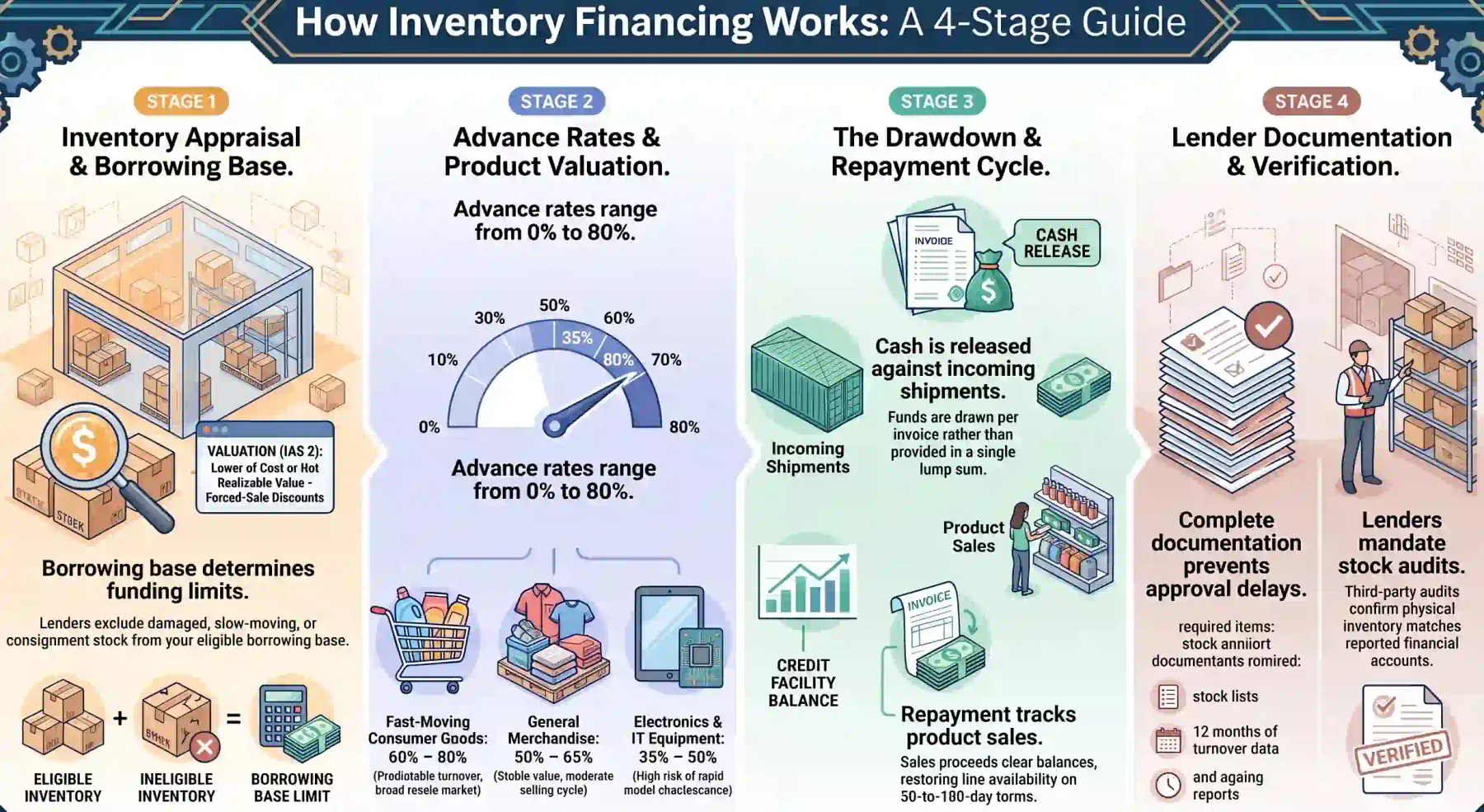
The mechanics follow a predictable sequence, and knowing it early helps you prepare before approaching any lender. Each stage below changes how much funding you can actually access.
1. Inventory appraisal and the borrowing base
Your borrowing base is the pool of eligible stock a lender agrees to fund. Slow-moving lines, damaged units, and consignment goods usually fall outside it, which trims the figure you expected.
Valuation follows the lower of cost and net realisable value principle set out in IAS 2 Inventories. Lenders then apply a further discount reflecting forced sale conditions.
Accuracy matters here far more than volume. When your records overstate quantities, the appraisal corrects downward, and your facility shrinks along with it.
2. Advance rates and what moves them
Advance rates typically range from 20 to 65 per cent of appraised value, although fast-moving consumer goods can reach 80 per cent. Perishables and bespoke items sit at the lower end.
Turnover speed carries the most weight, since a lender wants stock that clears quickly if things go wrong. Resale breadth matters too, because goods with many buyers move faster than niche items.
Storage arrangements also count. Bonded warehouses and third-party logistics providers with audited stock records tend to earn better rates than a self-managed backroom.
| Product type | Typical advance rate | Reason for the rate |
|---|---|---|
| Fast moving consumer goods | 60 to 80 per cent | Predictable turnover and a broad resale market |
| General merchandise and hardware | 50 to 65 per cent | Stable value with a moderate selling cycle |
| Electronics and IT equipment | 35 to 50 per cent | Rapid model obsolescence erodes resale value |
| Fashion and seasonal apparel | 25 to 40 per cent | Narrow selling window and markdown exposure |
| Perishables and bespoke items | 0 to 25 per cent | Short shelf life or no secondary buyer |
3. The drawdown and repayment cycle
Once approved, you draw funds against purchase invoices or incoming shipments instead of receiving one lump sum. The lender releases cash as stock arrives and gets verified.
Repayment then tracks sales. As goods leave the warehouse and customers settle, proceeds clear the outstanding balance, and a revolving line restores headroom for your next order.
Most facilities run on 30 to 180 day terms, matched to the selling cycle. Seasonal businesses often negotiate longer tenors so repayment lands after the peak rather than during it.
4. What lenders ask you to submit
Documentation is lighter than a secured property loan, yet it still needs preparation. Gaps here cause most of the delay between application and first drawdown.
Expect to provide a current stock list with quantities and unit costs, 12 months of turnover data, supplier agreements, and recent management accounts. Ageing reports are often requested as well.
Lenders may also commission a third-party stock audit before approval and at intervals afterwards. Those visits confirm the collateral still exists in the quantities you reported.
Types of Inventory Financing
Not every facility labelled inventory finance behaves the same way. The four structures below differ in how funds are released, what secures them, and who holds title to the goods.
1. Inventory loan versus inventory line of credit
An inventory loan pays a fixed sum upfront with scheduled repayments, which suits a single large purchase such as pre-season stock. Interest accrues on the full amount from day one.
A line of credit behaves differently. You draw only what you need, pay interest on the drawn portion, and the limit replenishes as you repay, which fits businesses reordering year-round.
2. Floor stock financing
Floor stock financing, also called floor plan financing, funds high-value units held for display or resale. Motor dealers, marine traders and heavy equipment distributors use it most in Singapore.
The lender pays your supplier directly and holds a charge over each identified unit. When a unit sells, you settle that specific advance rather than a pooled balance.
3. Purchase order financing
Purchase order financing sits one step earlier in the cycle, covering supplier costs for a confirmed order you cannot yet fund. Approval leans heavily on your buyer's creditworthiness.
Lenders often pay the supplier directly and collect from your customer on delivery. Because the facility ties to one specific order, it rarely revolves the way an inventory line does.
4. Warehouse receipts and trust receipts
A warehouse receipt facility pledges goods held in a licensed warehouse, with the operator confirming quantities to the lender. Control over release stays with the financier until payment clears.
Trust receipts remain a staple of trade financing in Singapore. Your bank settles the import documents, releases the goods to you in trust, and you repay from sale proceeds within a set period.
International practice for these instruments follows ICC trade finance rules, which standardise how documents and payment obligations are handled across borders.
| Structure | How funds release | Typical users in Singapore | Repayment trigger |
|---|---|---|---|
| Inventory loan | Single lump sum at drawdown | Retailers buying pre-season stock | Fixed monthly instalments |
| Inventory line of credit | Drawn in tranches as needed | Distributors reordering year-round | Sales proceeds, limit replenishes |
| Floor stock financing | Lender pays supplier per unit | Motor, marine and equipment dealers | Settlement when each unit sells |
| Purchase order financing | Lender pays supplier on a confirmed order | Wholesalers fulfilling large contracts | Customer payment on delivery |
| Warehouse or trust receipt | Goods released against a bank undertaking | Importers clearing inbound shipments | Repayment within the trust period |
When to Use Inventory Financing
Timing separates a facility that pays for itself from one that simply adds cost. The scenarios below reflect where the economics usually work for businesses in Singapore.
1. Peak season stockpiling and bulk purchase discounts
Festive and mid-year sales periods force buying decisions months ahead of revenue. Inventory financing covers that gap so you order at full depth instead of hedging and running out early.
Volume discounts often justify the cost outright. When a supplier offers 8 per cent for doubling an order and your facility prices at 1.2 per cent monthly, the arithmetic favours borrowing.
2. Importers and distributors with long lead times
Shipments from North Asia or Europe can tie up cash for 60 to 90 days before a single unit sells. Importers use inventory finance to keep that capital working elsewhere in the meantime.
Singapore's role as a regional distribution hub amplifies the effect. Businesses holding stock here for onward sale across Southeast Asia carry longer cycles than purely domestic retailers.
3. Launching a new product line without draining cash
A new line demands stock before demand proves itself, which makes owners reluctant to commit reserves. A ring-fenced facility limits exposure to the launch instead of the whole balance sheet.
Keep that first order conservative. Lenders apply tighter advance rates to untested goods, so a modest pilot quantity usually prices better than an ambitious one.
4. When inventory financing is the wrong tool
Slow-moving or obsolescent stock rarely qualifies, and forcing it through raises your cost without fixing the underlying problem. Selling the stock down beats borrowing against it.
Service businesses and those with receivables rather than goods should look at invoice financing instead. Where cash sits trapped in unpaid invoices, inventory collateral simply does not apply.
What Inventory Financing Costs and Where the Risks Sit
Pricing sits above a conventional working capital loan, because the lender carries the risk that unsold stock loses value. The components below make up most quoted costs.
1. Interest, service and collateral monitoring fees
Interest usually runs monthly on the drawn balance rather than annually on the limit. Arrangement fees, often 1 to 3 per cent of the facility, apply at the start and sometimes on renewal.
Monitoring adds a cost most borrowers overlook. Field audits and periodic stock counts get charged back, and the frequency rises whenever your reporting proves unreliable.
2. Worked example on a S$500,000 facility
The figures below illustrate a typical arrangement for a Singapore distributor holding fast-moving consumer goods. Treat them as a structure to test with your lender, not as a quoted rate.
| Component | Amount |
|---|---|
| Appraised inventory value | S$500,000 |
| Advance rate agreed | 60 per cent |
| Facility limit | S$300,000 |
| Amount actually drawn | S$250,000 |
| Interest at 1.2 per cent monthly over 90 days | S$9,000 |
| Arrangement fee at 2 per cent of the limit | S$6,000 |
| Monitoring and stock audit charges | S$2,500 |
| Total cost over 90 days | S$17,500 |
| Effective cost on the drawn amount | 7.0 per cent per quarter |
On those numbers, the facility costs 7 per cent of the drawn amount across one quarter. That works only when the stock earns a gross margin comfortably above it, which most distributors achieve.
3. Depreciation, overstocking and shrinkage risk
Collateral value erodes in ways a loan agreement cannot prevent. Electronics and fashion lose resale value quickly, so a lender may revalue downward mid-term and cut your available limit.
Overstocking is the quieter danger. Borrowing to hold more stock than you can sell turns a cash flow tool into a carrying cost, while storage and insurance keep accruing as the goods sit.
Shrinkage from theft or spoilage reduces the borrowing base directly. Weak stock controls therefore raise your cost of funds rather than only your operating losses.
4. What happens if you default
The lender can seize and liquidate the pledged inventory, usually at a fraction of book value. Any shortfall stays your liability, and corporate or personal guarantees are frequently attached.
Covenant breaches bite well before default does. Falling below an agreed turnover ratio or missing a stock report can freeze further drawdowns until you remedy the position.
Inventory Financing vs Other Working Capital Options
Most businesses weigh several facilities at once, and the right answer depends on where cash currently sits. These distinctions matter because lenders price each structure against a different asset.
1. Inventory financing vs invoice financing
Invoice financing advances cash against unpaid invoices, so it releases money after you have sold. Inventory financing releases money before the sale, which is the gap importers usually need to bridge.
Advance rates differ sharply too. Invoice facilities commonly reach 70 to 90 per cent of invoice value, because a confirmed receivable carries less resale risk than stock sitting in a warehouse.
Many distributors run both together. Inventory finance funds the purchase, then invoice finance covers the collection period once the goods ship out to the customer.
2. Inventory financing vs trade financing
Trade financing is the broader category covering letters of credit, trust receipts, shipping guarantees, and supplier payment instruments. Inventory financing sits as one component inside it.
The practical difference is scope. Trade facilities follow the transaction from order through to delivery, whereas an inventory facility funds the stock only once it belongs to you.
Importers clearing goods through Singapore often use both in sequence. A trust receipt handles the shipment, then an inventory line funds the holding period before the stock sells.
3. Where asset-based lending fits in
Asset-based lending is the umbrella term for any facility secured on balance sheet assets, including receivables, equipment and property alongside inventory. Inventory financing is the stock-specific form.
Larger borrowers sometimes combine them into a single borrowing base. One facility might advance 80 per cent against receivables and 50 per cent against inventory, under one shared limit.
That blended structure lowers the average cost of funds. It also raises reporting demands, since the lender now monitors two asset pools rather than one.
4. Choosing by cash conversion cycle, not by rate
Comparing headline rates alone misleads, because each facility covers a different stretch of your cash cycle. Map where the money actually sits before shortlisting any lender.
When cash locks up in stock for 70 days and in receivables for 45, an inventory facility addresses the larger problem. Chasing the cheaper invoice rate would leave the bigger gap unfunded.
| Facility | What secures it | Typical advance | Stage of cash cycle covered | Best suited to |
|---|---|---|---|---|
| Inventory financing | Stock on hand or inbound | 20 to 80 per cent of appraised value | Purchase to sale | Importers, distributors and retailers |
| Invoice financing | Unpaid customer invoices | 70 to 90 per cent of invoice value | Sale to collection | Businesses selling on credit terms |
| Purchase order financing | A confirmed customer order | Up to 100 per cent of supplier cost | Order to delivery | Wholesalers winning large contracts |
| Trade financing | Shipping documents and goods in transit | Varies by instrument | Order to customs clearance | Cross-border importers and exporters |
| Asset-based lending | A pooled borrowing base of assets | Blended across asset classes | The whole working capital cycle | Larger businesses with mixed assets |
Inventory Financing for Singapore Businesses
Singapore's lending market gives stock-backed borrowers more routes than most regional centres. Government-supported schemes sit alongside bank facilities and a deep pool of fintech lenders.
1. Enterprise Financing Scheme Trade Loan
Enterprise Singapore runs the Enterprise Financing Scheme, which includes a Trade Loan among its eight loan types. Participating banks share the risk with the government.
Inventory purchases, purchase order fulfilment, and documentation costs typically fall within the Trade Loan's scope. Quantum and risk-sharing terms change periodically, so confirm the current figures first.
Applications still go through a participating financial institution rather than Enterprise Singapore directly. Your bank assesses the request, and the scheme only reduces its downside exposure.
2. Banks, fintech lenders, and what each will fund
Local and foreign banks offer the lowest pricing, yet they favour established borrowers with audited accounts and a couple of years of trading. Approval timelines run longer as a result.
Fintech and specialist lenders move faster and accept thinner records, pricing the extra risk into their rates. Several focus specifically on inventory and purchase order facilities for growing importers.
Floor stock providers form a third group, serving dealers in vehicles, machinery and marine equipment. They underwrite individual units rather than a pooled stock balance.
| Lender type | Typical speed to funding | What they prioritise | Main trade off |
|---|---|---|---|
| Local and foreign banks | Three to six weeks | Audited accounts, trading history and an existing relationship | Lowest cost, slowest decision |
| Fintech and specialist lenders | Five to ten business days | Stock turnover data and buyer quality | Faster access, higher pricing |
| Floor stock financiers | One to three weeks | Serial numbered units and dealer agreements | Unit-level control, narrow eligibility |
| Government-backed Trade Loan | Through a participating bank | Scheme eligibility plus the bank's own credit view | Shared risk, standard bank process |
3. What Singapore lenders check before approving
Stock turnover sits at the top of the list, since it shows how quickly collateral converts back into cash. Twelve months of consistent movement data carries more weight than one strong quarter.
Record quality comes next. Lenders compare system balances against physical counts, and a variance above a few per cent usually triggers a lower advance rate or a demand for tighter controls.
Compliance also features heavily for importers. Clean permit records under Singapore import procedures reassure a lender that shipments will not stall and strand the collateral.
Strengthening Your Borrowing Base with Inventory Management Software
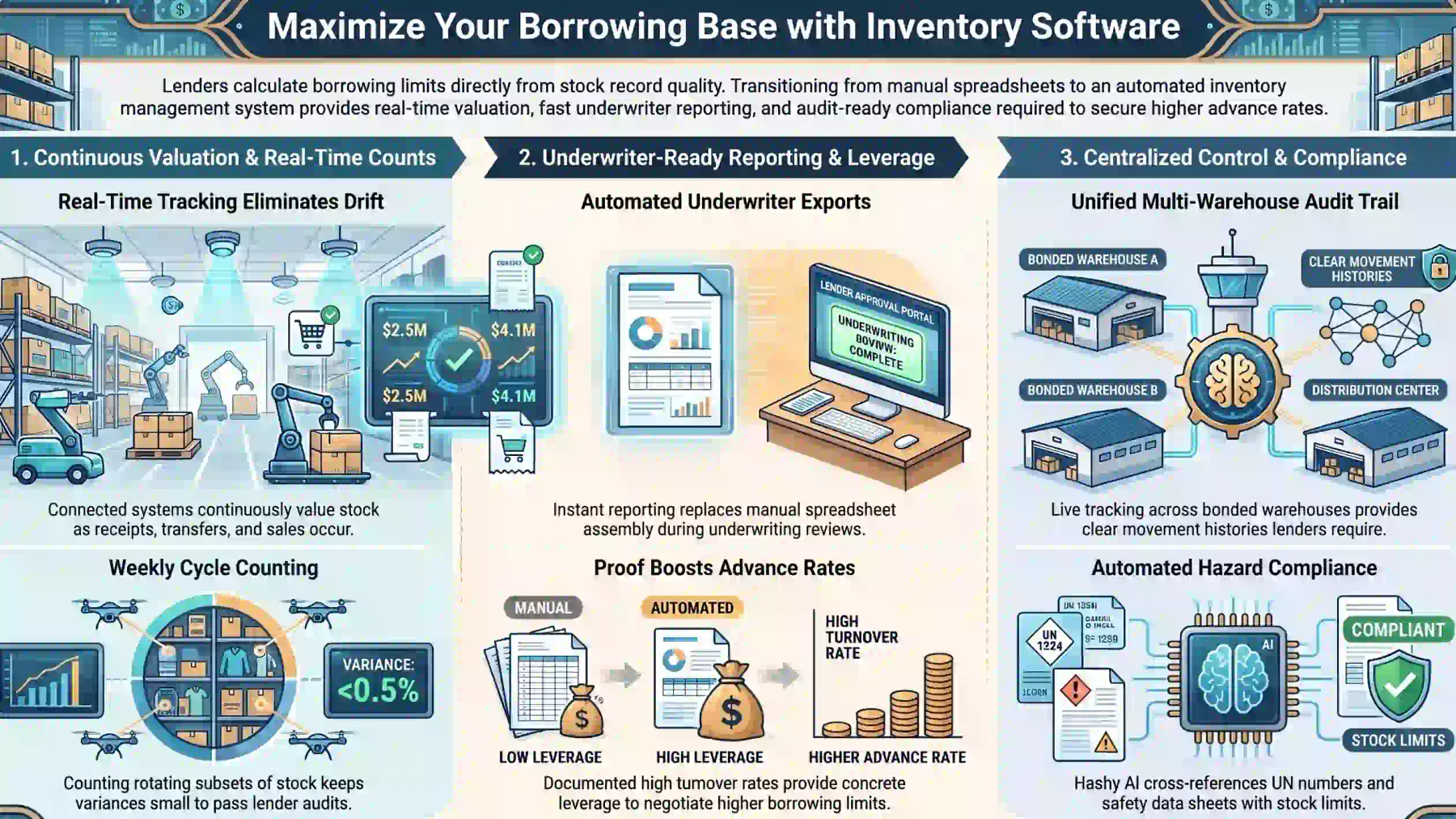
Everything a lender measures comes out of your stock records, which makes record quality a financing lever rather than an administrative chore. Better data lifts the advance rate you qualify for.
1. Accurate counts and real-time stock valuation
Spreadsheet tracking drifts the moment receipts, transfers, and sales happen faster than someone can update a file. Lenders discount what they cannot verify, and that discount lands on your limit.
A connected inventory system records every movement as it happens and values stock continuously under your chosen costing method. Appraisals then start from a figure you can defend line by line.
Cycle counting closes the remaining gap. Counting a rotating subset each week keeps variances small, so a lender's audit confirms your numbers instead of correcting them.
2. Turnover and ageing reports lenders want to see
Underwriters request much the same reports every time, and producing them manually costs days a growing business rarely has. Automated reporting reduces that to a short export.
The core set covers stock ageing by item, turnover by category, slow-moving and obsolete listings, plus reorder history against supplier lead times. Each answers a specific underwriting question.
Having them ready also strengthens your negotiating position. A borrower who can evidence nine turns a year argues for a higher advance rate than one who merely claims strong movement.
3. How HashMicro supports Singapore importers and distributors
HashMicro's inventory management software gives Singapore importers and distributors one record of stock across warehouses, with continuous valuation and full movement history behind every figure.
Replenishment signals, run rate analysis and ageing views sit in the same system, so the reports a lender asks for come from live data rather than a rebuilt spreadsheet.
Teams handling bonded stock and onward regional shipments gain the audit trail that supports a larger borrowing base. Demonstrated control is what moves an advance rate upward.
Hazard compliance holds only when class data and stock records stay in sync. Hashy AI reads UN numbers, licence limits, and safety data sheets together, then flags what needs review.






Conclusion
Inventory financing solves a narrow but expensive problem, which is cash trapped in stock between purchase and sale. On fast-moving goods with healthy margins, it funds growth without diluting ownership.
Singapore businesses can use the Enterprise Financing Scheme Trade Loan or fintech lenders, but structure matters more than rate. Tighten stock counts and have turnover and ageing data ready before applying.
To learn more about inventory financing, book a free consultation with our service today. Start anytime and improve your business.
Frequently Asked Questions
Inventory financing is a short-term loan or credit line secured against the stock your business owns or is buying. The lender advances part of its value, and you repay as the goods sell.
Most lenders advance 20 to 65 per cent of appraised value, with fast moving consumer goods reaching 80 per cent. Perishables, bespoke items and ageing stock get the lowest advance rates or none.
Inventory financing funds stock before you sell it, while invoice financing advances cash against invoices already issued. Many distributors use both, one for the purchase and one for the collection.
Inventory financing is one form of asset based lending, which covers any facility secured on balance sheet assets. Larger borrowers often pool inventory with receivables and equipment under one limit.
Yes. The Enterprise Financing Scheme includes a Trade Loan covering trade needs such as inventory purchases and purchase order fulfilment. You apply through a participating bank, not directly.