






Container unloading starts before a truck reaches the dock. Singapore warehouses need to plan labour and equipment, check shipment documents, open the container safely, inspect the cargo and record stock accurately. A delay at any point can hold up put-away, customer orders and the return of the empty container.
This guide explains the container unloading process, the equipment used for different cargo types, key workplace safety controls and the measures that help warehouses reduce handling time and receiving errors.
Key Takeaways
Plan the dock, labour, equipment and receiving space before the container arrives.
Check the container number, seal, documents and cargo condition before confirming receipt.
Choose unloading equipment according to cargo weight, packaging and whether goods are floor-loaded or palletised.
Singapore warehouses should assess unloading risks, prevent vehicle movement and follow relevant WSH guidance.

What Is Container Unloading?
"Efficient container unloading depends on more than speed. Safe handling, accurate receiving, suitable equipment and real-time inventory updates help Singapore warehouses reduce delays, damage and stock discrepancies."
Container unloading is the removal of cargo from a shipping container at a warehouse, depot or distribution centre. For a receiving team, the job also includes verifying what arrived, recording damage or shortages, and moving accepted goods to a storage or staging location.
Container unloading, devanning and destuffing: what the terms mean
Container unloading is the broad term for removing cargo. Devanning and destuffing also describe taking goods out of a container and are often used interchangeably in logistics. A warehouse may use “devanning” for the full receiving operation and “destuffing” for the physical removal of goods, so confirm the scope when booking a service.
Why container unloading matters for inbound logistics
An unloaded container does not automatically mean stock is ready to sell. Staff still need to count, inspect, record and put away the goods. If those activities fall behind, available stock may remain invisible to sales teams even though it has reached the warehouse.
A controlled process also frees the dock for the next vehicle, documents damage while evidence is available and helps the business return the empty container within its agreed free time.
Container Unloading Process Step by Step
The most reliable process follows the shipment from its expected arrival through goods receipt and put-away. Each handover should make clear who checks the cargo and who resolves exceptions.
Pre-arrival planning and dock scheduling
Before arrival, confirm the delivery appointment, container size, expected product lines, packing method, cargo weight and any special handling requirements. Reserve a suitable dock, staging space, workers and equipment. For floor-loaded cartons, plan how staff will move goods out of the container without creating long carrying routes.
Use the purchase order and packing list to prepare an expected receipt. If the shipment contains temperature-sensitive, hazardous or unusually heavy cargo, agree on the handling procedure before the vehicle arrives.
Document and seal checks
At arrival, compare the container number and seal number with the delivery paperwork. Check the purchase order, packing list and delivery or transport documents against the shipment. Record a missing, broken or mismatched seal and visible container damage before opening the doors.
Photographs and a dated exception note help the receiving team explain discrepancies to the supplier, freight forwarder or carrier. Staff should follow the company’s escalation procedure before accepting a shipment that appears tampered with.
Opening the container and unloading the cargo
Park the vehicle in the designated area, secure it against movement and keep pedestrians clear of the unloading route. Open the doors cautiously because cartons or pallets may have shifted during transport. Inspect the load from a safe position before anyone enters the container.
Remove cargo in a stable sequence using equipment suited to its weight and packaging. Keep damaged or uncertain goods apart from accepted stock so they are not put away or allocated to orders by mistake.
Inspection, counting and damage recording
Count pallets, cartons or units at the level required by the receiving process. Compare the result with the purchase order and packing list, then inspect labels and packaging for damage, moisture, incorrect items and missing quantities.
Record shortages, overages and damage against the relevant shipment or goods receipt. Where products require traceability, capture their batch, serial or expiry details. Photograph damage before repacking or moving the goods away from the dock.
Put-away and inventory update
Move accepted goods to assigned bins, racks or staging locations and record where they were placed. Keep rejected or quarantined goods separate. Confirm received quantities only after the team has checked the physical stock and resolved, or clearly recorded, any exceptions.
Updating the inventory record promptly lets purchasing, sales and warehouse teams work from the same received quantity. For businesses with several warehouses, the record should also identify the correct receiving location.
Container Unloading Methods
The right method depends on how the supplier packed the container, the cargo’s weight and shape, and the warehouse’s dock layout. The fastest method is only useful when it also keeps the load stable and workers safe.
Floor-loaded (loose) vs palletised cargo
Floor-loaded cargo sits directly on the container floor. It can use container space efficiently, but individual cartons often take more time and labour to remove. A conveyor may shorten the carrying distance for repeatable cartons.
Palletised cargo groups goods into handling units that suitable equipment can move more quickly. Before using a forklift or pallet jack, check pallet condition, load weight, container access and the capacity of any dock plate or ramp.
Manual, mechanical and automated unloading
Manual unloading may suit light, irregular or low-volume goods, provided workers use a safe handling method. Mechanical unloading uses equipment such as pallet jacks, forklifts and conveyors to reduce repeated carrying. Automated systems can suit high-volume sites with consistent carton sizes and predictable flows.
Automation is an investment decision, not a default requirement. Compare equipment cost, maintenance, available space and expected container volume with the labour and time it could save.
FCL vs LCL unloading
A full container load (FCL) shipment is generally assigned to one consignee, so its receiving team can reconcile the full container against its documents. A less-than-container load (LCL) shipment shares a container with other consignments and may be separated at a container freight station before delivery.
For LCL cargo, confirm whether your warehouse will unload a container or receive an already separated shipment. That distinction affects labour planning, documents and who records discrepancies at each handover.
Container Unloading Equipment

Choose equipment based on the load, access route and dock design. Check its rated capacity and condition before work begins.
Forklifts and pallet jacks
Forklifts can move suitable palletised loads, while manual or powered pallet jacks can serve shorter, level routes. A container’s floor strength, doorway clearance and the load’s stability all matter when selecting equipment. Keep pedestrians outside the equipment route and use trained operators.
Dock levellers, ramps and conveyors
Dock levellers and ramps bridge height differences between the vehicle and warehouse floor. Their capacity and position must suit the equipment and load passing over them. Flexible or telescopic conveyors can move cartons from the container towards a receiving or sorting point, reducing repeated walking and carrying.
Container unloaders and automation
Dedicated container unloaders and telescopic conveyors can help sites that regularly handle large volumes of loose cartons. More automated operations may connect conveyors with sorting or palletising equipment. A site should assess carton consistency, safety controls, maintenance needs and space before purchasing such systems.
Container Unloading Safety in Singapore
Singapore employers must assess workplace risks and put controls in place for loading and unloading work. The procedure should address the actual vehicle, cargo, equipment and site layout rather than rely on a generic checklist.
Common hazards: falling cargo, manual handling and vehicle movement
Cargo can topple when doors open or restraints are removed. Other risks include unstable pallets, vehicle movement, forklift collisions, falls at the dock, slips on wet surfaces and strain from repeated lifting. Stop work and reassess the method if the load has shifted or the planned equipment cannot handle it safely.
WSH guidelines and SS 663 for safe loading and unloading
The Workplace Safety and Health Council’s loading and unloading guidance calls for suitable unloading areas, firm and level ground, controls against vehicle movement, equipment in good condition and checks for loads that shifted in transit. Singapore’s SS 663:2020 Code of Practice for Safe Loading on Vehicles provides related principles for safe carriage and handling.
SS 663 is a reference for vehicle-loading practices, not a substitute for a site-specific container unloading risk assessment. The Ministry of Manpower explains that employers must identify hazards, control risks and provide workers with appropriate instruction, training and supervision.
PPE, training and SOP checklist
Before unloading, the supervisor should confirm that the team understands the load, the unloading sequence and the stop-work procedure. The site’s safe work procedure should cover vehicle immobilisation, pedestrian separation, unstable cargo, equipment checks, damage handling and emergency response.
- Check that workers have suitable safety footwear, high-visibility clothing and task-specific protection.
- Confirm that equipment operators are trained and authorised for their tasks.
- Inspect forklifts, pallet jacks, ramps and conveyors before use.
- Secure the vehicle and establish a clear unloading area.
- Keep workers clear of doors until the load’s stability has been assessed.
- Report unsafe conditions, incidents and near misses promptly.
Container Unloading Costs and Delay Risks
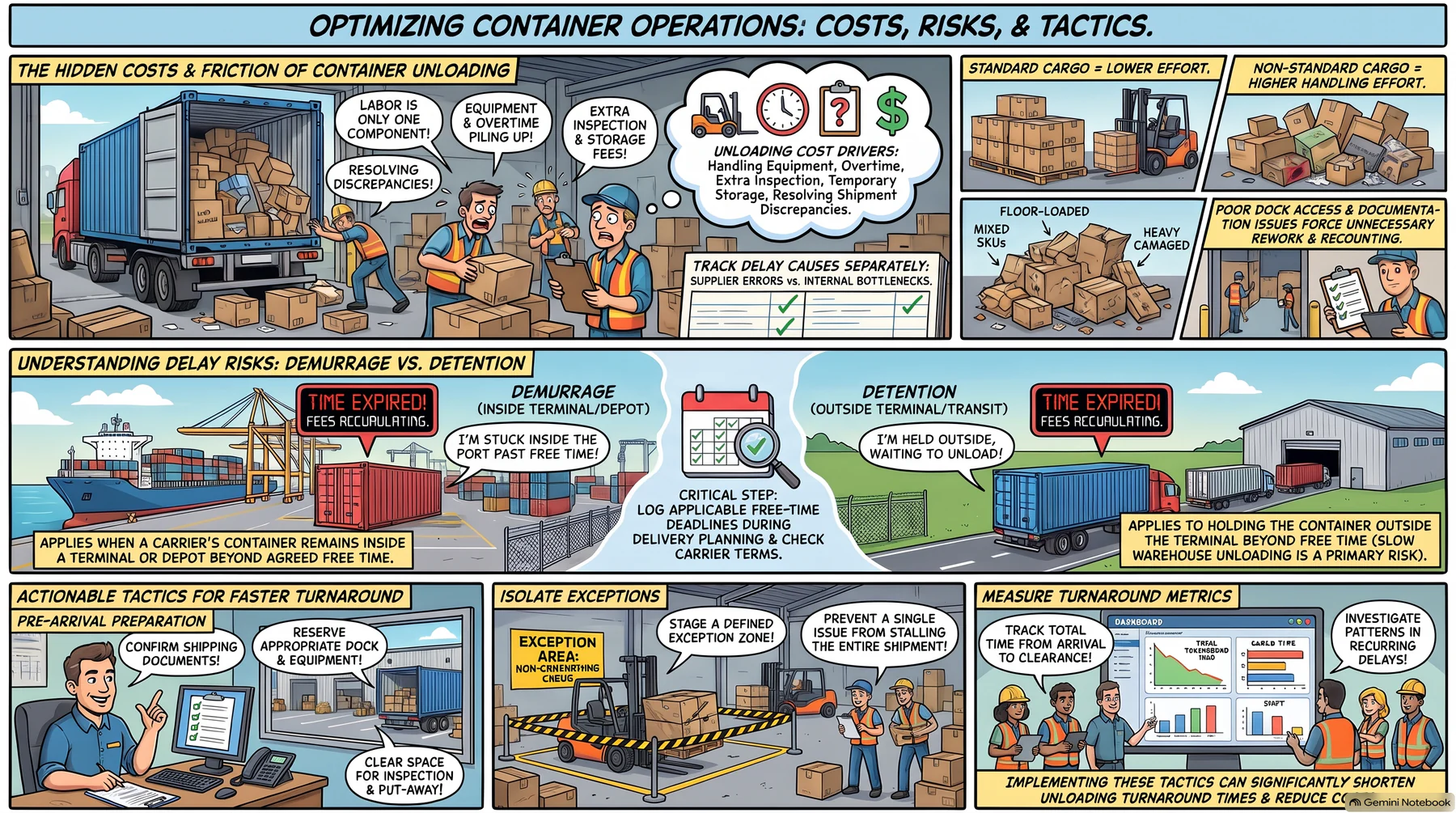
Labour is only one part of unloading cost. A warehouse may also pay for handling equipment, overtime, extra inspection, temporary storage and time spent resolving shipment discrepancies.
What drives labour and handling costs
Floor-loaded goods, mixed SKUs, heavy cartons and damaged packaging generally demand more handling than uniform palletised cargo. Poor dock access, missing labels and inaccurate packing lists can add counting and rework. Track these causes separately so the team can distinguish supplier issues from warehouse delays.
Demurrage and detention charges
Demurrage generally concerns a carrier’s container remaining inside a terminal or depot beyond the agreed free time. Detention generally concerns holding the container outside the terminal or depot beyond its free time. Some contracts use a combined charging structure, so check the carrier’s terms for the shipment.
Once the import container has left the terminal for the warehouse, slow unloading is primarily a detention and empty-return risk . Demurrage is more closely linked to delays before the full container leaves the terminal. Record the applicable free-time deadline when planning each delivery.
How to shorten unloading time
Confirm documents before arrival, reserve the right dock and equipment, and make space for inspection and put-away. Use a defined exception area so one damaged pallet does not hold up the entire receipt. Measure the time from arrival to container clearance, then investigate recurring delays by supplier, cargo type or shift.
Common Container Unloading Challenges and How to Solve Them
Most delays come from a small number of preventable handover problems. Record the cause of each exception so the warehouse can improve the next delivery rather than repeatedly absorb the same cost.
| Challenge | Practical response |
|---|---|
| Cargo has shifted against the doors | Stop, establish an exclusion area and use a safe opening method based on a fresh risk assessment. |
| Packing list does not match the cargo | Record actual quantities and escalate the discrepancy before confirming receipt. |
| Loose cartons slow the dock | Plan labour by carton volume and assess a suitable conveyor for recurring shipments. |
| Damaged goods mix with accepted stock | Photograph and label exceptions, then move them to a separate holding area. |
| Stock appears available before put-away | Define when the system changes stock from received to available and record the storage location. |
| Empty-container return is delayed | Track the return deadline alongside the delivery appointment and unloading status. |
How a WMS Improves Container Unloading
A warehouse management system helps most when it connects the physical receipt with the stock record. The exact scheduling and automation features vary by product and configuration.
Dock scheduling and receiving workflows
Where dock scheduling is available, the team can coordinate arrival slots with receiving capacity. Even without that feature, a WMS can prepare expected receipts, record actual quantities and track exceptions against the relevant order. This reduces reliance on a separate spreadsheet after the container is unloaded.
Barcode scanning and real-time stock updates
Scanning can help staff confirm the product and location at receiving and put-away. The team should still check quantities and condition: a correct barcode does not prove that a carton contains the expected number of undamaged units.
Once staff confirm the receipt and storage movement, the WMS can update the stock record for the relevant warehouse. That gives purchasing and sales teams a clearer view of what has arrived and what remains under inspection.
KPIs to track: unloading time, dock-to-stock time and damage rate
Use consistent start and end points for each measure. For example, define unloading time as the interval from opening the container to removing the last item. Define dock-to-stock time as the interval from vehicle arrival to the point accepted stock becomes available in its recorded location.
Calculate damage rate as damaged units divided by total units received for the same period. Review these measures with shipment type and supplier information; a rise in damage on one route may call for a different response from a rise in unloading time across every dock.
How HashMicro WMS Supports Container Unloading for Singapore Businesses
HashMicro offers warehouse and inventory workflows that can connect goods receipt, stock movements and reporting with purchasing. For a Singapore distributor or importer, the useful test is how the proposed configuration handles an actual inbound shipment, including shortages and damaged stock.
Inbound receiving and put-away
HashMicro’s inventory workflow supports goods receipt and stock records by warehouse. During a demonstration, ask the team to show how a purchase order becomes a receipt, how a discrepancy is recorded and how accepted goods move to their storage locations. Confirm any directed put-away rules required for your site in the proposed scope.
Barcode, mobile and multi-warehouse tracking
HashMicro offers barcode-supported warehouse processes and stock visibility across warehouses. If your staff need to scan goods on handheld devices at the dock, include that exact receiving workflow, device requirements and connectivity conditions in the demonstration and quotation.
Free demo and tailored quote
Request a HashMicro demonstration using one of your own container shipments: its purchase order, packing list, products, warehouse locations and common exceptions. Ask for a tailored quote that identifies the warehouse functions, barcode or mobile setup, integration work, training and support included in the project.






Conclusion
Safe container unloading depends on preparation before arrival, careful checks at the doors, suitable equipment and accurate receiving. Singapore warehouses should assess the risks of each load, document discrepancies while the evidence is available and track the deadline for returning the empty container.
A WMS can help turn the physical receipt into a reliable inventory record. HashMicro businesses can assess that fit through a demonstration of goods receipt, barcode checks, put-away and multi-warehouse stock visibility using their own inbound process.

Frequently Asked Questions About Container Unloading
Container unloading is the removal of cargo from a shipping container, followed by checking quantities and condition and moving accepted goods to warehouse storage or staging.
The terms often describe the same activity. Container unloading is the general term; devanning commonly refers to removing cargo from a container at a warehouse, depot or distribution centre.
There is no fixed duration. It depends on whether goods are palletised or floor-loaded, carton volume, labour, equipment, dock access and the amount of inspection required.
Employers should assess unloading risks, implement suitable controls and train and supervise workers. Relevant references include Workplace Safety and Health Council loading and unloading guidance and SS 663:2020 on safe loading on vehicles.
Depending on the load and site, warehouses may use forklifts, pallet jacks, dock levellers, ramps, conveyors or dedicated container unloading systems.
A WMS can prepare expected receipts, support barcode checks, record discrepancies and update warehouse stock as goods are received and put away. Dock scheduling should be confirmed as a separate feature in the chosen system.