







Days Inventory Outstanding (DIO) is a financial metric that every business carrying physical stock should understand it tells you how many days, on average, your inventory sits before it’s sold. According to a 2020 Statista survey of 454 Philippine SMEs, businesses with efficient inventory management delivered a higher share of their output on time than businesses with inefficient inventory management.
Whether you’re in retail, manufacturing, or distribution, DIO gives you a clear view of how well your inventory control practices are working and where slowdowns in the sales cycle are occurring. This guide explains what DIO is, how to calculate it using the standard formula, and how to improve it if your number is higher than it should be.
Key Takeaways
Days Inventory Outstanding (DIO) is a financial ratio that measures how many days a business holds inventory before selling it, a direct indicator of stock turnover efficiency.
DIO is calculated using three inputs: average inventory value, cost of sales, and number of days in the period, making it one of the more straightforward financial ratios to compute.
A lower DIO is generally better, it means inventory is turning over quickly, reducing holding costs and freeing up working capital for other parts of the business.
Businesses can reduce a high DIO by improving demand forecasting, keeping stock levels balanced, speeding up the sales cycle, and clearing out slow-moving or outdated inventory.
What Is Days Inventory Outstanding (DIO)?
Days Inventory Outstanding (DIO) is a financial ratio that tells you how long your business keeps inventory before selling it. It helps you see how much it costs to hold onto the inventory systems used by Philippine companies and why there might be delays in selling it.
A lower DIO means inventory turns over quickly, which reduces storage costs and frees up working capital. Manufacturers read this differently, because raw materials and work in progress move on separate cycles, and manufacturing inventory software tracks each stage on its own.
The number only means something when you read it against your own industry and your own history. Here is how to interpret it:
- High DIO: stock sits longer than planned. Usual causes are over-ordering, slow-moving SKUs, seasonal stock bought ahead of peak, and deliberate safety stock buffers.
- High DIO is not always bad: custom manufacturers with long production cycles and strong margins can hold materials for months and still stay profitable.
- Low DIO: inventory moves fast, cash comes back sooner, and storage costs stay low.
- Low DIO has a limit: cutting stock too far creates shortages, and you lose orders you could have filled.
- No universal target: compare your DIO with direct competitors in the same industry, then track your own trend quarter over quarter.
Days Inventory Outstanding Formula for Business with Example

DIO formula is very simple:
Here’s what you need to count days inventory outstanding formula:
- Average inventory: The value of your stock over a certain period.
- Cost of sales: The amount spent on producing the goods you’ve sold.
- Number of days: The total days in that period (e.g., 365 days for one year).
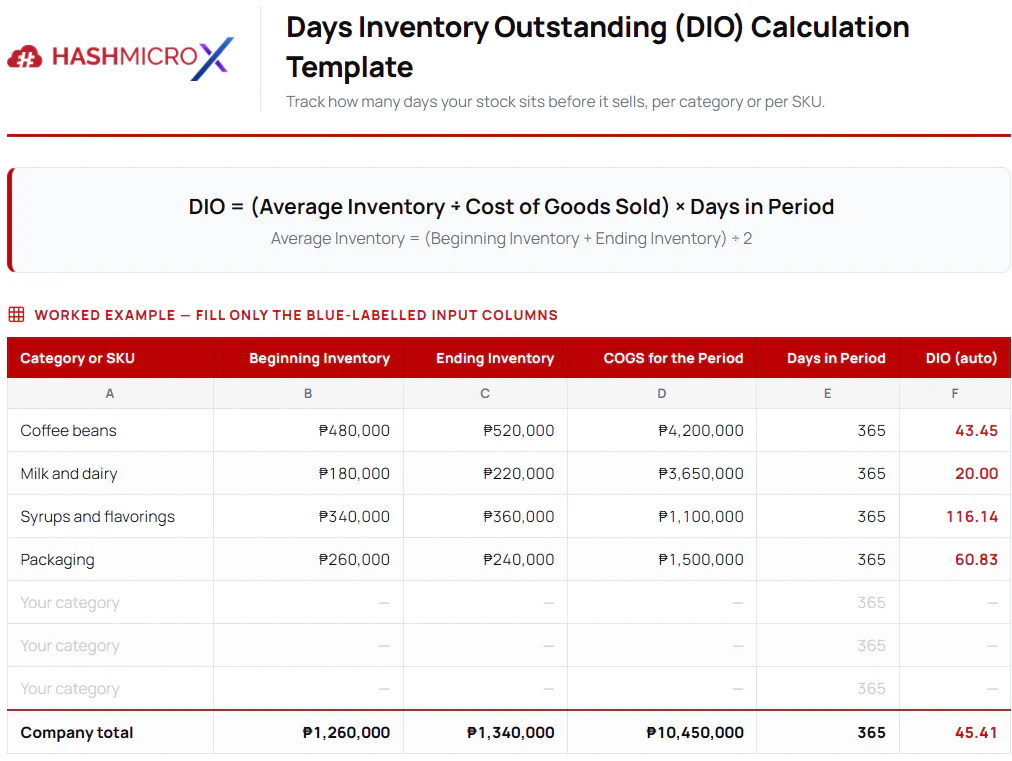
For example, a coffee supply distributor in Metro Manila closed FY2025 with ₱10,450,000 in total COGS. Its stock value by category looked like this:
| Category | Beginning Inventory | Ending Inventory | Average Inventory | Annual COGS | DIO |
|---|---|---|---|---|---|
| Coffee beans | ₱480,000 | ₱520,000 | ₱500,000 | ₱4,200,000 | 43.45 days |
| Milk and dairy | ₱180,000 | ₱220,000 | ₱200,000 | ₱3,650,000 | 20.00 days |
| Syrups and flavorings | ₱340,000 | ₱360,000 | ₱350,000 | ₱1,100,000 | 116.14 days |
| Packaging | ₱260,000 | ₱240,000 | ₱250,000 | ₱1,500,000 | 60.83 days |
| Company total | ₱1,260,000 | ₱1,340,000 | ₱1,300,000 | ₱10,450,000 | 45.41 days |
Take the syrups line as the walkthrough. Average inventory is (₱340,000 + ₱360,000) ÷ 2, or ₱350,000. Divide that by ₱1,100,000 in COGS, then multiply by 365 days. The result is 116.14 days.
The company average of 45.41 days hides the real problem. Milk clears in 20 days because it spoils fast, while syrups tie up cash for almost four months. A single company-wide DIO tells you very little, so calculate it per category or per SKU group.
Download Free DIO Template
Download Free DIO Template
What a Good DIO Means for Your Business
A good DIO is not the lowest number you can reach. It is the number that keeps stock moving without breaking your service level. Here is what your DIO actually tells you about the business:
- It sets the length of your cash cycle. DIO is the inventory leg of the cash conversion cycle, alongside days sales outstanding and days payable outstanding. Every day you shave off inventory is a day sooner your cash returns.
- It puts a peso value on excess stock. Using the distributor example, daily COGS is ₱28,630. Cutting DIO from 45.41 days to 35 days releases about ₱298,000 in working capital, without a single extra sale.
- It exposes your true carrying cost. Warehouse rent, insurance, financing, handling, and shrinkage all scale with holding time. Slow categories quietly consume margin that never appears on the sales report.
- It flags obsolescence and spoilage risk early. Food, pharmaceutical, and fashion stock loses value on a clock. A rising DIO in these categories usually predicts markdowns and write-offs a few months ahead.
- It shows when your purchasing rhythm is wrong. A high DIO on a steady seller often means order quantities are too large, not that demand disappeared. Smaller and more frequent orders fix it faster than discounting does.
- It protects you from cutting stock too far. A falling DIO paired with rising stockouts is not efficiency. Read DIO next to your fill rate, because both numbers have to hold.
- It only means something against a benchmark. Grocery and fresh food operators turn stock in days, while industrial parts and furniture dealers hold it for months. Judge your DIO against your own industry and your own last four quarters.
Once you know which categories are holding cash the longest, the next step is fixing the cause.
How to Improve Days Inventory Outstanding (DIO)
Improving DIO means moving the same volume of stock with less cash parked in the warehouse. The fix is rarely one big change. It is a set of smaller corrections to forecasting, ordering, and data accuracy that compound over a few quarters. Work through the seven below in order, because each one makes the next easier.
1. Forecast Demand from Your Own Sales History
Most excess stock starts as a guess. Pull at least 12 months of sales per SKU, then separate the steady sellers from the seasonal ones. Steady sellers can run on a simple moving average, while seasonal items need the same month from last year as the baseline.
Review the forecast monthly, not annually. A forecast that is refreshed four times a year will always lag a market that moves weekly.
2. Set Reorder Points and Order Smaller, More Often
A high DIO on a product that still sells well usually means the order quantity is too large, not that demand disappeared. Calculate a reorder point per SKU using average daily usage multiplied by supplier lead time, then add a safety buffer sized to how often that supplier is late.
Smaller and more frequent purchase orders raise your handling cost slightly. They cut holding cost far more, and sizing each order against your cycle stock stops a single bulk discount from locking up four months of cash.
3. Clear Slow-Moving and Obsolete Stock on a Schedule
Aging stock does not improve with time. Run an aging report every quarter and flag anything that has not moved in 90 days, then act on it in the same month with bundles, markdowns, or a return-to-vendor request.
Treat the write-off as the cost of a past buying error, not a loss you can avoid by waiting. Every month you hold dead stock adds storage cost on top of the capital already spent.
4. Shorten Supplier Lead Times and Renegotiate Minimum Order Quantities
Long lead times force you to hold more safety stock, which raises DIO before you sell a single unit. Ask your top suppliers for a shorter confirmed lead time, a lower minimum order quantity, or a scheduled delivery that splits one large shipment into three smaller ones.
For imported goods, a local or regional second source is often worth a slightly higher unit price. Weeks saved in transit translate directly into days removed from DIO, and the same supplier review usually helps you reduce procurement costs at the same time.
5. Segment Your Stock and Set a DIO Target per Class
One company-wide target hides the products that actually cause the problem. Sort your SKUs into A, B, and C classes by annual cost value, then set a separate DIO target for each class.
- Class A: the 20 percent of SKUs driving most of your COGS. Tight reorder points, weekly review, lowest DIO target.
- Class B: steady mid-volume items. Monthly review and a moderate buffer.
- Class C: low-value items where a stockout costs more than the holding cost. Larger orders here are fine.
In the distributor example above, syrups carry a DIO of 116.14 days against a company average of 45.41 days. Bringing that one category down to roughly 60 days releases about ₱170,000 and pulls the company figure to 39.47 days, with no change to any other product line.
6. Fix Your Stock Data Before You Fix the Process
Every improvement above depends on knowing what you actually hold. If your system count and your shelf count disagree, your team reorders stock you already own and your DIO rises for a reason no report will show.
Run cycle counts instead of one annual stocktake. Count class A items monthly, class B quarterly, and class C twice a year, then investigate every variance above your tolerance before updating your accurate inventory records.
7. Track DIO Automatically Instead of Rebuilding It Each Month
A spreadsheet works for a first calculation. It breaks down once you need DIO per category, per warehouse, and per month across hundreds of SKUs. An inventory management system calculates the figure from live stock movements and flags categories that drift past their target.
Automation also removes the delay. Knowing your syrups category crossed 100 days last month is useful. Knowing it crossed 100 days last week is what lets you cancel the next purchase order in time.
None of these produce a result in a single month. Measure DIO per category every month, keep the history, and judge the change against your own baseline rather than a number you found online.
Conclusion
Tracking Days Inventory Outstanding gives businesses in the Philippines a clear, quantifiable view of how efficiently their stock is moving and where the gaps in the inventory cycle are costing them money. Used consistently alongside other financial ratios, DIO helps inform smarter decisions around procurement, pricing, and storage
For businesses looking to track and reduce DIO more systematically, the right inventory management software can automate the calculations and surface real-time stock movement data across all product lines. A comparison of the leading inventory management systems available in the Philippines can help identify which platforms are best suited to your business size, industry, and reporting needs.

FAQ About Days Inventory Outstanding
To effectively manage inventory and balance between overstocking and understocking, many experts suggest that an ideal Days Sales of Inventory (DSI) falls between 30 and 60 days. However, this range can differ depending on the industry, company size, and other factors.
In general, the lower a company’s DIO, the better. A low DIO indicates that the company can sell its inventory quickly and efficiently. This is beneficial because it reduces costs related to holding inventory, such as storage expenses.
Inventory days on hand is a metric that indicates the average number of days needed to sell all the units of a product currently in stock. It is also referred to as days inventory outstanding (DIO) or days sales of inventory (DSI).