











 Limited to 100 registrants

In recent years, logistics disruptions have shifted from being occasional incidents to recurring operational risks. Congestion at major ports, limited vessel availability, fluctuating tariffs, and unexpected regulatory changes are now part of day-to-day global trade. For many companies operating across Indonesia, Australia, and Bangladesh, these disruptions directly affect both direct shipment and transshipment strategies. A shipment that appears secure at the time of booking can quickly become delayed due to schedule changes at sea, port congestion, or capacity reallocation by carriers.
Whether goods are transported via air cargo and at sea, every shipment operates under contractual agreement terms that often limit last-minute adjustments. This challenge directly impacts the broader supply chain, especially inventory management. Delayed shipments increase holding costs, reduce turnover, and strain working capital. Without real-time tracking, decision-makers are left reacting instead of planning
Key Takeaways
Transshipment is the strategic movement of cargo between vessels at an intermediate port, ensuring goods reach their final destination efficiently across global transport networks.
An integrated ERP or warehouse system should gives businesses real-time visibility, automated compliance, and cost control to manage transshipment risks efficiently and keep global logistics running smoothly.
HashMicro provides a comprehensive ERP system designed to give businesses complete control and visibility over their entire supply chain.
What Is Transshipment?
Transshipment refers to the logistics process of transferring cargo from one vessel to another at an intermediate port before it reaches its final destination. This process may involve transloading, where goods are moved between containers, vessels, or transport modes such as air cargo and at sea.
Why Visibility Matters in Transshipment?
Because transshipment involves multiple legs, vessels, and ports, visibility often breaks down precisely when cargo changes hands. Without real-time tracking, businesses may lose sight of whether goods have arrived at the transshipment port, been cleared by customs, or loaded onto a connecting vessel making delays difficult to detect until they impact delivery schedules and inventory levels.
This is why visibility is critical at every stage of the transshipment process, from origin documentation to final delivery. Understanding how each step works in practice helps companies identify where risks typically emerge and how timely data can maintain continuity across the supply chain.
When supported by integrated systems, transshipment can enhance and not weaken the end-to-end supply chain. It transforms from a perceived risk into a strategic advantage that helps businesses maintain operational resilience.
How Transshipment Process Works in Practice
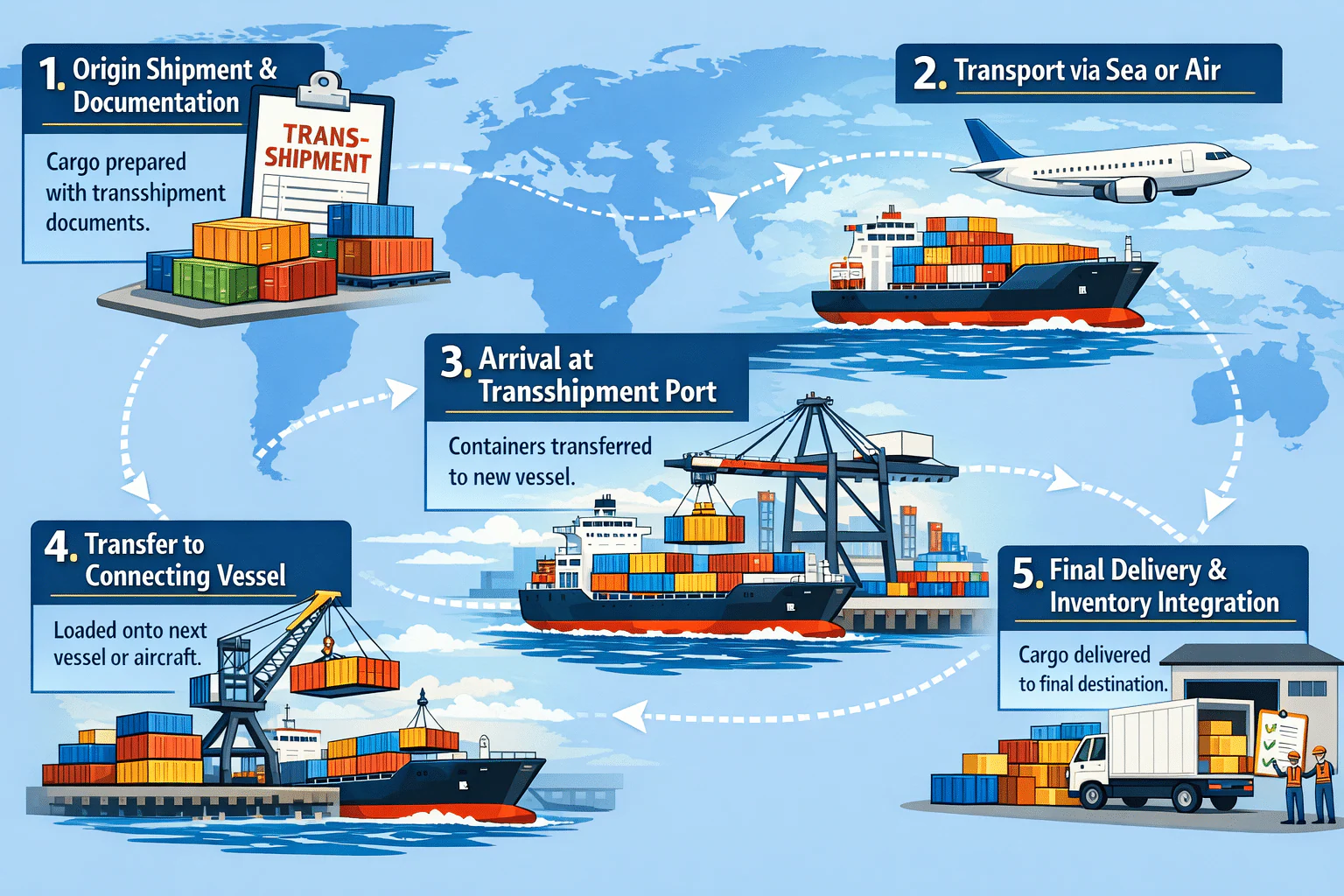
The transshipment process involves more than simply moving cargo between vessels. It is a coordinated sequence of operational, regulatory, and commercial steps designed to maintain continuity across the supply chain.
Step 1: Origin Shipment and Initial Documentation
The process begins at the port of origin, where cargo is prepared for international transport under a defined agreement with the carrier.
At this stage, shipping documents must already indicate that the cargo will undergo transshipment. This ensures the process is allowed under customs regulations and avoids unnecessary delays or additional tariffs.
Step 2: Transport via Sea or Air
Cargo is transported either at sea or via air cargo, depending on cost, urgency, and route availability. In many trade lanes such as shipments from Indonesia to Australia or Bangladesh direct vessel connections are limited, making transshipment a practical necessity.
Step 3: Arrival at the Transshipment Port
Upon arrival at the intermediate port, cargo remains under customs control. During this phase, transloading may occur, where containers are transferred to another vessel or consolidated with other shipments. Importantly, the final destination does not change, which distinguishes transshipment from re-export.
Step 4: Transfer to Connecting Vessel
Cargo is then loaded onto the next available vessel or aircraft according to the revised shipping schedule. This flexibility allows companies to respond to congestion, vessel delays, or route disruptions, something that direct shipment does not always permit.
Step 5: Final Delivery and Inventory Integration
Once cargo reaches the destination port, it enters the local distribution network. At this stage, accurate tracking data is critical to synchronize delivery timelines with inventory management systems.
Without real-time visibility, delays during transshipment can ripple across procurement, warehousing, and sales operations.
Major Transshipment Ports Around The World

Certain global ports have evolved into major transshipment hubs due to their location, infrastructure, and connectivity. These ports play a critical role in maintaining efficiency across international supply chains.
Singapore
Singapore is one of the world’s largest transshipment hubs, connecting Asia-Pacific trade routes. Its strategic position supports cargo flows between Southeast Asia, Australia, and South Asia, offering reliable vessel connections and advanced tracking infrastructure.
Tanjung Pelepas (Malaysia)
Serving as a key alternative hub in Southeast Asia, this port supports high-volume transshipment activity for cargo originating from Indonesia and surrounding regions. Its efficiency helps mitigate congestion risks commonly faced by direct shipment routes.
Jebel Ali (UAE)
Jebel Ali functions as a central transshipment gateway linking Asia, Europe, and Africa. Its role is particularly significant for long-haul shipments that require flexible routing and tariff management.
Colombo (Sri Lanka)
Colombo has become a strategic transshipment point for South Asian trade, especially for cargo moving to and from Bangladesh. Its geographic position allows carriers to consolidate shipments before final distribution.
Busan (South Korea)
Busan supports transshipment flows across Northeast Asia and global trade lanes. Its advanced port systems enable high visibility and process reliability, reducing uncertainty for shippers.
Essential Tools to Manage Transshipment and Logistics Risks
As global logistics continue to evolve, businesses can no longer rely solely on static routing decisions. To handle transshipment effectively and reduce supply chain disruption, businesses need an Warehouse system with a focused set of integrated capabilities, such as below :
1. Real-Time Shipment and Inventory Visibility
System must provide real-time tracking for goods moving via direct shipment or transshipment, including inventory that is at sea or in air cargo. This visibility helps businesses manage stock accurately across multiple ports and transit points, supporting better inventory management decisions.
2. Automated Shipping and Compliance Documentation
Since transshipment is only allowed under strict customs requirements, the system used should automatically generate and manage essential shipping documents such as bills of lading and cargo manifests. This reduces errors, supports regulatory compliance, and minimizes delays caused by documentation issues.
3. Supply Chain Monitoring and Exception Alerts
Rather than reacting to delays, it should provide end-to-end supply chain visibility and alert teams when vessel schedules change or disruptions occur. This enables faster decision-making during unexpected events.
4. Multi-Location Inventory Control
An effective system must support inventory coordination across warehouses, consolidation hubs, and transshipment ports, ensuring accurate stock data and smooth transfers between locations.
5. Integrated Cost and Tariff Management
The platforms used should consolidate logistics costs including freight charges, handling fees, and tariffs into a single financial view. This allows businesses to evaluate the true cost impact of transshipment versus direct shipment strategies.
By bringing these essential capabilities into a single, integrated platform, like an ERP system, it enables businesses to manage transshipment and logistics operations with greater clarity and control. This can helps businesses reduce uncertainty, improve inventory accuracy, and maintain operational continuity
Conclusion
Managing transshipment and modern logistics requires more than choosing the right shipping route. Businesses need visibility, flexibility, and control across the entire supply chain to respond effectively to disruption.
In example, HashMicro ERP helps integrate shipment tracking, inventory management, and logistics costs into one unified system enabling businesses to manage both direct shipment and transshipment with greater clarity and confidence.
For companies exploring how to improve their logistics operations, HashMicro offers a free demo, try it to experience how an integrated ERP system can support a more resilient supply chain.

Frequently Asked Questions
Transshipment tracking refers to the process of monitoring goods as they are moved from one mode of transport to another at an intermediate location before reaching their final destination. It ensures that cargo is accounted for during the transfer and helps identify any delays or issues that may occur during the transshipment process.>
A transshipment vessel is an intermediate ship that transfers cargo from the port of origin to a transit point before the goods are loaded onto another vessel toward their final destination, aiming to optimize logistical routes and shipping efficiency.>
Transshipment is generally legal and widely used in global logistics to optimize shipping routes. However, it becomes illegal if used to bypass sanctions, evade taxes, or disguise the origin of prohibited goods.>
Transshipment under CBP (U.S. Customs and Border Protection) is the legal movement of goods through intermediate ports, requiring strict documentation and bonds to ensure cargo isn’t diverted into domestic commerce without paying duties.>