






Do you know that businesses managing inventory manually often face expensive mistakes each year? Many of these errors can be avoided by using effective methods like the First-In, First-Out (FIFO) method. Whether you run a small shop in Manila or manage a large distribution center in Cebu, applying FIFO principles can make a big difference.
Using inventory management by HashMicro that supports FIFO can further enhance this process. These tools automate inventory management, ensuring FIFO is applied consistently. This improves accuracy, reduces waste, and boosts efficiency, ultimately impacting your bottom line and helping you stay competitive.
To learn more about how FIFO works and how you can apply it effectively in your business, read our next section on “What is the FIFO Method.”
Key Takeaways
The FIFO (First-In, First-Out) method helps businesses reduce waste and improve profitability by ensuring that the oldest inventory items are sold first.
FIFO is especially beneficial for industries with perishable goods, such as food and beverages, as well as sectors like electronics and fashion, where product relevance is key.
FIFO calculations use the oldest purchase batches first to determine COGS and ending inventory value.
FIFO offers simple tracking and realistic inventory value, but it can also increase taxable income during inflation.
What is the FIFO Method?
The FIFO (First-In, First-Out) method actively manages the control of inventory by selling or using the first items added to inventory first. This technique ensures that goods purchased or produced earlier are utilized or sold before newer inventory.
FIFO effectively aligns inventory costs with current sales prices, giving companies a more accurate assessment of their inventory value. By selling older items first, businesses base their cost of goods sold (COGS) on the cost of earlier purchases, often reflecting lower prices.
This method also prevents discrepancies between current market prices and the inventory recorded in financial statements, providing businesses with a clear and consistent view of profitability.
How the FIFO Method Works
FIFO follows one simple rule, that is businesses sell or use their oldest inventory first. That rule shapes two things at once, the cost recorded for each sale and the value of the stock that remains. Both effects show up in daily operations and in financial reports.
The rule matters most in industries where freshness, relevance, or expiry dates drive value. Food and beverage companies move older stock first to cut spoilage and avoid aging inventory. A single missed batch can turn a profitable order into written-off stock.
Fashion, electronics, and pharmaceutical firms apply the same logic for a different reason. Their products lose value or become obsolete fast, so selling the oldest units first protects margins. FIFO also mirrors the real flow of goods, which keeps stock records and audits simple.
That flow becomes clearer once you turn it into numbers, first through valuation, then through the calculation itself.
FIFO Inventory Valuation Explained
FIFO inventory valuation is straightforward. The cost of goods sold (COGS) draws from the earliest inventory purchases. During inflation, when prices climb over time, COGS reflects those older and lower costs.
The remaining inventory then carries the most recent, higher costs. That leaves the balance sheet closer to current market value, which gives finance teams a more accurate picture of what the stock is worth today.
Under Philippine Financial Reporting Standards, that carrying value is then checked against the net realizable value of each item, and whichever is lower is what goes on the books.
The FIFO Calculation Process
The calculation matches the oldest inventory costs with the newest sales. For every sale, you assign the cost in purchase order, starting with the earliest batch still on hand.
Once that batch runs out, the next oldest batch takes over, and the cycle repeats. Recording each layer this way keeps COGS traceable and makes the ending inventory figure easy to defend during an audit.
FIFO Formula & Calculation Example
The FIFO formula does not subtract the oldest inventory cost from revenue. It calculates the cost of goods sold (COGS) by assigning the cost of the oldest units to the units sold first. The cost moves batch by batch until the sale is fully covered. It is expressed as:
Because the earliest costs go out first, the ending inventory keeps the value of the most recent purchases. The steps below show how to apply the formula to one sale, then a full example follows with real numbers.
Step-by-Step Calculation
- Identify the oldest inventory batch and its unit cost.
- Match the units sold with that batch first.
- Multiply the number of units sold by the unit cost of that batch.
- If the sale exceeds the first batch, continue with the next oldest batch.
- Add the costs from each batch to get the total FIFO COGS, the figure that drives your reported inventory costs.
Real-Life Example and Walkthrough
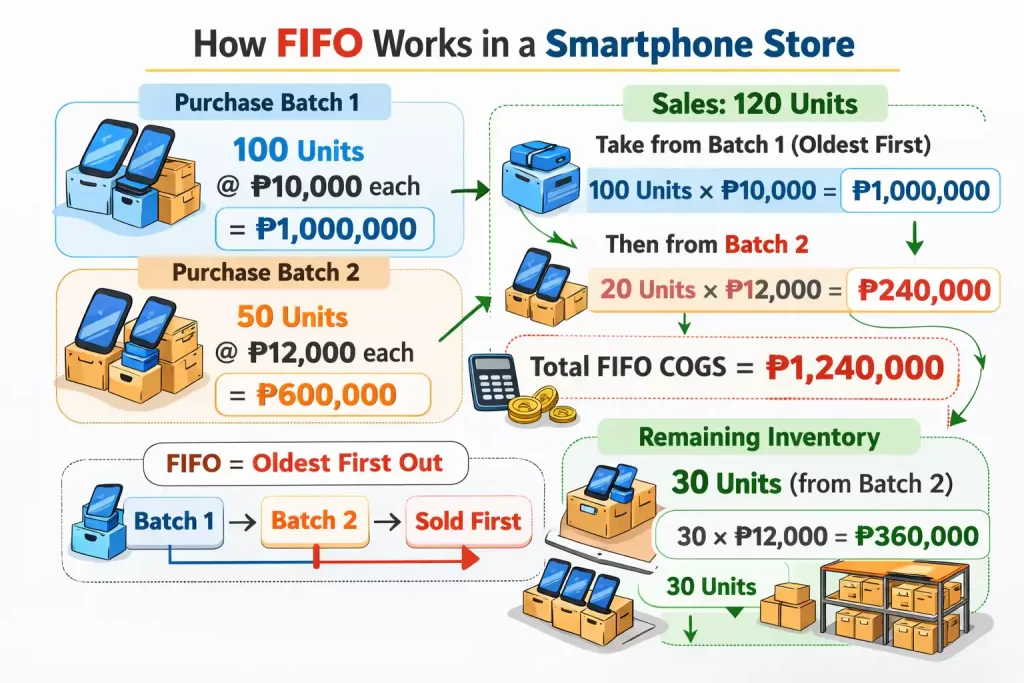
Suppose an electronics store purchased 100 smartphone units at ₱10,000 each and later purchased 50 more units at ₱12,000 each.
If the store sold 120 units, FIFO assigns the cost of the first 100 units to the oldest batch:
- 100 × ₱10,000 = ₱1,000,000
The remaining 20 units come from the second batch:
- 20 × ₱12,000 = ₱240,000
So, the total FIFO COGS = ₱1,240,000
The remaining inventory is 30 units from the second batch, valued at:
- 30 × ₱12,000 = ₱360,000
This method ensures that the business records the oldest inventory costs first, while the remaining inventory reflects more recent purchase costs. Tracking each batch inside an inventory management system keeps this calculation accurate once order volume grows.
Pros and Cons of the FIFO Method

The FIFO method, like any other inventory management method, has its own benefits and downsides. How strongly you feel each one depends on your margins, your tax position, and the system behind your records. Businesses that run FIFO inside ERP software in the Philippines tend to feel the downsides less, because the system keeps every cost layer intact. These key pros and cons will show you if FIFO fits your operation:
Advantages
- Higher Valuation for Ending Inventory: FIFO results in a higher valuation for ending inventory, as it accounts for the most recent costs.
- Increased Net Income: By using older, lower-cost inventory first, businesses can show higher profits during inflationary periods.
- Reflects Actual Inventory Movement: FIFO accurately represents the physical flow of inventory, especially for perishable goods.
Disadvantages
- Potential Discrepancies with Spikes in COGS: During periods of rapid price increases, FIFO may lead to discrepancies in COGS, affecting profit margins.
- Higher Taxes Due to Increased Income: Higher reported income can lead to higher tax liabilities, a significant consideration for businesses.
FIFO vs. Other Inventory Methods
Businesses use several inventory valuation methods, and each one changes how cost, stock value, and profit appear in the books. The table below compares FIFO with the three methods it competes with most often.
| Method | How It Works | Key Difference from FIFO |
|---|---|---|
| FIFO (First-In, First-Out) | Sells or uses the oldest inventory first, so the earliest purchase costs move into COGS. | Baseline method. The cost flow mirrors how goods physically leave the warehouse. |
| LIFO (Last-In, First-Out) | Sells the most recently acquired inventory first, so the newest costs move into COGS. | Opposite cost flow. It can lower taxes during inflation, but it rarely matches the real movement of stock. |
| Average Cost Method | Averages the cost of all units on hand and applies that single average to every sale. | One blended cost instead of cost layers. Simpler to run, but less accurate when purchase prices swing. |
| Specific Identification | Tracks every item individually and assigns its exact purchase cost at the point of sale. | Item-level precision instead of batch order. Highly accurate, but impractical at high volume. |
Among these options, the LIFO method is the one Philippine businesses cannot use, since PFRS follows IAS 2. In practice, the real decision is between FIFO and the average cost method.
FIFO sits in the middle of that range, more accurate than a blended average, far lighter to run than item-level tracking. The next section will helps you decide which method fits your operation.
That choice only holds up if every batch is actually costed in the order it arrived. Manual spreadsheets lose that discipline once stock moves across several warehouses, and the FIFO layer quietly drifts from what is physically on the shelf. Software that enforces batch order keeps your COGS and ending inventory defensible at audit.

How to Choose the Right Inventory Method

No single method wins for every business. The right one depends on what you sell, how fast your costs move, and what your accountant must report. Check these five factors before you commit, since switching methods later means restating your books.
- Product shelf life: Perishable goods, medicine, and fast-moving fashion lose value on a clock. FIFO fits these categories because its cost flow follows the same order your team already picks stock.
- Cost volatility: Check how much your purchase prices moved over the past year. Stable prices make the average cost method workable, while sharp swings make FIFO cost layers far more informative.
- Reporting rules: Philippine companies report under PFRS, which follows IAS 2 and does not permit LIFO. That narrows most local decisions to FIFO or average cost before anything else matters.
- Inventory volume: Count your SKUs and your monthly transaction lines. Specific identification suits low-volume, high-value items such as vehicles or jewelry, while FIFO handles thousands of interchangeable units without extra tracking work.
- System capability: A method is only as reliable as the records behind it. Spreadsheets lose cost layers quickly, so check whether your inventory system can store batch costs and rebuild COGS on demand.
Most Philippine businesses land on FIFO for a practical reason. It matches how stock physically moves, keeps inventory turnover honest, and cuts the spoilage and obsolescence losses that hit local retailers and distributors hardest.
Conclusion
Wrapping up, it’s clear that the right inventory management approach can really impact your business’s success. The FIFO method, with its simple yet effective strategy, helps keep your inventory organized, reduce waste, and ensure you’re always selling the oldest stock first.
Keeping track of inventory can be challenging, no matter how great your method is. That’s where the right inventory management system comes to the rescue. It’s designed to make your life easier, giving you real-time insights and reports that help you stay on top of your stock without the stress.

FAQ Around FIFO Method
The FIFO method is crucial because it ensures that the oldest inventory is sold first, reducing waste, preventing obsolescence, and providing a more accurate reflection of inventory costs, especially in industries with perishable goods or fluctuating prices.
FIFO is better because it reduces waste by selling older stock first, reflects actual inventory movement, and provides accurate financial reporting during inflation by aligning costs with the oldest inventory.
To solve FIFO, track inventory costs from the oldest to the newest. Match the oldest costs to sales first, then continue with the next oldest until all units sold are accounted for.
FEFO is better when products have expiration dates, such as food, medicine, and cosmetics. FIFO works well for general inventory, but FEFO helps businesses reduce spoilage and sell items before they expire.>
Yes, because LIFO often feels less intuitive and may not match the actual physical flow of inventory.>