





Singapore enforces clear employment regulations through the Ministry of Manpower (MOM) to uphold fair consideration. These rules aim to protect local workforce opportunities while still allowing businesses to access foreign talent.
Beyond compliance, hiring decisions directly influence workforce stability and long-term business performance. Employers that prioritize transparency and fairness are more likely to build stronger teams and maintain organizational credibility.
To support these objectives, frameworks such as the Fair Consideration Framework (FCF) provide structured guidance for employers. When applied effectively, they help businesses stay competitive while fostering a sustainable workforce.
Key Takeaways
|
What is the Fair Consideration Framework?
The Fair Consideration Framework (FCF) by Singapore’s Ministry of Manpower ensures employers fairly consider local candidates when hiring foreign talent. It promotes merit-based evaluation without mandating a Singaporean be hired for every role.
Introduced in 2013, the FCF requires employers to advertise positions to locals and assess applicants based on skills and experience. Local candidates must be prioritized if equally or better qualified, ensuring fair opportunities while filling specialized roles.
The framework applies to Employment Pass holders, requiring employers to advertise roles to locals and assess candidates based on merit, supporting a strong Singaporean workforce.
The Evolution of the Framework
Since its inception, the FCF has grown from a basic advertising rule to a stronger enforcement framework. Initially focused on the Jobs Bank (now MyCareersFuture), its scope expanded as hiring discrimination concerns increased.
Today, the FCF aligns with the Tripartite Guidelines on Fair Employment Practices (TGFEP). Companies with unusually low Singaporean PMET representation are monitored and may face scrutiny, showing the government’s active stance on fair hiring.
Key Compliance Requirements for Employers
Compliance with the FCF is not merely a box-ticking exercise. It involves a systematic approach to recruitment that must be documented and justifiable. The core requirement centers on the advertisement of job vacancies, but the obligations extend into the selection process itself.
The MyCareersFuture Advertisement Requirement
The most visible component of the FCF is the requirement to advertise job vacancies on MyCareersFuture (MCF). Before submitting an Employment Pass application, employers must advertise the job on MCF for at least 14 consecutive days.
The advertisement must meet specific criteria to be considered valid:
- Accuracy: The job description must accurately reflect the role’s responsibilities and requirements. It should not be tailored to fit a specific pre-selected foreign candidate.
- Salary Range: The advertisement must state a clear salary range. The offered salary to the EP applicant must fall within this advertised range. Employers cannot advertise a low salary to deter locals and then offer a higher salary to a foreign candidate.
- Duration: The 14-day window is a minimum. If the employer makes material changes to the job description or salary during this period, the 14-day count must restart.
Exceptions to the Advertising Requirement
While the rule is stringent, there are specific exemptions where advertising on MCF is not mandatory. However, MOM emphasizes that even if exempt, employers are still expected to practice fair hiring. Exemptions typically apply in the following scenarios:
- The company has fewer than 10 employees.
- The role is a short-term contingency of not more than one month.
- The fixed monthly salary for the vacancy is S$22,500 or above.
- The role is filled by a local transferee (an existing employee transferring from a related branch or subsidiary).
- The role is filled by a candidate under the intra-corporate transferee (ICT) arrangement (subject to strict criteria under trade agreements).
It is crucial to note that being exempt from advertising does not grant immunity from scrutiny. If a company is found to have pre-selected a foreign candidate without assessing other applicants, it can still be penalized under the broader principles of the FCF.
The Strategic Importance of Fair Hiring
Viewing the Fair Consideration Framework solely as a regulatory hurdle is a missed opportunity. When approached strategically, compliance with the FCF can drive significant benefits for an organization.
Accessing a Wider Talent Pool
By enforcing a rigorous search for local talent, companies often discover qualified candidates they might have otherwise overlooked. Relying on familiar networks or defaulting to foreign hires can create a blind spot.
The FCF forces organizations to cast a wider net, often revealing local professionals with the exact cultural context and market knowledge that a foreign hire might lack. This local knowledge is invaluable for businesses aiming to deepen their foothold in the regional market.
Enhancing Employer Branding
In an era where corporate social responsibility (CSR) and ethical practices are highly valued, a reputation for fair hiring is a significant asset. Companies known for prioritizing the local workforce and practicing meritocracy attract better talent.
Conversely, companies placed on the MOM watchlist for discriminatory practices suffer reputational damage that can affect client relationships and future recruitment efforts. Adhering to the FCF signals to the market that the organization is committed to national interests.
Stability and Retention
Building a Singaporean core provides workforce stability. Foreign professionals are subject to work pass renewals, changing immigration policies, and global mobility trends. A strong local core is less volatile and ensures business continuity.
Furthermore, investing in the training and development of local staff fosters loyalty and reduces turnover rates, which are often higher among expatriate staff who may view their stint in Singapore as temporary.
Step-by-Step Implementation Guide
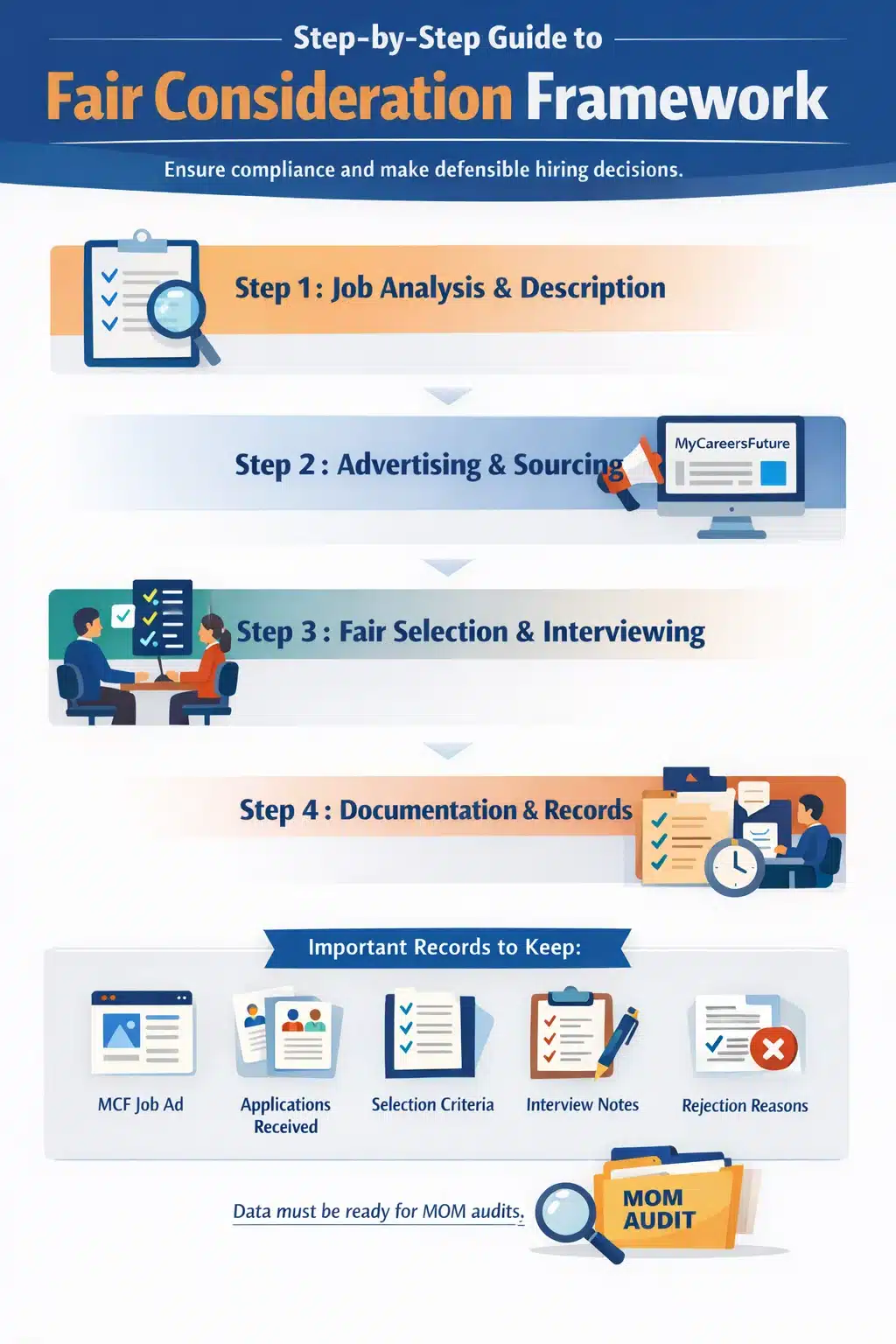
To ensure full compliance and optimize the recruitment process, organizations should follow a structured implementation plan. This approach minimizes the risk of errors and ensures that every hire local or foreign is defensible.
Step 1: Job Analysis and Description
Before a vacancy is even posted, HR and line managers must align on the job requirements. The job description (JD) must be skills-based rather than demographic-based. Avoid language that implies a preference for a specific nationality or gender.
The requirements listed must be essential to the job. For example, requiring “native-level proficiency” in a specific language must be justified by the business need, not just a preference for a specific cultural fit.
Step 2: Advertising and Sourcing
Post the job on MyCareersFuture immediately. Ensure the compensation range is realistic and consistent with market rates. While the ad is running on MCF, the company can and should use other channels (LinkedIn, recruitment agencies, company career pages) to source candidates.
Step 3: Fair Selection and Interviewing
Once applications come in, screen them based strictly on the criteria listed in the JD. If a Singaporean applicant meets the criteria, they must be interviewed. During the interview, focus on competency-based questions.
Avoid questions about personal background that are irrelevant to the job. If a foreign candidate is selected over a local candidate, there must be a clear, documented reason why the local candidate was unsuitable.
Step 4: Documentation and Record Keeping
This is the most critical step for audit purposes. Employers must keep records of:
- The job advertisement (screenshots of the MCF posting).
- The number of applications received (local vs. foreign).
- Selection criteria used.
- Interview notes and assessment forms for all shortlisted candidates.
- Reasons for rejecting local candidates.
These records should be retained for at least five years. In the event of an audit or a complaint, MOM will request this data to verify that fair consideration was given.
Common Challenges and Solutions
Despite best intentions, companies often face hurdles in implementing the FCF effectively. Understanding these challenges allows businesses to proactively address them.
Challenge: Niche Skill Shortages
The Problem: Employers often argue that they cannot find locals with specific, highly specialized skills, particularly in emerging tech sectors or niche engineering fields.
The Solution: While skill shortages exist, employers must demonstrate effort. This includes engaging with local universities for operational flow programs, offering training to bridge skill gaps for near-fit local candidates, and documenting these efforts.
Challenge: Implicit Bias
The Problem: Hiring managers often unconsciously favor candidates who share their background or cultural experiences, leading to “cloning” where teams lack diversity.
The Solution: Implement structured interview processes and diverse interview panels. Training hiring managers on unconscious bias is essential. Using scoring matrices for candidates ensures that evaluation is based on data and evidence rather than “gut feeling.”
Challenge: Administrative Burden
The Problem: The requirement to document every step of the process for every role can be administratively heavy, especially for high-volume hiring.
The Solution: Digitalization is key. Utilizing modern Human Resource Management (HRM) systems allows for automated tracking of applicants, storage of interview notes, and generation of compliance reports.
The Role of Technology in Fair Hiring
In the modern regulatory environment, managing fair consideration manually is risky and inefficient. Advanced HR technology plays a pivotal role in ensuring compliance while streamlining operations.
Automated Job Posting and Tracking
Sophisticated HR systems can integrate with job portals to automate the posting process. More importantly, they track the duration of the posting, ensuring that the mandatory 14-day window is respected before the system allows a recruiter to proceed with an EP application.
Centralized Candidate Data Management
To survive an audit, data retrieval must be swift and accurate. HR software acts as a centralized repository for all candidate data. It stores resumes, application dates, and communication logs.
When an employer needs to prove that they reviewed local applicants, the system can instantly generate a report showing who applied, when they were reviewed, and the outcome of that review.
Standardized Evaluation Frameworks
Technology allows companies to build standardized evaluation forms into the recruitment workflow. Hiring managers can be required to complete specific scorecards for each interview.
This ensures that every candidate is evaluated against the same criteria, reducing bias. Furthermore, these digital scorecards serve as permanent records of the decision-making process.
For example, some providers of business software solutions, such as SAP, Oracle, or HashMicro, offer modules that assist in recruitment management, ensuring that every step of the hiring funnel is documented and auditable.

Penalties for Non-Compliance
MOM takes a stern view of non-compliance. The penalties are designed to be punitive enough to deter discriminatory behavior. It is vital for business leaders to understand the severity of these consequences.
Debarment from Hiring Foreign Workforce
The most significant penalty is debarment. Companies found to have breached the FCF or practiced discriminatory hiring can be barred from applying for new work passes and renewing existing ones.
This debarment can last anywhere from 6 months to 24 months. For businesses that rely on foreign expertise to function, this can be crippling. It effectively freezes the company’s ability to bring in talent or retain key foreign staff whose passes are expiring.
Prosecution for False Declarations
When submitting an EP application, employers must declare that they have complied with the FCF advertising requirements. If an employer makes a false declaration, for example, posting an ad but having already pre-selected a candidate.
Placement on the Watchlist
Companies that may not have outright breached the law but show signs of discriminatory hiring (e.g., an exceptionally high concentration of a single nationality) may be placed on MOM’s watchlist.
While on the watchlist, their work pass applications are subjected to intense scrutiny and delays. They effectively lose the privilege of expedited processing, which hampers business agility.
Industry-Specific Use Cases
The application of the FCF varies slightly across different industries due to the nature of the work and the availability of local talent. Examining these nuances helps in understanding practical application.
The Financial Services Sector
The financial sector in Singapore has historically relied heavily on global talent. Consequently, it faces high scrutiny regarding the “Singapore Core.” Financial institutions are expected to have robust plans for knowledge transfer.
When hiring senior foreign bankers, for instance, the firm must often demonstrate a succession plan that involves grooming local talent to eventually take over those roles. Compliance here involves not just fair hiring today, but strategic workforce planning for tomorrow.
The Information and Communications Technology (ICT) Sector
The tech talent crunch is a global phenomenon. In Singapore, the demand for developers, data scientists, and cybersecurity experts far outstrips local supply. In this context, MOM acknowledges the need for foreign talent.
However, tech companies must still prove they are investing in the local ecosystem. This might involve hiring fresh local graduates and training them, rather than only hiring experienced foreign seniors. The FCF in this sector emphasizes the “effort” to train.
The Manufacturing and Engineering Sector
In specialized manufacturing, roles often require niche technical knowledge. Employers here must ensure that their job descriptions are precise. If a role requires knowledge of a specific legacy machine or proprietary software, it must be clearly stated.
However, employers must be careful not to make the requirements so specific that only one pre-identified foreign candidate can qualify, as this is a common red flag for investigators.
Comparison with Global Standards
Singapore’s FCF is unique, but it shares similarities with labor market testing requirements in other jurisdictions. Understanding these comparisons helps multinational corporations (MNCs) harmonize their global mobility policies.
United States: Labor Certification (PERM)
In the US, the PERM process for Green Cards requires employers to prove there are no able, willing, qualified, and available US workers. Similar to the FCF, it requires advertising. However, the US process is often more rigid and bureaucratic.
The FCF relies more on “principles” and “scrutiny” rather than the strictly prescriptive recruitment steps found in the US system, allowing Singapore employers slightly more flexibility provided the intent is genuine.
United Kingdom: Resident Labour Market Test
The UK previously utilized a Resident Labour Market Test (RLMT) similar to the FCF. However, post-Brexit reforms have largely removed this for skilled worker visas to streamline hiring.
Singapore has maintained and strengthened the FCF, signaling a distinct policy choice to prioritize social cohesion and local workforce development over pure deregulation.
Australia: Labour Market Testing (LMT)
Australia requires LMT for certain visa subclasses, mandating ads on national recruitment websites. The FCF is comparable but goes further by integrating the watchlist mechanism and using data analytics to identify firms with “unusual” hiring profiles.
Future Trends: COMPASS and Beyond
The landscape of fair hiring in Singapore underwent a massive shift with the introduction of the Complementarity Assessment Framework (COMPASS) for Employment Pass applications. The FCF is no longer a standalone pillar; it is now deeply integrated with COMPASS.
Integration with COMPASS
COMPASS is a points-based system that evaluates EP applications. It awards points for four foundational criteria: Salary, Qualifications, Diversity, and Support for Local Employment. The FCF principles are directly embedded in the “Diversity” and “Support for Local Employment” attributes.
- Diversity (C3): Companies score fewer points if the candidate’s nationality is already overrepresented in the firm. This discourages the formation of national enclaves, a key concern of the FCF.
- Support for Local Employment (C4): Companies score more points if they have a healthy share of local professionals compared to their industry peers.
This means that fair hiring is now mathematically scored. Non-compliance or poor diversity statistics directly impact the ability to secure an EP, regardless of how well the specific job was advertised.
Data-Driven Enforcement
Moving forward, MOM is utilizing more advanced data analytics to detect non-compliance. By analyzing CPF data and work pass data, authorities can identify firms that may be “window dressing”, posting ads but never hiring locals.
Focus on Skills Transfer
The future of FCF will likely place a heavier emphasis on skills transfer. It will not be enough to simply hire fairly; companies hiring foreign experts may increasingly be asked to demonstrate how those experts are upskilling the local team.
Conclusion
The Fair Consideration Framework underscores Singapore’s commitment to inclusive growth and merit-based hiring. For employers, fair hiring should be embedded into organizational culture, not treated as a compliance task, but as a long-term strategy.
By aligning hiring practices with FCF principles and leveraging structured processes, businesses can build a strong and competitive workforce. Companies that prioritize local talent will be better equipped to grow sustainably while navigating global talent challenges.
Want to ensure your hiring strategy aligns with Singapore’s employment framework? Schedule a free consultation to explore how your organization can strengthen compliance and workforce planning.
Frequently Asked Questions
-
Who is exempt from the Fair Consideration Framework advertising requirement?
Exemptions apply to companies with fewer than 10 employees, jobs paying a fixed monthly salary of S$22,500 or more, short-term roles of under one month, or roles filled by local transferees. However, fair consideration principles still apply.
-
What happens if an employer fails to comply with the FCF?
Non-compliance can lead to debarment from hiring foreign workers, prosecution for false declarations (fines/jail), and placement on MOM’s watchlist, which results in increased scrutiny and delays for work pass applications.
-
How long must a job be advertised on MyCareersFuture?
The job vacancy must be advertised on MyCareersFuture for at least 14 consecutive days before an Employment Pass application can be submitted.