




CPF contributions are a compulsory social security savings program in Singapore, where both employers and employees contribute monthly to the employee’s CPF account. These contributions help build funds across Ordinary, Special, and MediSave accounts for long-term needs.
This system helps more than 4.3 million members save for retirement, housing, and healthcare, with contributions totalling billions each quarter, according to the CPF Board’s latest statistics. Understanding how CPF contributions work is crucial for employers and employees in Singapore’s job market.
For employers, getting CPF contribution rates and ceilings right ensures compliance with Singapore law and smooth payroll processing. From basics to updated rates and ceilings, the system affects take-home pay and future benefits. That’s why an employee needs to understand CPF contribution in Singapore.
Key Takeaways
|
Get to Know CPF Contribution and Why It Is Important for Your Business
CPF contribution is a mandatory social security savings scheme in Singapore where employers and employees make monthly payments into an employee’s CPF account. The fund supports long-term needs such as retirement, housing, and healthcare for Singapore Citizens and Permanent Residents.
CPF contributions have two core parts: the employer’s contribution (an added cost on top of gross salary) and the employee’s contribution (a payroll deduction the employer must remit). Both are calculated in accordance with CPF rules, including age-based rates and wage ceilings.
For businesses, CPF affects compliance, payroll accuracy, and cost planning, so mistakes can create audit and penalty risk. Consistent, on-time CPF management also strengthens trust and retention because employees see their employer protecting their future.
Who Is Required to Receive and Pay CPF Contributions?
Generally, any employee who is a Singapore Citizen or a Permanent Resident and earns more than S$50 per month is required to receive CPF contributions. Here is a breakdown of who is eligible for CPF and the obligations that fall upon the employer.
1. Criteria for eligible employees
Employees eligible for CPF are Singapore Citizens or Permanent Residents working in Singapore under a contract of service, including full-time, part-time, temporary, and contract roles. CPF generally applies when monthly wages exceed S$50, regardless of hours worked or whether pay is hourly, daily, or project-based.
2. Exemptions and special cases
Foreign workers on Employment Pass, S Pass, or Work Permit are not covered under CPF, so no CPF contributions are required for them. Some arrangements also fall outside CPF on that income, such as partners in a partnership or directors paid only directors’ fees instead of wages.
3. Obligations of the employer
Employers must compute CPF, deduct the employee share, add the employer share, and pay the total to the CPF Board by the last day of each calendar month. Late or incorrect payments can trigger interest/penalties, and employers should keep clear CPF records for audit purposes.
Details of the Latest CPF Contribution Rates and Calculations
CPF contribution rates are structured progressively, determined by the employee’s age bracket and their monthly wage. Let’s examine the rates, ceilings, and a calculation example in more detail.
1. Table of CPF contribution rates by age group
Take a look at this table of CPF contribution rates by age group.
| Employee’s age (years) | Contribution rates from 1 January 2026 (monthly wages > $750) | ||
|---|---|---|---|
| By employer (% of wage) | By employee (% of wage) | Total (% of wage) | |
| 55 and below | 17 | 20 | 37 |
| Above 55 to 60 | 16 | 18 | 34 |
| Above 60 to 65 | 12.5 | 12.5 | 25 |
| Above 65 to 70 | 9 | 7.5 | 16.5 |
| Above 70 | 7.5 | 5 | 12.5 |
2. Understanding CPF contribution caps (Ordinary & Additional Wage Ceiling)
The Ordinary Wage (OW) Ceiling sets the maximum monthly salary subject to CPF contributions, currently set at S$6,800 as of September 2023, with further increases planned. Meanwhile, the Additional Wage (AW) Ceiling applies to supplementary income like annual bonuses.
Its calculation is more complex, as it depends on the total OW already subjected to CPF throughout the year. Mastering both ceilings is essential to ensure a company neither overpays nor underpays its CPF obligations.
3. Case study of a CPF calculation
To provide a clearer picture, consider an employee aged 35 with a monthly salary (OW) of S$7,000 and an annual bonus (AW) of S$10,000. The CPF contribution for their monthly salary will only be based on the OW Ceiling of S$6,800.
The calculation for the bonus will then take into account the total OW subject to CPF for the year to determine how much of the S$10,000 bonus falls within the AW Ceiling, ensuring the total annual contribution does not exceed the overall limit.
Mandatory vs. Voluntary CPF Contributions
Beyond the compulsory CPF payments (Mandatory Contributions), CPF also allows Voluntary Contributions as extra top-ups by employers or employees. Knowing how both work helps companies structure payroll and benefits clearly, while giving employees a practical way to strengthen long-term savings.
- Mandatory Contribution (MC)
Mandatory Contribution is the legally required CPF payment for eligible employees, and employers must calculate and remit it every month. The amount follows CPF Board rates based on the employee’s age and wages, creating a baseline for retirement, housing, and healthcare. - Voluntary Contribution (VC)
Voluntary Contribution is an additional CPF top-up made beyond the mandatory amount, either by the employer or the employee. For employers, it can be positioned as a meaningful benefit that supports retention and makes the total package more attractive. - Tax implications and benefits for the company
Employer Voluntary Contributions may be tax-deductible as a business expense, as long as they stay within the applicable limits and rules. This can be a cost-efficient way to enhance employee benefits without simply increasing base salary.
Common Challenges in CPF Management and How to Overcome Them
Managing CPF contributions, or managing payroll in a business, particularly in a company with a large workforce, can present numerous administrative challenges. Here are some prevalent challenges and how technology provides effective solutions to them.
- Calculation errors due to age-related rate changes
Tracking when employees move into a new age bracket can easily cause CPF rate miscalculations if HR misses the cutoff. Use a payroll system that auto-updates CPF rates based on date of birth and applies the correct rate every cycle. - Late payments and the risk of fines
CPF payments have a fixed month-end deadline, and even a one-day delay can trigger interest and penalties. Set automated payroll timelines with reminders and standardized month-end checklists so submissions are always on time. - The complexity of reporting for many employees
Managing CPF records for many employees is detail-heavy, and small data mistakes can create rework or audit risk. Centralize employee data and generate CPF-ready reports automatically to keep records consistent and exportable. - Automation solution
Manual CPF handling increases the chance of rate errors, late payments, and slow reporting as headcount grows. Technology such as payroll software automates age-based CPF updates, sends payment reminders, and produces compliance reports quickly to keep payroll clean and audit-ready.
Step-by-Step Guide to Paying CPF Contributions
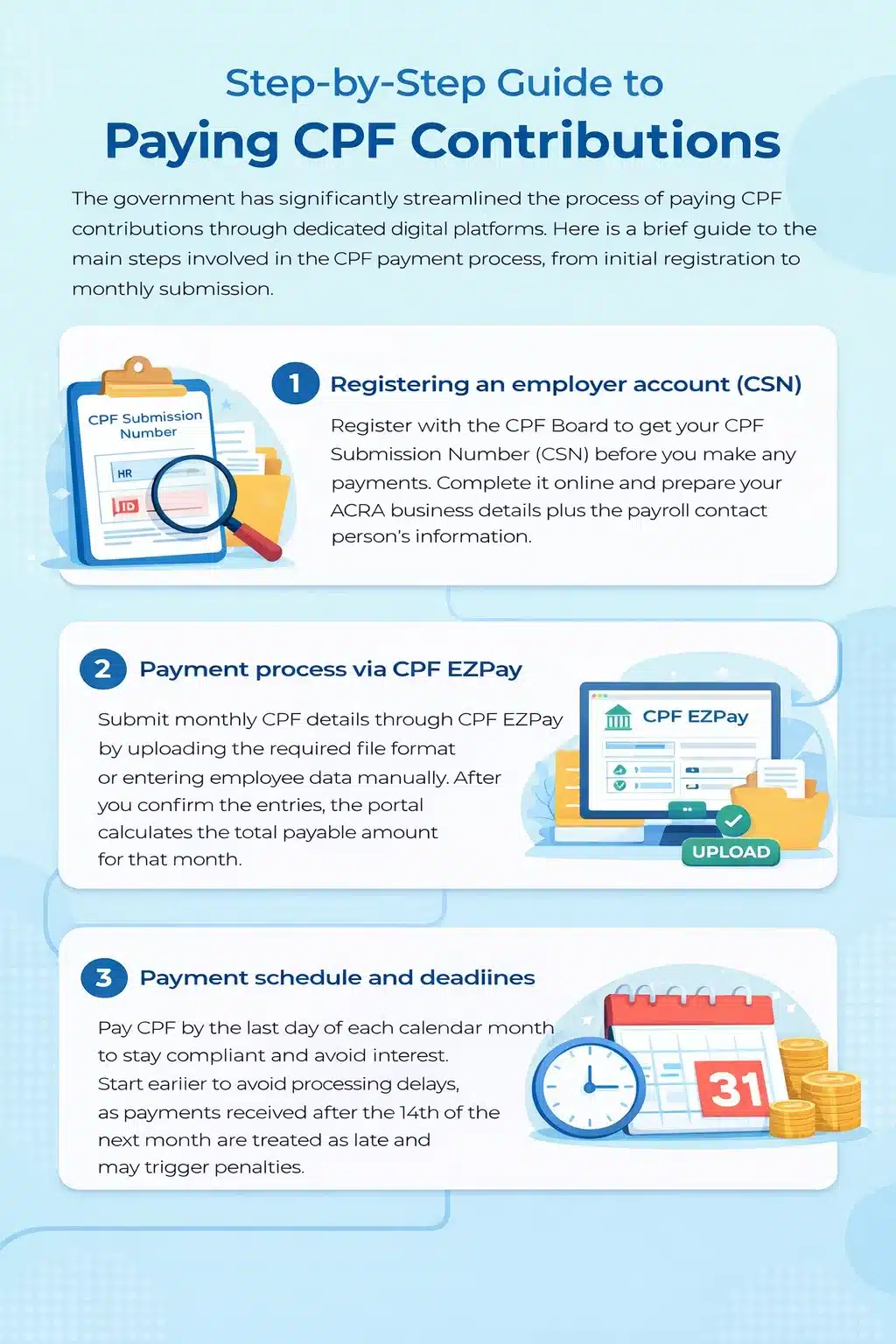
The government has significantly streamlined the process of paying CPF contributions through dedicated digital platforms. Here is a brief guide to the main steps involved in the CPF payment process, from initial registration to monthly submission.
- Registering an employer account (CSN)
Register with the CPF Board to get your CPF Submission Number (CSN) before you make any payments. Complete it online and prepare your ACRA business details, as well as the Singapore payroll contact person’s information. - Payment process via CPF EZPay
Submit monthly CPF details through CPF EZPay by uploading the required file format or entering employee data manually. After you confirm the entries, the portal calculates the total payable amount for that month. - Payment schedule and deadlines
Pay CPF by the last day of each calendar month to stay compliant and avoid interest. Start earlier to avoid processing delays, as payments received after the 14th of the next month are treated as late and may trigger penalties.
To understand better, take a look at this infographic.
How Mitsubishi Automates CPF Contribution Payment with HR System
Mitsubishi operates complex manufacturing and engineering businesses with large, multi-generational workforces. To manage CPF contributions accurately and at scale, the company relies on an integrated HRM system that embeds CPF compliance directly into payroll operations.
- Centralised employee data across manufacturing sites
Mitsubishi uses its HRM system to centralise employee profiles across plants, offices, and operational units. This ensures CPF calculations always reference a single, accurate source of employee age, citizenship status, and employment type. - Automatic CPF rate adjustments based on employee age
In a workforce with long tenure, age-based CPF rate changes are frequent and easy to miss manually. The HR system automatically updates CPF contribution rates when employees cross age thresholds, eliminating calculation errors. - Built-in payroll rules aligned with CPF regulations
CPF contribution formulas, wage ceilings, and eligibility rules are pre-configured in the HRM system. Payroll teams no longer need to interpret CPF updates manually, reducing compliance risk during regulatory changes. - Seamless payroll-to-CPF submission workflow
Once payroll is processed, CPF contribution data is generated in CPF EZPay–ready formats. This allows Mitsubishi to submit CPF payments efficiently without re-entering or revalidating employee data. - Consistent compliance across permanent and contract workers
Mitsubishi manages a mix of full-time, contract, and shift-based employees in Singapore. The HRM system applies CPF rules consistently across employment types, ensuring no eligible worker is missed. - Audit-ready CPF records for governance and reporting
Every CPF deduction, employer contribution, and submission record is logged automatically. This supports Mitsubishi’s internal audits, statutory inspections, and corporate governance standards. - Reduced payroll workload for HR and finance teams
By automating CPF calculations and submissions, HR teams spend less time on repetitive checks. This frees resources for workforce planning, skills development, and operational efficiency initiatives.
Conclusion
CPF contribution is a mandatory social security framework in Singapore that directly affects payroll accuracy, legal compliance, and employee financial security. Managing it properly helps businesses stay compliant while building trust and long-term confidence among their workforce.
If CPF calculations, submissions, or compliance checks are slowing your payroll down, getting the right guidance can make a real difference. Speak with our experts to review your CPF contribution process and ensure it runs accurately, efficiently, and in line with current regulations.
FAQ About CPF Contribution Singapore
-
What happens if a company is late in paying CPF contributions?
Companies that pay late are subject to a late payment interest of 1.5% per month on the outstanding amount, calculated on a daily basis.
-
Are part-time employees also entitled to CPF?
Yes, as long as the employee is a Singapore Citizen or PR and earns more than S$50 a month, they are entitled to CPF contributions, regardless of their part-time status.
-
Can the CPF calculation and payment process be automated?
Absolutely. Using payroll software like HashMicro’s can automate the entire process, from calculating rates to generating files for CPF EZPay, reducing errors and saving time.
-
What documents need to be kept regarding CPF payments?
Companies must keep detailed payroll and CPF payment records for each employee for at least 2 years. These records are crucial for internal audits and official inspections.
-
How are bonuses (Additional Wages) treated in CPF calculations?
Bonuses have a separate annual contribution ceiling. The calculation is based on the difference between the annual Total Wage Ceiling and the total Ordinary Wages (OW) already subjected to CPF throughout the year.