






Tap your card, hear a beep, grab your coffee the whole thing takes three seconds. But behind that moment, multiple banks are talking to each other, security checks are running, and money is already moving. That network quietly powering every cashless transaction is called Electronic Funds Transfer, or EFT.
Most people only notice it when something goes wrong a failed payment, an unexpected fee, a delayed deposit. But whether it’s your paycheck, a utility bill, or a mobile transfer to a friend, it’s all the same underlying system. Knowing how it works helps businesses cut transaction costs, manage cash flow better, and avoid the kind of surprises that show up on a bank statement.
Key Takeaways
EFT isn’t a single payment method it’s the system everything runs on. The method you choose within it determines how fast your money moves, what it costs, and whether you can get it back.
The right EFT method depends on three things, how fast you need the money to move, what you’re willing to pay, and how your industry actually operates. Getting that match wrong costs more than most businesses realize.
Between interchange fees, exchange rate markups, and intermediary deductions, the real cost of an EFT is usually higher than advertised and most of it is avoidable with the right approach.
What Is EFT Payment?

EFT payment is an electronic transfer of money between bank accounts or payment accounts without using cash or paper checks. It covers several payment methods, including ACH transfers, wire transfers, card payments, direct deposits, and some digital wallet transactions. EFT payments may include digital wallet transactions, depending on the platform and payment flow.
An EFT transaction usually starts when the sender authorizes a payment through a bank, payment processor, or digital platform. The provider verifies the account details, checks authorization and available funds, then routes the transaction through the relevant payment network.
The recipient’s bank or payment provider receives and posts the funds after the transaction clears. Processing time, fees, and reversibility depend on the EFT method, transaction volume, payment provider, and whether the transfer is domestic or international. Some merchants also offer buy now, pay later as an alternative payment arrangement.
How It Differs from Wire Transfers, ACH, and Digital Wallets
While all digital transfers are EFTs, the specific method used dictates the speed, cost, and reversibility of the transaction. It is helpful to think of EFT as the “genus” and specific methods like ACH or Wire as the “species.” For in-person transactions, a payment terminal can capture card or other electronic payment instructions.
| Key Differences | EFT Payment | Wire Transfers | ACH | Digital Wallets |
|---|---|---|---|---|
| Scope | Broad category for electronic money transfers | Specific EFT method | Specific EFT method using batch processing | Payment interface that may use different EFT rails |
| Processing speed | Depends on the method | Usually minutes to one business day | Usually one to three business days | Often instant within the platform |
| Cost | Varies by method and provider | Generally higher | Usually low | Varies by wallet and withdrawal method |
| Reversibility | Depends on the method | Usually difficult to reverse | May be returned or disputed | May support disputes or wallet-specific reversals |
| Best for | General electronic payments | Urgent or high-value transfers | Payroll, recurring bills, and vendor payments | P2P payments and customer convenience |
- ACH (Automated Clearing House)
This is the workhorse of the modern economy. It is designed for high-volume, low value transactions. When you receive your salary or pay a utility bill, it is usually via ACH. These transactions are processed in batches, which makes them incredibly cheap (often costing pennies) but slower, typically taking one to three days to settle.
- Wire Transfers
If ACH is a bus taking a planned route with many passengers, a wire transfer is a private jet. It moves funds individually and directly from one bank to another. It is fast often settling within hours or minutes but it is expensive. Banks charge significant fees for this speed and the manual intervention often required to process wires.
- Digital Wallets
Apps like PayPal, Venmo, or regional equivalents often act as a layer on top of traditional EFT rails. When you pay with a digital wallet, the transfer might happen instantly within the app’s ecosystem (ledger-to-ledger), but if you withdraw that money to your bank account, the app initiates a standard EFT (usually ACH) to move the funds. They provide a user friendly interface that masks the complex banking protocols churning in the background.
How to Choose the Right EFT Method?
Choosing the wrong transfer method is a common inefficiency in both personal finance and business operations. Using a wire transfer to pay a small vendor invoice is like taking a taxi to the mailbox unnecessarily expensive. Conversely, relying on standard ACH for a time sensitive real estate closing could result in a lost deal. Selecting the appropriate EFT channel requires balancing three variables: speed, cost, and Choosed volume.
- Speed and cost: Compare the required settlement time with the total transaction cost, including provider fees, exchange-rate markups, and possible intermediary charges.
- Transaction volume and business needs: High-volume businesses should prioritize batch processing, automation, reconciliation, and integration with their ERP system.
- Industry requirements: Retail may prioritize fast authorization, while B2B, healthcare, logistics, and regulated industries may require stronger approval controls, audit trails, and payment documentation.
- Push, pull, and reversibility: Push payments give the sender more control over timing, while pull payments support recurring collections. Reversibility and dispute rules should be reviewed before choosing a method.
Understanding EFT Fees

One of the most frustrating aspects of electronic payments is the opacity of pricing. While cash trades at face value, digital money has a toll at every gate it passes through. Understanding the fee structure of EFTs is essential for businesses to protect their margins and for consumers to avoid unnecessary charges. Each financial transaction may have different processing, authorization, and settlement requirements.
Where Hidden Charges Tend to Show Up
The advertised rate is often not the real cost. Merchants may pay interchange, processor markups, network, compliance, and chargeback fees, while international transfers often hide charges in weaker exchange rates or deductions from intermediary banks.
Ways to Minimize What You’re Paying Per Transaction
Processing rates are negotiable most businesses don’t realize this. High volume merchants can push for interchange plus pricing, which is more transparent than flat rate. Steering customers toward debit cards or direct bank transfers for larger invoices also cuts costs, since those methods carry lower fees than rewards credit cards.
Consolidation helps too. Paying vendors bi-weekly or monthly instead of weekly reduces the number of transactions and the fees that come with them. A finance team with visibility into payment data can spot where costs are creeping up and reroute accordingly.
How Safe Is Your Money During the Transfer?
Security is the bedrock of the EFT system. Without trust, the volume of digital commerce we see today would be impossible. The protection of funds during transit relies on layers of cryptographic protocols and regulatory safeguards.
- Encryption and Tokenization
Data moving between a terminal and a bank is encrypted intercepted, it’s unreadable. Tokenization adds another layer by replacing your actual card number with a one time digital stand in. Even if that token gets stolen, it’s useless.
- Authentication
The shift toward Two-Factor Authentication (2FA) and biometric verification (fingerprint or face ID) has made it significantly harder for unauthorized users to initiate transfers. In the corporate world, “dual control” is a standard security measure where one employee initiates a payment and a second, senior employee must approve it before funds are released.
- Regulation
In most countries, your liability is capped if someone makes an unauthorized transfer from your account provided you report it quickly. That legal pressure is what keeps banks investing in fraud detection. Most now use automated systems that can spot unusual activity and freeze a transaction before the money actually leaves.
Implementing EFT for Your Business
Transitioning to an EFT-centric payment model requires more than just signing up for a service. It involves a strategic integration of banking relationships, software, and legal compliance. A business may also use a payment gateway to connect customers, merchants, banks, and payment providers.
Here is a roadmap for businesses looking to implement or upgrade their EFT capabilities.
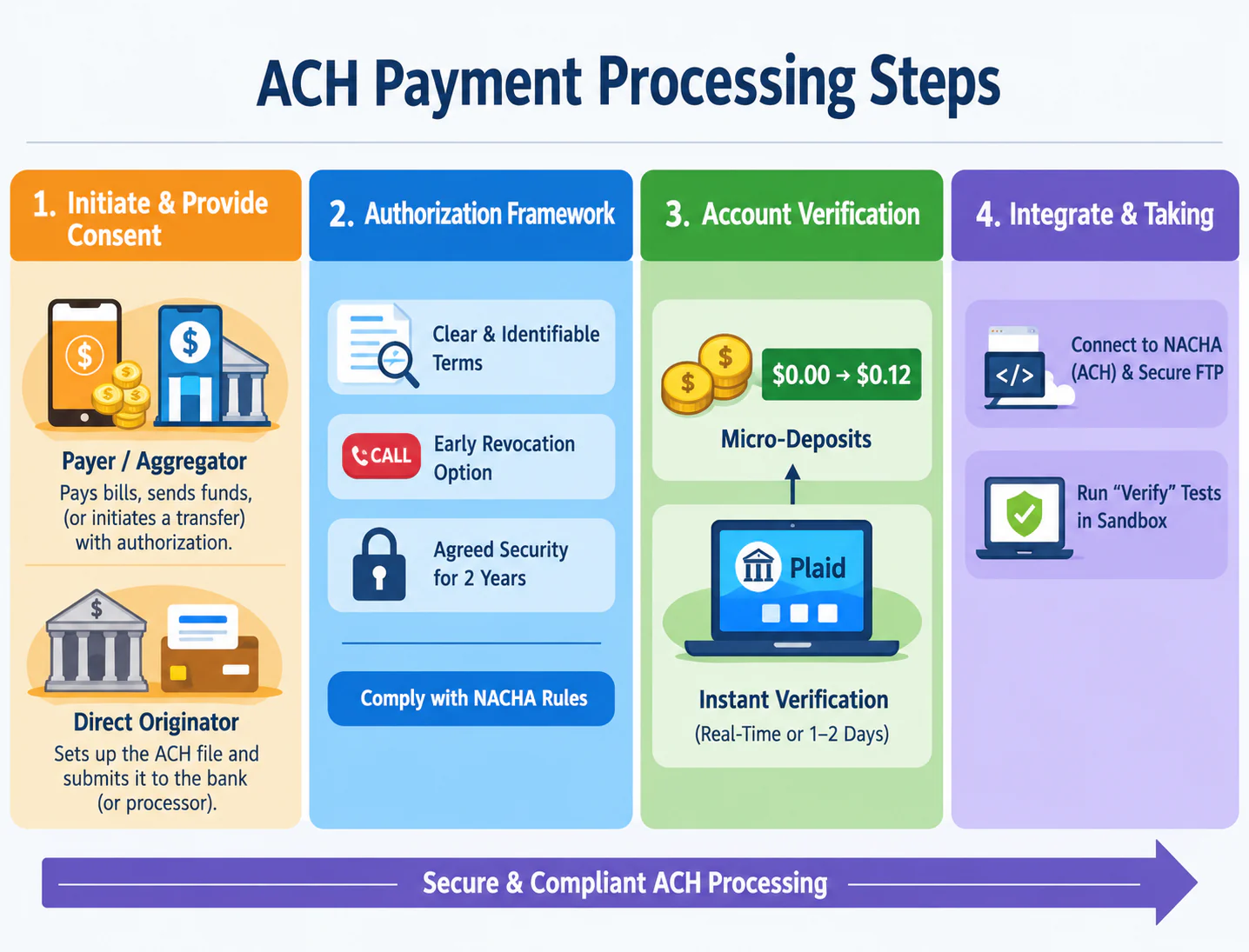
1. Assessment and Provider Selection
First, analyze your transaction volume and average ticket size. If you process thousands of small transactions, a Third Party Payment Processor (TPPP) or an aggregator (like Stripe or Square) might offer the easiest API integration, though their per transaction fees may be higher. For businesses with fewer, high value transactions, or massive volumes where every cent counts, a direct “Originator” relationship with a commercial bank is often more cost effective. Retail businesses can connect payment acceptance with a POS system to record sales at the point of purchase.
2. The Authorization Framework
Before you can debit a customer’s or vendor’s account, you must obtain proper authorization. This is a strict legal requirement regulated by NACHA (in the US) and similar bodies globally. The authorization must be:
- Clear and Readily Identifiable: The terms cannot be buried in fine print.
- Revocable: You must state how a customer can cancel the authorization.
- Stored Securely: You must keep a copy of the authorization (digital or physical) for two years after the final transaction.
For recurring payments, you are generally required to send a notification if the amount varies from the previous month or falls outside a pre agreed range.
3. Account Verification
To prevent failed payments and fraud, you must verify that the bank account information provided is valid. There are two common methods:
- Micro deposits: You send two small amounts (e.g., $0.03 and $0.12) to the account. The customer verifies these amounts to prove ownership. This is slow, taking 1-3 days.
- Instant Account Verification (IAV): Using services like Plaid or Yodlee, customers log into their bank via a secure portal during checkout. This instantly verifies the account exists, has funds, and belongs to the user.
4. Integration and Testing
Once the legal and banking framework is set, the technical integration begins. If using a direct bank connection, this often involves generating NACHA formatted files (fixed width text files) and uploading them via a secure FTP server. Modern implementations prefer RESTful APIs that handle the file creation in the background. Always run “penny tests” in a sandbox environment to ensure the data flows correctly between your ERP system and the banking network.
Pitfalls, Rejections, and Troubleshooting

EFT payments can be rejected, delayed, or returned because of incorrect account details, insufficient funds, invalid authorization, transaction limits, or bank processing schedules. A pending payment does not always mean the transaction failed; it may still be waiting for a cutoff time, review, or settlement.
To identify the problem, check the transaction status, reference number, submission time, expected settlement date, and any return or rejection code. Bank holidays, weekends, international processing, and compliance checks can also extend the timeline.
Common Reasons for EFT Payment Failures
- Incorrect account, routing, or beneficiary details
- Insufficient funds or exceeded transaction limits
- Missing, expired, or revoked payment authorization
- Bank holidays or missed processing cutoffs
- Fraud, compliance, or unusual-activity checks
- Technical errors, duplicate submissions, or incomplete payment files
If the bank provides an R-code or Notification of Change, use it to identify the reason for the return or the updated account information. Correct the source record before resubmitting the payment to avoid repeated rejections or duplicate transactions.
How to Troubleshoot a Failed EFT Payment
- Confirm the payment status and reference number.
- Review the account details, amount, authorization, and available balance.
- Check the provider’s cutoff time and expected settlement date.
- Review any rejection message, R-code, or compliance notice.
- Contact the bank or payment provider if the payment remains unresolved.
- Correct the original record and reconcile the final result.
When payment errors happen repeatedly, reviewing each transaction manually can slow down finance operations. A connected business system can help teams organize payment-related records and identify issues earlier, so unresolved transactions do not remain hidden in daily workflows.

Advanced Practices and the Future of EFT
The world of electronic payments is currently undergoing its most significant infrastructure upgrade in decades. Moving beyond basic debit and credit operations involves adopting new standards that allow for richer data and faster settlement.
1. ISO 20022 and Rich Data
Traditional EFT messages could move money but not much else attaching detailed invoice or remittance data wasn’t really possible.
The shift to ISO 20022 changes that by allowing rich, structured data to travel alongside the payment, so instead of receiving a lump sum and manually matching it to invoices, the payment arrives already telling you exactly what it covers.
2. Real Time Payments (RTP) and FedNow
Traditional ACH runs in batches and takes hours or days. RTP and FedNow are changing that both run 24/7 and settle in seconds, with no option to reverse.
For businesses, that kind of speed unlocks real flexibility, from paying suppliers on delivery to disbursing emergency funds without waiting for banking hours. For businesses handling digital transactions, integrating a payment gateway can help streamline payment processing and provide customers with a more convenient way to pay, while supporting more efficient cash flow management.
3. Cross-Border EFT Complexity
Taking EFT global adds layers of complexity regarding currency conversion (FX) and regulatory compliance (OFAC sanctions). Advanced payment operations now utilize “Local rail” aggregation.
Instead of sending an expensive international wire (SWIFT), a US company can use a provider that accesses the local EFT network of the recipient country (like SEPA in Europe or BACS in the UK). This treats an international payment like a domestic transfer, significantly lowering fees and landing times.
Conclusion
Understanding how EFT works from clearing networks to cross-border compliance gives businesses a real edge in managing cash flow, controlling costs, and avoiding payment failures before they happen. The mechanics are more accessible than they appear, and getting familiar with them is the first step toward building a more resilient financial operation.
For businesses evaluating how payments fit into their broader operations, the infrastructure you build around EFT matters just as much as the method itself. Looking into the best POS systems available in the Philippines is a good starting point for identifying platforms that support the payment channels your customers and vendors already rely on.
FAQ Around EFT Payments
EFT (Electronic Funds Transfer) is the broad category for all digital money movements. ACH (Automated Clearing House) is a specific type of EFT used primarily in the US for batch processing low-cost transfers like payroll and bill payments.
Timelines vary by type. Wire transfers can settle in hours, while standard ACH transfers typically take 1-3 business days. International EFTs may take up to 5 business days depending on intermediary banks.
Yes, EFTs use rigorous security measures including SSL encryption, tokenization, and multi-factor authentication. However, businesses must still guard against phishing and invoice fraud.
Common reasons include insufficient funds (NSF), incorrect account or routing numbers, bank holidays delaying processing, or security flags triggering a manual review by the bank.
Yes, but international EFTs (often called wire transfers or SWIFT transfers) operate differently than domestic ones, usually involving higher fees, exchange rates, and longer processing times due to the correspondent banking network.