









 Limited to 100 registrants


This article was first published in Asia Pacific Food Industry (APFI) magazine and written by Lusiana Lu, Business Development Director of HashMicro, in September 2017.
As someone in the F&B industry, I know how complex and chaotic business operations can be. An automated ERP solution makes it easier to handle all those back-breaking processes. In this article, I will share how ERP software functions have been shaped by the F&B industry and what to consider when choosing the right system.
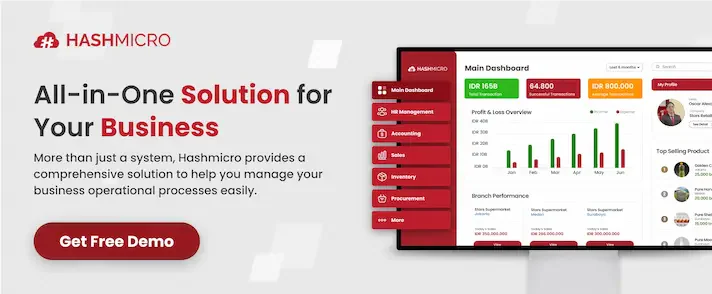
Nowadays, cloud-based ERP software is widely used because it helps F&B owners gain insight, visibility, and control across their operations. It also optimizes food production, simplifies purchasing and warehouse management, and provides scalability and flexibility to meet unique needs from anywhere. Try a free demo with HashMicro to see how it works for your business.
Key Takeaways
ERP software helps the food and beverage industry ensure quality, safety, efficiency, and compliance across operations.
When choosing ERP software, businesses should clearly define requirements, avoid focusing only on price, and ensure the system offers high mobility.
The right ERP software should simplify operations, ensure compliance, and support reliable tracking.
Elevate your F&B business with HashMicro ERP that ensures compliance, efficiency, and growth.
F&B Industry Challenges in Singapore
The food and beverage industry in Singapore is popular and highly competitive. Businesses face challenges such as inventory management problems and the growth of online ordering, all while competing with many other establishments. Managing these with manual systems makes it harder for operations to run efficiently, which is why more F&B companies are turning to ERP software for food and beverage businesses.
Benefits of Food Processing ERP Software
Here are the main benefits of food processing ERP software that I’ve found helpful:
- Product labeling and packaging: ERP software can manage label data such as ingredients, allergens, and nutrition information. The FDA explains the regulatory and consumer-information role of food labels; contamination prevention depends on separate food-safety and packaging controls.
- Recipe management: I can control any changes in the food production cycle to ensure quality, consistency, and traceability.
- Food quality: ERP software maintains nutrition, taste, and health standards at every stage to meet consumer expectations.
- Data access for recalls: I can quickly retrieve data in case of recalls caused by issues like cross-contamination, undeclared allergens, or improper labeling.
- Food safety compliance: The system supports regulations such as packaging, allergen warnings, and shelf-life protocols set by the US Food and Drug Administration.
- Inventory traceability: I gain strong control over traceability to ensure the quality and safety of food supplies with precise data on timing, management, and flow of goods.
- Contamination control: Effective tracking, labeling, and documentation help me reduce risks of decay or food-borne diseases.
- Waste reduction: ERP software minimizes raw material shortages and waste, enabling higher profits and more efficient production.
- Sales management: I can manage direct and indirect sales channels in the food and beverage industry from a single cloud platform.
- Sales performance: Real-time dashboards let me track representative performance, transaction profitability, and campaign results.
- Customer service automation: With one cloud-based system, I can automate customer service, support, and status inquiries online.
Benefits of ERP for Restaurants and F&B Outlets
For restaurants and F&B outlets, these are the main benefits and the problems they solve:
| Benefit | Problem Solved | HashMicro Module |
| Sales tracking | Cash, debit, and credit transactions are hard to track manually. The system records even the smallest transaction, shows what customers like, and generates sales reports. | Restaurant POS System |
| Advanced payment process with POS | Slow checkouts and front-of-house to kitchen miscommunication. The POS speeds up payments, tracks daily profit, loss, and sales tax, and sends orders straight to the central kitchen. An easy-to-use POS also generates sales reports for any time range automatically, so you can focus on the best-selling items in your purchase history. | Restaurant POS System |
| Efficient workforce management | Daily management, sales, and accounting work takes too long. Automating these tasks frees staff for work that needs manual checking and improves productivity. | Human Resource Management |
| Inventory monitoring | Unexpected food recalls and poor stock visibility. Integrated inventory tracks lot numbers, dates, quantities, and movement. Real-time data also makes raw material usage forecasts more accurate to avoid waste, monitors stock transfers across locations, and calculates how much stock to repurchase. | Inventory Management |
| In-depth financial reports | Financial reporting in the culinary industry is complicated. Integration with accounting produces detailed reports, from profit and loss to sales tax. | Accounting System |
| Customer management automation | Customer data is scattered across outlets. A centralized database stores loyal customers' sales history and members' frequently purchased items, improving customer segmentation and demand forecasting. | CRM |
Consistent Customer Experience Across Outlets
A reservation system lets customers book a table, date, and time of visit, so every outlet can prepare the right service and meet their expectations. Delivering the same experience at each location also strengthens your restaurant's reputation. For more detail on running several locations, see how automation in F&B can help you manage multiple outlets.

Key F&B ERP Features: Traceability, Quality Control and Scheduling
ERP software for food and beverage businesses acts as a single source of truth for all teams and facilities, removing information silos between departments. On top of that foundation, three features stand out.
Easy Product Tracking
Today's consumers want to know where and how their products are made, and they tend to be more loyal to companies that are open about the ingredients they use and source them responsibly. Delivering that transparency means coordinating information with vendors, suppliers, and distributors at every stop, and an ERP system handles the labor-intensive work of keeping those records up to date as materials travel from the source to manufacturing to the retailer.
Food Safety and Quality Control
No F&B company wants to deal with a product withdrawal, and customer expectations and regulatory standards keep getting stricter. F&B automation provides quality assurance tools to make sure every product leaving the line meets your requirements, from automated inspections with smart scales and sensors to AI-driven image analysis for anomaly detection.
Because these tools update in real time, industry-specific ERP software can track your readings and flag deviations in consistency, volume, appearance, or any other quality that matters for your products, so problems are fixed before they worsen.
Schedule automation
People are prone to error, but when the system schedules and executes key tasks automatically, preventable mistakes are far less likely. Cleaning and maintenance are crucial in F&B, and ERP can schedule them at the most advantageous times to reduce production downtime.
Connected devices in your facilities can also be used to automate and calibrate safety inspections for your food products, while supervisors track performance through an interface that always reflects the latest data.
Food for Thought When Choosing an ERP Software
Before deciding to implement ERP software for your food business, here are some important parameters you need to know.
1. Create a clear and extensive list of requirements before you start looking for ERP vendors
A good evaluation begins by assessing my current business needs and processes to determine what I need from an ERP solution. It’s helpful to start by evaluating the business challenges and individual pain points I need to address and determine the business value my company needs to retrieve from the software.
Although this process may take some time, especially for large companies or companies with complex processes, it is very important. There is never a perfect strategy that companies can use when implementing an ERP business solution. Still, most industry professionals encourage organizations to take the time and map out the processes to get it right on the first implementation.
2. The best price doesn’t guarantee the best quality of an ERP software
I should not choose an ERP solution based solely on the low price. Of course, the cost is one of the main factors. Still, affordable systems usually lead to more issues down the road, including the inability to change to meet new demands or difficulty retrieving data.
I also need to consider integrating the ERP solution with other systems or tools. Companies that follow these cautious steps are likely to end up investing in an ERP technology that best suits their overall needs.
3. Look for an ERP system that offers high mobility
Since mobility and the concept of ‘bring your own devices (BYOD)’ increases across industries, accessing ERP systems from desktops alone is no longer an option. I should choose an ERP solution that enables me to be productive on smartphones and tablets while at the same time ensuring that all-important information is safe.
Think Carefully Before You Customize Your ERP Software

Companies should consider the number of adjustments required to configure and deploy ERP software. Highly customized systems will result in higher costs in the initial deployment and when upgrading from release to release. As a business with unique requirements, I need to understand these considerations to eliminate steep cost curves. Using a restaurant pos system can facilitate the transaction process, promotion programs, and also can manage all branches in one system
In addition, I need to understand that customization will require longer implementation cycles, longer ROI, and more instability. Turnkey solutions may offer less flexibility but more stable and less initial and ongoing costs.
In general, many of my company’s basic business processes are almost identical (e.g., paying invoices, collecting revenue, and procuring supplies). This is why ERP software is built in the first place. I can take advantage of standard processes that are already advanced and tested by many other companies.
If I believe that my business needs customized ERP software, then I must make sure I list all the needs very well. I must remember that the cost of the customization is not just about writing and testing the code for the initial implementation but also includes providing long-term support of custom code and treating every adjustment as an exception each time I update my software. I should keep it simple, and try not to allow customization into my ERP program.
ERP solutions can solve my company’s challenges instead of adding more problems. So, it’s important to make sure that the ERP solution I choose has the following features:
Specific Industry: I need to make sure that the ERP solution I choose has been built to meet the needs of the F & B industry and has a track record to prove it.
Scalability: An ERP system built on a scalable architecture will help me manage growth. The fewer adjustments the system requires to meet a particular need, the more convenience the system provides.
Functionality: The right ERP system must have the ability to do everything my business strategy demands. It should be fast, reliable, and easy to integrate with my other systems.
Deployment Options: On-premise, Cloud, or hybrid options combined with mobile access for my employees ensure that my company will remain flexible and responsive.
Features to Consider for an ERP Solution
Having an ERP solution that is easy to implement is very important for me. I do not want to go through a difficult learning process or have negative impacts on the performance of my ERP system. An ERP system with an intuitive, user-friendly interface will enhance my employees’ satisfaction and productivity.
To find a perfect ERP software for my food and beverage business, I need to make sure that it highlights the following features:
- Expiry date management (FEFO)
- Lot number tracking
- Barcoding system
- Pick & put away
- Stocktaking
- Weighing scale integration to production
- Inventory transfer
- SKU management
- Bin management
- Logistic planning
- Handheld inventory device
- Manufacturing planning
- Bill of material
- Batch/item production consolidation (grouping similar items into one production window)
- Multi-plan production management
- Production cost analysis
- Production forecasting
- Dynamic and graphical reporting
- Multi-pricelist management
- Integration to accounting software
- Order management
- Central kitchen management
- Customer loyalty management
- Procurement budgeting and supplier performance monitoring
- Kitchen order display (automated routing, order summary, and cooking time management)
- Easy menu ordering
When analyzing my business needs, I must audit my practices to comply with any regulations placed on my industry. Any areas in which I fall short of compliance should be considered when evaluating ERP vendors.
Food and beverage industries are under constant pressure to meet regulatory requirements, and choosing an ERP system for beverage manufacturers to manage compliance helps maintain efficient food management and keep up with health codes.
Tracking capabilities can also help me solve complex problems. For example, by law, in some countries, I am required to label packages if they were processed at the same facilities with products containing allergens such as peanuts. In 2011, most foods recalled occurred due to this problem. I can easily adapt ERP software to find out where the products are being processed or manufactured to avoid this problem.
Conclusion
A robust cloud ERP system ensures my company consistently runs efficient business processes throughout the organization. It gives me the ability to track changes and shows improvement opportunities. It also helps me build relationships with my customers while keeping my institution compliant with applicable rules and regulations. For a free tour of this system, click here!
Frequently Asked Questions About ERP Software
ERP (Enterprise Resource Planning) software is a business management system that integrates and automates core processes such as finance, inventory, sales, supply chain, and production. By centralizing data, it helps companies improve efficiency, reduce errors, and make better decisions in real time.
In the food and beverage industry, an ERP system is designed to manage specific needs like recipe and batch management, inventory traceability, compliance with food safety regulations, quality control, and production planning. This ensures consistent product quality, reduces waste, and streamlines operations from procurement to distribution.
CRM (Customer Relationship Management) in the food industry is a solution that helps businesses manage and analyze customer interactions, track sales performance, create personalized promotions, and improve customer service. By using CRM, food businesses can increase customer satisfaction, loyalty, and long-term revenue.