

Getting procurement wrong costs more than just money. Delayed orders, poor supplier relationships, and compliance gaps all trace back to how well a business manages its procurement life cycle.
The procurement life cycle is the end-to-end process a business follows to acquire goods and services, from identifying a need through to payment and supplier review. When managed well, it reduces costs, strengthens supplier relationships, and gives leadership a clear view of where money is going.
This guide covers the key stages, how the process works in sequence, and what businesses can do to make their procurement life cycle more efficient and controlled.
Key Takeaways
The procurement life cycle is the end-to-end process a business uses to acquire goods and services, from identifying a need through to supplier payment and performance review.
The six core stages, needs identification, sourcing, contracting, purchasing, payment, and supplier evaluation, each build on the one before and directly determine procurement outcomes.
Poor requirement definition, inefficient supplier selection, lack of spend visibility, and manual processes are the most common reasons procurement functions underperform.
Standardising workflows, using procurement software, strengthening supplier relationships, and monitoring KPIs are the practices that separate effective procurement from reactive purchasing.
What Is the Procurement Life Cycle?
The procurement life cycle refers to the complete set of activities involved in acquiring goods or services for a business. It begins when a need is identified and ends when the supplier is paid and performance is reviewed.
Unlike a single transaction, the procurement life cycle is a repeatable process. It includes sourcing, contracting, purchasing, receiving, paying, and evaluating, and each activity builds on the one before it.
For businesses managing complex supply chains, a well-defined procurement life cycle delivers end-to-end purchasing control, keeping every transaction consistent, compliant, and cost-effective. Without it, procurement becomes reactive rather than strategic.
Key Stages of the Procurement Life Cycle
"The businesses that treat procurement as a strategic function rather than a back-office task consistently outperform those that do not, on cost, risk, and supplier reliability."
The procurement life cycle covers several distinct stages, and each plays a specific role in the overall process. Understanding what happens at each stage is the starting point for identifying where improvements are needed.
The core stages are as follows.
1. Needs identification and planning
Every procurement activity starts with a clearly defined need. A business must determine what it requires, in what quantity, by when, and within what budget before any supplier engagement begins.
Getting this right at the start prevents costly scope changes later. Poorly defined requirements lead to incorrect orders, wasted spend, and delays that flow through the rest of the procurement process.
2. Supplier sourcing and selection
Once the need is defined, the supplier acquisition workflow begins. The business identifies potential suppliers and issues a Request for Information (RFI), Request for Proposal (RFP), or Request for Quotation (RFQ) depending on the complexity of the purchase.
Supplier selection involves more than comparing prices. Delivery reliability, financial stability, quality history, and risk profile all factor into the decision. A rigorous selection process reduces the likelihood of supply disruptions down the track.
3. Negotiation and contract management
After selecting a preferred supplier, the business negotiates terms covering price, delivery schedule, quality standards, and payment conditions. A well-structured contract protects both parties and provides a clear reference point if disputes arise.
Contract management does not end at signing. Businesses need to monitor contract compliance, track renewal dates, and renegotiate terms when market conditions or business requirements change.
4. Purchasing and order fulfilment
With a contract in place, the business raises a purchase order and the supplier fulfils the order. This stage involves receiving goods or services, confirming that what was delivered matches what was ordered, and documenting receipt for payment purposes.
Accurate documentation at this stage is essential. It forms the basis for three-way matching during invoice processing and protects the business in the event of a supplier dispute.
5. Invoice processing and payment
Once goods or services are received and verified, the supplier submits an invoice and the business processes payment. The key control at this stage is three-way matching, which compares the purchase order, goods receipt, and invoice to confirm accuracy before payment is approved.
Errors or delays in invoice processing affect supplier relationships and can result in late payment penalties. Efficient payment processes reflect well on the business and help maintain strong supplier partnerships.
6. Supplier performance evaluation
After the transaction is complete, the business reviews how the supplier performed against the agreed terms. That includes delivery timeliness, quality, responsiveness, and any issues that arose during fulfilment.
Regular performance evaluation gives procurement teams the data they need to decide which supplier relationships to develop, renegotiate, or exit. It also creates a feedback loop that improves future procurement decisions.
Step-by-Step of Procurement Life Cycle
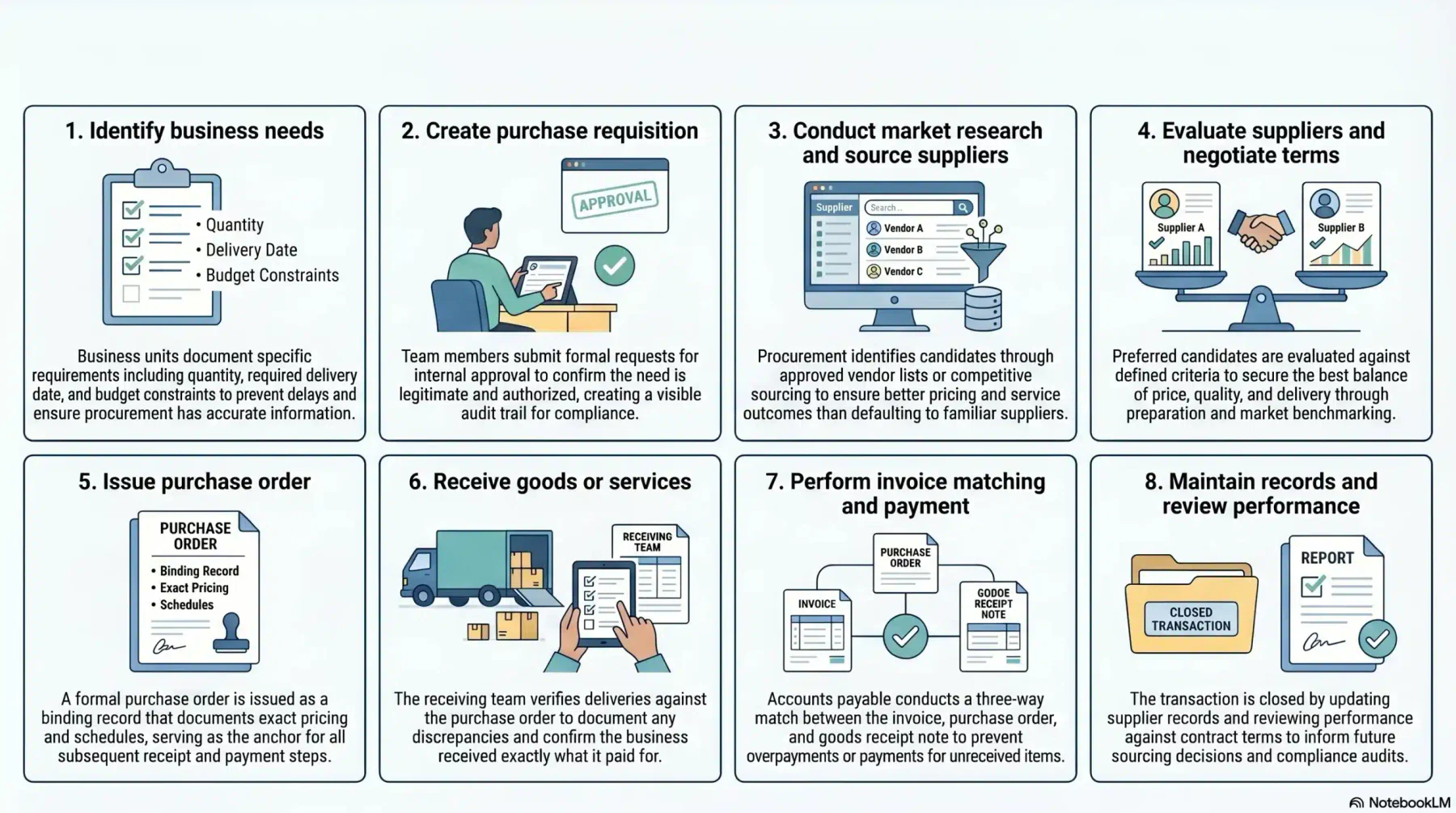
Understanding the stages of the procurement life cycle is useful, but seeing how they connect in sequence makes the process clearer. The following walkthrough covers each activity in the order it typically occurs.
1. Identify business needs
The process begins when a business unit identifies a need for goods or services. That need is documented with specifics, including quantity, required delivery date, and budget constraints, so that procurement can act on accurate information.
Vague or incomplete needs statements are one of the most common causes of procurement delays. The more clearly the requirement is defined upfront, the smoother the rest of the process becomes.
2. Create purchase requisition
Once the need is documented, the relevant team member submits a purchase requisition for internal approval. This formal request confirms that the need is legitimate, budgeted, and authorised before any supplier engagement begins.
Purchase requisitions create a visible audit trail from the start of the procurement process. That supports compliance, budget control, and spend visibility across the business.
3. Conduct market research and source suppliers
With an approved requisition in hand, procurement researches the supplier market and identifies candidates. That may involve checking an approved vendor list, issuing a tender, or running a competitive sourcing process depending on the value and complexity of the purchase.
Market research at this stage ensures the business is not defaulting to familiar suppliers when better options are available. Competitive sourcing consistently produces better pricing and service outcomes than single-source purchasing.
4. Evaluate suppliers and negotiate terms
Procurement evaluates responses from shortlisted suppliers against defined criteria and enters into negotiation with the preferred candidate. The goal is to secure the best combination of price, quality, and delivery terms, not simply the lowest cost.
Effective negotiation requires preparation. Procurement teams that enter negotiations with market benchmarks and a clear understanding of the supplier’s priorities consistently achieve better outcomes.
5. Issue purchase order
Once terms are agreed, the business issues a formal purchase order to the supplier. The PO documents exactly what was ordered, at what price, and on what delivery schedule, creating a binding record for both parties.
The purchase order is the anchor document for the rest of the procurement process. Everything that follows, including goods receipt, invoice matching, and payment, refers back to it.
6. Receive goods or services
When the supplier delivers, the receiving team checks the goods or services against the purchase order. Any discrepancies in quantity, quality, or specification are documented immediately and communicated to the supplier for resolution.
Accurate goods receipt is critical. It confirms that the business received what it paid for and provides the documentation needed for three-way matching during invoice processing.
7. Perform invoice matching and payment
The accounts payable team receives the supplier invoice and matches it against the purchase order and goods receipt note. If all three documents align, payment is approved and processed according to the agreed terms.
Discrepancies identified during matching are escalated for resolution before payment is released. That protects the business from overpayments, duplicate payments, and payments for goods never received.
8. Maintain records and review performance
After payment is processed, procurement closes the transaction by updating supplier records and documenting any issues that arose during the process. The supplier’s performance is then reviewed against the agreed contract terms.
These records inform future sourcing decisions and provide the data needed to manage supplier relationships over time. A well-maintained procurement record is also essential for compliance audits and spend reporting.
Procurement Life Cycle Flow (End-to-End Overview)
The procurement life cycle is often described through three interconnected flows, each covering a different portion of the end-to-end process. Together, they form a complete picture of how procurement activities connect from sourcing through to supplier management.
Source-to-Contract (S2C)
Source-to-Contract covers everything from identifying a need to signing a supplier agreement. It includes needs definition, market research, supplier evaluation, negotiation, and contract execution.
S2C activities are primarily strategic, and integrated sourcing processes at this stage directly affect the contract terms and supplier relationships that carry through the rest of the procurement life cycle.
Procure-to-Pay (P2P)
Procure-to-Pay covers the transactional activities that follow contract execution. It includes purchase requisition, purchase order issuance, goods receipt, invoice processing, and payment.
P2P is where the day-to-day volume of procurement activity occurs. Automation in this flow reduces processing time, cuts errors, and frees procurement staff to focus on higher-value work.
Supplier management
Supplier management covers ongoing performance monitoring, relationship development, and risk assessment across the supplier base. It runs alongside both S2C and P2P rather than sitting at a single point in the life cycle.
Businesses that invest in supplier management technology reduce supply disruptions, manage risk exposure more effectively, and gain the visibility needed to renegotiate terms with confidence.
Procurement Life Cycle vs Procure-to-Pay (P2P)
Procure-to-pay is one of the most commonly referenced terms in procurement and is often confused with the procurement life cycle as a whole. Understanding the distinction helps businesses choose the right tools and apply the right focus to each part of the process.
| Procurement Life Cycle |
Procure-to-Pay (P2P) |
| ✓ Covers the full end-to-end procurement process | ✓ Covers transactional activities only |
| ✓ Starts at needs identification | ✓ Starts at purchase requisition |
| ✓ Ends at supplier performance evaluation | ✓ Ends at supplier payment confirmation |
| ✓ Includes sourcing, contracting, and supplier management | ✓ Focuses on PO creation, invoice matching, and payment |
| ✓ Strategic and operational in scope | ✓ Operational and transactional in scope |
| ✓ Requires strategic procurement platforms | ✓ Best handled by P2P automation software |
What Is Procure-to-Pay?
Procure-to-pay is the transactional subset of the procurement life cycle that covers activities from purchase requisition through to supplier payment. It focuses on processing accuracy, approval workflows, and payment efficiency.
P2P is where most procurement software automation is concentrated. Tools in this space handle purchase order creation, invoice matching, approval routing, and payment processing, reducing the manual workload across accounts payable and procurement operations.
Key differences and overlaps
The procurement life cycle is broader than P2P. It includes strategic activities like supplier sourcing, contract negotiation, and performance evaluation that sit outside the transactional scope of procure-to-pay.
P2P is a component of the procurement life cycle, not a replacement for it. Businesses that optimise P2P without addressing sourcing, contracting, and supplier management miss a significant portion of the value available from a well-managed procurement function.
Where P2P fits in the lifecycle
P2P sits in the middle of the procurement life cycle, bridging the gap between contract execution and supplier payment. It begins once a contract is in place and ends when the payment is processed and confirmed.
Understanding where P2P starts and ends helps businesses identify the right tools for each part of the process. Strategic procurement platforms handle S2C activities, while P2P tools focus on transactional efficiency.
Challenges in the Procurement Life Cycle
Most procurement problems are predictable. The same issues appear repeatedly across businesses of different sizes and industries, and they nearly always trace back to one of the following challenges.
Poor requirement definition
When the initial need is not clearly defined, every stage that follows is affected. Suppliers receive ambiguous briefs, quotes come back for the wrong items, and the final delivery does not match what the business actually needed.
Investing time in clear requirement definition at the start of the procurement process is one of the highest-return activities a procurement team can undertake. It reduces rework, prevents delays, and sets accurate expectations with suppliers from the outset.
Inefficient supplier selection
Defaulting to familiar suppliers without running a proper evaluation process leaves savings on the table and increases risk exposure. Many businesses underestimate the cost of poor supplier selection until a supply failure or quality issue creates a visible problem.
A structured supplier evaluation process, even a lightweight one, consistently produces better outcomes than informal selection. It also creates documentation that supports compliance and audit requirements.
Lack of visibility and control
When procurement data is spread across spreadsheets, email threads, and disconnected systems, it is difficult for anyone to see what is being spent, with whom, and under what terms. That lack of visibility makes it harder to identify savings opportunities or catch compliance issues early.
Centralising procurement data is therefore one of the most impactful changes a business can make. Even a basic system that consolidates spend data in one place improves decision-making significantly.
Manual processes and delays
Manual purchase order creation, paper-based approvals, and manual invoice matching slow down the procurement cycle and introduce errors at every stage. Delays in procurement flow through to delayed deliveries, strained supplier relationships, and frustrated internal stakeholders.
Automation addresses this directly. Even partial automation of approval workflows and invoice matching reduces cycle times considerably and frees procurement staff to focus on activities that require judgement rather than data entry.
Best Practices for Managing the Procurement Life Cycle

Businesses that manage their procurement life cycle well share a set of consistent practices. These are not complicated changes, but they require deliberate effort to implement and sustain.
Standardise procurement workflows
Consistent workflows reduce errors, speed up approvals, and make it easier to train new team members. When everyone follows the same process, procurement becomes more predictable and easier to audit.
Standardisation starts with documenting current processes and identifying the activities that vary most between teams or individuals. Removing that variation is usually more impactful than adding new tools or systems.
Use procurement software and automation
Procurement software consolidates sourcing, contract management, purchase orders, and payment processing in one platform. That gives procurement teams a single view of spend, supplier activity, and contract status across the business.
Automation handles the repetitive tasks, such as purchase order generation, invoice matching, and approval routing, that consume the most time in manual procurement operations. The result is faster cycle times and fewer errors across the full life cycle.
Click the Hashy banner below to see how an AI coworker can help track approvals, review suppliers, and find procurement records faster.






Strengthen supplier relationships
Strong supplier relationships produce better pricing, priority access during supply shortages, and more flexible terms when business conditions change. They also reduce the risk of supply disruptions that can affect operations and customer commitments.
Relationship building requires consistent communication, fair treatment, and timely payment. Businesses that treat suppliers as strategic partners rather than interchangeable vendors consistently get more value from their supply base.
Monitor performance and KPIs
Procurement performance should be measured regularly against defined KPIs, including purchase order cycle time, invoice processing time, supplier delivery performance, and contract compliance rates.
Regular measurement makes it possible to identify where the procurement life cycle is underperforming and where improvements will have the greatest impact. Without data, procurement improvement is largely guesswork.
How to Optimise the Procurement Life Cycle
Optimisation is an ongoing discipline that requires consistent attention to data quality, process efficiency, and supplier performance. The following areas offer the clearest opportunities for improvement.
Improve data accuracy and spend visibility
Accurate spend data is the foundation of effective procurement. Businesses that cannot see clearly what they are spending, with which suppliers, and under what terms cannot make informed sourcing or renegotiation decisions.
Improving data accuracy starts with consolidating spend data into a single system and establishing consistent coding and classification practices. That investment pays back quickly in the form of better sourcing decisions and more accurate budget forecasting.
Automate approval and matching processes
Manual order approval flows and invoice matching are among the most common sources of delay and error in the procurement life cycle. Automating these activities reduces processing time, cuts the error rate, and creates a consistent audit trail across every transaction.
Start with the highest-volume, most rule-based tasks, such as three-way invoice matching and purchase order approval routing. Those are typically the quickest to automate and the fastest to produce measurable results.
Continuously review and improve supplier performance
Supplier performance should be reviewed on a regular cadence, not only when problems arise. Scheduled reviews give procurement teams the opportunity to address minor issues before they become significant problems and to recognise suppliers that consistently deliver.
Regular reviews also support renegotiation. When performance data is available, procurement teams can enter contract renewals with a clear view of what the supplier has delivered and where terms could be improved.
Importance of the Procurement Life Cycle in Business
A well-managed procurement life cycle is one of the most direct levers available for improving business performance. The benefits extend beyond cost savings to risk management, operational efficiency, and financial transparency.
Cost control and savings
Every stage of the procurement life cycle is an opportunity to control costs. From competitive sourcing and negotiated contract terms through to automated invoice matching and spend analysis, the potential for savings is present throughout the process.
Businesses that manage procurement as a strategic function rather than a back-office task consistently achieve better cost outcomes. The cumulative impact of small improvements across each stage adds up significantly at scale.
Risk management and compliance
Procurement carries risk at every stage, from supplier failure and contract disputes to fraud and regulatory non-compliance. A structured procurement life cycle creates the controls and documentation needed to identify and manage those risks proactively.
Compliance requirements, including supplier due diligence, contract record-keeping, and payment controls, are embedded naturally into a well-designed procurement process. That makes compliance a by-product of good procurement practice rather than a separate burden.
Operational efficiency and transparency
When the procurement life cycle runs smoothly, internal stakeholders get what they need on time, suppliers are paid correctly, and procurement teams have the information they need to make good decisions. That efficiency directly supports operational performance across the business.
Transparency is equally important. When leadership can see procurement spend, supplier relationships, and contract status in real time, they can make more informed decisions about where to invest, which relationships to prioritise, and where costs need to be reduced.
Conclusion
A well-managed procurement life cycle gives businesses more than cost control. It creates the structure needed to manage supplier relationships, maintain compliance, and make purchasing decisions based on accurate data rather than guesswork.
The difference between a reactive procurement function and a strategic one comes down to how consistently the life cycle is followed and improved. Book a free consultation with our team to find out how to make your procurement process more efficient and controlled.
Frequently Asked Question
The procurement life cycle is the end-to-end process a business follows to acquire goods and services. It begins with identifying a need and ends with supplier payment and performance review, covering sourcing, contracting, purchasing, receiving, paying, and evaluating supplier performance.
The procurement life cycle typically covers six core stages: needs identification and planning, supplier sourcing and selection, negotiation and contract management, purchasing and order fulfilment, invoice processing and payment, and supplier performance evaluation. The exact number can vary depending on how a business structures its procurement function.
The procurement life cycle covers the full end-to-end process from needs identification through to supplier performance review. Procure-to-pay is a subset of that lifecycle, covering only the transactional activities from purchase requisition through to payment. P2P is a component of the procurement life cycle, not a replacement for it.
The most impactful improvements are standardising procurement workflows, centralising spend data, automating approval and invoice matching processes, and reviewing supplier performance on a regular cadence. Businesses that address data quality first typically see the fastest results from any other improvement they make.
A structured procurement life cycle gives businesses control over costs, reduces supply chain risk, and ensures that purchasing decisions are made consistently and transparently. It also creates the audit trails and documentation needed to meet compliance requirements and pass financial audits.