










 Limited to 100 registrants

A bonded warehouse is a licensed warehouse where imported goods can be stored under customs control before duty and taxes are paid. Australian businesses use bonded warehousing to defer duty and GST, manage imported stock, re-export goods, and keep customs records under tighter control.
In Australia, the Australian Border Force uses the term “licensed warehouse” under the Customs Act 1901. However, many importers, exporters, 3PLs, and freight teams still use the term bonded warehouse in daily trade conversations.
Key Takeaways
A bonded warehouse stores imported goods in a customs-approved facility while duty and GST stay deferred until the goods enter the local market.
Deferring import duty and GST improves cash flow, since businesses only pay once the goods are sold or released rather than on arrival.
Bonded warehouses suit importers, wholesalers, and re-exporters that hold stock, repackage, or ship goods overseas without triggering local tax.
Australian businesses using a bonded warehouse must meet customs licensing and record-keeping obligations to stay compliant with the Australian Border Force.
What Is a Bonded Warehouse?
A bonded warehouse is a secure storage facility approved for goods that remain under customs control. This means the goods can sit in the warehouse before the importer clears them for home consumption.
Duties and taxes are generally deferred while goods remain under customs control. Therefore, businesses can manage cash flow better because they do not always need to pay duty and GST as soon as goods arrive.
Australian bonded warehouses operate under a licence framework. The ABF issues warehouse licences for specific premises, and the licence holder must follow strict record-keeping, security, and reporting obligations.
Bonded Warehouse vs Non-Bonded Warehouse
A bonded warehouse and a non-bonded warehouse both store goods, yet they serve different customs purposes. The real difference sits in whether the goods stay under customs control and when the business pays duty and GST.
In a bonded warehouse, imported goods remain under Australian Border Force control and the duty and GST stay deferred until release. In a non-bonded warehouse, the goods have already cleared customs, so the business has paid duty and GST and can move the stock freely. The table below sets the two side by side across the factors that matter most.
A bonded warehouse suits importers that need customs-controlled storage. A non-bonded warehouse suits goods already cleared for local sale or use.
Who Needs a Bonded Warehouse?
Not every importer needs a bonded warehouse. It suits businesses where duty deferral, re-export, or customs-controlled storage creates a clear commercial benefit.
Bonded warehousing may suit:
- Importers with high-duty goods
- 3PLs handling imported stock for multiple clients
- Alcohol or fuel supply chains with relevant licences
- Businesses that re-export goods from Australia
- Retailers managing seasonal imported inventory
- Distributors waiting for customer allocation before clearance
- Freight and logistics companies handling underbond movements
However, these businesses may also benefit from platforms for warehouse efficiency that connect inventory tracking, document control, dispatch planning, and compliance workflows in one system.
How Does a Bonded Warehouse Work?
Bonded warehousing follows a controlled process from import arrival to release, re-export, or movement. The key point is simple: goods remain under customs control until the business takes an approved action.
1. Import and bond: goods enter without duty payment
Imported goods can enter a licensed warehouse through a warehouse declaration. This lets the importer move goods into customs-controlled storage before paying duty and taxes.
The importer or customs broker usually lodges the declaration through the Integrated Cargo System. Then, the warehouse must verify the received goods against the relevant documents.
2. Storage under ABF supervision with duty deferred
Once goods enter the licensed warehouse, they remain under customs control. The licence holder must manage security, stock records, movement permissions, and access to the premises.
During this period, the business can store, unpack, repack, package, or blend approved goods where the licence permits it. However, activities that add value are generally not allowed in a customs licensed warehouse.
3. Release, re-export, or destruction
Goods can leave the bonded warehouse in several ways. A business may enter them for home consumption, export them, move them to another licensed warehouse, or follow approved destruction processes if required.
If the goods enter home consumption, the importer must lodge the right declaration and pay applicable duties and taxes. If the goods are exported, duty may not become payable in the same way.
Types of Bonded Warehouses in Australia

Australia uses licensed warehouse categories under customs law, although trade teams may describe them using bonded warehouse terms. Businesses should always confirm the exact licence type with the ABF before applying.
1. Public licensed warehouse
A public licensed warehouse stores goods for more than one owner. This suits 3PLs, freight forwarders, and warehouse operators that serve multiple importers.
For importers, this can reduce the need to apply for their own warehouse licence. However, they still need strong visibility over stock, declarations, and release status.
2. Private licensed warehouse
A private licensed warehouse usually stores goods owned by the licence holder. This suits importers that handle regular shipments and want tighter control over customs-controlled inventory.
Private warehouses can support predictable supply chains and high-volume imports. However, the business must carry the full compliance burden.
3. Excise equivalent goods warehouse
An excise equivalent goods warehouse covers imported goods that are treated similarly to excisable goods. These can include alcohol, fuel, and tobacco-related categories, subject to strict rules.
These goods require careful handling because both customs and tax obligations may apply. Businesses dealing with EEGs should involve customs and tax specialists before setting up the process.
4. Special circumstances warehouse
A special circumstances warehouse applies where goods or operations do not fit standard warehousing needs. The ABF may set specific conditions based on the goods, risks, and intended use.
This type requires close consultation before approval. Businesses should prepare clear operational workflows, security measures, and record-keeping processes.
5. Sub-licensed warehouse
A sub-licensed warehouse arrangement can apply where a licensed structure involves another approved site or operating arrangement. This can help larger supply chains manage goods across specific premises.
Because conditions vary, businesses should not assume this model suits every operation. They need formal approval and clear controls before moving goods under customs control.
6. Other international classifications: customs bond, free trade zone, and manufacturing bond
Other countries may use terms such as customs bond, free trade zone, or manufacturing bond. These terms do not always match Australian law.
For example, Australia’s licensed warehouse framework does not automatically allow manufacturing or value-adding work. Therefore, businesses should not copy overseas warehouse models without checking Australian customs rules first.
Benefits of a Bonded Warehouse for Australian Businesses
Bonded warehouses can improve cash flow and customs control, especially for importers that hold stock before local sale or re-export. The benefits become clearer when goods carry high duty, slow turnover, or seasonal demand.
1. Cash flow advantage through duty and GST deferral
The main benefit is duty and GST deferral. Businesses can hold imported goods under customs control before paying applicable charges.
This can support cash flow because payments align more closely with release or sale timing. For importers managing large shipments, that timing difference can matter.
2. Duty-free re-export capability
Bonded warehouses can help businesses re-export goods without first entering them for home consumption. This is useful for distributors that use Australia as a regional stock point.
For example, a business may import goods, store them under customs control, and later ship them overseas. In that case, the duty outcome may differ from goods sold locally.
3. Flexible inventory management under bond
Importers can use bonded storage to manage stock before final market decisions. They may hold goods while confirming local demand, customer orders, or export allocation.
This flexibility helps businesses avoid clearing every shipment immediately. However, they must still maintain accurate records and movement approvals.
4. Free Trade Agreement leverage before duty assessment
A bonded warehouse can give businesses time to finalise origin documents and review Free Trade Agreement eligibility before release.
If documentation is incomplete at arrival, the goods may sit under customs control while the importer works with suppliers and customs brokers. This can reduce the risk of paying the wrong duty rate.
5. Compliance confidence with ABF oversight
Licensed warehouses operate under formal ABF conditions. This gives businesses a clearer framework for security, records, movement permissions, and stock accountability.
Strong oversight can also reduce uncontrolled handling of imported goods. However, it only works when the warehouse team follows the rules consistently.
Disadvantages of a Bonded Warehouse
Bonded warehousing can create strong benefits, but it is not a simple storage upgrade. Businesses should weigh the operational and compliance costs before applying for a licence or using a bonded facility.
1. ABF compliance complexity and audit obligations
Licensed warehouse operators must keep auditable records and meet licence conditions. They must also manage staff access, visitor logs, goods under customs control, movement permissions, and stock accountability.
If a licence holder fails to account for goods, duty and GST may become payable. Serious failures can also lead to penalties, suspension, or licence cancellation.
2. Higher setup, licensing, and surety bond costs
A bonded warehouse can involve licensing fees, security requirements, system setup, insurance, and financial security. These costs can outweigh the benefit for low-volume importers.
The ABF charges annual warehouse licence fees, and licence holders may also need to provide financial security. Therefore, businesses should model the cost before applying.
3. Restricted access to goods under bond
Goods under customs control cannot move freely like normal warehouse stock. The business needs the right authorisation before release or movement.
This can slow down urgent dispatch if paperwork, system updates, or broker coordination is not ready. As a result, warehouse staff need clear procedures.
4. 5-year record rule under Australian law
A common misunderstanding is that goods can only stay in a bonded warehouse for five years. ABF guidance states goods entered on a warehouse declaration may be held indefinitely until entered for home consumption or exported.
The five-year requirement applies to records. Warehouse licence holders must keep relevant records for five years and make them available to authorised officers when requested.
5. Need for specialised inventory management technology
Bonded warehouses need more than basic stock counting. Teams must distinguish bonded stock, duty-paid stock, free goods, movements, declarations, and release status.
Spreadsheets often fail when volumes rise. A warehouse management system can reduce errors by linking stock records with customs status, broker workflows, and audit trails.
Businesses can also compare warehouse automation tools to improve stock visibility and reduce manual reconciliation work.
Regulatory Requirements for Bonded Warehousing in Australia
Australian bonded warehousing sits inside a strict legal and operational framework. Businesses should understand the requirements before storing goods under customs control.
1. Australian Border Force licensing framework
The ABF licenses warehouses under section 79 of the Customs Act 1901. Licences apply to specific premises, and a business needs separate approval for each licensed place.
The ABF may issue licences to individuals, companies, or partnerships. It does not grant licences directly to trusts, although a trustee may receive a licence in some cases.
2. Customs Act 1901: key provisions for warehouse operators
The Customs Act 1901 sets the legal basis for licensed warehouses, customs control, movement, and obligations. It also supports ABF enforcement action when licence holders breach conditions.
Warehouse operators must follow approved activities. They may store, unpack, repack, package, or blend approved goods, but they generally cannot carry out value-adding activities.
3. Excise equivalent goods and ATO obligations
Excise equivalent goods can involve both customs and tax obligations. This area needs careful handling because mistakes can create duty, excise, GST, and reporting exposure.
Businesses dealing with alcohol, fuel, or other EEG categories should check ABF and ATO requirements before storage. They should also confirm whether extra licences, permissions, or returns apply.
4. How long can goods stay? The 5-year rule explained
ABF guidance states that goods entered on a warehouse declaration may be held indefinitely in a licensed warehouse until entered for home consumption or exported.
However, licence holders must keep records for five years. This includes records about cargo condition, movement, unpacking, repacking, storage, release, import declarations, export declarations, and movement permissions.
5. Ongoing compliance obligations for licence holders
Licence holders must maintain control over the licensed premises and goods. They must also provide staff lists when requested, keep visitor logs, manage movement permissions, and report variances.
Records must be legible and in English. The ABF may inspect, examine, copy, or take extracts from relevant records when authorised.
"Bonded warehouse management depends on accurate stock status, customs records, and release controls. Without real-time tracking, businesses risk duty errors, stock variances, and costly compliance gaps."
How to Manage a Bonded Warehouse Effectively
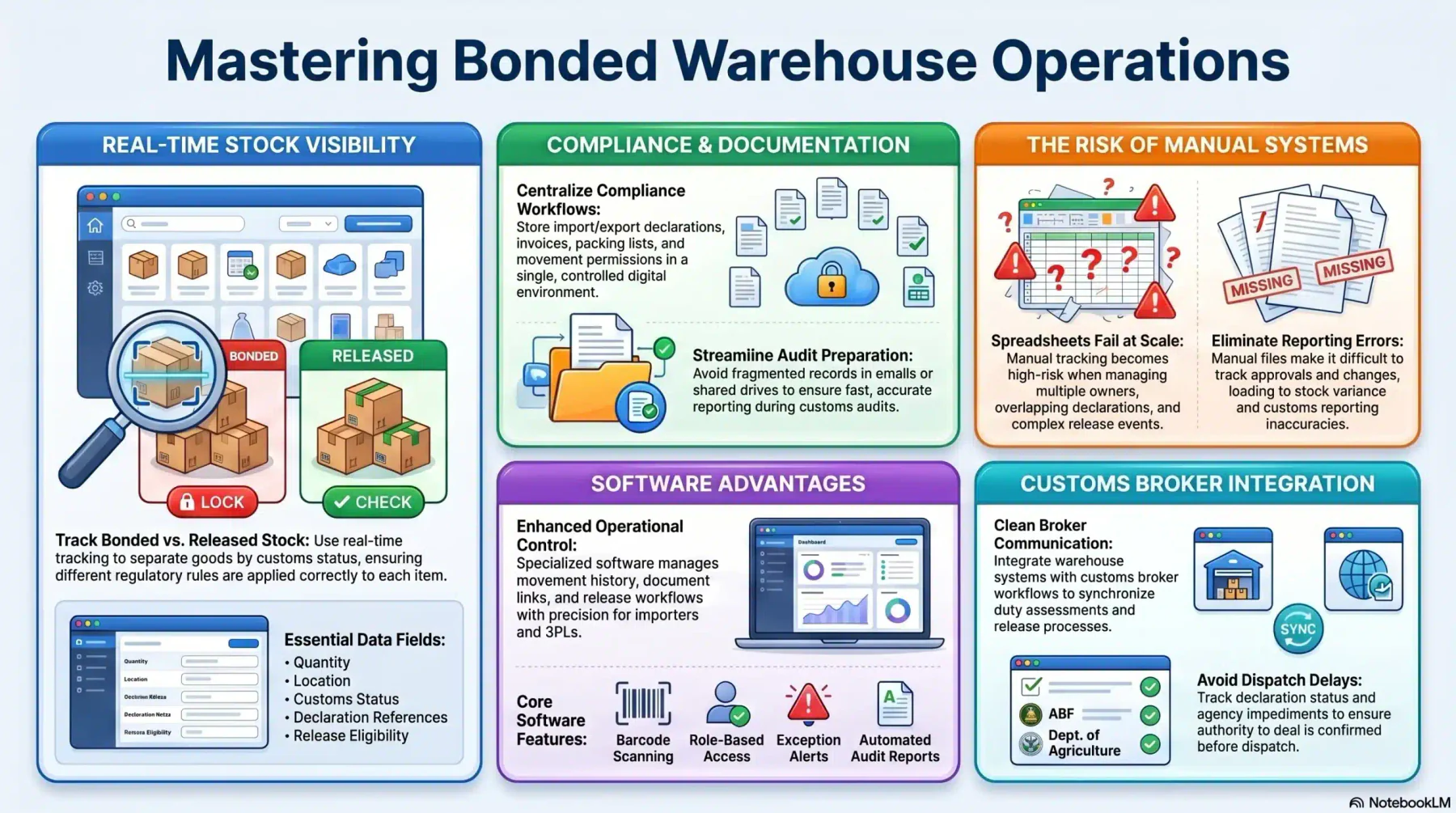
Managing a bonded warehouse means controlling both stock and customs status. The warehouse must know what goods are bonded, what goods are duty paid, what can move, and what needs approval.
For businesses managing higher import volumes, warehouse process automation can help standardise receiving, storage, release approvals, and audit documentation.
1. Tracking bonded vs released stock in real time
Real-time stock tracking helps warehouse teams separate bonded goods from released goods. This matters because different rules apply to each stock status.
A good system should show quantity, location, customs status, declaration reference, owner, and release eligibility. This reduces the risk of releasing goods without authority.
2. Compliance documentation and ABF reporting workflows
Bonded warehouse teams should store all key documents in one controlled workflow. This includes warehouse declarations, import declarations, export declarations, movement permissions, invoices, packing lists, and authority to deal records.
When records sit across email inboxes and shared drives, audit preparation becomes slower. Therefore, document control matters as much as physical stock control.
3. Integrating with your customs broker workflow
Customs brokers play a key role in declarations, duty assessment, and release processes. Warehouse systems should support clean communication with brokers.
At minimum, the warehouse team should track declaration status, release authority, movement permissions, and any ABF or Department of Agriculture impediments.
Freight teams can also improve coordination by reviewing options for direct freight transfers, especially when goods need to move between ports, licensed warehouses, and customer delivery points.
4. Why manual tracking fails at scale: spreadsheet risk
Spreadsheets can work for a small number of shipments, but they become risky when multiple owners, declarations, movements, and release events overlap.
Manual files also make it hard to track changes, approvals, and stock status. This increases the chance of variance issues and customs reporting errors.
5. What bonded warehouse management software does
Bonded warehouse management software helps teams manage stock location, customs status, movement history, document links, and release workflows.
It can also support barcode scanning, role-based access, exception alerts, and audit reports. For 3PLs and importers, this gives better control over goods under customs control and supports efficient storage management across bonded and duty-paid inventory.
Managing bonded goods requires teams to track stock status, customs documents, and approvals. The banner below shows how Hashy, HashMicro’s AI assistant, helps identify release delays and suggest the next action.






Conclusion
A bonded warehouse helps Australian businesses store imported goods under customs control while deferring duty and GST until approved release. It can improve cash flow, support re-export strategies, and give importers better control over stock timing.
However, bonded warehousing also requires strict ABF compliance, accurate records, and reliable inventory management. If your business wants to manage bonded stock more efficiently, book a free consultation with our experts.
Frequently Asked Question
A bonded warehouse is commonly used to describe a customs licensed warehouse where imported goods can be stored under customs control before duty and taxes are paid. In Australia, the ABF uses the term licensed warehouse under the Customs Act 1901.
ABF guidance states that goods entered on a warehouse declaration may be held indefinitely until entered for home consumption or exported. The five-year rule relates to record keeping, not the storage period.
Yes, a business can operate a bonded warehouse if it obtains the right approval from the ABF and meets licence conditions. The licence applies to a specific place, so each approved premises needs the correct authorisation.
A bonded warehouse stores goods under customs control, which means duty and taxes are usually deferred until approved release. A non-bonded warehouse stores goods that have generally cleared customs and can move through normal warehouse workflows.
The main disadvantages include ABF compliance complexity, licensing costs, restricted access to goods, detailed record-keeping obligations, and the need for stronger inventory control.
Many imported goods can be stored in a bonded warehouse if the licence and customs rules allow it. Examples may include alcohol, retail goods, spare parts, raw materials, and goods intended for re-export.
You manage a bonded warehouse by tracking stock status, declarations, movement permissions, release approvals, documents, and audit records in one controlled process. Warehouse management software can help reduce errors when shipment volumes increase.