








 Limited to 100 registrants

Running out of stock costs more than a single missed sale. It frustrates loyal customers, disrupts production schedules, and hands revenue straight to your competitors.
For any business that holds physical inventory, an out of stock situation is one of the most preventable yet most damaging problems to face. Whether you run a retail chain, a wholesale operation, or a manufacturing floor, understanding why stockouts happen gives you the tools to stop them before they hit your bottom line.
This guide covers the most common causes of out of stock events, the industries they hit hardest, and the practical strategies Australian businesses use to keep shelves full and orders flowing.
Key Takeaways
What does out of stock mean? It describes a situation where a customer wants to buy a product but the business has zero available units, resulting in a lost sale and potential long-term customer churn.
Common causes of stockouts include poor demand forecasting, inaccurate inventory records, supplier delays, manual processes, and sudden demand spikes that catch businesses off guard.
Business impact of being out of stock spans lost revenue, reduced customer loyalty, production downtime, emergency procurement costs, and lasting damage to brand reputation.
Technology reduces out of stock risk through inventory management systems, POS-ERP integration, and multi-warehouse visibility that automate reorder points and deliver real-time data.
What Does “Out of Stock” Mean?
An item is out of stock when a customer wants to buy it but the business has zero available units to sell or ship. It does not matter whether the shortage sits at the warehouse, the store shelf, or the online listing; the result is the same: a lost transaction.
Out of stock differs from a discontinued product because the item is still active in your catalogue. The business intends to replenish it, but a gap in supply or planning has left it temporarily unavailable.
The term also applies upstream in supply chains. A manufacturer can be out of stock on a raw material, which then delays finished goods for every retailer waiting on the order.
Common Causes of Out-of-Stock Situations






Most stockouts trace back to a handful of recurring issues. Fixing even one of them can cut your out of stock rate significantly.
Below are the five causes that Australian businesses encounter most often.
1. Poor demand forecasting
When a business underestimates how much of a product customers will want, it orders too little from suppliers. Seasonal swings, promotional spikes, and shifting consumer trends all throw basic forecasts off course.
Relying on gut instinct rather than historical sales data makes the problem worse. Therefore, companies that skip structured demand planning tend to experience stockouts repeatedly on their best-selling lines.
2. Inaccurate inventory records
If your system says you have 50 units on the shelf but the actual count is 12, no reorder gets triggered until it is too late. Shrinkage, data-entry errors, and misplaced stock are the usual culprits behind record mismatches.
Inaccurate records also affect online channels. As a result, your website may accept orders for items that do not physically exist, creating back-order headaches and refund requests.
3. Supplier delays and lead time issues
Even a well-planned order can go wrong if the supplier cannot deliver on time. Port congestion, raw material shortages, and freight disruptions regularly extend lead times across Australia.
Businesses that rely on a single supplier face the greatest risk. When that one source slows down, there is no backup to fill the gap, and shelves go empty.
4. Manual inventory management
Spreadsheets and clipboard counts introduce human error at every touchpoint. Staff may forget to log a receipt, miscount during a stocktake, or delay updating the system after a large sale.
These small mistakes compound over days and weeks. Therefore, businesses that still manage inventory manually often discover shortages only after a customer complaint arrives.
5. Sudden demand spikes
A viral social media post, an unexpected weather event, or a competitor pulling a product from the market can send demand through the roof overnight. No forecast model catches every surge.
However, businesses that monitor real-time sales velocity can react faster. Quick communication with suppliers and temporary purchase limits help cushion the impact until fresh stock arrives.
Industries Most Affected by Out-of-Stock Issues
While any business holding inventory can run out of stock, some sectors feel the pain more sharply than others. The following industries deal with stockout pressure on a daily basis.
Retail and e-commerce
Retailers live and die by shelf availability. A customer who walks into a store or lands on a product page and finds “out of stock” will often switch to a competitor within seconds.
Online retailers face the added pressure of marketplace algorithms. For example, platforms like Amazon and eBay lower product rankings when stock runs out, making recovery slower even after replenishment.
Manufacturing and production
A single missing component can halt an entire production line. Manufacturers depend on precise just-in-time deliveries, so even a short supply gap cascades into delayed shipments for every downstream customer.
Australian manufacturers importing raw materials from overseas are especially exposed. Therefore, lead time variability and customs processing delays require larger safety stock buffers than domestic sourcing.
Wholesale and distribution
Wholesalers sit between suppliers and retailers, which means a stockout at the wholesale level triggers shortages across multiple storefronts simultaneously. The ripple effect is wider than in any other sector.
Distributors that manage thousands of SKUs across several warehouses face an added complexity. Keeping visibility across every location without a centralised system is nearly impossible at scale.
Hospitality and food services
Restaurants, cafés, and catering companies work with perishable inventory that has a narrow shelf life. Running out of a key ingredient during a busy service disrupts the menu and frustrates diners.
Unlike retail, hospitality cannot simply backorder and wait. The product must arrive fresh and on time, or the dish comes off the board entirely for that day.
Business Impact of Being Out of Stock

A stockout is never just an inventory problem. It creates a chain reaction that touches revenue, operations, customer trust, and long-term brand value.
Here are the five most damaging consequences Australian businesses face when products go out of stock.
Lost sales and revenue
The most immediate cost is the sale that never happens. If a customer cannot buy what they want, they either leave empty-handed or buy from someone else.
Research from IHL Group estimates that global retailers lose over $1 trillion annually to out of stock events. Even a small reduction in your stockout rate translates directly into recovered revenue.
Reduced customer satisfaction and loyalty
Customers expect the product to be available when they want it. One stockout might earn a second chance, but repeated unavailability pushes shoppers toward competitors permanently.
For subscription and repeat-purchase models, the damage is even steeper. Consequently, losing a high-lifetime-value customer over a preventable stockout is one of the most expensive mistakes a business can make.
Production downtime and operational delays
In manufacturing and assembly environments, missing parts force idle machines and idle workers. Every hour of downtime carries a direct labour and overhead cost that erodes margins.
The delay also pushes back delivery promises to end customers. As a result, one upstream stockout can trigger penalty clauses, cancelled contracts, and strained supplier relationships downstream.
Increased emergency procurement costs
When a business runs out of a critical item, it often resorts to express shipping, alternative suppliers at higher prices, or last-minute air freight. These emergency measures eat into profit margins fast.
Planned procurement through standard channels almost always costs less. Therefore, preventing the stockout in the first place is cheaper than scrambling to fix it after the fact.
Damage to brand reputation
Frequent stockouts signal poor planning, and customers notice. Online reviews mentioning “always out of stock” or “never available” deter new buyers and weaken brand credibility.
In B2B relationships, unreliability is even more damaging. A wholesale buyer who cannot depend on your supply will quietly shift volume to a competitor without warning.
Out of Stock vs Overstock: Finding the Right Balance
"Most stockouts are not supply problems. They are visibility problems, and the moment you give your team real-time data across every warehouse and store, your out of stock rate drops fast."
Stockouts and overstocking are two sides of the same coin, and both cost money. The goal is to land in the middle, where you hold enough inventory to meet demand without tying up excessive capital.
Overstocking inflates warehousing costs, increases the risk of obsolescence, and ties up cash that could fund growth elsewhere. On the other hand, understocking leads to the lost sales, emergency procurement, and customer churn described above.
The sweet spot sits at the reorder point, which is the inventory level that triggers a new purchase order before stock drops to zero. Calculating reorder points accurately requires clean data on lead times, average daily sales, and safety stock buffers.
Businesses that balance both extremes use demand forecasting combined with automated reorder alerts. As a result, they maintain lean inventory levels while still protecting against unexpected demand surges.
How to Measure and Track Out-of-Stock Rates
You cannot fix what you do not measure. Tracking your out of stock rate gives you a clear baseline and shows whether your prevention efforts are working.
1. Key inventory metrics to monitor
Start with the out of stock rate itself, which is the percentage of SKUs unavailable for sale at any given time. A rate above 8 per cent is considered high for most retail and wholesale operations.
Pair that metric with fill rate (the percentage of customer orders fulfilled completely from available stock) and lost sales value (estimated revenue missed due to stockouts). Together, these three numbers paint a full picture of your inventory health.
2. Stock turnover and reorder point analysis
Stock turnover measures how many times your inventory cycles through in a given period. A high turnover rate with a low stockout rate means your replenishment timing is dialled in well.
Reorder point analysis uses average daily usage and supplier lead time to calculate when to place the next order. Therefore, reviewing these figures monthly ensures your reorder triggers stay aligned with current demand patterns.
3. Real-time stock visibility across locations
If your business operates from multiple warehouses or stores, you need a single view of stock levels across every location. Without it, one site may run dry while another sits on surplus.
Real-time visibility also supports inter-branch transfers. For example, moving 200 units from a low-demand location to a high-demand one is faster and cheaper than placing a new supplier order.
Short-Term Actions When Products Are Out of Stock
When a stockout has already happened, speed matters. The following actions help you limit the damage while you wait for replenishment.
First, communicate the shortage clearly. Update your website with expected restock dates, brief in-store staff so they can offer alternatives, and send proactive emails to customers with pending orders.
Second, offer substitutes wherever possible. A comparable product at a similar price point keeps the customer in your ecosystem rather than sending them to a competitor. Pair the substitute with a small discount or loyalty reward to soften the inconvenience.
Third, expedite the incoming order. Contact your supplier to confirm the fastest possible delivery, and consider splitting the order across multiple carriers to get partial stock onto shelves sooner.
Finally, log the event in detail. Record the SKU, the duration of the stockout, the estimated lost revenue, and the root cause. This data feeds directly into your long-term prevention strategy.
Long-Term Strategies to Prevent Out-of-Stock Issues
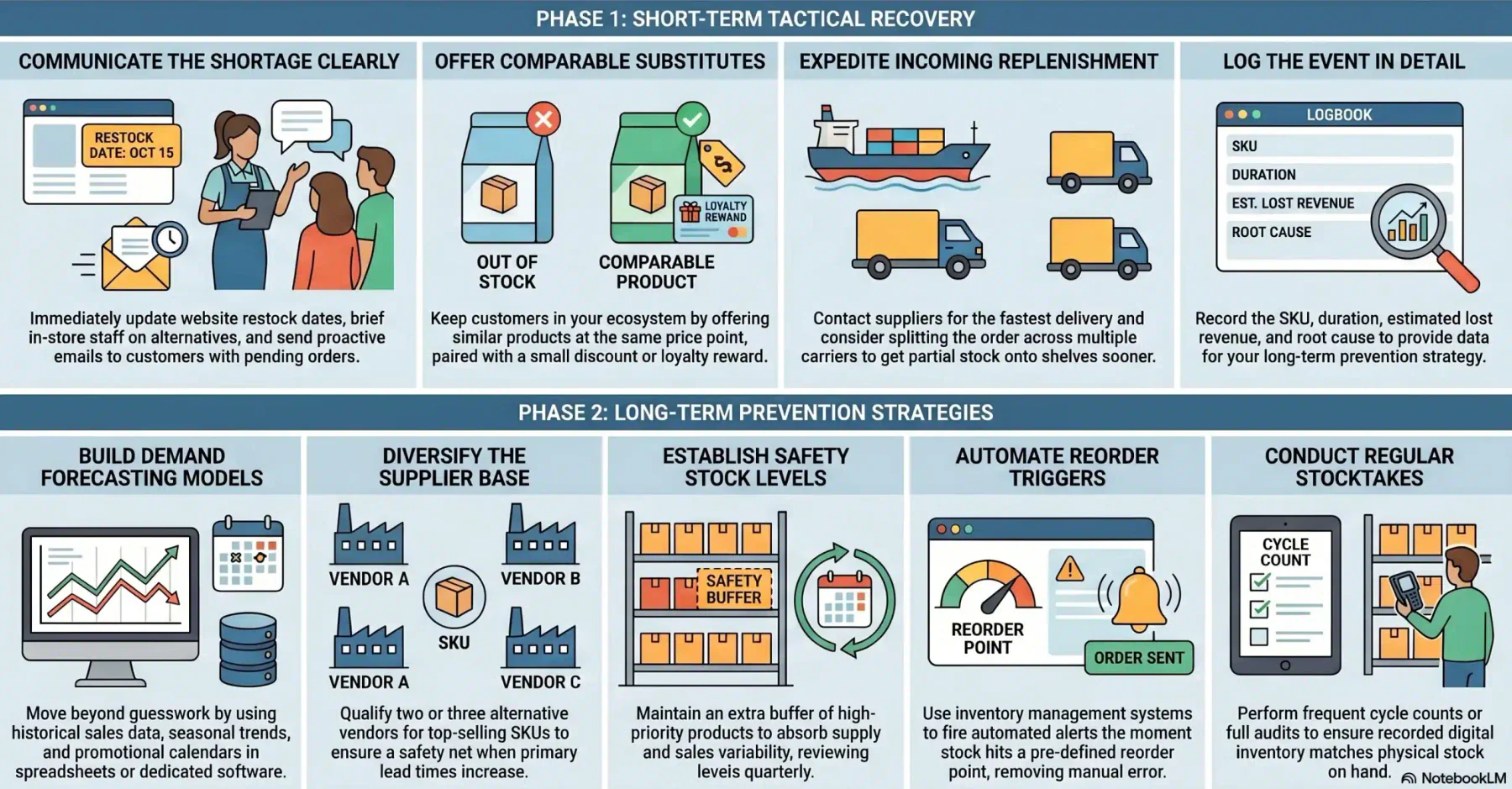
Short-term fixes buy time, but sustainable improvement requires structural changes to how your business plans, orders, and monitors inventory. The strategies below address the root causes rather than the symptoms.
Build a demand forecasting model that uses historical sales data, seasonal trends, and promotional calendars. Even a simple spreadsheet-based model outperforms guesswork, and dedicated software takes accuracy further.
Diversify your supplier base so that no single vendor becomes a bottleneck. Qualifying two or three alternative suppliers for your top-selling SKUs provides a safety net when lead times blow out.
Set safety stock levels for every high-priority product. Safety stock is the extra buffer you hold above your expected demand to absorb variability in both supply and sales. Review these buffers quarterly as demand patterns shift.
Automate reorder triggers through your inventory management system. Manual reordering depends on someone remembering to check stock levels, whereas automated alerts fire the moment inventory hits the reorder point.
Conduct regular stocktakes, whether cycle counts or full audits, to keep your recorded inventory aligned with your physical inventory. Even the best software cannot compensate for data that drifted months ago.
The Role of Technology in Reducing Out of Stock
Technology does not replace good inventory practices, but it makes them faster, more accurate, and far easier to scale. The right tools turn reactive stock management into proactive prevention.
Inventory management systems
A dedicated inventory management system tracks every unit from the moment it arrives at your warehouse to the moment it leaves. It automates reorder points, logs stock movements in real time, and flags discrepancies before they become stockouts.
Cloud-based platforms also give your team access from anywhere. Therefore, warehouse managers, purchasing officers, and store supervisors all work from the same live data set.
POS and ERP integration
When your point-of-sale system talks directly to your ERP, every transaction updates inventory counts instantly. There is no lag between a sale on the shop floor and the stock figure your purchasing team sees.
This integration also feeds accurate data into demand forecasting models. As a result, your reorder decisions reflect what is actually selling right now, not what sold last time someone ran a report.
Multi-warehouse and multi-store visibility
Businesses with stock spread across multiple locations need a single dashboard that shows every unit in every site. Without centralised visibility, surplus in one warehouse hides behind a stockout in another.
Modern inventory platforms support inter-location transfers with a few clicks. For example, HashMicro’s inventory management module gives your team real-time stock levels across all warehouses and stores, so you can redistribute inventory before shortages reach customers.
Data-driven decision making
Every transaction, supplier lead time, and seasonal pattern your system records becomes a data point for smarter decisions. Trend analysis highlights which SKUs are trending up, which are slowing down, and where your safety stock buffers need adjustment.
Dashboards and automated reports replace the guesswork that causes most stockouts. Consequently, your purchasing team spends less time chasing numbers and more time preventing problems before they surface.
Conclusion
Out of stock situations drain revenue, erode customer trust, and create operational chaos that spreads across your entire supply chain. The good news is that most stockouts trace back to fixable root causes like poor forecasting, inaccurate records, and manual processes.
Technology ties all of these fixes together into a system that works without constant manual oversight. HashMicro’s inventory and ERP platform automates reorder points, syncs stock across every warehouse and store, and feeds real-time data into demand forecasting. Book a free consultation with our team today to see how it fits your business.
Frequently Asked Question
Most retail and wholesale operations aim for an out of stock rate below 8 per cent. However, top-performing businesses push that figure under 5 per cent by combining demand forecasting with automated reorder triggers and regular cycle counts.
Divide the number of SKUs currently unavailable by the total number of active SKUs in your catalogue, then multiply by 100. For example, if you carry 2,000 products and 120 are out of stock, your rate is 6 per cent. Track this figure weekly to spot trends early.
An out of stock item has zero units available and no confirmed replenishment date, so the customer cannot purchase it at all. A backordered item is also unavailable right now, but the business accepts orders and commits to shipping once new stock arrives from the supplier.
Safety stock is an extra buffer of inventory held above your expected demand to absorb variability in supply lead times and sales spikes. It acts as insurance, so if a supplier delivery runs late or demand jumps unexpectedly, you still have enough units to fulfil orders without interruption.
No software can guarantee zero stockouts, because external factors like supplier failures and sudden demand surges will always exist. However, a good inventory management system dramatically reduces the frequency by automating reorder alerts, providing real-time stock visibility, and improving forecast accuracy with historical data.