





In Malaysia’s fast changing business environment, companies need more than separate tools to manage daily operations. Finance, inventory, procurement, human resources, and customer data all need to work together smoothly if a business wants to grow without creating more complexity. This is why many businesses are turning to Enterprise Resource Planning systems to build a more connected and scalable way of working.
The real value of an ERP system lies in the components behind it. Each component is designed to support a specific business function, such as accounting, supply chain management, reporting, or human resources, while still sharing data through one centralized system. When these components work well together, businesses can reduce manual tasks, improve visibility, and make decisions with greater confidence.
If you want to understand how ERP supports modern business growth, the best place to start is by looking at the components that shape the system itself. In this article, you will discover 12 essential ERP components that can help businesses operate more efficiently, adapt more quickly, and build a stronger foundation for long term growth.
Key Takeaways
ERP works best when every business function runs through one connected system, so teams can share data faster and avoid disconnected workflows.
Each ERP component plays a different role in supporting daily operations, from finance and HR to inventory, procurement, and reporting.
A strong ERP setup depends on the right technology and implementation strategy.
How Enterprise System Architecture Works
ERP architecture connects business functions through one shared system. Each module uses the same database and interface, so data can move across departments without manual re entry. This helps teams work with the same information in real time and reduces the risk of duplicate or conflicting records.
This structure improves data integrity because information entered in one module can be used immediately in another. For example, when a sales order is confirmed in the CRM, the system can update inventory, help manage production workflows, and trigger invoicing for the finance team. That is what makes ERP more efficient than disconnected software.
It also gives growing businesses more flexibility. Companies can start with core modules such as finance or inventory, then add more as operations expand. Because the system stays connected, businesses can scale without creating data gaps between departments.
Key ERP Components That Support Business Operations
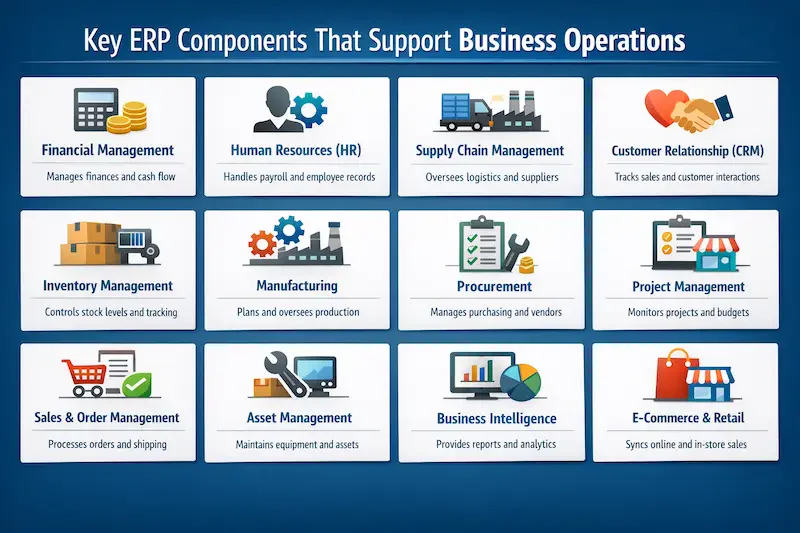
1. Financial Management
The Financial Management module is one of the most important parts of any ERP system. It tracks money moving in and out of the business. Beyond basic bookkeeping, it manages the general ledger, accounts payable, accounts receivable, and fixed assets. Modern finance modules also automate tax calculations and support compliance with standards such as GAAP or IFRS. With real time visibility into cash flow, this component helps teams make better budget and investment decisions.
2. Human Resources Management HRM
An ERP’s HR component manages the entire employee lifecycle. From recruitment and onboarding to payroll and performance reviews, this module centralizes employee data. It often includes self service portals where employees can request leave or view pay stubs, reducing the workload for HR teams. Advanced HRM modules may also include talent management and learning systems to support employee growth.
3. Supply Chain Management SCM
The SCM component is vital for businesses that deal with physical goods. It gives end to end visibility across the supply chain, from raw material purchases to final delivery. By tracking lead times, shipping status, and supplier performance, this module helps businesses improve logistics, reduce costs, and respond faster to disruptions.
4. Customer Relationship Management CRM
The CRM module centralizes customer data, interaction history, and sales pipelines. It gives sales and marketing teams a clearer view of each customer. When connected to an ERP, CRM also helps teams check stock availability before confirming delivery dates. This supports better service and stronger customer relationships.
5. Inventory Management
This component tracks stock levels across multiple warehouses in real time. Using tools like RFID, QR codes, or barcodes, it helps prevent overstocking and stockouts. It also manages unit conversions and gives insight into inventory turnover, helping businesses run more efficiently.
6. Manufacturing and Production
For industrial companies, the manufacturing module is indispensable. It handles the Bill of Materials BOM, shop floor control, and Material Requirements Planning MRP. It also helps managers schedule production based on machine availability and labor capacity. Some systems include Quality Control QC checkpoints to maintain product standards.
7. Procurement
The procurement module streamlines the purchase to pay process. It manages vendor relationships, automates Request for Quotations RFQs, and enforces spending policies. By centralizing purchase orders, businesses can improve spending control and secure better pricing.
8. Project Management
Essential for service based industries or construction, this component tracks project milestones, resource allocation, and financial health. It helps project managers compare actual costs with budgets so projects stay profitable and on track.
9. Sales and Order Management
This component focuses on the order to cash cycle. It automates order entry, credit checks, availability checks, shipping, and invoicing. This helps reduce processing time and improve customer satisfaction.
10. Asset Management
The asset management module tracks the maintenance cycles of machinery, vehicles, and IT equipment. It supports preventive maintenance and helps businesses monitor asset depreciation for tax and planning purposes.
11. Business Intelligence BI and Reporting
Modern ERPs turn data into insights. The BI component uses data from other modules to create dashboards and reports. This helps businesses monitor performance and make better decisions.
12. E commerce and Omnichannel Retail
This component keeps online sales connected to back office operations. When a customer places an order online, inventory updates automatically and the shipping team can respond right away. This creates a smoother omnichannel experience.
What Powers Modern ERP Systems

The efficiency of these ERP components relies on a robust technical foundation. The move from legacy on premise systems to cloud infrastructure has been a game changer. Cloud ERPs offer better scalability, lower upfront hardware costs, and allow teams to access data from anywhere. This is supported by a centralized database, which ensures that every module pulls from the same source of data, reducing the risk of conflicting information.
Furthermore, the integration of Artificial Intelligence AI and Machine Learning is transforming ERPs from passive record keeping tools into more proactive business systems. AI can automate repetitive tasks like invoice matching, predict inventory needs based on historical trends, and even flag potential fraud in financial transactions. Systems like modern ERP software platforms use these technologies to give businesses an edge through automation and predictive analytics.
Strategic Implementation and Connectivity
- Start with a clear ERP strategy: Choosing the right components is important, but implementation still needs proper planning from the beginning.
- Identify which modules are essential first: A needs assessment helps businesses focus on what they truly need before adding optional features.
- Prioritize configuration over heavy customization: A modern ERP system can support business growth more effectively, but too much customization may make future upgrades harder and more expensive.
- Make sure the system can connect with other tools: Many businesses still need ERP to work with third party apps such as shipping platforms or banking portals.
- Prepare your team for the rollout: Whether the system is launched all at once or in phases, proper training helps improve adoption and return on investment.
A strong ERP implementation depends on more than software alone. Businesses also need the right strategy, smooth connectivity, and a team that is ready to use the system well.
How to Choose the Right ERP Components for Your Business
Choosing the right ERP components starts with understanding how your business actually operates day to day. Not every company needs the same modules from the beginning, so it is better to focus on the functions that have the biggest impact first. For some businesses, that may be finance and inventory. For others, it could be procurement, HR, or project management.
The key is to avoid treating ERP as a one size fits all system. A growing business in Malaysia, for example, may need components that improve reporting, stock control, and cross department coordination before adding more advanced tools. The right setup should solve current operational issues while still giving your business room to scale.
"A successful ERP implementation depends not only on the right modules, but also on a clear rollout strategy, strong connectivity, and proper user training. When these elements are in place, businesses can get far more value from the system in the long run"
Conclusion
Choosing the right ERP components can make a big difference in how smoothly your business runs every day. When each function, from finance and HR to inventory and procurement, works in one connected system, teams can reduce manual work, improve accuracy, and respond faster to operational needs. This is why ERP is no longer just a supporting tool, but a key part of building a business that can grow without losing control.
As business needs become more complex, the role of ERP also becomes more important. The right combination of components helps companies improve visibility, avoid disconnected processes, and make better decisions based on real time data. Instead of relying on separate systems that slow teams down, businesses can build a stronger operational foundation through a setup that is more connected, flexible, and easier to scale.
If you are still deciding which ERP components fit your business best, it may be worth discussing your needs with the right team before moving forward. A free consultation can help you map out the modules that match your current operations, future plans, and industry requirements, so you can choose a system that supports growth more effectively.
FAQ About ECOUNT ERP
ERP components are the modules that handle core business functions such as finance, HR, inventory, procurement, and reporting. They matter because these modules work in one connected system, helping businesses reduce data silos, improve visibility, and make faster decisions.
The best way to choose ERP components is to start with the most critical business needs first. Businesses should identify which modules are essential for daily operations, then add other components as needs grow. This approach helps avoid unnecessary complexity and makes implementation more effective.
Cloud ERP gives businesses better scalability, lower upfront infrastructure costs, and easier access across locations. AI adds more value by automating repetitive tasks, improving forecasting, and helping teams gain faster insights from operational data.