













Even small defects or unfinished details can delay project completion and affect client satisfaction. In construction projects, final quality checks are critical to ensure that every element meets agreed standards before handover.
A snag list serves as a structured way to document and resolve remaining issues identified during final inspections. By clearly recording defects, incomplete work, or adjustments needed, project teams can coordinate corrections more efficiently.
Managing the snagging process effectively helps maintain quality, protect timelines, and ensure the finished project meets. By addressing defects systematically before handover, project teams can reduce rework and avoid potential disputes.
Key Takeaways
|
Understanding the Fundamental Definition of a Snag List
A snag list is a formal document created towards the end of a construction project to record all minor outstanding jobs, defects, or damages that require rectification before the final handover to the client.
Without a structured snag list, the process of identifying and rectifying deficiencies can become disorganized, leading to potential disputes between the contractor and the client and delaying the final payment.
The primary objective is to achieve a state of “zero defects” before the property is formally handed over. In some regions, particularly the United States, the more common term is a completion checklist, although both serve the same fundamental purpose.
Grasping the essence of a snag list is the first step for any project manager dedicated to ensuring client satisfaction and upholding the professional reputation of their construction firm.
The Crucial Difference Between a Snag List and a Punch List
 The difference lies more in terminology than in function, as the ultimate goal of both documents is identical: to ensure that the project’s final quality meets or exceeds expectations.
The following points detail the main differences between a snag list and a punch list, helping you navigate industry conversations with clarity and precision, regardless of your project’s location.
1. Geographical origins and usage
The term snag list is predominantly used in the United Kingdom, Ireland, Australia, and other Commonwealth countries. In British English, “snag” can mean a minor problem or difficulty.
Conversely, the term punch list is the standard in the United States and Canada. This term originated from the historical practice of printing the list of remedial tasks on paper; as each item was completed, a hole was physically “punched” next to it with a special tool to mark its completion.
2. Practical context and function
Functionally, there is no significant difference between a snag list and a punch list in modern construction practice. Both refer to a detailed list of defects, deficiencies, or incomplete work identified during the final inspection phase.
These lists are typically generated after the project has reached substantial completion and serve as the contractor’s final to-do list. Completing all items on the list is a prerequisite for the final handover and the client’s release of the final payment.
3. Perception and formality
In some professional circles, a punch list might be perceived as slightly more formal and systematic due to its historical association with the tangible process of “punching out” completed items.
Meanwhile, the snag list is sometimes viewed as a more colloquial or everyday term. However, within a professional context, both documents carry the same weight and importance.
Why is a Snag List a Critical Element in Construction Projects?
The creation of a snag list is far more than an administrative formality at the project’s conclusion; it is a fundamental pillar of the quality assurance process that ensures every aspect of the build is not just finished, but also meets the agreed-upon standards.
Here are some primary reasons why the snag list holds such a vital role in every construction project.
1. Ensures compliance with quality standards and contract specifications
A snag list serves as the final verification tool to confirm that all work has been executed in accordance with the technical drawings, material specifications, and quality benchmarks outlined in the contract.
This comprehensive review covers everything from the quality of the paint finish and the alignment of tiles to the proper functioning of the Mechanical, Electrical, and Plumbing (MEP) systems.
Without this detailed checklist, minor yet significant items could be overlooked, diminishing the building’s overall value and functionality and potentially leading to contractual breaches.
2. Protects the client’s investment and satisfaction
Clients invest substantial financial and personal resources into a construction project and are entitled to a flawless end product. The snag list empowers them to thoroughly review the workmanship and request corrections for any shortcomings.
This collaborative process directly contributes to client satisfaction, which is paramount for generating positive testimonials, securing repeat business, and building a strong reputation in the industry.
3. Forms a legal basis for project handover
The complete resolution of all items on the snag list is often a primary condition for the signing of the final handover certificate, known as the Berita Acara Serah Terima (BAST) in some regions.
This document has binding legal force, signifying that the contractor has fulfilled all contractual obligations. By diligently completing the snag list, contractors can ensure a smooth final payment process and protect themselves from future claims.
4. Prevents future disputes and unexpected costs
Identifying and rectifying issues before the official handover is significantly more efficient and cost-effective than addressing them after the building is occupied. Minor defects that are ignore can escalate into major problems that require expensive.
A thorough snag list minimizes the potential for disputes over post-handover damages, as all pre-existing deficiencies have been documented and resolved, clearly defining the state of the property at the time of transfer.
Key Components That Must Be Included in a Snag List
To ensure a snag list is truly effective, the document must be comprehensive, well-structured, and leave no room for ambiguity. Each recorded item needs to be detailed enough for the contractor’s team to easily understand the issue.
The following are the essential components that must be identified and documented during the inspection process to ensure no detail is overlooked.
1. Structural and exterior works
This category focuses on the building’s core and envelope, including inspections of the foundation, walls, roof, and facade. Inspectors should look for any structural cracks, leaks around windows or on the roof, and uneven exterior paint.
It is also crucial to ensure that drainage systems are functioning correctly and that there is no water pooling around the building, which could compromise the foundation over time and lead to significant long-term issues.
2. Interior and finishing touches
This is the area most visible to the client and includes all aesthetic aspects within the building. Checks should cover the quality of wall paint, scratches on floors or doors, uneven tile installation, the neatness of ceiling joints, and the functionality of all hardware, such as door handles.
3. Mechanical, Electrical, and Plumbing (MEP) systems
Functionality is paramount, and this category ensures all vital systems are operating perfectly. This involves testing every light switch and power outlet, confirming that the air conditioning system works effectively in all rooms and checking water pressure at all taps.
Additionally, it is essential to verify that ventilation and fire safety systems, such as smoke detectors and sprinklers, are installed and functioning in accordance with safety standards and local regulations.
4. Document completion and administration
Beyond physical inspection, a snag list should also verify the completeness of handover documentation, such as equipment warranties, updated as-built drawings, and occupancy permits. Missing documents can delay final handover and accounting administration issues for the client.
The Snag List Creation and Completion Process (Step-by-Step)
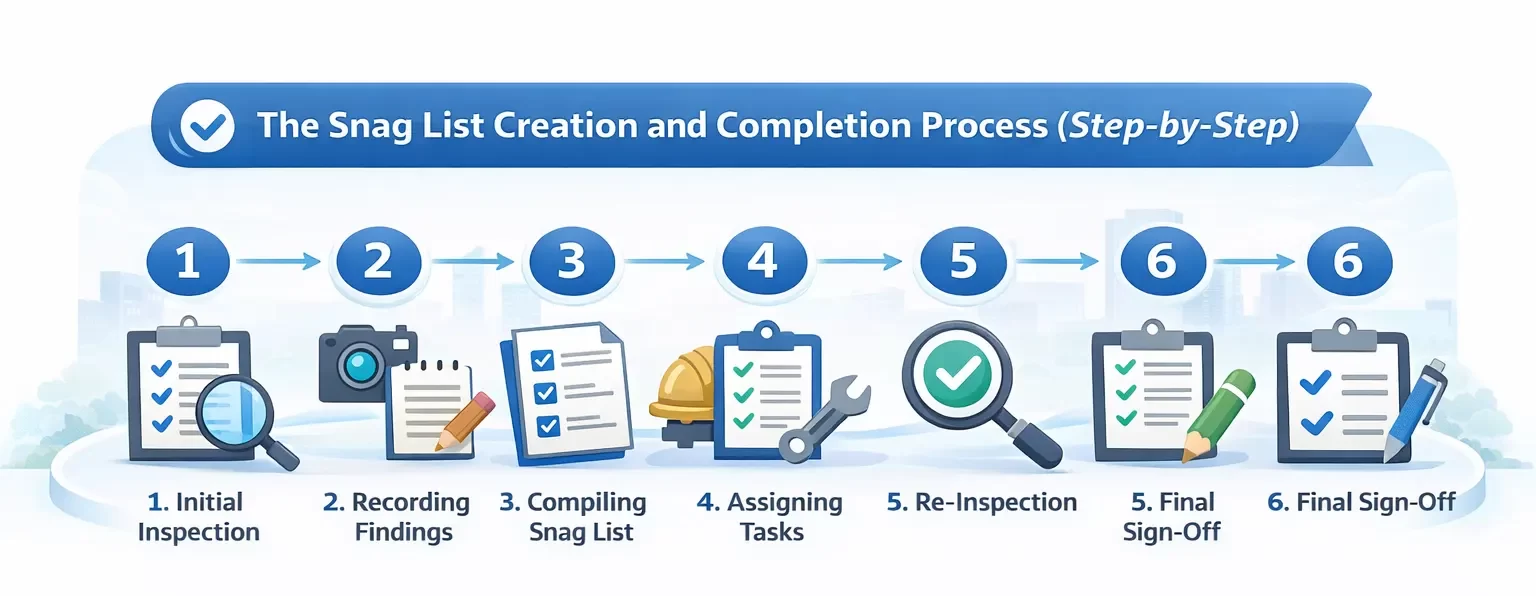
Creating and managing a snag list requires clear collaboration between the client, contractor, and consultants or architects. A structured workflow ensures issues are documented, resolved, and verified efficiently, reducing delays.
Here is a step-by-step guide to managing the entire lifecycle of a snag list, from its inception to its successful completion.
Step 1: Scheduling and conducting the initial inspection
Once the contractor declares that the project has reached substantial completion, a formal inspection should be scheduled with the customer’s requirements, the project manager, and the architect.
This inspection, often called a walkthrough, is designed to methodically review every area of the project to identify any defects or deficiencies. It is crucial that all key stakeholders are present to ensure a comprehensive and agreed-upon initial list.
Step 2: Recording findings in detail
During the walkthrough, every issue should be documented clearly, including the problem description (e.g., “scratch on the north-facing wall”), its exact location (floor or room number), and photo or video evidence. Using a digital app helps prevent data loss and keeps all records organized in one place.
Step 3: Compiling and distributing the snag list
After the inspection is complete, all findings are compiled into a single, formal snag list document. This list is then distributed to all relevant parties, especially the contractor’s team responsible for the rectification work.
Each item on the list should be assigned a unique number or code to facilitate easy tracking and referencing throughout the correction process, ensuring clear communication and accountability.
Step 4: Assigning tasks and the rectification process
The contractor’s project manager assigns each item on the snag list to the appropriate team or subcontractor. Clear deadlines for the completion of each item must be established and communicated.
During this phase, consistent communication and progress monitoring are vital to ensure that the rectification work stays on schedule and meets the required quality standards. Regular updates should be provided to the project manager.
Step 5: Re-inspection and verification (de-snagging)
Once the contractor reports that all items have been rectified, a second inspection is scheduled to verify the completion of the work. This process is often referred to as de-snagging.
The client’s representative will re-examine each item on the original list to confirm that the repairs have been carried out satisfactorily. If any rectification work does not meet the required standard, the item remains open on the list for further attention.
Step 6: Closing items and final sign-off
After all items on the snag list have been successfully verified and approved by the client, the document is formally closed. This closure signals that the contractor has fulfilled all outstanding obligations and the project is ready for final handover.
Optimizing Snag List Management with Construction Software
Manual processes are highly susceptible to a host of problems, including lost data, miscommunication between teams, difficulty in tracking progress, and slow rectification cycles.
This shift not only accelerates project completion but also enhances the overall quality of the final deliverable and improves client relations.
1. Centralized data and real-time access
Construction software enables all snag list items to be recorded on a single, centralized platform, accessible to all team members in real time. This can be done from anywhere, whether on a desktop in the office or a mobile device on-site.
This eliminates the risk of lost physical records and ensures everyone is working with the most current information. Any status updates are instantly synchronized across all users, creating a single source of truth for the project’s final phase.
2. Easier and documented team collaboration
Digital platforms facilitate seamless communication between on-site teams, project managers, and even clients. Each item on the snag list can be directly assigned to the responsible individual or team, complete with detailed instructions and deadlines.
All conversations and updates related to a specific item are digitally logged, creating a clear and permanent audit trail. This level of documentation drastically reduces the potential for miscommunication and disputes over what was said or agreed upon.
3. Transparent progress tracking with dashboards
With visual dashboards, project managers can easily monitor the overall status of the snag list at a glance. This includes metrics such as the number of open, in-progress, and completed items.
This high-level visibility allows for the quick identification of potential supply chain disruption or delays, enabling prompt corrective action. Clients can also be granted limited access to view progress and build trust throughout the final stages of the project.
4. Integrated visual documentation
One major advantage of using software is the ability to attach photos or videos to each snag list item. This visual documentation provides clear context, reduces miscommunication, and helps repair teams understand tasks easily.

Common Mistakes to Avoid in Snag List Management
Most errors stem from a lack of detail, poor communication, or an unstructured process, all of which can be mitigated with careful planning and the right tools. Here are some of the most common mistakes that every project manager should strive to avoid.
- Vague or Ambiguous Descriptions: Recording items like “fix wall” without specifying the location, type of damage, or repair standard can confuse the repair team and lead to incomplete or incorrect work.
- Lack of Visual Documentation: Not including photos or videos makes it harder to communicate the issue clearly and can lead to misunderstandings or disputes.
- A Rushed Inspection Process: Conducting the walkthrough too quickly increases the chance of missing small but important defects that may cause problems later.
- Delay in Compiling and Distributing the List: Taking too long to share the snag list reduces the time available for repairs and may pressure teams to rush the work.
- Not Establishing Priorities: Failing to prioritize critical issues, such as safety risks or leaks, can delay essential repairs and affect building functionality.
- Poor Communication Between Teams: Weak coordination between inspection, management, and repair teams can result in missed updates, confusion, and unnecessary rework.
Conclusion
In conclusion, a snag list, or punch list, is an essential tool that connects the final construction phase with a smooth project handover. More than a record of defects, it reflects a commitment to quality, professionalism, and client satisfaction.
By understanding its purpose and following a structured inspection process, construction teams can ensure that all issues are resolved before delivery, reducing rework and misunderstandings.
Using modern technology can make documentation and coordination more efficient. A well-managed snagging process helps deliver better project outcomes and strengthens a company’s reputation. Consider scheduling a free consultation to learn how to improve your project-handover process.

FAQ About Snag List
-
Who is responsible for creating a snag list?
Typically, a snag list is created collaboratively. The client or their representative inspects the project with the contractor. However, proactive contractors often create an internal list first to ensure quality before the joint inspection.
-
When is the best time to start creating a snag list?
The ideal time to start a snag list is when the project reaches ‘substantial completion. This is when major construction work is finished, and the building is functional, though minor finishing touches may remain.
-
What if a defect is found after the snag list is closed?
If a defect is found after the handover, it is typically covered under the ‘defects liability period’ or warranty period defined in the contract. These are known as latent defects and remain the contractor’s responsibility to fix.