





In my experience, managing a construction project rarely goes exactly to plan due to the inevitable need for a variation order. These changes can disrupt budgets and schedules if not handled correctly.
To prevent cost overruns and disputes, I rely on robust tools, such as a construction software solution, to track every adjustment efficiently. This technology ensures that every change is documented and approved in real-time.
In this article, I will guide you through the essentials of managing variation orders effectively. Read on to discover strategies that keep your projects profitable and organised.
Key Takeaways
|

What Is a Variation Order in a Construction Project?
A variation order is a formal document that instructs a change to the original scope of work in a construction contract. It legalises adjustments to the project, ensuring all parties agree on the new terms.
These orders typically fall into types such as additions to the scope, omissions of work, or substitutions of materials. Each type requires specific documentation to justify the cost and time implications.
Types of Variation Order
Before jumping into the types, it helps to treat a Variation Order (VO) as a formal contract instruction that changes the original scope, specifications, method, or sequencing of works, so it typically affects cost and/or time.
In Singapore, the way a VO is issued and valued depends on the contract form and pricing model in use (for example, lump-sum vs. remeasurement), so the same change can be priced and approved differently across projects. That is why classifying a VO by “type” clarifies what needs to be documented, who must approve it, and where the schedule risk is likely to sit.
The table below breaks down the most common VO types with examples and typical impacts, so teams can align expectations before the change snowballs.
| VO Type | Definition | Example (Singapore context) | Typical cost impact | Typical schedule impact |
|---|---|---|---|---|
| Additive VO | Adds new scope/work items beyond the original contract. | Adding extra MEP points and finishes after a tenant change in a retail unit. | Increase | Often extends |
| Omissive VO | Removes part of the scope or reduces a deliverable. | De-scoping feature lighting and switching to standard fittings. | Decrease | Can shorten (depends) |
| Substitution VO | Replaces a specified material/method with another. | Switching façade panel type due to lead-time constraints. | Up or down | Usually minor, unless re-approval needed |
| Schedule VO | Changes the timeline, sequencing, or access constraints. | Phased handover by levels to support earlier occupancy readiness. | Variable | Significant, affects critical path |
| Design Change VO | Alters design intent, layout, or system configuration. | Layout change that forces re-coordination of exit access/partitions. | Often significant | Often significant |
Why Are Variation Orders Important and Common?
 Understanding the triggers for these orders helps anticipate potential disruptions throughout the project lifecycle. Here are the most common reasons why they are critical and frequent in construction.
- Client requirements often evolve during the build, requiring formal documentation to adjust the design to their new preferences.
- Unforeseen site conditions, such as unexpected soil issues, demand immediate scope changes to ensure structural safety.
- Design errors or omissions in the initial drawings necessitate corrections that must be formally recorded to avoid disputes.
- Fluctuations in material availability may require resource substitutions, which must be approved through a formal order.
- Changes in government regulations may require adjustments to the project scope to maintain legal compliance.
The Standard Process for Submitting and Approving a Variation Order
Following a standardised workflow is essential to maintain transparency and legal validity when changes occur. The following steps outline the typical journey of a variation order from request to approval.
- The process begins with the client, contractor, or consultant identifying a necessary change to address a specific issue.
- A formal change request is then submitted, detailing the proposed modification and the reason for the deviation.
- The contractor performs an impact analysis to calculate the additional costs and time required to implement the change.
- Negotiation takes place between stakeholders to agree on fair pricing and schedule adjustments based on the analysis.
- Finally, the official variation order is issued and signed by authorized parties, allowing the work to proceed legally.

Effective Strategies for Managing Variation Orders with Technology
Relying on manual change-management methods often leads to errors, making digital adoption crucial for modern construction. Here are effective strategies for utilizing technology to streamline this process.
- Centralize all documents on a cloud-based platform to ensure every stakeholder accesses the same updated information instantly.
- Track budgets in real time with digital dashboards that automatically update cost projections whenever changes are made.
- Foster transparent collaboration by allowing teams to review, comment on, and approve variation requests digitally.
- Integrate the system with accounting modules to automatically sync financial data when a variation order is approved.
Singapore’s Specific Compliance for Variation Orders
In Singapore, a variation order (VO) is not considered “complete” unless it also covers regulatory, safety, and programme impacts, not just cost and scope.
1. Statutory compliance statement
Include a clause such as: “All works shall comply with the latest prevailing SCDF Fire Code (currently Fire Code 2023), and applicable Singapore Standards (SS/Eurocodes).” This matters because the change must remain compliant for approvals tied to TOP requirements.
2. BIM and technical alignment
State that the team will submit updated BIM objects and revised shop drawings that reflect the variation. This is especially important for IDD projects, where accurate models and as-built information are part of the delivery expectation.
3. WSH risk and safety assessment
Require a revised Risk Assessment (RA) and Safe Work Procedures (SWP) when the variation changes the construction method or introduces new hazards. This aligns with obligations under the Workplace Safety and Health Act to manage risk before work proceeds.
4. EOT and critical path impact
Add a clear programme impact check: does the VO affect the master programme and the completion date, and is an Extension of Time (EOT) required? This keeps time entitlement transparent and helps prevent disputes over liquidated damages later.
5. Use a standard, audit-friendly template
If your project follows contract standards such as PSSCOC or SIA-aligned formats, use a VO template that meets those requirements. It makes approvals, claims, and audits cleaner because the structure is familiar and consistently documented.
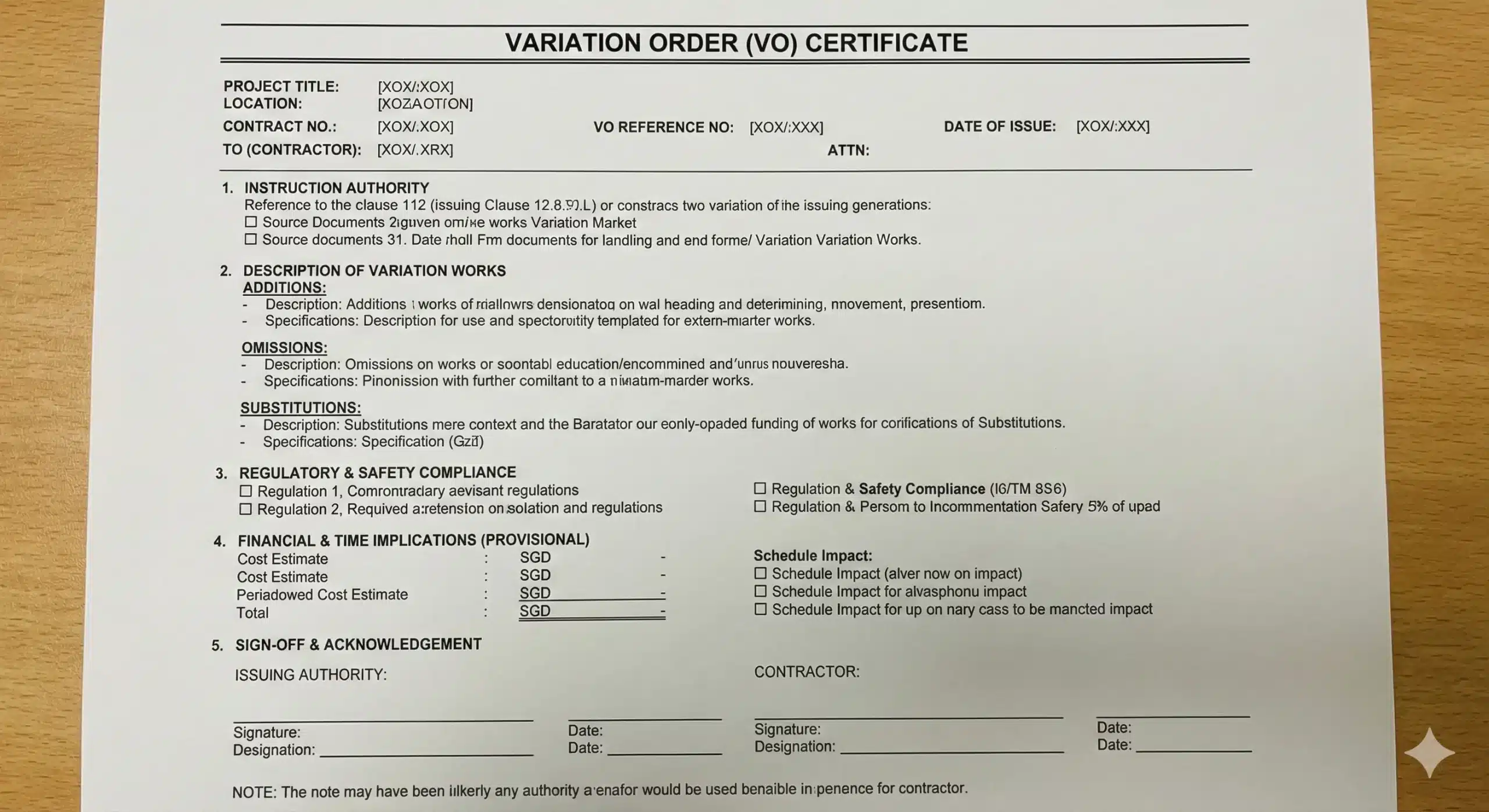
Key Elements Required in a Variation Order Document
A well-drafted document is your best defense against future disputes and financial discrepancies. To be legally binding and clear, every variation order must contain the following specific details.
- Project and contract identification details must be included to link the change specifically to the original legal agreement.
- A detailed description of the change is required to explicitly outline what work is being added, deleted, or modified.
- A transparent breakdown of the cost impact should list material, labour, and equipment expenses to justify the new price.
- Any adjustment to the completion timeline must be clearly stated to protect the contractor from delay penalties.
- Signatures from authorised representatives are mandatory to signify mutual agreement and to validate the document legally.
Standard Operating Procedure: Variation Order Administration & Approval
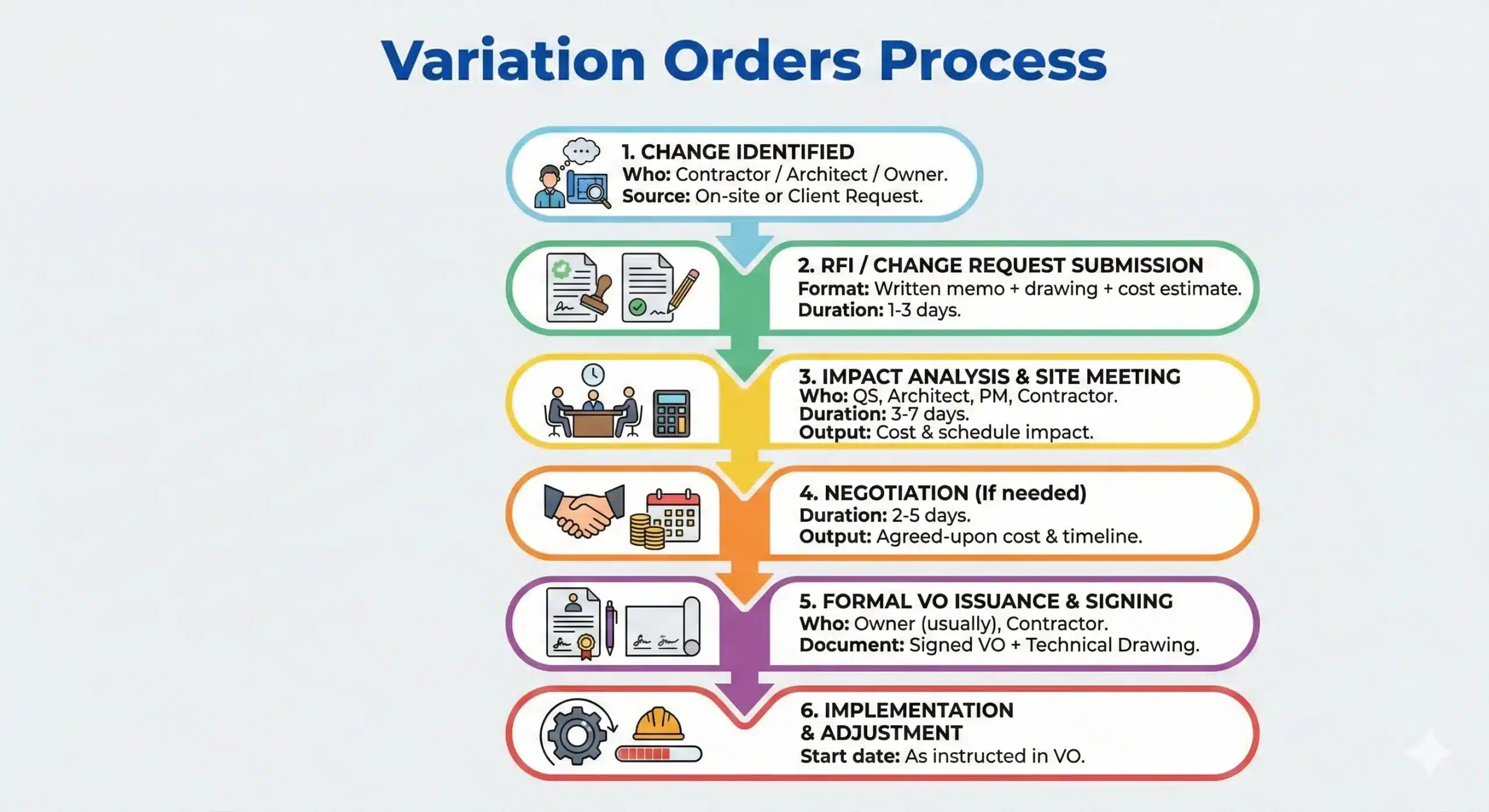
Effective VO management requires a disciplined workflow to prevent disputes under the Security of Payment Act (SOPA). Below is the end-to-end approval framework, from identification to formal issuance.
Step 1: Identification & Documentation (Days 1–2)
- Trigger: Discrepancies are identified by the Main Contractor, Architect, or Superintending Officer (SO) during site walks or technical reviews.
- Action: Immediate documentation via Requests for Information (RFI), Site Memos, or joint-inspection photos.
- System: Logged into the Common Data Environment (CDE) or Project Management System (e.g., Procore, Aconex).
Step 2: Change Request & Notice of Claim (Days 1–3)
- Submission: The Main Contractor submits a formal notification (Notice of Claim) citing relevant contract clauses (e.g., PSSCOC Clause 19).
- Requirements: Must include technical drawings, projected schedule impact (EOT), and a preliminary cost estimate.
- Key Stakeholder: Submitted to the Architect or Superintending Officer (SO).
Step 3: Impact Analysis & QS Assessment (Days 3–7)
- Evaluation: The Professional Quantity Surveyor (PQS) assesses the claim against contract rates (“Star Rates” or Pro-Rata rates).
- Components: Breakdown of material, labour, machinery, and reasonable profit/overhead margins.
- Output: A detailed Cost Impact Report submitted to the Employer.
Step 4: Commercial Negotiation & Approval (Days 2–5)
- Meeting: A dedicated Commercial Meeting involving the Developer, PM, QS, and Contractor to align on the final figure.
- Resolution: If the price is disputed, provisional sums may be agreed upon to allow work to proceed while final costs are adjudicated.
Step 5: Formal VO Issuance (Day 1)
- Execution: The Architect/SO issues the formal Variation Order (VO) Certificate.
- Implementation: Site instruction is released, and the construction team proceeds with the works.
Stakeholder Governance Matrix
In the Singapore context, authority is strictly defined to ensure compliance with financial audits and regulatory standards (BCA/URA).
| Stakeholder | Role in VO Process | Authority Level | Key Deliverables |
|---|---|---|---|
| Employer (Developer) | Final budget sanctioning & decision making. | Ultimate Approval | Signed VO Approval Form |
| Architect / SO | Assesses technical feasibility & design impact. | Key Approver | Architect’s Instruction (AI) |
| Quantity Surveyor (PQS) | Validates costs vs. Contract Rates & market prices. | Key Recommender | Cost Assessment Report |
| Main Contractor | Submits technical proposal & pricing breakdown. | Submitter | Quotation & EOT Claim |
| Project Manager | Mediates disputes & tracks timeline impact. | Advisory | Recommendation Report |
| Statutory Bodies (BCA/SCDF) | Approves only if VO affects GFA or fire safety. | Regulatory Compliance | Written Permission / BP Approval |
Local Case Study Singapore Unforeseen Ground Condition Variation Order
- Project: 18-storey commercial building, Central Area (2022–2023).
- Situation: The initial soil investigation was sufficient for early design, but deeper excavation later revealed weaker-than-expected strata, which required changes to the piling/foundation approach and the addition of temporary works to keep the site stable.
VO issued:
- Cost addition: SGD 1.6M–2.2M
- Time impact: 15–25 working days (EOT)
Key challenge: The Employer hesitated because the contingency was already tight, while the Contractor needed quick direction to avoid holding up the critical path. Without a clean paper trail, the discussion risked devolving into “who agreed to what” rather than “what the change actually costs and how it affects time.”
Resolution: The QS validated the revised scope against the contract basis and benchmarked key rates. The team then ran limited value engineering on non-critical packages to offset part of the uplift. Progress tracking and daily site records were used to substantiate the time impact, so the EOT request was tied to measurable disruption rather than assumptions.
Learning points:
- For deep basements or constrained sites, consider deeper or phased ground investigation so major surprises surface earlier.
- Treat abnormal ground findings as an immediate VO trigger, so pricing and approvals start while the change is still manageable.
- Keep an explicit contingency (often 8–12% for complex ground risk) and define approval thresholds so decisions don’t stall on site.
How a system helps in this scenario:
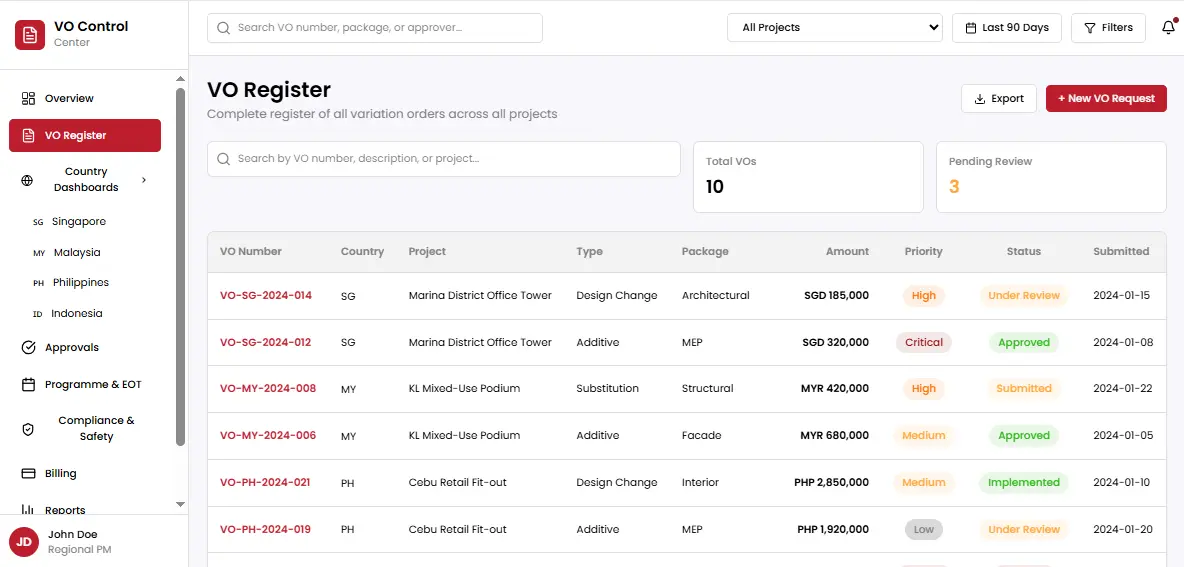
Many teams reduce VO friction by using a project control system that keeps progress, cost codes, equipment usage, invoicing, and approvals connected in one workflow, so each change has a clear audit trail (instruction → pricing → approval) and its schedule/budget impact is visible early.
In practice, the most helpful capabilities include S-curve progress tracking (planned vs actual), budgeting by cost codes (so VO uplifts don’t get buried), asset utilisation logs (for more accurate costing), automated progress claims (based on approved work), and digital VO routing (authorised sign-offs).
Conclusion
Mastering the variation order process is essential for delivering construction projects without avoidable cost leakage or schedule drift. When managed properly, a VO turns what could become a dispute into a controlled, documented adjustment that keeps all parties aligned.
The process becomes much easier when the project team uses a structured, digital workflow to track instructions, pricing, approvals, and time impact in one place. With real-time visibility and a clear audit trail, every change is accounted for early, and budget decisions are made with facts, not assumptions.
Take the first step towards total project control by exploring our solution today. I invite you to take advantage of our free consultations to see how we can optimise your operations.

FAQ About Variation Order
-
What is the difference between a variation order and a verbal instruction?
The main difference lies in legality and documentation. A variation order is a formal, legally binding document that amends the contract and details the cost and schedule impacts. Verbal instructions have no legal standing, are challenging to prove, and often lead to disputes because there is no official record.
-
How does a variation order affect a performance bond?
Typically, a variation order is issued by the client’s representative, architect, or project manager after a change request has been approved. Although a contractor can initiate a change request, the official VO document is issued by the employer or their representative.
-
How can software help prevent disputes related to variation orders?
It depends on the contract clauses. Most standard contracts require contractors to implement changes ordered by the client, provided they fall within the general scope of the project. However, a contractor may have grounds to refuse if the change fundamentally alters the project’s nature or if a fair agreement on cost and time cannot be reached.