





Quantity takeoff is a fundamental process in construction that involves measuring and listing all materials, labor, and equipment required for a project. This step provides the basis for estimating costs and planning resources effectively.
Accurate quantity takeoff ensures that project budgets and schedules are realistic. It helps teams maintain a smooth workflow, allocate materials and manpower efficiently, and stay compliant with Singapore regulations, such as BCA guidelines.
The process requires careful attention to detail, systematic calculations, and organized documentation. Implementing structured methods and reliable tools can improve efficiency and maintain consistency across projects.
Key Takeaways
|
What Is Quantity Takeoff in a Construction Project?
Quantity takeoff is the process of measuring and listing all materials, labor, equipment, and subcontracted work from design drawings and specifications. It forms the foundation for accurate cost estimation and resource planning.
The process involves analyzing technical drawings to determine quantities for structural components, finishes, and systems, accounting for dimensions, unit conversions, and material waste.
By translating blueprints into a precise inventory of resources, quantity takeoff helps project managers and estimators plan efficiently, control costs, and minimize delays or budget overruns.
Comparison of Quantity Takeoff Methods
Choosing the right method significantly impacts the speed and accuracy of your estimation. The table below compares the three most common approaches used in the industry today.
| Feature | Manual Method | Digital Method (2D) | Digital Method (3D/BIM) |
| Tools Used | Blueprints, scale ruler, Excel | PDF/CAD software, digital counters | BIM Software, 3D Models |
| Accuracy | Low (High risk of human error) | Medium (Reduces calculation errors) | High (Automated extraction) |
| Speed | Slow and labor-intensive | Faster than manual | Very fast (Instant updates) |
| Collaboration | Difficult (Physical documents) | Improved (Digital files) | Seamless (Cloud integration) |
The Main Goals of an Accurate Quantity Takeoff
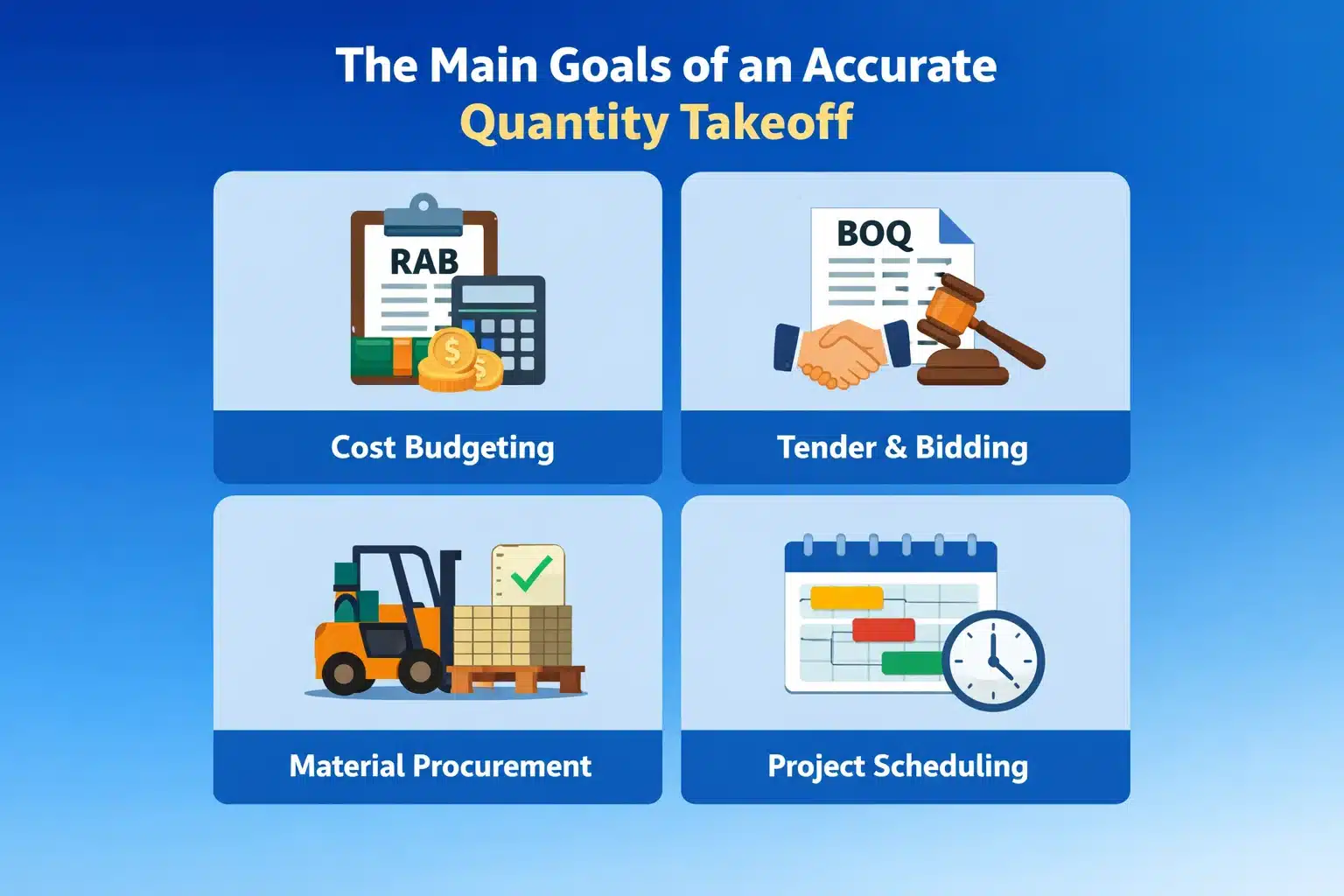
Accurate measurements act as the financial backbone of any successful construction project. Here are the primary objectives that make this process indispensable for project management.
- Foundation for cost budgeting (RAB)
This process provides the specific data needed to create a precise Rencana Anggaran Biaya (RAB). It ensures that every financial projection relies on actual physical requirements rather than guesses. - Benchmark for tender and bidding processes
The resulting Bill of Quantities serves as a standardized document for all contractors during bidding, and a bill of quantities for fair pricing ensures that everyone quotes the same scope of work. - Planning for material procurement
A material takeoff enables the procurement team to order exact amounts to prevent overstocking. This strategic approach helps avoid project delays caused by unexpected material shortages. - Developing a realistic project schedule
Knowing the exact quantity of work allows managers to calculate realistic durations for each task. This data helps in allocating resources effectively to meet strict project deadlines.
Challenges in the Quantity Takeoff Process and Its Solutions
Despite its importance, the takeoff process is fraught with obstacles that can undermine accuracy. Here are the common challenges I have encountered and how to effectively address them.
- Incomplete or inaccurate design drawings
Ambiguous documents often force estimators to make risky assumptions during calculations. The solution is to proactively submit Requests for Information (RFI) to clarify discrepancies immediately. - Risk of human error
Manual data entry is susceptible to simple typos that lead to significant cost variances. Adopting digital tools automates calculations and significantly reduces the likelihood of these mistakes. - Design changes mid-project
Mid-project revisions make tracking financial impacts difficult with manual methods. Using model-based software ensures quantities update automatically whenever the design model changes. - Complexity of modern projects
Modern complex designs are increasingly difficult to measure accurately by hand. Leveraging software that handles 3D models allows for precise dissection of intricate assemblies.
How to Perform a Quantity Takeoff?
Executing a takeoff requires a methodical mindset to ensure no component is overlooked. Follow these systematic steps to maintain consistency and thoroughness throughout your project.
- Review all project documents
I begin by thoroughly studying all architectural and structural drawings to understand the scope. This initial review helps identify unique materials or conditions that impact quantities. - Categorize and sequence the work
You should break down the project into standard categories like excavation or concrete work. Structuring the list this way makes it easier to track progress and prevent omissions. - Perform systematic measurements
Measure each item using consistent units while documenting every calculation clearly. This step creates a transparent inventory assessment trail for lengths, areas, and volumes. - Create the Bill of Quantities (BOQ)
All measurements are aggregated into a structured document listing descriptions and quantities. This final output prepares the data for the subsequent application of unit pricing. - Conduct verification and validation
The final step involves cross-checking all calculations to catch errors or duplications. Conducting an independent review helps spot mistakes that were initially missed.

Conclusion
Quantity takeoff is the cornerstone of successful construction management, providing a solid foundation for accurate budgeting. It ensures that procurement and scheduling are based on precise, reliable data rather than estimates.
Leveraging advanced construction software can streamline this process by automating complex calculations and integrating workflows, helping teams minimize risks and maintain effective cost control.
Investing in the right tools is essential for long-term financial health and operational efficiency. Businesses can explore a free consultation to learn how these solutions support better project management and decision-making.

Frequently Asked Questions about Quantity Takeoff
-
What is the difference between quantity takeoff and a bill of quantities (BOQ)?
A quantity takeoff is the process of measuring and calculating quantities from drawings. A Bill of Quantities (BOQ) is the final document that lists all these quantities in a structured format. The takeoff is the activity, while the BOQ is the output.
-
Who is responsible for performing a quantity takeoff in a project?
This task is typically performed by a specialized Quantity Surveyor or a Cost Estimator. In smaller companies, a project manager or engineer may also be responsible for conducting the takeoff.
-
Can I use Excel for quantity takeoff?
Yes, Excel is commonly used in manual takeoffs to organize and calculate data. However, it is prone to human error and lacks the automation and visualization features of specialized takeoff software, making it less efficient for complex projects.
-
How is BIM technology changing the quantity takeoff process?
BIM (Building Information Modeling) automates the takeoff process by allowing software to extract quantities directly from a 3D model. This dramatically increases accuracy, speeds up the process, and automatically updates quantities when the design changes.
-
How accurate should a quantity takeoff be?
While 100% accuracy is the goal, a typical tolerance for error is around 2-5%. However, this can vary depending on the project stage. Higher accuracy is crucial for the final bidding phase.