











Construction progress tracking refers to the process of monitoring on-site activities to ensure work aligns with project plans, timelines, and budgets. It connects field updates, work completion data, and reporting into a structured flow that supports better coordination between site and management teams. When visibility is clear, project leaders can make timely adjustments and keep performance on course.
According to a McKinsey analysis of over 1,000 large construction projects, 80% run over budget by an average of 30% and 45% face schedule delays when field progress lacks real-time monitoring. These overruns emphasize how poor visibility into on-site execution erodes profitability, extends timelines, and undermines stakeholder trust.
To reduce these risks, many firms adopt structured progress tracking supported by digital tools that centralize field data, cost updates, and resource information in real time. Understanding how this approach works helps reveal where better visibility can strengthen project control and decision-making.
Key Takeaways
|
What Is Construction Progress Tracking?
Construction progress tracking is the systematic process of monitoring, documenting, and analyzing on-site work against the planned schedule and budget. Moreover, it uses continuous quantitative and qualitative data to show project health, identify issues early, and support timely, cost-efficient decisions.
The core of progress tracking is constantly comparing the plan with reality. It monitors task completion, material use, labor, and milestones. With accurate real-time data, managers can measure performance, forecast outcomes, and turn field data into insights that guide the project to success.
Why Is Construction Progress Tracking Crucial?
Ignoring detailed construction progress tracking lets a project run without clear direction, increasing financial and reputational risks. Moreover, a McKinsey report shows large projects often take 20% longer and cost up to 80% more, proving the need for tighter control and visibility.
From a business perspective, solid progress tracking creates a real competitive edge. It helps deliver projects on time and within budget, boosting profit and reputation, especially when supported by tools for managing construction projects that provide better control, visibility, and coordination across teams.
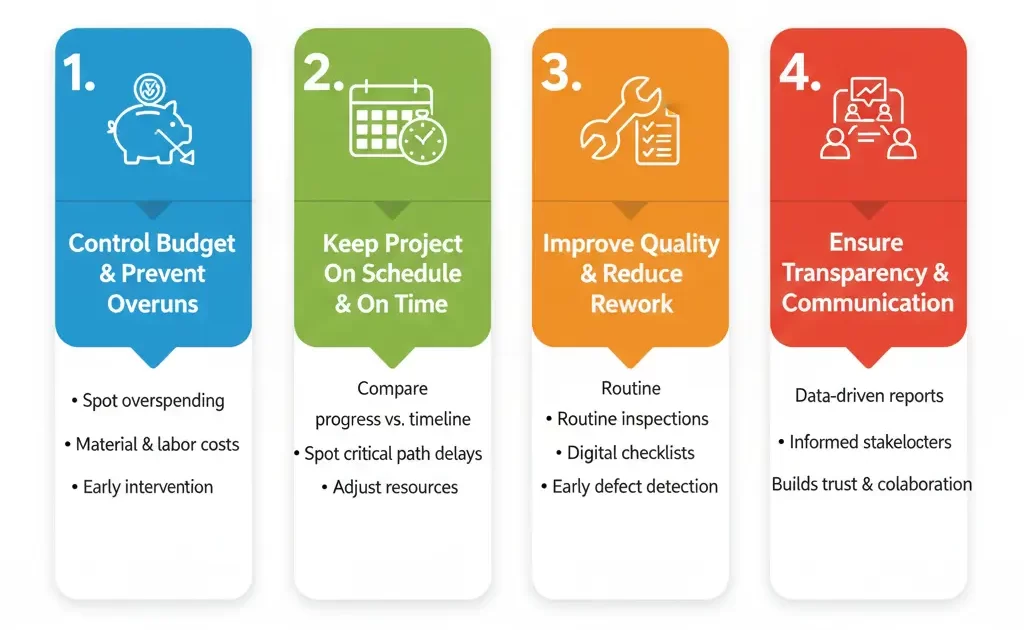
1. Control the budget and prevent cost overruns
By comparing actual costs with the planned budget, teams can quickly spot overruns. Detailed tracking shows where spending exceeds limits, whether from material prices or inefficient labor. As a result, managers can intervene early before small deviations become serious losses.
2. Keep the project on schedule and on time
The schedule is the lifeblood of any construction project, so delays can trigger a costly domino effect. Progress tracking lets managers compare actual progress with the timeline, spot slow activities on the critical path, adjust resources, and keep projects on time, proving reliability. Effective construction scheduling plays a key role in aligning tasks, resources, and timelines to prevent delays and ensure smooth project execution.
3. Improve quality and reduce rework
Progress tracking is not just about quantity but also quality. Through routine inspections, photos, and digital checklists, teams ensure work meets standards. Moreover, early detection of defects makes fixes easier and cheaper, cutting rework, cost, and time waste in construction.
4. Ensure transparency and effective communication for stakeholders
Project stakeholders need clear, accurate progress information. Structured, data-driven reports from a reliable tracking system keep everyone informed. As a result, this transparency builds trust, improves collaboration, reduces disputes, and strengthens long-term client relationships.
Methods of Progress Tracking: From Traditional to Digital
As technology has advanced, the way construction tracks project progress has evolved. Now, methods fall into two types, traditional and modern. Understanding their differences helps companies choose the best approach for their project scale, complexity, and efficiency goals.
The traditional approach relies on manual processes and often leads to inefficiency and inaccuracy. In contrast, the modern approach uses digital technology for faster, more accurate, integrated data. As a result, shifting to automation is now essential to stay competitive with real-time information.
1. Traditional methods prone to human error
Traditional methods rely on manual records and paper-based communication like Excel sheets, handwritten reports, and separate photos. However, these create fragmented data, delays, and high human error, so teams struggle to see an accurate, real-time picture and often decide with outdated information.
2. Modern methods with integrated technology
The modern approach uses integrated construction management software as a single source of truth. Field data from reports, photos, and checklists flows through mobile apps to a central dashboard. Moreover, BIM, drones, and IoT add real-time, accurate data that speeds up and sharpens decisions.
As construction teams move toward digital tracking, selecting the right system becomes essential for accuracy and control. For Singapore companies, solutions supported by up to 70% CTC grant funding help reduce adoption costs while improving project visibility.
Effective Steps to Implement Construction Progress Tracking
Implementing a successful progress tracking system is not just about buying software. Instead, it requires a structured, disciplined process so data is relevant, accurate, and actionable. With this, tracking shifts from a basic admin task to a powerful tool that drives project performance.
Each step in this process is interconnected and supports the next. By following a systematic framework, companies ensure their tracking system works technically, is adopted by the whole team, and delivers high value by turning collected data into clear, actionable decisions.
1. Establish clear Key Performance Indicators (KPIs)
The first step is to define what success means by setting measurable KPIs. These should cover more than schedule, including CPI, SPI, percent complete, reworks, and safety. In turn, clear KPIs give teams concrete targets and form the basis for all progress analysis.
2. Choose the right tools and technology
Once KPIs are set, choose tools to collect and analyze data. For small projects, spreadsheets and chat apps may work. However, complex projects benefit from user-friendly construction software with mobile access, automated reports, visual dashboards, and variation order and snag list management.
3. Collect field data accurately and consistently
The quality of your analysis depends on the quality of the data you collect. Therefore, set clear daily field procedures that define who reports, what must be recorded, and how it is documented. Using mobile apps for reports, photos, and videos also improves accuracy and cuts delays.
4. Analyze data and create progress reports
Collected data must be analyzed regularly to measure performance against KPIs. This means comparing actual progress with the plan using tools like S-curves or Gantt charts. Moreover, modern software can automate reports, highlight issues, reveal trends, and suggest corrective actions.
5. Communicate results to the entire team and stakeholders
The final step is to share insights from data analysis with all stakeholders. Hold regular progress meetings to review results and plan solutions. Also, use a centralized dashboard for real-time transparency so everyone stays aligned with the same project goals.
Construction Suite as an Integrated Progress Tracking Solution
In complex construction projects, using fragmented tools for progress tracking often creates new issues. Therefore, a centralized platform that links budgeting and field execution is crucial. An integrated construction management suite addresses this need by providing clearer visibility and stronger operational control.
This system is not just a tracking tool. Instead, it functions as a comprehensive management ecosystem that unifies financial, operational, and resource data within a single dashboard. By reducing manual processes, teams can focus more on delivering high-quality projects on time and within budget.
1. Visualize progress and costs with S-Curve Management
One key challenge is understanding how schedule and budget performance relate. An S-Curve management feature compares planned curves with actual progress and costs. As a result, managers can quickly see whether a project is ahead or behind schedule and over or under budget, allowing earlier corrective action.
2. Real-time budget control from RAB to realization
With an integrated system, every expense can be tracked in real time, from quantity takeoff to materials and subcontractor costs. Budget estimates are connected with financial records so each cost is automatically compared against the plan. This helps prevent overspending and keeps financial tracking transparent.
3. Centralized reporting through an interactive dashboard
Instead of relying on scattered manual reports, a centralized dashboard presents key metrics and KPIs in a clear, interactive format. Managers gain faster insight into project status, progress, budgets, and potential issues, enabling more responsive decision-making.
4. Integrated management of projects and resources
Effective progress tracking depends on how well project elements are connected. A unified platform links project, asset, inventory, and workforce data, allowing teams to monitor equipment, materials, and productivity in one place. This reduces data silos and aligns resources more closely with field requirements.
Study Case: Improving Construction Progress Control in a Singapore Project
A large commercial building project in Singapore faced recurring issues with delayed reporting and inconsistent site updates. Project managers relied on manual spreadsheets and fragmented communication between site teams and the head office. As a result, deviations in schedule and budget were often detected late, leading to rushed corrective actions and rising operational costs.
To address this, the contractor adopted a structured digital progress tracking approach that centralized field updates, cost data, and resource utilization into a single system. Site supervisors submitted daily progress records through mobile tools, while management monitored performance using visual dashboards and S-curve comparisons between planned and actual progress. This gave stakeholders real-time visibility into work completion, budget consumption, and potential bottlenecks.
Within one project cycle, reporting time was significantly reduced, coordination between teams improved, and schedule risks were identified earlier. The more transparent tracking process helped maintain tighter control over timelines and costs, demonstrating how integrated progress monitoring strengthens overall project performance in complex construction environments.
Conclusion
Construction progress tracking helps project teams stay aligned with schedules, budgets, and quality standards through accurate field data. With structured monitoring and timely updates, companies can spot deviations earlier and respond before small issues grow into larger setbacks. This supports more predictable timelines and steadier project performance.
A connected digital approach makes it easier to centralize progress records, monitor budget usage, and coordinate resources across different project stages. Features such as visual progress curves, automated reporting, and shared dashboards give teams clearer insight into ongoing activities and overall project health.
To better understand how this approach could support your project requirements and operational priorities, you may consider discussing your needs through a consultation to explore the most suitable direction.
FAQ about Construction Progress Tracking
-
What is the most important first step in starting progress tracking?
The most crucial first step is to clearly define the project scope and break it down into measurable tasks. After that, establish specific Key Performance Indicators (KPIs) such as schedule targets, task budgets, and quality standards. Without this planning foundation, any data collected will lack the context needed for proper analysis.
-
How often should construction project progress be tracked and reported?
Ideally, data collection from the field should occur daily through daily reports. However, for analysis and reporting to management or clients, a weekly frequency is often best. Weekly reporting provides a good balance between getting frequent updates for corrective action and not overburdening the team with excessive administrative tasks.
-
What is the main difference between progress tracking and project monitoring?
Although often used interchangeably, they have slightly different focuses. Project monitoring is a broader oversight activity to ensure the project is generally on track. Progress tracking is a more specific subset of monitoring, focused on collecting and measuring quantitative data (like % complete) to compare actual progress against the planned schedule and budget.
-
How does an S-Curve help in construction progress tracking?
An S-Curve is a graphical representation of cumulative progress (whether cost, man-hours, or quantity) over time. By comparing the planned S-curve with the actual S-curve, project managers can quickly visualize if the project is ahead of or behind schedule. If the actual curve is below the planned curve, it indicates a delay.
-
Is progress tracking software only suitable for large-scale projects?
No. While its benefits are most pronounced on large, complex projects, small to medium-sized projects can also gain significant advantages from using software. Software helps standardize processes, improve recording accuracy, and provide neat documentation, which is valuable even for projects with small teams. Many modern solutions, including HashMicro, offer scalability to fit your project’s size.